Lean In & Launch!

leaningimage

Last week, I reactivated my Facebook account after a little hiatus to a deluge of posts asking me if I was leaning. What? My Facebook friends, mainly women, were posting photos of them and their friends leaning to one side or leaning forward. They were talking about women leaning in. So I did what we often do in this social media crazed world we live in, to see what all the buzz was about, I went to Twitter, then Instagram and again there it was “Lean In.” What the heck. I couldn’t imagine what the fuss was all about. So I  leaned in to try and learn more.

There is was a full-on media debate on an age old dialogue…women in the workplace. The media had leaned all the way discussing a new book that was about to release and the author hoped would spark a movement. It seemed that ‘lean in’ was becoming a very sticky idea (Heath & Heath, 2007) in hopes of building awareness to garner supporters. A week before the book hit store shelves. From Forbes.com to USA Today to TechCrunch.com media outlets across the spectrum all discussing whether leaning in puts women in front of the discussion or behind their male counterparts yet again. But I was more intrigued by the fully engaged integrated marketing communications strategy that was clearly consistent across executions, consistent across media and connecting across media.

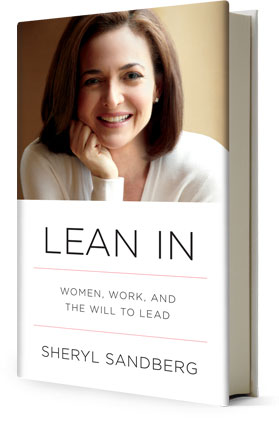
Having worked on the book publishing industry I know first-hand the difficulty in creating an integrated marketing communications plan that is consistent and help garner exposure for the book, the author and impact sales. With it’s release on tomorrow, Monday march 11, 2013 Sheryl Sandberg has created a firestorm of debate for her debut book entitled, “Women, Work, and the Will to Lead.”

Leaninbookcover

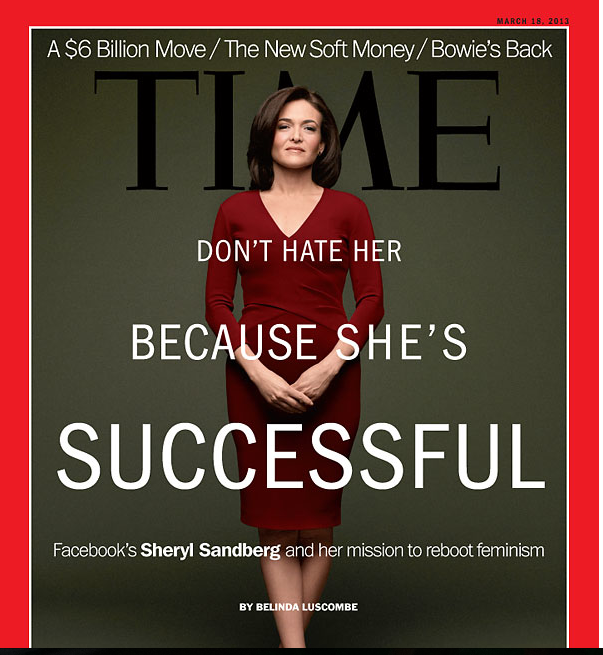
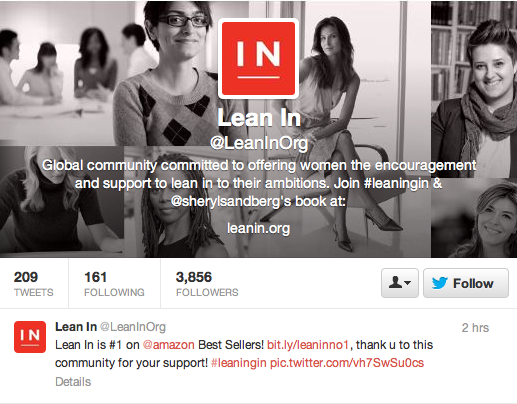
On Wednesday, March 6th the book campaign began executing with the launch of a non-profit organization LeanIn that will, they hope, create a global movement of women leaning in to their success. the non profit launched its website that included the sotries of successful women in politics, business, entrtainment and more who leaned in. It also featurd stories and statements of suport from men who leaned in. The lean in organization hopes to create mor than just a book but a movement. They have created “Lean in Circles” and “Circle Kits” to engage consumers to continue the dialogue and for others the debate.  And she created a total media blitz from the cover of Time Magazine.

Screen Shot 2013-03-10 at 8.32.46 PM


The COO of Facebook, a billionaire, mother, and wife has used technology, social media, PR and controversy to become the #1 book on Amazon all before the book’s official release. Twitter fans of Lean In have created the #leanin hashtag, posting photos of leaning circles and stories as its followers grow daily. Screen Shot 2013-03-10 at 8.02.21 PM

Now, the debate on whether Sandberg is serving the elite with her book and its advice versus the average working mom has proven that she has a “sticky idea.” Sandberg through IMC has captured all six of Heath & Heath’s pillars:

  1. Simple
  2. Unexpected
  3. Concrete
  4. Credible
  5. Emotional
  6. Stories

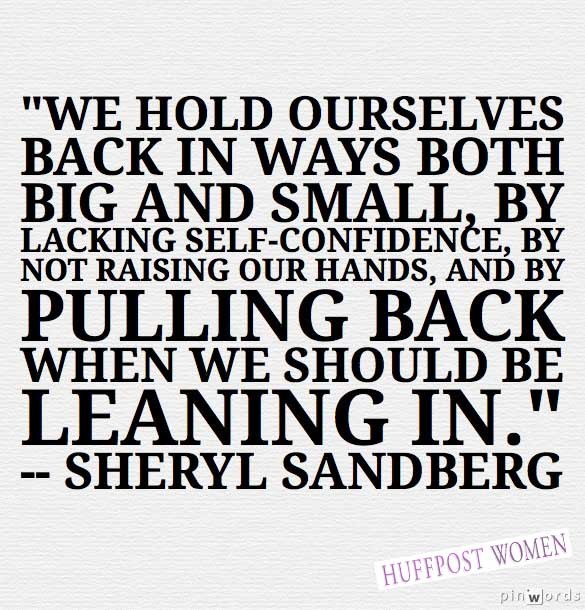
Tonight, she was featured on CBS’ 60 minutes talking to Norah O’Donnell about the challenges women face and how they often “downplay their accomplishments and instead of taking risks, they lean back instead of leaning in” (Sandberg, 2013). http://youtu.be/OxpmXmAZAHg

And tomorrow with the book’s official release and Sandberg’s appearance on Good Morning America I will again ‘Lean In’ to listen and watch this idea and see if the movement sticks and changes the dialogue. In the interim, Sandberg has used IMC to spark a dialogue that will continue for years to come.

slide_284595_2183655_free

Beyonce told us that girls rule the world. Sandberg says that women need to acknowledge that we don’t rule the world but that women, in essence are “stalled.” So the question I raise, whether you agree or disagree with Sandberg’s premise is are you leaning in or pushing back?

~ LaVenia LaVelle {CMGT541A}

References

Heath, C., & Heath, D. (20077). Made to stick: Why some ideas survive and others die. New York, NY: Random House.

Posted in Uncategorized | 7 Comments

SXSW Talks Location-based Marketing: “Checking-in” is Cool Again

Checking-in is no longer the social suicide forced upon us by our worrisome moms and dads wanting to track our every location to make sure we were “out of harm’s way”. Thanks to the proliferation of location-based marketing platforms, checking-in now comes with a host of perks and plusses aimed at deepening the consumer/business relationship. This year’s SXSW conference in Austin, TX, showcased a panel discussion on social media as the enabler of contemporary marketing approaches, and leveraging location-based platforms to gain better insight into consumer interest and purchasing behavior.

Image courtesy of Rosa Golijan / NBC News

South by Southwest (SXSW ®), once billed as a independent music and film festival now boasts 8 days of over 2,000 musical concerts, hundreds of independent films, and countless panels, demos, and discussions on today’s most dynamic emerging technologies. This past Friday, OMMA (Online Media, Marketing, and Advertising) Magazine hosted a SXSW panel discussion on leveraging Facebook’s new Graph Search as a marketing tool to provide more useful insight into consumer affinity.

While location-based marketing isn’t exactly new, Facebook, through Graph Search, seems to have found a way of entering the search database arena without directly competing with data behemoth, google.com. Still in the beta stage, Graph Search currently uses location-based data and facebook member “likes” and “check-ins” to mine and narrow search results within friend profiles. Golijan (2013) explains “For example, let’s say you want to play matchmaker for a friend who recently moved to New York City from Germany. You could search for all friends-of-friends who happen to reside in New York City, lived in Germany at some point, and are single. Ta da! You’ll have a list of the ideal matches for your pal.”

OMMA’s panel discussion touched on the marketing opportunities inherent in being able to search for consumer target markets based on check-in information. The panel made sure to discuss how prior to Graph Search, marketers using Facebook for market research and consumer outreach only had “likes” as measurable product feedback. As “liking” is initiated by the consumer, it removes any real ability for the marketer to steer the progress of the consumer relationship. With Graph Search, marketers will be able to seek out target markets and initiate the product relationship.Graph Search challenges the notion that marketing engagement can be measured by “likes” and “follows”, and will seek to offer information based on customer-initiated feedback and habits. When a consumer checks in at Banana Republic, or Starbucks, they are telling us what they like, being able to search this information with Graph Search allows marketers to do less asking and guessing and more targeting!

Loopt, launched in 2008 at an Apple conference, Fourquare and Gowalla (eventually acquired by Facebook) were both launched at SXSW in 2009, and even Yelp has hopped on the bus. There is certainly a place in digital media for location-based marketing. Hopefully Facebook’s Graph Search will offer marketers more meaningful insight into buying patterns and build campaigns that use social media to enable the purchasing experience.

foursquare-logo gowalla loopt-logoyelp-logo

Cydney Peyton 541A

References:
DeJarnett, P., Fasano, P. Kalehoff, M., & McMichael, C. (2013, March 8). Marketing Implications of Facebook’s Graph Search. Panel discussion given at South by Southwest, Austin, TX.

Golijan, R. (2013, January 15). Facebook’s new ‘Graph Search’ lets you search everything related to friends [web log post]. Retrieved from http://www.nbcnews.com/technology/gadgetbox/facebooks-new-graph-search-lets-you-search-everything-related-friends-1B7983587

Posted in Uncategorized | 8 Comments

“Oh Lord, Won’t You Buy Me a Mercedes-Benz?”

I’ve always loved Mercedes-Benz, but always found their amazing cars incredibly pricey and aimed towards people with means – O.k. upper middle class.

Weeks ago, while I was watching the Superbowl, Mercedes Benz kicked off the company’s advertising campaign to unveil their new, lower-priced, sleeker, smaller car – the 2014 CLA Sedan. Normally, I’m intrigued by the entertainment value of Superbowl commercials, but this particular ad lured me in and actually motivated me to research the awesome looking car with luxury features like panoramic moon roofs, wood trim, heated seats, rearview camera, parking system, multimedia packages, etc.

Take a look:

Their slick ad with Williem Dafoe, as the devil, along with celebrity Kate Upton did an awesome job of branding and positioning the new sedan aimed at potential new customers in their twenties, thirties and forties. And it’s price point is reasonable as well, for a Mercedes that is. The CLA’s base price is about $30,000 compared to their average cars that start in the mid-50’s.

It’s scheduled to hit U.S. markets in September of this year, but the question remains was it financially beneficial to spend millions of dollars on advertising to launch their campaign during Superbowl on a product that won’t debut till later this year? Will it lose it’s momentum and consumer interest?

Either way, the company’s goal is to attract a younger market share and convert them to brand loyalists with their new car – potential consumers who might otherwise purchase a BMW 1 series or Audi A3 because they previously could not afford a Mercedes.

All in all, it will be interesting to see their next strategic campaign move to promote the CLA.

References:

Carty, Sharon (2013, January 13). Mercedes CLA 250 Aims To Attract Younger Buyers Aol. Retrieved from: http://autos.aol.com/article/2014-mercedes-cla-250-detroit-auto-show/

George, Patrick. (2013, January 30). Mercedes Super Bowl Ad: Buy A CLA And We’ll Throw In Kate Upton And Usher. Jalopnik. Retrieved from: http://jalopnik.com/5980204/mercedes-super-bowl-ad-buy-a-cla-and-well-throw-in-kate-upton-and-usher

Posted in Uncategorized | 7 Comments

Be Original!

beoriginal

Photo: courtsey of google images

I love it when people say “Be Yourself.” It is simple, gives people a sense of empowerment, and the phrase could be used in almost any situation that requires advice. For example, If one  has  to speak in front of a crowd and if one asks someone for advice, I am sure that person would say “Be Yourself,” or for those individuals who have gone on a blind date and they ask a friend how they should act, the person would probably say “Be Yourself,” or during an interview, if an individual  asks a mentor or someone he or she trusts how should that person should act, they say . . . that’s right . . . “Be Yourself.” Being yourself, means that one acts naturally, in such a way that it is truly that person! But what about when it comes to branding and marketing; is it better to be perfect and to appear completely flawless, or can a brand be completely imperfect and be successful?

4198R-3587

Image: Courtsey of google images

In a blog written by Rohit Bhargava, the argument is made that being “real” and communicating a relatable message is a competitive advantage compared to being perfect, and that companies that are trying to be flawless are starting to be a thing of the past. The consumers value a brand experience that is unique. “We value something that is real above everything else.” (Bhargava, 2013 p#4) Bhargava, goes on to use Trader Joes as an example of a brand that has mastered “being themselves” and offering a great brand experience to its customers. “What Trader Joe’s has figured out about offering a great experience is something every brand should consider … sometimes being perfect isn’t as important as just having a real personality and being yourself.” Bhargava gives the example of how Trader Joes constantly changes the name of their brand, Trader Giottos for Italian food, or Trader Ming’s for Chinese food, and they make a standard grocery store experience interesting (Bhargava p#5) Trader Joes has found a way to be distinctive with their brand. Peter Coughter also draws from this notion of “being real,” as being advantageous to achieving success in a world where everyone tries to be different.  Despite that fact that Coughter is speaking in the context of giving a presentation – his reasoning strongly applies to core marketing principles, and parallels Bhargava’s points about  being novel. He opines: “It’s a conversation, only you are doing most of the talking. A lot of people have a hard time with this idea. I see it almost every time I work with folks at an agency. They cling to the notion that they need to be ‘different’ than they are in ‘real life’ . . . what they end up accomplishing is being boring.” (Coughter p. 15)

 “Being real” is easy on a personal level, if one is in touch with who one is; however, “being real” might actually prove to be more difficult in a marketing situation. Struggles may develop when a brand has lost touch with who the target market is and, more importantly, how they adapt to change. Communication of the brand is pivotal and is the paramount way to create a unique space and a niche for the brand to operate in. Moreover, if brand can create a space for itself, it is okay to be imperfect; there are no standards, no rules, no precedents explaining how to act, what to say, what to convey to a target market.  I agree with Bhargava and Coughter that the payoff to be real and being oneself is greater than trying to presume a false persona, and it does give a brand a competitive advantage.

-Alexandra Waterworth

Bhargava, Rohit.  (2013, February 21). Why Being REAL Matters More Than Being Perfect. Infuencial Marketing Blog . Retrieved from http://www.rohitbhargava.com/2013/02/why-being-real-matters-more-than-beingperfect.html?utm_source=feedburner&utm_medium=feed&utm_campaign=Feed%3A+rohitbhargava+%28Influential+Marketing%29

Coughter, Peter. (2012). The Art of the Pitch, Persuaion and Presentation Skills that Win Business. New York: Palgrave MacMillan.

Posted in Uncategorized | 8 Comments

The Mindful Marketer: A Lesson in Mindful Marketing Communication

1376811_waterlily_-_blue_lotus

Can an understanding of Buddhist philosophy help us become more effective marketing communicators?  I believe the answer is a most definite “yes.”  In order to fully explain why I believe this is the case, a basic understanding of Buddhism is necessary.

The founder of Buddhism is commonly known as the Buddha, a term which means awakened one.  The Buddha was a spiritual teacher born around 563 B.C. in Lumbini, which is now present day Nepal.  During his lifetime, the Buddha gave tens of thousands of teachings.  One central teaching that the Buddha taught is known as the eight-fold path.  The Buddha taught the eight-fold path as a way of liberation and self-awakening.

The eight-fold path consists of the following aspects: 1) Right View, 2) Right Intention, 3) Right Speech, 4) Right Action, 5) Right Livelihood, 6) Right Effort, 7) Right Mindfulness, and 8) Right Concentration.

Although I believe all aspects of the eight-fold path have practical application and benefit to modern business, the aspect that I would like to focus on for purposes of this blog-post is the aspect of Right Speech.  My focus is on Right Speech, because it is arguably the aspect of the eight-fold path that is most directly relevant for marketing communicators.

What is Right Speech?  The Buddha taught that Right Speech has four characteristics: “Abstaining from lying, from divisive speech, from abusive speech, and from idle chatter….”[1]  Based on those characteristics, we can discern through implication that Right Speech is speech that is honest, kind, and useful.  Essentially, Right Speech can be thought of synonymously as speech that is mindful.

Another important characteristic of Right Speech, as well as effective communication, is listening.  On this point, the highly regarded Vietnamese Zen Buddhist monk Thich Nhat Hanh has stated in his book “The Heart of the Buddha’s Teaching” that:

Deep listening is the foundation of Right Speech. If we cannot listen mindfully, we cannot practice Right Speech. No matter what we say, it will not be mindful, because we’ll be speaking only our own ideas and not in response to the other person.”

Many marketing communication benefits and insights follow from the above understanding of Right Speech.

For example, if your marketing communications are mindful (honest), you will be more likely to be trusted; of course, building trust with your audiences is vital, particularly given the importance of word-of-mouth in modern marketing.  Also, if your speech is mindful (kind), you will be better able to cultivate a positive emotional connection with your audiences.

As stated above, a key characteristic of mindful speech is that it is useful.  So, make sure to provide your audiences with useful content.  Providing useful content in your marketing communications will help you in your efforts to build a loyal following for your brand.

As you engage your audiences, strive to make a concerted effort to deeply listen to what your audiences are saying about your product.

By using your speech mindfully, you will be better able to engage in meaningful, authentic conversations with your audiences.

References:

  1. http://www.accesstoinsight.org/ptf/dhamma/sacca/sacca4/samma-vaca/index.html


Posted in Uncategorized | 16 Comments

Always Coca Cola!

coca_cola_logo

Considered to be the most recognized trademark in the world, Coca Cola has enjoyed a very steady rise to the top. It is instantly recognizable in any country or language and it has always been at the forefront of admirable brands. From its early beginnings as a pharmaceutical to treat minor ailments, to the multi-billion dollar company it is today, it has grown to be one of the most impressive companies ever. Coca Cola did not become successful by accident.
Drink-Coca-Cola-in-BottlesThe formula was invented by Doc Pemberton after the Civil War to help cure wounded veterans who were addicted to morphine. Asa Candler took over soon after the company took its first steps. Candler built the company and grew the brand to the nostalgic icon it is today by doing two things: aggressively protecting the trademark and making sure there was a Coca Cola sign painted on the sides of as many buildings as the budget allowed. Over the next few decades, the brand became the number one choice among consumers. With tag lines like “Drink Coca Cola” and “The pause that refreshes,” consumers were bombarded with one successful marketing campaign after another.

hoopskirtDuring both world wars, the Coca Cola Company made sure that a bottle no further than 10 feet from the soldiers. They wanted a case in every trench or tent. This loyalty to the troops followed the brand back home and profits soared. When America wanted to send astronauts to the moon, Coca Cola invested over $7 million to develop a can that can be consumed in zero gravity and news of the cosmic Coke was broadcast to millions of people around the world. It was a large investment at the time but how many brands can astronomical product placement? Advertising is always top priority for the company.

Restaurants have Coke branded signs, menus and cups. Scores of coolers and vending machines line gas stations, drug stores and super markets as constant reminders that the refreshing drink is always within reach. Sports venues like the World Series, Super Bowl, the Olympics and the World Cup all have sponsorships from Coca Cola. The company constantly battles with Pepsi to place vending machines in schools and universities to win brand loyalty of impressionable young minds. And the tactics impress, win and retain consumers. Interactive fountain and vending machines continue to wow us to buy another can or bottle. The hoop-skirt bottle design is one of the most successful shapes in the marketing world. We just can’t wait to get our hands around that bottle!

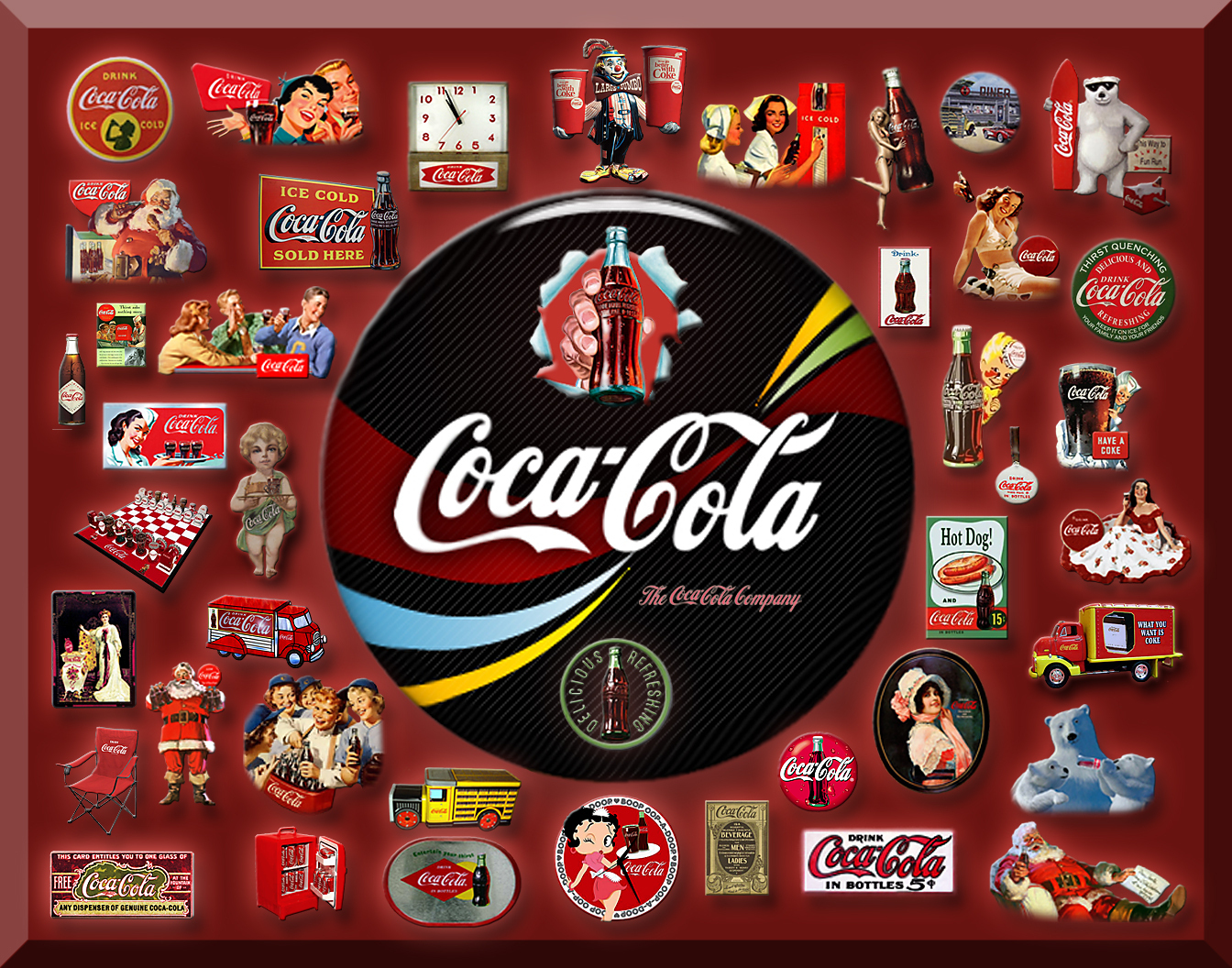
Coca-Cola-Collage-coke-22493435-1344-1056Everywhere you look, you can see its brand presence. It is almost unavoidable in the Western world.  Whether you love it or hate it, the advertising campaigns deliver a smile and a positive message. Today that legacy of brand placement and advertising has made the trademark among the ten top brands in the world. Some have estimated the trademark to be valued at about a trillion dollars. The company has 15 products that are “billion dollar brands” and it was named 2011 Marketer of the Year by Ad Age magazine. In addition to impressive product performance, the company has invested and pledged billions of dollars in developing countries. Campaigns range from wildlife protection to clean water in Africa.

With over 60 million likes on Facebook and hundreds of thousands of fans on Twitter, LinkedIn and YouTube, Coca Cola will continue to be trendsetter in marketing excellence!

By Michael David

References:

The Coca Cola Company (2011). Company Highlights. [ONLINE] Available at: http://www.coca-colacompany.com/annual-review/2011/company-highlights.html. [Last Accessed 3/4/2013].

The Coca Cola Company (2013). Coca Cola Journey. [ONLINE] Available at: http://www.coca-colacompany.com/brands/the-coca-cola-company. [Last Accessed 3/4/2013].

Pendergrast, Mark, (2000). For God, country and Coca-Cola : the definitive history of the great American soft drink and the company that makes it. 2nd ed. New York: Basic Books.

Posted in Uncategorized | 9 Comments

A Play within a Play: Product Embeds

I have a habit of identifying fictional TV characters with the brands they use.  Like the Ron Livingston character on Band of Brothers who only drank Vat 69. Or the Milton character in Office Space and his red Swingline stapler.  Or Hannah Horvath and her iPhone. Not too long ago producers took pains to cover up a telling logo or create a fictional brand. (Remember those 70s sitcoms where they would actually put black tape over a product name?)  The label on Archie Bunker’s beer said simply Best Quality Beer: The Favorite Everywhere (though if you look carefully, the logo had rather Lowenbrau-esque heraldry:)

195844086_90e2b4a864
The Modern Family producers usually cover up the illuminated Apple logo on the backs of their characters’ laptops.  And so viewers were taken aback (or enraged) when an entire episode was devoted to Phil Dunphy’s infatuation with the new iPad. Many felt like they were sitting through a 30-minute commercial for Apple. As it turns out, Apple paid nothing for the product placement; it was just a convenient plot device that seemed to fit with Phil’s gadgety personality.

Screen Shot 2013-03-04 at 4.51.10 PM
Intentional or not, there’s nothing new about product placement.  Even Shakespeare included references to specific brands of spirit — and was the reference to Marco Luchese’s inn (in The Merchant of Venice) a clever way of repaying a debt?  These days the placements are more likely to be fairly overt.  Watch any ten-minute cycle of Mad Men and count the product references. (One entire episode revolved around an ad launch for Heineken, and yep, it was paid for by the beer maker.)

How should we feel about it? In the UK it’s frowned upon. Never mind that London is one of the most ad-saturated cities in the world — any TV program with a product placement receives an icon to warn viewers.

200px-PP_-_Product_Placement_UK_logo.svg
Should PP’s be legislated? I’m learning to give them a break. Sometimes you need it for the gag. Like when the drowning woman in Horse Feathers is begging Groucho Marx to throw her a life saver, and he reaches in his pocket and … you guessed it.

Screen Shot 2013-03-04 at 6.26.36 PM
Placements add verisimilitude as well. Sometimes it just makes more sense in a movie for the guy with a package to wear a FedEx hat rather than some distracting bogus brand (USP? ExPress?). And if we’re going to stare at Tom Hanks relating to a soccer ball for two hours in Cast Away, it doesn’t make much sense to call it anything but Wilson.

But wait, didn’t Hanks work for FedEx?

— Will Everett

Please comment with your favorite brand placement examples.

————————–

References

Bershad, J. (2010, April 2). iPad produce placement on Modern Family, actually wasn’t, still irked fans.  Mediaite. Retrieved on March 4, 2013, from http://www.mediaite.com/online/ipad-product-placement-on-modern-family-actually-wasnt-still-angered-fans/

Tosi, L., & Bassi, S. (2011). Visions of Venice in Shakespeare. Ashgate Publishing Company.

Clip from Modern Family: Phil and his iPad: http://www.youtube.com/watch?v=XJp4_bxHOgU

Posted in Uncategorized | 10 Comments

FOR YOUR CONSIDERATION…

  The Academy of Motion Pictures Arts and Sciences (AMPAS) every year awards one lucky film the Oscar for “Best Picture.” The “Academy” is comprised of approximately 6000 members who are professionals in the film industry. There are two rounds of Oscar voting with the first being the nominations and the second being the winners of the categories. The members are divided into 16 branches (i.e. actors, directors, executives, cinematographers etc…) and during the first round of voting they vote within designated categories for nominations, then a few weeks later, all members vote for the winners in all categories which are announced in a televised ceremony. The process appears to be a straight-forward contest based on merit right? Well, sort of, that’s where Academy Award marketing campaigns come into play.
Academy1
I’M JUST SO HAPPY TO BE NOMINATED!!!
The key marketing objective of a movie studio Oscar campaign is to build consensus with Academy members and with consumers so that their movie is the undeniable winner of the category. This is accomplished through timing release, consultants, advertising, PR and other award shows.

Timing is critical to the Oscar marketing campaign. When to release the movie closest to award season so that members and consumers remember the title during the academy season is key. Which is why many movies that are considered contenders are released completely or partially during the holiday season. For example, Zero Dark Thirty was released in major markets such as L.A. and N.Y. in December to qualify for the Oscars and then released to the rest of country in January. Although December and the holiday season was not ideal for consumers to want to see Zero Dark Thirty due to the subject matter, in order to qualify for the Oscars it needed to release at least partially in 2012.

Each studio hires a consultant who is an expert on the Academy membership behavior as an organization. This group is a small and exclusive pool of consultants and everyone knows everyone. They are experts in when to send out DVDs of the movies, ads to buy, scenes to show for other award shows, what appearances the actors should do, which branches can influence specific certain categories and how they will vote based on other award shows. For example, these consultants know how to look at what wins at the Screen Actors Guild (SAG) Awards and how that will affect the voting for the Oscar for Best Picture because they know that SAG is the largest guild, so if a movie wins a SAG award, then those voting choices will probably be replicated by that guild with their Academy votes. According to Nakashima of the Associated Press (2013) gifts are a big part of the campaign for Oscar; “Giant coffee table books, iPod Shuffles, signed letters from directors, even “Lincoln” turkey roasting pans” were distributed to key voters earlier in the season. The Academy goes to great lengths to maintain the integrity of the Oscars and has strict rules for how the studios can market to AMPAS members especially in regards to gifts and campaigning. Penalties for studios can include reprimands and fines. Academy members I’ve spoken to are extremely vigilant in their voting, but since many members do work for movie studios, it’s assumed that they will vote for their studio’s nominations. Good thing voting is confidential.

AND THE WINNER IS…
Everyone! Everyone associated with a nomination or a winner that is, which is why anyone remotely attached to a nomination or a win is a stakeholder. For movie studios, it means additional box office ticket and DVD sales, because consumers view an Oscar nomination or a win as validation that the movie is worth seeing (Nelson, Donihue, Waldman & Wheaton, 2001). Of the nominations for the 2013 Oscars, 6 of the 9 Best picture contenders have raked in $100 million plus domestically which tops 2012 when all 9 nominated films in total received $111 millions in box office. (Nakashima, 2013) In addition to cold, hard profits, the benefits for the filmmakers is not only bragging rights, but leverage to negotiate on their next productions. Directors get access to the best scripts and talent for their next project and for actors it ups their credibility and cultural presence. Although for actors, there is the dreaded “Oscar Curse” where winning doesn’t necessarily translate into an upward trajectory. Although the criteria is subjective, Marisa Tomei, Cuba Gooding Jr., Miro Sorvino and Adrian Brody have had less than stellar opportunities post Oscar win (Bukszpan, 2013), Can you think of a recent film or tv show that you saw Academy Award winning best actor Jean Dujardin? By the way, he was last year’s winner for Best Actor.

I interviewed a prominent Academy member and studio executive about marketing campaigns and how it affects their voting decision about specifically Best Picture. “Marketing doesn’t consciously affect my vote. In my mind, when I make my vote for the Oscar for Best Picture, I use the Academy criteria which is “ Which of the nominations represent the best achievement in film making?” I asked does consumer and industry consensus play a part? “I think it does to some people, but not to me, I focus on the best achievement criteria.”

THE AFTER PARTY
So the question to ask yourself if you went to see this year’s Best Picture Argo, did you see because it won Best Picture? Or did you see it because of marketing? The answer might possibly be? Both.

M. Douponce
Full disclosure: I work for a movie studio but I am not a member of AMPAS.
Our Best Picture nominee Zero Dark Thirty lost.

References
Bukszpan, D. (2013, February 21). 13 Actors hit with the Oscar curse. Retrieved from http://www.cnbc.com/id/41720860/13_Actors_Hit_With_The_Oscar_Curse

Nakashima, R. (2013, February 23). Oscar campaign: Behind the scenes of what raises the big movies’ chances. Associated Press. Retrieved from http://www.huffingtonpost.com/2013/02/23/oscar-campaign-behind-the-scenes-movies_n_2750065.html?utm_hp_ref=entertainment

Nelson, R.A., Donihue, M.R., Waldman, D.M. & Wheaton, C. (2001). What’s an Oscar worth? Economic Inquiry, 39 (1), 1-16.

The Academy of Motion Picture Arts and Sciences. Retrieved from http://www.oscars.org

Posted in Uncategorized | 11 Comments

Frito-Lay: Bold Flavors to Match Bold Marketing

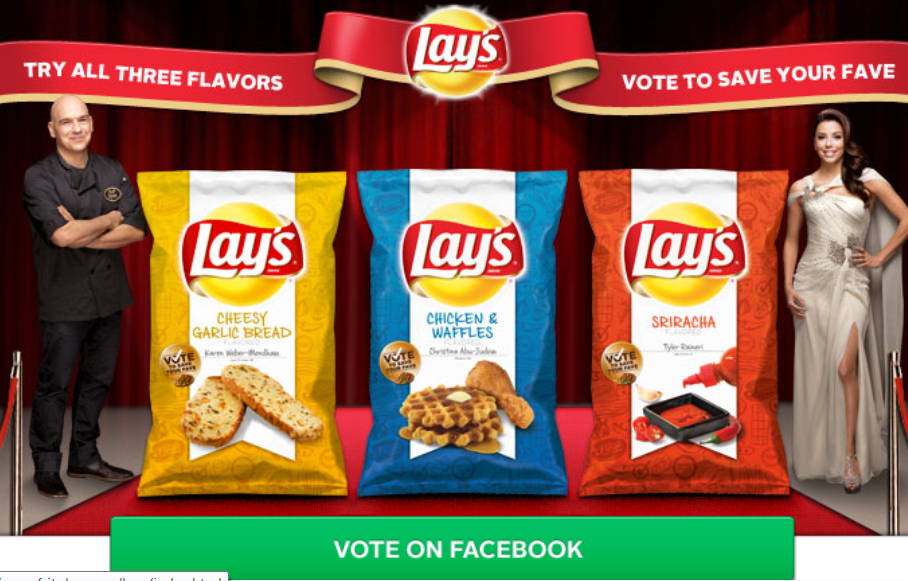
Chicken and Waffles potato chips anyone? If that’s not your cup of tea, perhaps Cheesy Garlic Bread or Sriracha flavored chips will spark your interest. Executives at Frito-Lay sure hope so, as the company has promised a handsome one million dollar reward, or 1% of net sales, to the creator of the newest Lay’s potato chip flavor that garners the most votes via Facebook. Oh, and the campaign features the beautiful Eva Longoria pretending that she eats potato chips and celebrity chef Michael Symon pretending that he is not appalled by crowd suggestions.

lays campaign

My head is spinning. I’m not sure which implied marketing strategy to focus on! But I must pick the one that intrigues me most. Crowdsourcing, a term coined by Jeff Howe in a 2006 Wired article, describes the genius practice of soliciting the public to perform a task for a company. It’s becoming an increasingly popular practice, popping up across all kinds of industries, from books to beer.
Frito-lay jumped on the band wagon last summer with a crowdsourcing project that is currently in-progress. In July of 2012 the public was approached by the company via a massive social media campaign to “Do us a flavor,” by concocting ideas for the brands newest potato chip offering. Now, let’s be honest, the marketing execs at Frito-Lay, in no way, thought it cost-effective to sift through what would turn out to be 3.8 million submissions just for a potato chip flavor concept. So, what’s the upside to this elaborate and costly crowdsourcing campaign? Marketing gold.
Utilizing free and ever-popular social media to conduct the quest ensured massive reach on the cheap. Engaging the public in such an interactive way is almost guaranteed to boost the company’s brand image. Not to mention that now that the flavor finalists have been determined, consumers have to purchase, not one, but three bags of Lay’s in order to make a knowledgeable decision before casting their vote via Facebook, Twitter or the company’s website. After all, what’s worse than an uninformed voter? But beyond all of this, the sheer amount of interest that this campaign has generated is staggering. People everywhere are talking about which flavor should win and creating their own mini-marketing campaigns for their favorite. It might not even matter if the snack chip flavors taste any good, for the amount of marketing hype they are creating for Lays. (Some examples here and here.)
This is not to suggest that the innovative marketing tool doesn’t have its downfalls. In an insightful Forbes article, Larissa Faw asks the questions, “Are millennials crowdsourcing themselves out of jobs?” and suggests that the cost-saving practice of crowdsourcing projects that would otherwise expend company resources may eventually endanger employment opportunities.
I have to say, after delving a bit deeper into the details of Frito-Lay’s campaign, I think our jobs are safe. Not only did the company invest a great deal of time and money into marketing the crowdsourcing project itself, they also produced the final three products for mass distribution and created individual marketing teams for each of the three flavors. When done on a massive scale, by a company as large as Frito-Lay crowdsourcing may create jobs. It certainly created partnerships, as seen in the sponsorship of the “Do us a Flavor” campaign by Target Stores. The mutually beneficial arrangement draws the public to Target in order to enter a sweepstakes for a chance to win a trip to Los Angeles and a meet and greet with Eva Longoria.
Companies with smaller marketing budgets may find real value in using crowdsourcing as an advertising tool. Combining this approach with the utilization of social media outlets seems to be the ideal marketing opportunity for growing companies looking to garner widespread buzz and some serious brand recognition.

Alexandra Murtha (CMGT541-A)


Posted in Uncategorized | 4 Comments

Neither Rain, nor Snow, nor dark of night . . . competition, however, that’s a Different Story

When we think about marketing, we typically think about how it is created, its substantive messaging, and to what type of audience it is intended to reach.  What we typically don’t think about is how it transcends all elements of our lives, and impacts so many different sectors of our economy.  While it’s easy to understand why and how a cosmetics, automotive, or restaurant chain relies on integrated marketing strategies to distinguish themselves from their competitors, certain businesses within our economy don’t readily come to mind when marketing is the topic of discussion.  One such organization that falls into this category is the United States Postal Service (USPS).  However, when we think about the type of competitive onslaught that this organization has faced during this and the prior decade, it becomes clear that in order for it to survive, it too must devise an effective, integrated marketing strategy to combat its more modern formatted competition.  However, this is not an easy task, for the USPS does not lend itself to fancy, glitzy or colorful marketing concepts due to its perceived aura of always being there without regard for what it may actually take to allow it to survive.  Additionally, it has not particular product to advertise graphically, only its service, which has always been subject to criticism to varying degrees.

Since its inception in 1775, the United States Postal Services (USPS) has provided urban and rural mail delivery service throughout the U.S. with a devout commitment to getting communications involved from its sender to intended recipient. The name itself is somewhat of a misnomer, inasmuch that USPS is not a government-owned corporation, but instead is an independent branch of the federal government that is regulated by the Postal Regulatory Commission, and is structured to function like any other corporate entity.  Its ability to meet its financial obligations comes from the revenue it generates – not from direct taxpayer subsidies (Carbaugh, & Tenerelli, 2011).  With a total of more than 650,000 workers, it ranks second only to Wal-Mart in terms of the number of civilians it employs (Number of Postal Employees, 2009).

Visions of the iconic uniform-clad postal delivery person going from house to house carrying his or her bag full of various forms of communication; and doing so with a smile and often times whistling a familiar tune, evoke both nostalgic feelings and security of assurance in knowing tomorrow will provide the same imagery all over again. We take comfort in something so reliable in its implicit certainty.  But is this certainty of recurrence merely one that is operating on borrowed time?  Given the current and projected financial condition and of the USPS, one could infer that future generations may not be assured of the mail always getting through – or even being attempted.  This organization is facing the grim reality that in order to conduct business in today’s market; it is imperative that costs be controlled and reduced wherever possible, and that niche markets must be developed in order to secure an operational and competitive edge in the lucrative communication transfer industry.

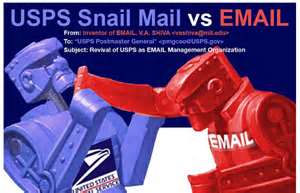
One would have to have been residing in a cave during the past decade to not have witnessed the impact that technology implanted unto the USPS.  We are now part of a society that simply refuses to wait for communication to come our way via a two or three day journey – we want it now!  Technology can provide this for written forms of communication in a way that the postal service simply cannot compete for consumer preference.thCA13S602  While it’s practically unfathomable to think of what our daily personal and professional communications activities would be like without email, teleconferences, webinars and other forms of video-enhanced forms of media utilization, it really wasn’t that long ago that the USPS provided the primary, and in some cases, the exclusive form of communication transference process.  That all changed with the advent of the Internet and the digital communication media platforms it helped spawn, and the “need for it now” approach to communications to which we are now accustomed, whereby rendering lengthier alternatives as archaic and infeasible.
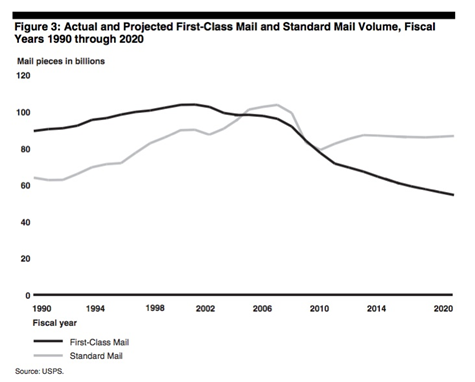
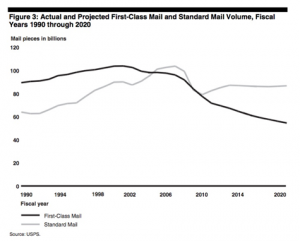
So where does this leave the USPS in its ability to provide acceptable service to its customers, while doing so in a manner that is financially feasible to its sustainability and longevity?  Things aren’t looking good.  First-Class mailings began a precipitous decline in 2006, with a similar decline in standard mail deliveries following suit in 2008. These trends are projected to continue through this decade.
usps table

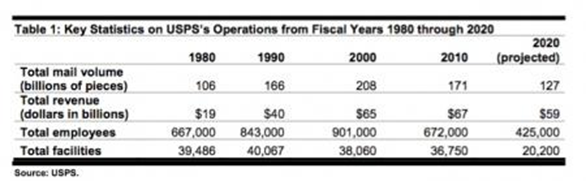
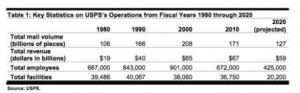
Customers have since opted to reduce their level of mailings, or converted to digital means of transferring communication to intended recipients, thus further propagating the financial woes the organization has and continues to encounter as a result of a major decline in revenue. Despite numerous initiatives to reduce operating costs, including layoffs and weekly labor hour reductions commencing in 2008, the impact of declining revenue has been difficult to overcome in terms of financial performance and is projected to continue in that direction.
usps table 2

Further compounding the problems, unlike other conventional consumer service or product providers, the USPS cannot arbitrarily increase the prices it charges customers without attaining federal approval to do so.  This is a time-consuming process, as well as one that is assured to evoke public displeasure.  We all know what type of public reaction occurs when talk of the stamp increasing by a penny or two is rumored. Given this type of public perception of the USPS, and outcry when price increases transpire, the organization is in a catch-22 position, whereby it is battling both its customers for acceptance of price increases, while trying to compete with digital communication transfer capabilities that consumers prefer. Therefore, it must find a way to avoid price increases and sustain acceptable financial performance, while contending with continued volume loss.  This is an undertaking most companies would not be able to successfully engage in.

With financial woes that has the USPS virtually on the brink of default, it is aggressively pursuing advertisers to increase their mailings under the premise that revenue from mass (junk) mailings can offset the decline in first-class consumer and business mail that has migrated to online formats (Schultz, 2011). This effort to reposition itself and its brand as the carrier of choice for bulk advertising communications may be the only avenue that remains if any chance of renewed financial performance and longevity is to be salvaged.  However, even if successful with this marketing platform, the fact remains that due to its cost structure and inability to raise prices for its service the way its package competitors can, the days of the USPS being our primary and preferred choice for mail and package delivery are likely to be just a part of our past.

Some would say that the apparently inevitable demise of such an iconic piece of the puzzle of American tradition is saddening, and speaks volumes to the assertion that all businesses eventually antiquate themselves.  Others subscribe to the premise that the USPS brought on its own perils by not addressing excessive labor and benefit costs earlier when other private and public businesses were forced to in order to remain competitive, and that it should have worked on re-inventing itself decades ago, so it’s getting what it deserves.   Regardless of which side you may defend, it can be said without apprehension that the business of communication and the means by which it is transferred will always be an evolving, highly competitive sector of our economy.  As such, if organizations wish to rest on their laurels, or fall prey to a false sense of brand loyalty and disregard the need to re-brand themselves through innovative marketing strategies, their inevitable demise is almost as assured as that of the USPS that most of us believed would always be around.

References

Carbaugh, R., & Tenerelli, T. (2011). Restructuring the U.S. postal service. Cato Journal, 31(1), 129-150.

Number of Postal Employees Continues to Decline (2009). Postal News, (June 30), p. 1.

Schulz, E.J. (2011). ‘Junk mail’ may be last hope for saving the USPS. Advertising Age, 82(32), 2-2,21.

Posted in Uncategorized | 1 Comment