
This gallery contains 3 photos.
By Kim Tarabetz If you have ever gone to a social event where men in the 21 – 40 age bracket were drinking beer, chances are you heard a quote that sounds something like this: He has … Continue reading

This gallery contains 3 photos.
By Kim Tarabetz If you have ever gone to a social event where men in the 21 – 40 age bracket were drinking beer, chances are you heard a quote that sounds something like this: He has … Continue reading
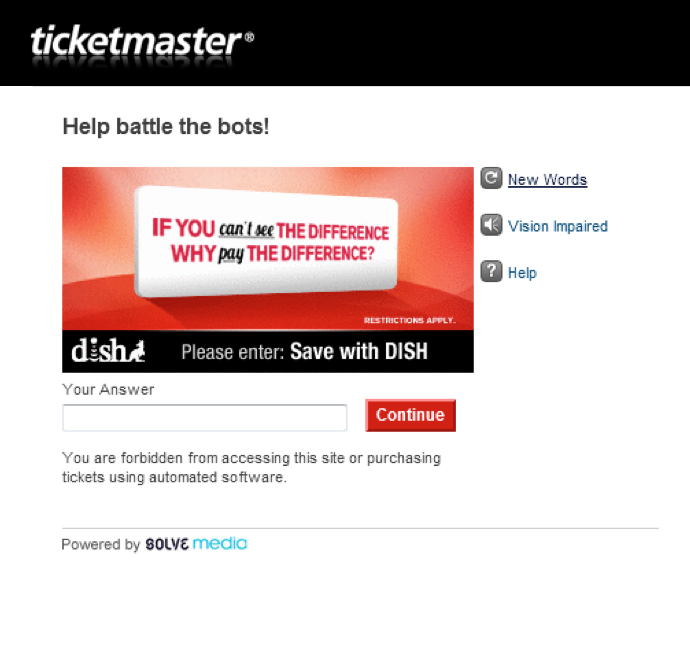
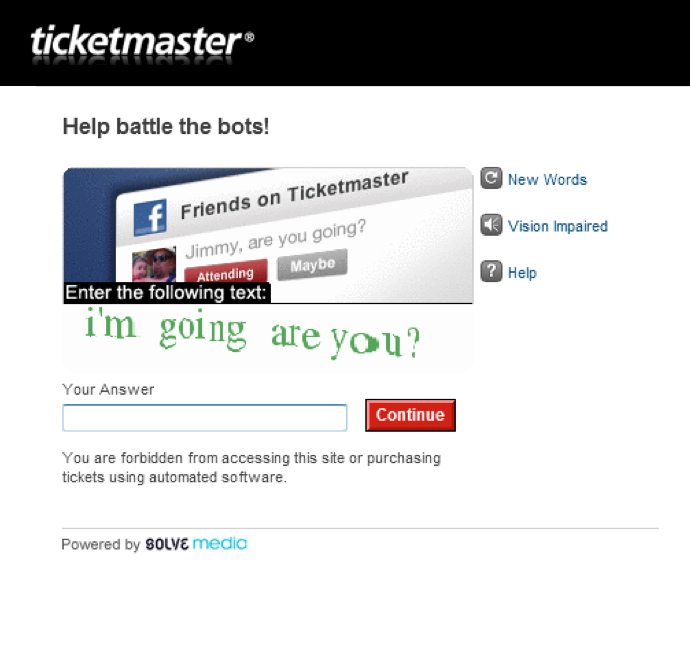
It’s noon on Thursday, I’ve got my Ticketmaster presale password and am ready for an old-fashioned online battle. I select “Best Available,” cross my fingers and wait. Then the little CAPTCHA box pops up where I expect to enter the very-hard-to-read print shown to prove I’m not a bot and indeed a real, live person. But wait, this box is different.
Dismayed at first when I see a foreign box pop up, I read it and shake my head. Brilliant, I think to myself. I’m not a marketer by trade or an advertising professional, so maybe I’m easily impressed but this was the most unique and clever way to advertise. I’m not sure whether it can be dubbed “product placement” but whatever category it’s in, I am fascinated by the team that dreamt this up.
Ticketmaster is known for discovering ways to combat ticket scalpers and the sophisticated tools they put to use. In an effort to protect their customers, Ticketmaster has implemented the CAPTCHA format for the past several years which require the customer to type-in the randomly chosen words and/or letters shown within the rectangular box before being allowed to complete the purchase of event tickets.
Solve Media has found an effective way to incorporate online advertising in a way that people will actually read. Take a look. http://vimeo.com/solvemedia/solve-media-capthca-type-ins
We’re all bombarded by online advertising. Whether it’s a simple display ad, text ad, or an annoying pop-up commercial, we’ve grown accustomed to basically ignoring them. I agree with the opinions shared by Solve Media on the video above; readers don’t remember the brand in the way they should, if at all. I think this new idea is fantastic and it’s not surprising that this advertising group has won over many large corporations with their innovative technique.
The “ads” I had in my CAPTCHA screens (I searched for tickets twice) were for DISH® Network and Facebook (see the screenshot below). I have to admit it worked: I had to read the taglines and it fueled an interest in what DISH® has to offer. Is it because it was my first time coming across this type of ad that made it so appealing to me? Maybe. Will I find it just as annoying as pop-ups and sponsorships riddled across my favorite internet pages? Perhaps. What do you think?
Oh, and I got the tickets.
By Nicole Palacios
References
Solve Media. (2013, February 28). Retrieved from http://solvemedia.com/index.html
Ticketmaster (2013, February 27). Retrieved from http://www.ticketmaster.com/
Among the many buzzwords making the rounds in marketing circles these days is “content marketing,” which comes with a variety of definitions, but “basically, content marketing is the art of communicating with your customers and prospects without selling.” (Content Marketing Institute, 2013).
One product I’ve found that uses this idea of content marketing brilliantly is NBC’s popular television show Parks and Recreation. The show, which chronicles the life of small-town councilwoman Leslie Knope (played by Amy Poehler) and her peculiar friends and co-workers in the fictional city of Pawnee, Indiana. What makes the content marketing for Parks and Rec so effective is how it takes the key elements of the product (characters and storylines) and allows them to live online in ways that make viewers spend more time on them and drive ratings for the show.
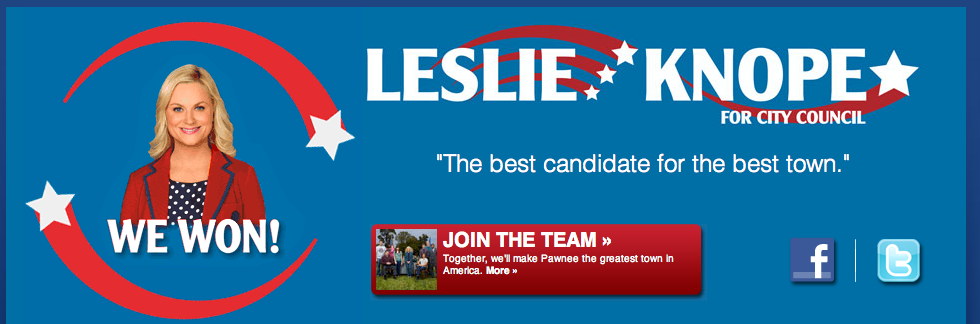
screen capture of the “campaign” website created for Parks and Recreation character Leslie Knope’s run for Pawnee City Council
Some of the tactics employed in this strategy have a small e-commerce angle, like the shop on Ron Swanson’s Grilling Webpage (pictured below), which offers barbecue sauce, an apron and t-shirts. Others are aimed purely at further engaging viewers, like a Pinterest board for the wedding of characters Ben and Leslie or a “coming soon” page for Rent-A-Swag, the business idea of the show’s serial entrepreneur, Tom. These micro-sites come in addition to the show’s official Tumblr and other social media pages like Twitter and Facebook, tactics which have become commonplace for many television shows.
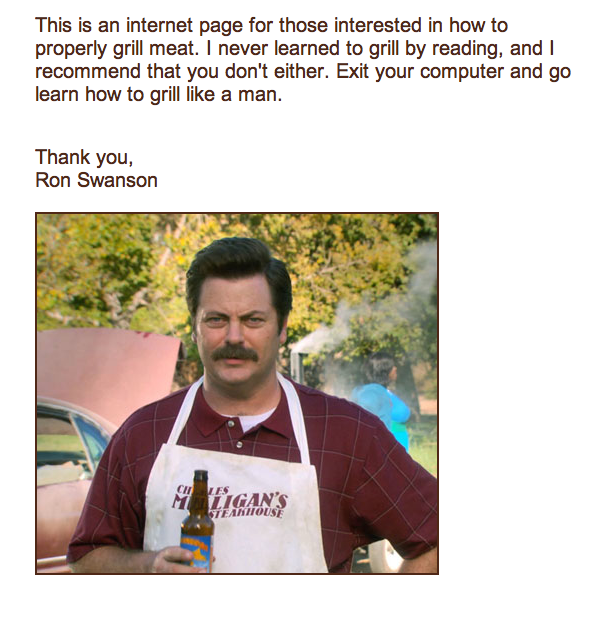
screen capture from ronswansongrill.com
What impressed me about these content marketing tactics is how much they reflect the show itself and what viewers love about it. Characters who might not get much screen time in the 22-minute episodes cultivate fan bases online in a way that feels absolutely authentic, due in large part to the show’s concerted efforts to have the same writers and producers who do the show also create these social media and content marketing vehicles.
What do you think? Is this an effective use of NBC’s resources to promote the show? Are there ways other organizations can tell their stories like this? What are the implications for brands that might not be as story-centric as television shows?
Lots to consider. If you’re looking for me, I’ll be taking Mr. Swanson’s advice: exiting my computer and learning to grill like a man.
References
Bishop, R. (2013, February 27). Parks and Recreation wedding album’s the best use of Pinterest yet [blog post]. Retrieved from http://www.geekosystem.com/parks-and-rec-wedding-album/.
Content Marketing Institute. (2013). What is content marketing? [blog post]. Retrieved from http://contentmarketinginstitute.com/what-is-content-marketing/.
Contentlead. (2013, January 21). Small businesses can learn from Parks and Recreation’s content vision [blog post]. Retrieved from http://contentlead.com/news/small-businesses-can-learn-from-parks-and-recreations-content-vision.
Feeney, N. (2013, February 28). How Parks and Rec brings Pawnee to life online. Time.com. Retrieved from http://entertainment.time.com/2013/02/28/how-parks-and-rec-brings-pawnee-to-life-online/.
Audrey Hepburn was a big fan favorite when she was young and when she died her style and movies were instantly referred to as classic. You can easily look at pictures of her so you know what a classy lady would wear but how are you supposed to know what chocolate Audrey would eat? Have no fear my friends for Audrey Hepburn herself has come back from the dead to let us know. No, really, Audrey Hepburn has recently appeared in a commercial for a British chocolate called Galaxy. See for yourself.
http://youtu.be/lnix9BHWJ2g
This isn’t Audrey’s first commercial since her death. In 2006, Hepburn was featured dancing in a Gap commercial. A trend in advertising is to use famous and easily recognizable celebrities posthumously to advertise products. The issue at the center of this is whether or not this practice should be acceptable. Hepburn’s sons’ provided consent for the Galaxy commercial but does this make it ok?
I will say that it is very cool to see some loved celebrities come back from the grave but shouldn’t they be allowed to rest in peace? Because they were celebrities while alive do the same rules apply to them even in death? If so, the question must be asked, who owns the dead? In return for using Hepburn’s image in the Gap commercial, Gap donated a large sum of money to her charity. However for the Galaxy commercial Hepburn’s sons’ received a payment.
When an actor is featured in a commercial advertising a product it’s usually because they are endorsing the product but how do the dead endorse products if they’re not alive? These people are not still being featured after their deaths however their opinions are not considered nor are they themselves receiving compensation. You have to wonder if there is more than one line being crossed when using posthumous images of celebrities. When are we ever going to let celebrities rest? I believe a good man named Homer Simpson once said, “You celebrities need to realize that the public owns you for life. And after you’re dead, you’ll all be in commercials dancing with vacuum cleaners.” Homer was referring to the Fred Astaire commercial below:
http://youtu.be/U_IeEi4nGVQ
What do you think? Acceptable or unacceptable?
By Melinda Menchaca
References:
Ellin, A. (2013, February 28). Audrey Hepburn sells chocolate from the grave. Retrieved from http://gma.yahoo.com/blogs/abc-blogs/audrey-hepburn-sells-chocolate-grave-185207727–abc-news-savings-and-investment.html
Usborne, S. (2013, February 24). Audrey Hepuburn advertise Galaxy chocolate bars? Over her dead body! Retrieved from http://www.independent.co.uk/arts-entertainment/tv/features/audrey-hepburn-advertisegalaxy-chocolate-bars-over-her-dead-body-8508603.html
Entering a war zone as a strategic communicator is always tough. Coming in fresh, you quickly see people’s hopes and dreams of fixing the crisis “lay scattered across the desert floor” (Lawrence, T.E.1922). In Kabul, the future of the Afghani people and their nation is on everyone’s mind. No one wants a return to the harsh rule of the Taliban, but the locals fear that once the US and NATO forces leave, there will be no one who can stop them.
The Taliban took control of Afghanistan during the worst part of a post-Soviet civil war. The war lords who ran the resistance that broke the Soviet occupation turned on each other for control of the nation. The Taliban moved in as the civil war reached exhaustion. At first they were welcomed because they stopped the fighting and restored order and security. It did not take long, though, before the Taliban leadership imposed a religious police state on the population.
Harboring and defending Al Qaida marked the Taliban downfall. US and Allied forces quickly took control of the nation and pushed the Taliban to the Pakistan border. The Taliban, stunned by the fast defeat in the land war, quickly returned to the attrition tactics that wore down every invading army that occupied the region. Their strategy: Draw the enemy into fighting in the Hindu Cush (Hindu Cush translated means Killer of Hindu or Indian (Wikipedia 2013). After ten years of mountain and guerilla warfare, the US and its Allies also face resource and personnel strain and are preparing to withdraw.
Enter my job, to develop the communication strategy to help the Afghan people to moderate violence and extremism and assist in promoting Afghan participation in the upcoming elections. Luckily, I am not alone. The country is filled with ambassadors, generals, troops in the field and civilians also working towards the goal of helping the Afghani build a moderate and collaborative society.
As the “new guy” in charge of focusing the US strategic communication for this effort, frankly, it’s daunting.
Luckily I have great leadership, which has allowed me to work my processes for developing large scale communication strategy. First, I plan to give myself up to thirty days to assess the environment. The assessment includes reviewing grants and operations that are actively engaging Afghan society. The assessment also includes interviewing people from the State Department, military, and civilians that are working the issue throughout the country. I first listen to their perspective, then sort out the “things” that have worked and the “things” that have not. So far, some key strategies that may be working are to develop ties between religious leadership in Afghanistan with moderate leaders from Turkey, Jordan and Saudi Arabia to show how moderate Islam supports variety and culture. Another goal with potential is to engage radical warlords or tribal leaders and try to integrate them and their people as partners in Afghan politics and society.
For the things that have not worked, my recommendation is to never throw those ideas away. Some remain examples of what not to do, others are examples of good ideas and how not to do them.
Strategy is mapping the road so tacticians can take the first steps towards the goals.
The last sets of interviews are the most important – meeting with the Afghani people. Even though I am far from done interviewing civilians and military, today I began my first Afghan interview. I pulled a series of current plans and strategic goals with a young man who had seen them all. He was able to explain why certain things worked and why others did not. The discussions also allowed me to watch his face and read his expressions as I discuss those and new concepts and goals for countering violent extremism. He smirked when I talked about the elections and organizing national surveys and polls to track interest in the upcoming elections, and how publicizing those numbers make it harder for political groups to throw an election. He laughed “You have dealt with this people before.”
The harder part was discussing the need to reconcile the Taliban; a discussion about finding a way to draw them from an extremist/militant force into a political partner in Afghan society – who is tolerant of other groups, and works to live in equality. His face and eyes darkened as he listened and fed back what he felt I wanted to hear. It was hard to watch. I bated him to speak his mind, but being polite he only spoke in agreement, clearly, his faced showed how his family had suffered during their rule. I’m sure he knew that reconciliation was needed, but hated the idea. Reconciliation is a sensitive wound for many in Afghanistan. People are hurt from the brutal treatment by the Taliban, and the Taliban are deeply wounded by the knowledge that fellow Afghanis sided with “outsiders” in order to remove them from power.
A good assessment of the communication environment is critical to successful strategy and implementation. If my assessment remains consistent, my strategy to countering violent extremism may have to root in the need to engage and moderate the emotional scars on both sides of the issues. The map to countering violent extremism may have to chart through reconciliation first so that there is a mutual trust that supports non-violent engagement. This is where reconciliation begins, and it will happen – It just depends on how long people are willing to live with the painful past or begin to move beyond that past, and learn how to shoulder together to build an Afghanistan where all Afghani can thrive.
It won’t be clean and it won’t be easy. It never is, but if reconciliation and trust lead Afghanistan to a path of trust and cooperation, the goal of countering violent extremism will also be met.
-Jack
Resources:
Lawrence, T. E., & Wilson, J. (1922). Seven pillars of wisdom. Unabridged Oxford text. ISBN 0-9546418-0-9
Wikipedia. (2013). [Website]. Retrieved from http://en.wikipedia.org/wiki/Hindu_Kush .
Justice will not be served until those who are unaffected are as outraged as those who are. ―Benjamin Franklin
Nima’s Story
Nima was 5 when she and her 3-year-old sister escaped from a life of horrific abuse at the hands of their father. A hollow tree in the woods served as their home, until the rainy season when Nima’s sister became gravely ill. In a frantic effort to save her sister, Nima went to the market to beg for someone to help. To Nima’s relief, her sister was taken in by a family who agreed to care for the sick child. Nima was left on her own, and lived on the streets, until she was taken and used as a domestic slave. Nima was beaten regularly for “poor housekeeping.”
It didn’t take long before the couple decided they could make money by selling Nima to a brothel. She was raped, abused and used daily by men. By the time she reached the age of twelve, Nima was an alcoholic and had given birth to two children. One fateful night, a rescue worker befriended Nima on the streets and eventually helped her escape this nightmare so Nima could receive the physical and emotional care needed to begin healing. Nima is now happily married and leads a program for other girls that have been rescued from slavery.
The number of people just like Nima who are ruthlessly enslaved around the world is heartbreaking and mind boggling. Tragically, most of their stories do not end with freedom. From brothels to private homes to fields and factories, more than 27 million people are living as modern day slaves with little hope of rescue:
A Wake Up Call
I sat dumbfounded hearing this story. Awareness has a strange way of doing that to a person – a lightbulb turns on and you think “How did I not know this before?” It felt like somewhere in the back of my mind I had heard something about this somewhere, but it hadn’t cut through the clutter and planted itself firmly in my reality. Until now. Sitting with my daughter at a Conference for 18-25 year old students my eyes were opened to a reality that I could not just walk away from. I was now responsible for the knowledge I had gained. The 60,000 attendees were challenged to take up the cause of justice and determine to end the scourge of slavery in their generation. CNN covered the gathering (I’m there in the crowd somewhere – it was a powerful night!):
http://www.youtube.com/watch?v=WFIoHX9VZ_g
A Campaign and a Crusade
And so, a marketing campaign called the End It Movement was born. It’s an awareness campaign, but isn’t that the same thing? Trying to break through the clutter that surrounds people to get them to focus, even if it’s just for a minute, on a message. The difference? This message, if successful in raising awareness to a level that cuts through the noise and compels people to focus has the potential to truly change the world.
The campaign tactics of the End It Movement are very similar to other mainstream marketing strategies. Take for example the launch – creating buzz from a live venue in the hope that the momentum creates a viral wave. This is Apple’s preferred method of product launch. Another similarity to the Apple strategy is the fact that all branding elements drive the interested party to the End it Movement website, which serves as the hub of information. It is here one can find videos, link directly to organizations fighting to end modern slavery, and be launched to the presence of the movement on the internet via Facebook, Twitter, and Instagram. The branding elements are simple, and are used consistently throughout all touch points. Where this campaign diverges from larger marketing endeavors is budget. The group has no corporate headquarters, no multi-million dollar budget. Media buy consists of one full-page ad in USA Today donated to the group. A college tour has launched to continue to raise the awareness level on campuses across the country. The goal of the movement’s organizers is clear – create maximum impact for minimal investment. They long to make the cause of freedom viral.
It’s a noble mission. So, my question is: Will it work? Is it possible to launch a campaign that can radically change the world for 27 million people on a shoestring budget? What are your thoughts?
Thank you for taking the time to engage in the cause of justice.

Kellie Clinebell
As the communications world continue to search for new strategies and tools to eliminate the crisis of engagement companies are having with consumers and employees, the word gamification is increasingly becoming the topic of discussion. Gamification is about taking the essence of games – fun, play, transparency, design and challenge – and applying it to real-world objectives rather than pure entertainment (Palmer, Lunceford and Patton, 2012). More than just a buzz word, Gartner, the world’ leading IT research and advisory company predicted www.gartner.com/newsroom/id/1844115 that 70% of the world’s top 2000 companies will be using gamification in some form by 2014.
An old but growing idea that has finally taken its place as an innovative engagement tool, gamification has some companies re-designing the way they work to include elements such as completing missions, competition, social interaction, status and rewarding achievement (BBC, 2012). Even more so, some organizations integrate gaming mechanics with their online marketing strategies to increase customer interaction. Last year Marketing Magazine presented their Top10 list of gamification executions www.marketingmag.com.au/news/top10-gamification-executions-13757/#.USr5oO1_SPs from around the world.
Currently an expensive way to play, gaming strategies have been used in the past by way of frequent flyer programs and loyalty programs, leaderboards and financial rewards to motivate sales teams. The difference today is the use of online and mobile computing technologies that not only enhance the gaming look and feel, and the interactive experience but also the collection of data on user’s behavior, a valuable tool for all types of organizations. These gamification strategies must be well thought-out, well designed and well executed to be effective. Gartner identified four principal means of driving engagement using gamification techniques:
1. Accelerated feedback cycles: Gamification increases the velocity of feedback loops to maintain engagement.
2. Clear goals and rules of play: Gamification provides clear goals and well-defined rules of play to ensure players feel empowered to achieve goals.
3. A compelling narrative: Gamification builds a narrative that engages players to participate and achieve the goals of the activity.
4. Tasks that are challenging but achievable: Gamification provides many short-term, achievable goals to maintain engagement.
Gamification may not be here forever but it is certainly the competitive engagement strategy that seems to be working. Many of us may already be engaged in the process through an employer or as a customer. As more and more organizations get in the game they will need to remember that the next trend is just around the corner.
References:
Fleming, N. (December 5, 2012). Gamification: Is it game over? BBC Future. Retrieved on February 19, 2013 from:
http://www.bbc.com/future/story/20121204-can-gaming-transform-your-life
Donston-Miller, D. ( May 0, 2012). 7 Examples: Put gamification to work. InformationWeek, the brainyard. Retrieved on February 18, 2013 from: http://www.informationweek.com/thebrainyard/slideshows/view/232901489/7-examples-put-gamification-to-work
Marketing Magazine (May 10, 2012). Top 10 gamification executions. Retrieved on February 24, 2013 from:
http://www.marketingmag.com.au/news/top10-gamification-executions-13757/#.USr5oO1_SPs and http://www.gartner.com/newsroom/id/1629214
Palmer, D., Lunceford, S. and Patton, A. (2013). The Engagement Economy: How gamification is reshaping businesses. Deloitte Review. Retrieved on February 24, 2013 from: http://www.deloitte.com/view/en_US/us/Insights/Browse-by-Content-Type/deloitte-review/c7cee86d96498310VgnVCM1000001956f00aRCRD.htm
If stalking brings to mind bad tabloid stories of stargazing cuckoos, take another look at how you can stalk your way to making more money for your product or company and win over consumers with social listening. With the world moving at the speed of light because of the Internet and the increased use of social media, a marketer no longer has the luxury of waiting for responses from traditional marketing mediums. Even new social marketing tactics like Facebook, Twitter or Vine aren’t bringing enough real-time results, so why not turn an ear and do more listening to uncover opportunities to win customers over.

Social listening is the art of studying and examining social media posts to obtain real-time customer feedback, which can be turned into marketing and customer service opportunities. Recently, Omni Hotels shared their story of how their quick response to a tweet from an unhappy customer turned into a viral opportunity to promote their brand (Humphrey, 2013).
Omni Hotels also shares in this recent article their strategy and principles for effective social listening (Humphrey, 2013). Here’s a short summary of these principles:
With any marketing medium, be sure to examine how this tactic can help or hurt your current marketing strategy. Although social listening offers a different way of using social media to boost a company’s marketing efforts, recent surveys from NetBase and J.D. Powers and Associates also show that 43% of consumers feel that social listening is an intrusion of their privacy (Wilson, 2013). But with any new marketing opportunity, companies should be thoughtful in approach and determine how social listening influences relationships with consumers (Wilson, 2013). It is wise for companies to listen, engage, and use common sense when opportunities are identified through social listening.

Social listening offers marketers the insights to jump on real-time opportunities to win customers over but judicious integration with current marketing and customer service strategies is essential to the success of this emerging marketing tactic. If done well, social listening combined with other tactics can yield positive customer perceptions and can lead to word-of-mouth and viral marketing (Humphrey, 2013, Fowler, 2012).
References
Fowler, G. A. (2012, June 18). Are you talking to me? Wall Street Journal. Retrieved from http://online.wsj.com/article/SB100014240527487041164045762630839709
61862.html
Humphrey, L. (2013, January 24). Omni Hotels: The power of social listening. Huffungton Post. Retrieve from http://www.huffingtonpost.com/lin-humphrey/social-listening-hotels_b_2530202.html
Wilson, M. (2013, February 19). The pitfalls of listening to followers on social media. Ragan Communications. Retrieved from http://www.ragan.com/PublicRelations/Articles/The_pitfalls_of_listening_
to_followers_on_social_m_46251.aspx#
-By Kristy Junio (Section C)

The 2013 awards show season has been perhaps the most hotly discussed and debated one ever. The biggest buzz: why was Ben Affleck, director of best picture nominee “Argo,” passed over for an Oscar nomination for best director when he has won almost every other award and accolade thus presented?
 Granted, there are always surprises and snubs when the nominations are announced. This is especially true in the best director category, now that the Academy has increased the potential number of best picture nominations to ten. Traditionally, when the best director and best picture nominations both numbered five, it was natural that the two categories should mirror each other. But now that there are potentially ten pictures and only five directors, someone is going to get snubbed. This year was no exception, with the omission of 2011 winner Tom Hooper (“The King’s Speech”) for his direction of “Les Miserables,” and 2010 winner Kathryn Bigelow (“The Hurt Locker”), director of “Zero Dark Thirty.”
At first glance, Ben Affleck’s being passed over for a best director nomination might seem only mildly shocking. After all, it was only Affleck’s third time behind the camera and other directors with bigger names (like Hooper and Bigelow), were also overlooked (Susman, 2013). But hindsight, as they say, is 20/20, and after Ben Affleck began to take every best director award on the planet (Golden Globe, Critic’s Choice, Directors Guild of America, etc.), the oversight started to grow in magnitude. So what happened with Oscar? Both of his previous turns as director resulted in Oscar nominations for his actors (Amy Ryan for supporting actress in “Gone Baby Gone” in 2007 and Jeremy Renner for supporting actor in 2010’s “The Town”), and “Argo” has received seven nominations (Gaudiosi, 2013). On top of that, this is not the first time Ben has directed, starred, and written or adapted the screenplay. But Affleck is likely to get the last laugh if he gets to take home the Oscar for best picture, a “consolation prize” not available to Hooper or Bigelow. Nor is it his first Oscar. Remember a little film in 1997 called “Good Will Hunting”? One of the two excited-beyond-belief twenty-something recipients for the best original screenplay WAS Ben Affleck. So, again, what is the Academy’s problem? Maybe it would help to look at the process leading up to Oscar night.
Campaigning for Nominations
The road to Oscar actually starts in November when election campaigns commence (Academy of Motion Pictures…, n.d.). Because the Academy monitors campaigning to eliminate gimmicks and gifts, aspiring nominees must make it their goal to ensure that the 6,000 voting members see their films. This consists primarily of holding private screenings for Academy members, free admission to commercial runs and mailing out DVDs “For Academy members’ consideration.” In case you wonder whether sending out DVDs qualifies as a “gift,” the Academy’s regulations do allow the sending of items that assist members in evaluating a film’s artistic and technical merits.
 However, there are ways to get around the Academy’s restrictions on campaigning. As a result, voters have received an embarrassment of riches from Disney, the studio behind “Lincoln.” In fact, one group of voters received four coffee table books, a framed DVD and a hand-signed letter from director Steven Spielberg (Naka Shima, 2013). Oh, but there is no campaigning for Oscars allowed!
Another factor may be a flaw in the nomination process. Two years ago, the Academy moved up its nominations voting in order to give its members “time between the nominations and final voting…to be able to see every movie and make a real judgment call” (Hammond, 2013). Wait a minute! Does that mean that Academy members are voting for nominations that they have not yet seen? Would it not stand to reason that members are only going to vote for the films they have already seen before the nomination process? And what is to stop someone for voting for something they have not yet seen? This could have a serious impact on the veracity of the nominations, reinforcing the opinion of many that the Academy Awards are nothing but a popularity contest.
Of course, there are some that are wondering if there is any chance that Ben Affleck could win best director from write-in votes. Unfortunately, the answer to that is a resounding “no.” The Academy dashed any hope of that in 1936 by banning write-in votes (Grossberg, 2013).
And the Oscar for Best Director Goes to…
So with Ben Affleck out of the running, the best director race gets really interesting. As far as the general public and popular press are concerned, Steven Spielberg is likely to win for “Lincoln,” with Ang Lee coming in a close second for “Life of Pi” (Buchanan, 2013). Michael Haneke, unfortunately, is caught in the same triangle in which Ang Lee found himself in 2001 with “Crouching Tiger, Hidden Dragon.” “Amour” is a shoe-in to win for best foreign language film, which essentially puts it out of the running for anything else.
References
The Academy of Motion Picture Arts and Sciences (n.d.). Voting for the Academy Awards. Retrieved from http://www.oscars.org/awards/academyawards/about/voting.html
Buchanan, K. (2013, February 19). Best director: without Ben Affleck, who has the edge? Vulture [Web log]. Retrieved from http://www.vulture.com/2013/02/best-director-who-has-the-edge-without-affleck.html
Gaudiosi, J. (2013, February 23). Why Ben Affleck’s Argo should with the best picture Oscar. Forbes.com. Retrieved from http://www.forbes.com/sites/johngaudiosi/2013/02/23/why-ben-afflecks-argo-should-win-the-best-picture-oscar/
Grossberg, J. (2013, January 17). Sorry, Ben Affleck: best director Oscar can’t be won by write-in votes (at least not yet). Eonline.com. Retrieved from http://www.eonline.com/news/379531/sorry-ben-affleck-best-director-oscar-can-t-be-won-by-write-in-votes-at-least-not-yet
Hammond, P. (2013, January 10). Oscars: Academy president defends controversial online voting, says more members voted than ever before. Deadline Hollywood. Retrieved from http://www.deadline.com/2013/01/academy-president-defends-oscars-controversial-online-voting-says-more-members-voted-for-nominees-than-ever-before/
Naka Shima, R. (2013, February 23). Oscar campaign: behind the scenes of what raises the big movies’ chances. Huffington Post. Retrieved from http://www.huffingtonpost.com/2013/02/23/oscar-campaign-behind-the-scenes-movies_n_2750065.html
Susman, G. (2013, January 10). Oscar nominations 2013: the snubs and surprises. Moviefone.com. Retrieved from http://news.moviefone.com/2013/01/10/oscar-nominations-2013-snubs-and-surprises_n_2446517.html
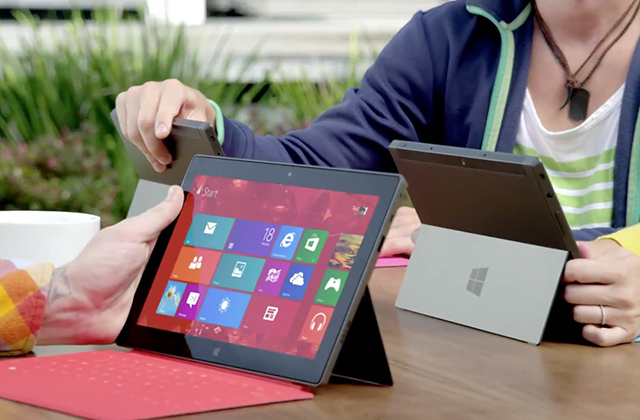
Microsoft launched a massive marketing campaign in October around Windows 8, Surface, and the Windows Phone. Since then consumers seem to be saturated with Microsoft advertisement with television, print, transit, billboards, online, and event sponsorships (O’Reilly, 2012). According to Forbes, Microsoft’s global marketing campaign around Windows 8 is estimated to cost $1.5 to $1.8 Billion (Einstein, 2012). The campaign has been a breath of fresh air for Microsoft with its use of upbeat music, vibrant colors, creative placement, and hot celebrities.
 During this same timeline Microsoft has promoted Bing, the Microsoft search engine and rival to Google. In hopes to enlighten internet search users, Microsoft launched “Scroogled” a blatant attack against Google and their results criteria. These ads have a far different feel from the fun “Windows Reimagined” campaign that seemingly surrounds us. As I drove from San Francisco to Mountain View this week I encountered a “Scroogled” ad on a digital billboard while passing through Palo Alto. With the bright red flashing text and negative tone I couldn’t help but feel slightly negative towards Microsoft. Maybe it was the abrasive flashing while I was driving or the obvious attack strategy on another tech company, something didn’t sit right.
This week Microsoft also launched Outlook.com and revived the anti-Google campaign with new messaging again Gmail. Microsoft has taken a slightly less abrasive approach with their Valentines cartoon commercial but the political like strategy is still present.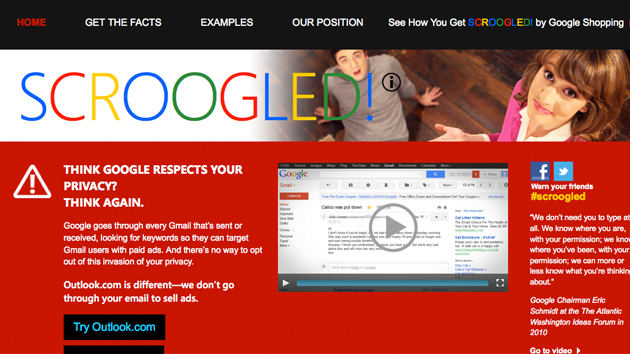
Scroogled TV Commercials
“Negative ads, as much as politicians might decry them, can have a devastating effect when deployed in a tight race, like last year’s Iowa Republican primary. Perhaps with this in mind, Microsoft hired ex-Clintonite Mark Penn, who pioneered the practice of micro-targeting ads based on consumer behavior, to work his black magic on Google. Penn, however, seems to not have recognized that there are some fundamental differences between consumer product battles and political campaigns, and mistaking one for the other can render them almost completely ineffective” (Depillis, 2013).
Microsoft has a great things going with the strategy and direction of their “Windows Reimagined” campaign. It’s debatable whether the Google attack marketing will convert users and generate loyalty to Microsoft products. I can’t help but feel this is not a great move for their integrated strategy or a direction I’d support for tech marketing.
-Erin Spaulding, 514 (A) Integrated Marketing, USC Annenberg
(*Posted with Sheila’s account)
Einstein, D. (2012, October 11). Microsoft betting big on cloud with windows 8 and tablets. Forbes. Retrieved from http://www.forbes.com/sites/netapp/2012/10/11/windows-8-release-date-tablet-microsoft-cloud/
Depillis, L. (2013, February 15). Microsoft’s Mark Penn mistake the tech giant is treating Google like a political rival. New Republic. Retrieved from http://www.newrepublic.com/article/112421/microsofts-scroogle-ads-and-mark-penn
O’Reilly, L. (2012, October 24). Microsoft unveils global windows 8 campaign. Marketing Week. Retrieved from http://www.marketingweek.co.uk/news/microsoft-unveils-global-windows-8-campaign/4004443.article