Does your brand “¿Habla Español?” It should!

By now, you many have heard the news… the Hispanic population in the U.S. is growing at an incredible rate. According to the U.S. Census, Hispanics represent 56% of the population growth since the year 2000. At 52 million strong, this is a target no marketer should ignore; yet many do. Why? Because many believe that investing in Hispanic advertising will not be a positive ROI.

Some marketers think that since Hispanics live in the U.S, and since many have lived here for a long time, they most likely speak English and therefore do not watch Spanish language TV. But with a $1.2 Trillion spending power, nothing could be farther from the truth. In fact, about 85% of Hispanics ages 18 – 34  chose to speak Spanish, even if they know how to speak English.

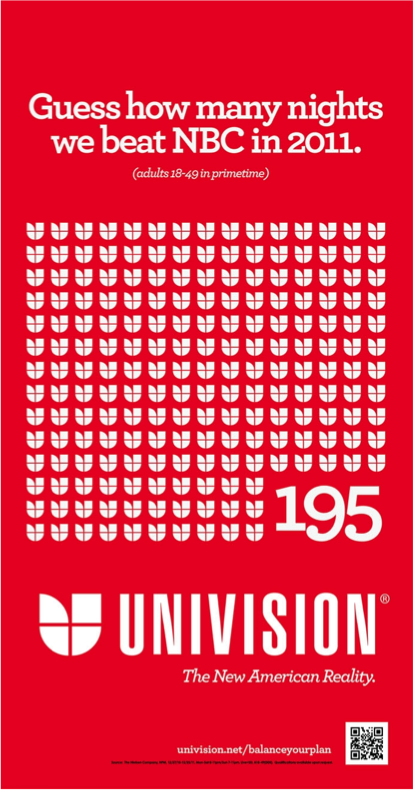
The numbers speak for themselves. Did you know that in 2011 Univision, the top Spanish language television network beat NBC’s Primetime 195 nights? Did you know that in major markets like Los Angeles, the most watched news channel is Spanish language news? Hispanics are tuning in, and they are tuning in, in Spanish. They are also Tweeting, chatting, catching up with friends and family on FB, and becoming one of the most techie groups out there, in many cases over-indexing non-Hispanics.

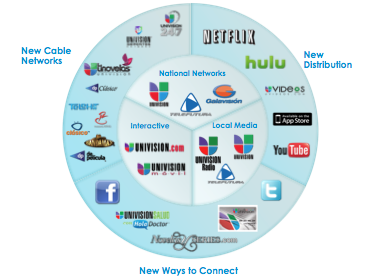
To keep up with them, Univision has expanded the way they connect with this valuable consumer segment. From HULU to Facebook, from Mobile, Apps to Online, no opportunity has been overlooked.

So to those marketers that still approach the Hispanic market as a “niche” opportunity, it’s time to wake up and smell the true potential it can bring. It’s time to say “¡Hola!”

Source: Univision. net; U.S. Census 2010; The Nielsen Company. 2012 Television Universe Estimates. Based on Language Spoken by the Person (Hispanic Adults 18-34), U.S. Image source: Getty Image RF

Posted in Uncategorized | 9 Comments

League Seeks Everyone for LTR (or, The Greatest Funeral I’ve Ever Seen)

Well, the schedule announcement is out, so the countdown can begin. On Friday, July 27, the Pittsburgh Steelers will report to preseason training camp at St. Vincent’s College for the 47th consecutive summer, meaning the annual fan pilgrimage to camp began way back in 1965. (Of course, that’s nothing compared to the tenure of the team ownership—the franchise has been in the same family since the Great Depression.) As fans, we love this kind of continuity. It helps define or, perhaps more accurately, excuse the depths of our passion. “Of course we’re going to Latrobe! It’s tradition. It’s the Steelers Way.”

But, has it always been that way? Where did this association with the Steelers brand originate? After all, despite the sense of consistency, like the “good old days,” attached to the franchise, just about everything about the sport has changed since Steeler Nation was born. Consider: When my parents were growing up in the still-Steel City of Pittsburgh, they couldn’t even watch the games on TV—it was considered bad for ticket sales. That seems downright quaint when compared to the $300 I eagerly spend each year on DirecTV’s Sunday Ticket because: (1) I live in New Jersey, (2) ticket prices average a few hundred dollars more than their face value, and (3) the waiting list to become an actual season ticket holder has grown to be about 30 years long.

Aside from the Steelers specifically, the entire National Football League has experienced exponential growth in popularity and profits. In terms of professional sports, the league competes with no one to be America’s Pastime. In fact, the NFL represents 64% of the 50 most valuable sports franchises in the world. (I calculated that by dividing 32—the total number of NFL teams—by 50. Every single NFL team appears somewhere on the list.) Gone are leather skull caps, rugby-style passing and Unitas’ Baltimore Colts. Welcome to 2012, where the NFL is a multi-billion dollar enterprise with a tightly controlled, spit-shined image. (As much as I love football, the league can teeter into Big Brother territory. I recommend reading about the head trauma controversy to see what I mean.) In short, the NFL has become a hugely powerful (cultural, financial, all-around) force.

Not to overstate my own importance, but the growth of the NFL and their resulting ownership of fandom in America is thanks to fans like me. The marketing efforts of not only the NFL but of their many and deep—pocketed sponsors (see, for example, VISA and Bud Light) are a thing of beauty in terms of integrated marketing communication. The league managed to take a mere sporting event, build a bigger consumer base, work in just about every medium known to man, and essentially offer long-term relationship status to anyone interested in any aspect of the game, even if they don’t know it at first: Not an NFL fan? No worries; just come to my Super Bowl Party. Oh, you don’t like the game? Well, watch the commercials and the halftime show. We’re rooting for the Saints. They’re wearing black. See? We wear these jerseys every week. Our beer cans and koozies match. In fact, you should see the NFL Shop. I buy hundreds of dollars in merch… Who’s that guy? It’s Drew Brees. Oh, you think he’s cute? He does a lot to help New Orleans. You should follow him on Twitter.  I’ll buy you a pink #9 jersey for next season. Cool, now you’re a fan, too. Stop by on Sundays next Sunday.

It is in this relationship building that the NFL has proved most successful. Not because they offer a continuous stream of marketing messages or provide people with weekend entertainment akin to gladiator fighting, but because they offer people the feeling of belonging and pride and nostalgia. We fans care not that those warm and fuzzies for the bygone era are largely manufactured by the current era. We don’t mind coming across as fanatical or cultish in this one aspect of life. We will continue to purchase branded items we don’t need because, really, can you own too much merchandise when it’s your team? Well, yes… you can, just not if you want to enter the afterlife in style!

Rest in Peace, Steeler Fan
Photo credit: Snopes.com

So, I’m curious:  Are you a fan? What do you think about the NFL’s integrated communication strategies? Do you get those pleasant feelings, or do you think they and we have gone a little overboard? Let’s discuss. Disregard the yellow towel I’ll be swinging around your head.

References:

Arthur, L. (2011, October 20). Can Bud Light score with its 2011 NFL season multi-platform campaign? [Web log post]. Retrieved from http://lisaarthur.wordpress.com/2011/10/20/can-bud-light-score-with-its-2011-nfl-season-multi-platform-campaign/

Associated Press. (2005, July 6). Family has unique viewing at funeral home. ESPN. Retrieved from http://sports.espn.go.com/nfl/news/story?id=2101713

Badenhausen, K. (2011, September 7). The NFL’s most valuable teams. Forbes. Retrieved from http://www.forbes.com/sites/kurtbadenhausen/2011/09/07/the-nfls-most-valuable-teams/

Kitchen, P. J. and Burgmann, I. (2010). Integrated marketing communication. In J. N. Sheth and N. K. Malhotra (Ed.), Wiley International Encyclopedia of Marketing. Hoboken, NJ: John Wiley & Sons, Ltd.

Labriola, B. (2012, June 17). Camp practice schedule announced. Steelers Digest. Retrieved from http://www.steelers.com/news/article-1/Camp-practice-schedule-announced/bb2dec5c-c132-4970-bca4-e362bcab7ec8

Laskas, J. M. (2009, October). Game brain. GQ. Retrieved from http://www.gq.com/sports/profiles/200909/nfl-players-brain-dementia-study-memory-concussions

Panter, N. (n.d.) Go Fans NFL integrated marketing campaign. Retrieved from http://corporate.visa.com/_media/go-fans-nflcampaign-fact-sheet.pdf

Posted in Uncategorized | Tagged , , , , | 2 Comments

A Curious Catch-22 for TV fans

by Aaron Schmidt

A recent trend in broadband cable, called Over the Top (OTT) viewing allows users to access and stream high quality video to their TVs without going through a multichannel video program distributors, or MVPDs such as Time Warner, Cox, AT&T, etc. The most popular options for OTT viewing are streaming services such as Netflix and Hulu, or using internet-connected TVs to view streaming videos from websites (legally or otherwise).  This is creating a problem for advertisers and cable companies, and will eventually cause a huge problem for TV fans.

OTT is seen as a threat to the MVPDs, who rely on subscription fees in order to maintain their feeds and provide content. The MVPDs in turn pay some of those subscription fees to the content providers in terms of licensing and share ad revenue. This arrangement creates a paradox for the OTT trend- that OTT users are taking money away from the budgets from the content they are watching. Right now, viewers are becoming so used to watching things on demand, that they are actively seeking out ways of watching TV whenever they want and for free, without wondering how the shows get their budgets in the first place.  

Currently, Netflix and Hulu have large viewer and subscriber bases that enable them to pay the licensing fees and provide on demand media at MVPD quality and speed. Users are increasing relying on these services, resulting in a phenomenon called ‘cutting the cord’ where homes go without a traditional MVPD connection. As stated before, this could lower advertising dollars and in turn budgets for the high-production value shows that attract viewers to Netflix and Hulu in the first place – which may necessitate the need for those services to produce original programming to make up for any loss in licensed content. And, in another paradox, this reliance on lower-quality original programming may cause a loss of subscriptions.

Basically, there is not enough money, and no good revenue plans in place, for content producers to embrace OTT over traditional MVPD. The real challenge will be finding a way to provide VOD through OTT that will make the customer, provider and producer happy. Right now, the system makes only the customer happy, but eventually, there won’t be any content to be happy about.

Is there a way to make all of the parties happy? Or will TV viewers need to cave to the need for advertising dollars to fund their shows?  If OTT wins out, how will advertisers reach audiences, and how will shows pay for their production budgets? No one seems to have any answers yet…

Posted in Uncategorized | 4 Comments

Bacon Craze in Full Effect

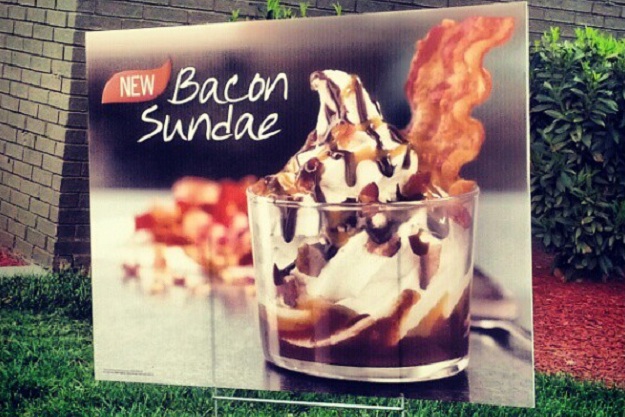
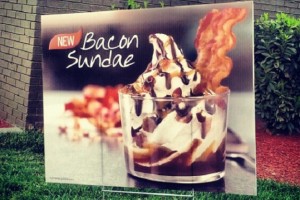
Taking bacon to a whole new level! Enjoy a delicious bacon sundae from Burger King! Hurry, as this item is only available until the end of summer!
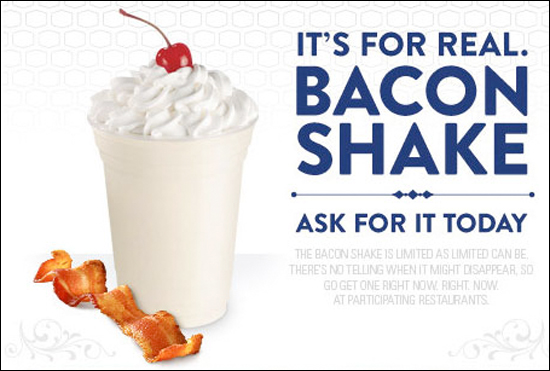
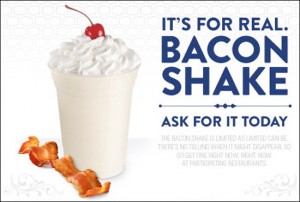
Looking for something with extra calories? Why not try the savory bacon milkshake from Jack in the Box for a limited time only?
Who is anxious to try one of these tasty treats? Or, who feels that adding bacon to a beverage and dessert item is a bit extreme? It is the battle of the bacon craze between two fast food giants, Burger King and Jack in the Box!

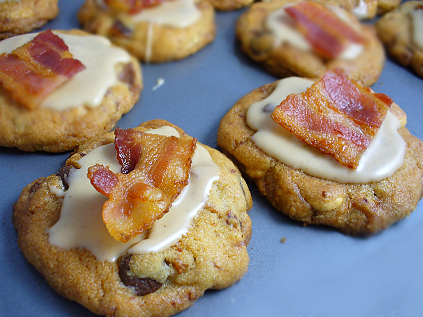
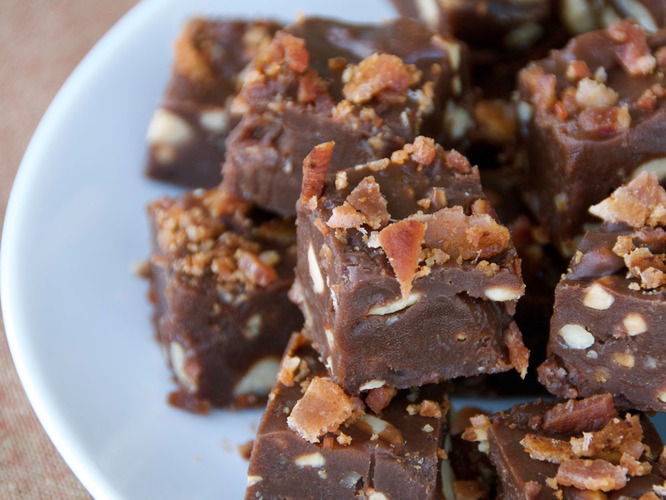
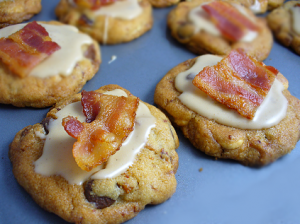
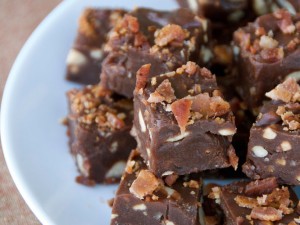
An idea that is simple and unexpected can be one of the most effective ways to attract a new audience or engage current customers (Heath & Heath, 1997). What are the reasons behind the bacon craze? The concept is simple; add bacon to an item already on the menu and market the creation as a new invention. The concept is unexpected; or is it? It is not uncommon to hear about bacon as an “ingredient of choice” for cookies, brownies, and other sugary foods.
Why the sudden interest in advertising a food that exceeds the daily caloric intake (or close to it), when both fast food chains have made a valiant effort to add healthy items to their menu? Maybe offering unhealthy and unique foods will increase profits more than nutritional products. However, do customers go to fast food chains for healthy food? Regardless of the reasons for joining the bacon craze, Burger King and Jack in the Box have successfully grabbed people’s attention!

In an effort to revive its menu, Burger King launched a series of healthy items earlier this year to target a broader audience (Associated Press, 2012). It has continued to change things up by rolling out its summer menu, which features mouthwatering barbeque items and, you guessed it; the bacon sundae! Just what is a bacon sundae? “The bacon sundae will come with soft-serve ice cream, fudge, caramel and a piece of bacon.” (HSU, 2012). Will this sundae be able to compete with the bacon milkshake from Jack in the Box?

Jack in the Box has introduced a “1,081-calorie bacon milkshake” – “made with no actual bacon, just real vanilla ice cream, bacon-flavored syrup, whipped topping and a maraschino cherry.” (Stein, 2012). Customers have the option of purchasing a 16 ounce milkshake with fewer calories if a 24 ounce shake is too much to handle. Do not be surprised if your local Jack in the Box is not advertising the bacon milkshake on its menu. As part of the “Love Bacon? Marry It” campaign, the milkshake is a “secret item” that can be requested for a limited time (Kindelan, 2012).

For all you bacon connoisseurs out there, what are your thoughts; bacon sundae or bacon milkshake? Customers who have indulged in these creations, what is your opinion? Is the bacon craze here to stay?

Sources

Associated Press. (2012, June 12). Burger King bets on bacon sundae for summertime. Businessweek.
Retrieved June 15, 2012, from http://www.businessweek.com/ap/2012-06/D9VBOOK04.htm

Heath, C., & Heath, D. (1997). Made to stick: Why some ideas survive and others die. New York, NY: Random House.

Hsu, T. (2012, June 12). Bacon sundae and sweet potato fries at Burger King? Los Angeles Times. Retrieved June 15, 2012, from
http://www.latimes.com/business/money/la-fi-mo-bacon-sundae-sweet-potato-fries-burger-king-20120612,0,7340641.story

Kindelan, K. (2012, February 7). Jack in the Box debuts bacon milkshake. ABC News.
Retrieved June 15, 2012, from http://abcnews.go.com/blogs/lifestyle/2012/02/jack-in-the-box-debuts-bacon-milkshake/

Stein, J. (2012, February 8). Are you ready for the 1,081-calorie bacon milkshake? Los Angeles Times. Retrieved June 15, 2012, from
http://articles.latimes.com/2012/feb/08/news/la-heb-bacon-milkshake-jack-in-the-box-20120208

Burger King – Bacon Sundae image: http://firewireblog.com/2012/04/11/burger-king-testing-bacon-sundaes/
Jack in the Box – Bacon Milkshake image: http://www.bestweekever.tv/2012-02-03/want-jack-in-the-box-bacon-milkshake/
Bacon cookies image: http://www.sogoodblog.com/2007/12/29/can-i-add-bacon-to-my-dessert/
Bacon fudge image: http://www.savvyhousekeeping.com/bacon-desserts/


Posted in Uncategorized | 17 Comments

The End of Administrative Assistants

A few days ago my boss came up to me and said, “I’ve got the iPhone 4s to help you!”  My first thought was why is this 69-year-old Irish man with no technology comfort level upgrading to the most technologically advanced phone on the market?  He furthered stated that “he” wouldn’t help me out, but “Siri” would help me do my job.  I looked at my boss and asked if I should be concerned about job security?

My boss chuckled and then asked me how to turn on his new phone, as we both laughed, I quickly began thinking about the impacts of voice recognition software and my position.  Voice recognition software is not new, but the advancement in the technology in the last several years is remarkable.  Currently, there are several very popular voice recognition programs on the market.  These programs include Dragon Speak, Windows Speech Recognition software, iListen, ViaVoice, and a handful of others.  As this technology has changed, it is also shaping how new products are being marketed to consumers.

Current voice recognition software is broken into two categories, small-vocabulary and large-vocabulary.  (Senecal, 2011).  Large-scale vocabulary recognition allows for computers to process items on a larger scale, such as writing papers, or specific voice recognition for fields such as legal or medical.  (Senecal, 2011).  While small-vocabulary programs are targeted for telephone banking or prescription refills.

For consumers, this technology is becoming more affordable and mobile.  For example, the geniuses at Apple have developed Siri, a voice activated module on the iPhone 4s.  With the touch of a button you can ask Siri to get you directions, reply to emails or just have a digital person to talk to.  Siri is smart enough to discuss deep questions, such as what’s for lunch, or the meaning of life.  (Apple, 2012).  When Siri first came out, the buzz was quite amazing, as many people flocked to Apple stores to see samples as well as test out this new technology.  With the popularity of Siri, it is only a matter of time before newer and more advanced technology on voice activation will come out.

Video retrieved from Apple home page

The future of voice activation could include computers understanding the meaning behind the words/voice (Grabianowski, 2011).  This would mean that computers could talk back and make complete sense.  It is estimated that at the rate technology is advancing, it could be about 25 years before this is ready for market.  With this on the horizon, the question then becomes; how do technology based companies develop these tools and begin marketing to consumers now?

With the popularity of Siri, consumers and telephone companies have made it clear that they will pay the $800 dollars per phone to get this technology.  While Siri is fun to play with and can be very useful for the executive or professional on the go, there is plenty of time to develop strategies to lure in those who are not currently comfortable with technology and prepare them for what may becoming.

My conversation with my boss may be a 25-year warning for the elimination of my job, as a voice recognition robot could easily make me look incompetent!  The lesson here is to learn from my boss’ personality.  He is a genius, world-renowned surgeon and oncologist, but can’t type or send an email if his life depended upon it.  Yet with all of his challenges and phobias towards technology, he still managed to want a device that had Siri.  While Apple is arguably the premier product with mobile voice recognition, as communicators and marketers, we should be jumping on the opportunity to develop plans to lure in new consumers and convert those who do not know they NEED voice recognition software.  This technology is a blue ocean in the making.  So I may be in a position that a robot with smart voice recognition can replace in 2 and a half decades, but I also can see an opportunity to be part of a strategic plan to gain a market share in undeveloped technology.

References:

(2012). Apple home page.  Retrieved from http://www.apple.com/iphone/features/siri.html

Grabianowski, E. (2011). How Speech Recognition Works. How Stuff Works. Retrieved from http://electronics.howstuffworks.com/gadgets/high-tech-gadgets/speech-recognition4.htm

Senecal, J. (2012) The future of speech recognition. How Stuff Works. Retrieved from http://electronics.howstuffworks.com/gadgets/high-tech-gadgets/speech-recognition4.htm

Posted in Uncategorized | 4 Comments

Online Dating Receives A Facelift With Hinge

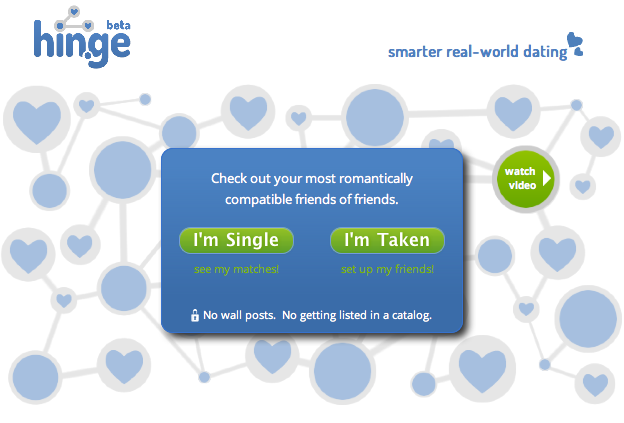
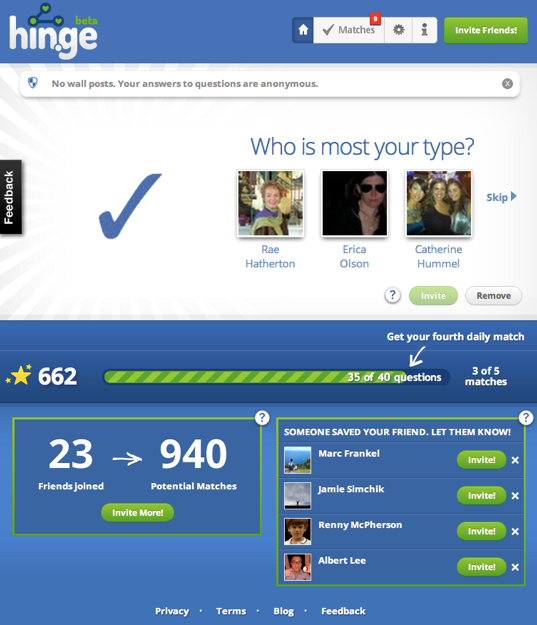
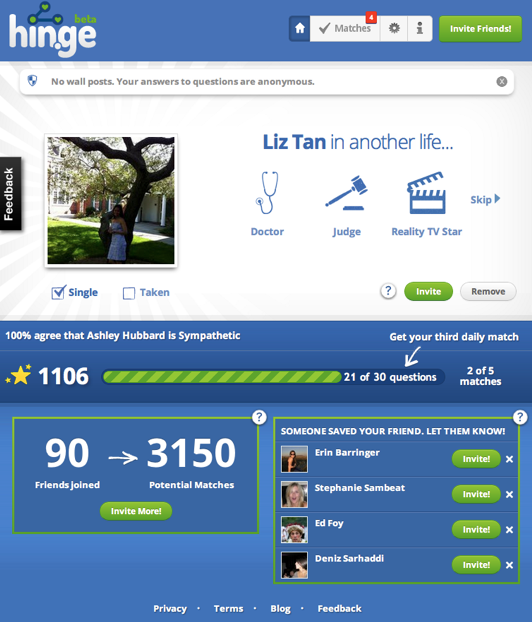
Hinge, or Hin.ge, is a Facebook app that uses a social graph to forever change how one views and uses “online dating.” Similar to other Facebook apps, Hinge uses friend-of-friend recommendations to create “smarter real-world dating.” Moreover, users can rate and answer questions about friends they already know, so the organization learns one’s tendencies. This organization is less than one month old and can ultimately change online dating.

Today, online dating organizations use algorithms to match people together. It seems complicated at first, but the numbers do not lie. The online dating industry is a $2.1 billion business in the United States (Market Research, 2012). The industry is believed to grow less than 10% this year due to an over-saturation of close to 2,000 online dating services (Market Research, 2012). Competition is fierce and the chances for an organization to succeed is scarce, so how do you attract consumers to your service? You establish a digital space on a digital platform where prospective users already congregate, Facebook. Facebook is a proven breeding ground for organizations to make traction. Facebook also delivers specifics analytics that makes it easier for organizations to view demographics. Facebook also allows for word of mouth marketing to take place.

Word of mouth marketing is a form of viral marketing once it hits the web. In other words, viral marketing “just replicates, again and again with geometrically increasing power, doubling with each iteration” (Wilson, 2005, p. 1). Viral marketing works because friends have similar interests. Due to viral marketing, organizations have been able to reevaluate traditional marketing protocol and enhance consumer attraction and interaction (Penenberg, 2009). Viral marketing attracts consumers in a number of ways. Tools used to boost viral marketing include, but are not limited to, Facebook, Twitter, and YouTube (Penenberg, 2009). However, Facebook has more than 750 million users. Wouldn’t you choose Facebook too? A consumer’s network of friends does the marketing of PR firm.

Organizations have come to realize that their target consumers are online and that is more of an incentive to participate in viral marketing. Everyday, 172 million different people spend time on Facebook (Spector, 2012). Those visits to Facebook equate to 4.7 billion minutes on Facebook daily (Spector, 2012).

A network of friends can spawn interest in a product or service by simply clicking “Like” on Facebook. Hitting “Like” can send a social ripple throughout the internet to friends of your friends and so forth. Online dating can improve with the help of Facebook. As Hinge utilizes Facebook’s capabilities and social graph, it can only grow. Hinge does not congest your personal page with postings or subscribe you to annoying listservs. Hinge has narrowed the exhaustive survey approach to finding a partner by opening it up to the people who know you best – your friends.

After all, your friends do know you best, so why shouldn’t someone in their social network fit into your social scheme. Additionally, the dating app is for everyone. Hinge increases its reach exponentially by allowing “taken” individuals to sign up.

What do you think? Will Facebook dating take off? Please leave a comment on your way out.

References

Market Research. (2012, January 1). The U.S. Dating Services Market. Retrieved from http://www.marketresearch.com/Marketdata-Enterprises-Inc-v416/Dating-Services-6773764/

Penenberg, A. L. (2009). Viral Loop: From Facebook to Twitter, how today’s
smartest businesses grow themselves. New York, NY: Hyperion Books.

Spector, D. (2012, March 5). Everything that happens in one day on the Internet.
Business Insider. Retrieved from
http://www.businessinsider.com/everything-that-happens-in-one-day-on-the-internet-20123?utm_source=feedburner&utm_medium=feed&utm_campaign =Feed:+typepad/alleyinsider/silicon_alley_insider+(Silicon+Alley+Insider

Wilson, R. F. (2005). The six simple principles of viral marketing. Web Marketing
Today, 1-2.

Posted in Uncategorized | Tagged , , , , , , , , , | 2 Comments

Facebook in the Fast lane? Or: Keep your eyes on the road, oh wait did she just unfriend me?

Facebook in the Fast lane? Or:

Keep your eyes on the road, oh wait did she just unfriend me?

As if texting and mobile phone calls weren’t distracting enough for drivers on the road, buckle your seat belts – we could be in for whole new way for people to be horrible drivers. Social media may be coming soon to a dashboard near you.

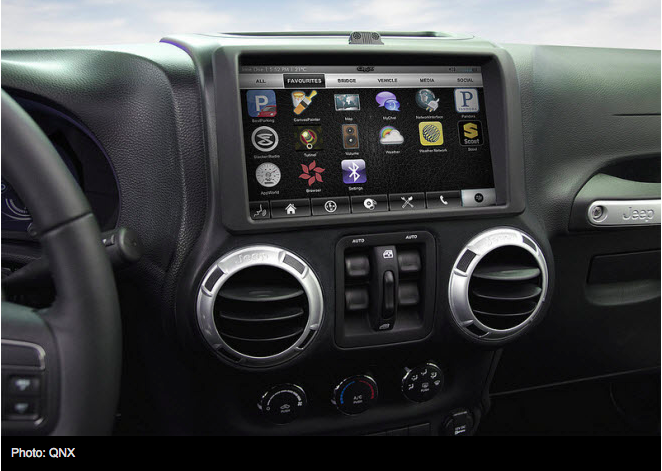
Telematics is a term that refers to the various telecommunication functions used in conjunction with automobiles. Telematics could include services like On-Star and accessing the web from your car or any other type of automotive infotainment. At a recent trade show for the Telematics industry in Detroit, the show began with the announcement that drivers do not need social media in their cars. Then the rest of the convention proceeded to show how many carmakers are taking strides to offer social media options in cars.

Photo: QNX

Photo retrieved from: http://www.wired.com/autopia/2012/06/telematics-detroit-2012/

Apparently loud music and a flashy video screen are not distracting enough, now the car needs to ask teen drivers if they want to share their song on Facebook. It doesn’t matter, they won’t hear it anyways – they will already be talking on the phone.

The link following shows how one of the Telematics companies, QNX, has a new a car system that supports HTML5 which will allow car systems to download applications much like an iPhone or Droid. One feature shows the console asking the driver if he wants to share the song he just played on Facebook.

http://bcove.me/ykkbu21

Another example of the potential changes or opportunities Telematics may provide is shown, by looking at a recent patent filed by On-Star. In the movie Minority Report, the digital billboard advertisements were custom tailored to consumers and followed them as they walked through train stations and malls. On-Star Telematics would allow billboards to access your personal data while you are driving to ensure that the upcoming marketing would be suited just for you. Does that weird you out? Wait there’s more. A recent article in Wired magazine by Keith Barry pointed out that On-Star could potentially use “in-vehicle cameras to determine unspecified demographics of vehicle occupants. Even power seat positions could be used to estimate the age of a driver.” The technology in your car could tell you advertisers everything about you.

Is this new technology going to be an advertising dream come true or a public safety nightmare? U.S. Transportation Secretary Ray LaHood recently released a “Blueprint for Ending Distracted Driving”. The plan goals follow:

Encourages the remaining 11 states without distracted driving laws to enact and enforce this critical legislation.

Challenges the auto industry to adopt new and future guidelines for technology to reduce the potential for distraction on devices built or brought into vehicles.

Partners with driver education professionals to incorporate new curriculum materials to educate novice drivers of driver distraction and its consequences.

Data from the National Highway Traffic Safety Administration (NHTSA) show drivers under the age of 25 are two to three times more likely than older drivers to send text messages or emails while driving.

Provides all stakeholders with actions they can take that go beyond personal responsibility to helping end distracted driving nationwide.

http://www.distraction.gov/content/press-release/2012/06-7.html

This technology raises a lot of interesting questions for drivers, consumers, advertisers, parents, the government, and people concerned with privacy issues. Much more study is needed to examine this rapidly advancing industry – hopefully it won’t be done while researchers are driving.
http://www.wired.com/autopia/tag/telematics/
http://www.wired.com/autopia/2012/06/telematics-detroit-2012/

Posted in Uncategorized | 5 Comments

Let Your Voice be Heard – The Importance of Word-of-Mouth Marketing

“Where should we go for dinner?” This is always a dreaded question in my household. My family has never been one that is up on the new trendy places or familiar with places that are getting rave reviews from critics. Lucky for us, we can now turn to social media for plenty of suggestions. More and more social media has become a platform for individuals to voice their support, enjoyment, gratification, or dissatisfaction for a product, service, or event. With all of this word-of-mouth publicity, smart businesses are starting to take note.

Yelp Home Page

Screen Shot of Yelp.com/Santa Monica

Yelp is currently atop the list of websites that allow customers to search for local businesses and review their experiences. This is a great example of word-of-mouth marketing. Word-of-mouth marketing is a great way for businesses to advertise without breaking the bank. But with sites like Yelp, that basically allow any user to become a critic, businesses also have to be sure that customers have an all-around pleasant experience. Otherwise, there are negative consequences that have to be dealt with.

In a recent blog at http://wordofmouth.org/tag/yelp Kevin Lee explains how businesses should work with these online reviews. In three seemingly simple rules, Lee gives valuable advice for the best results with user review sites such as Yelp. In a nutshell, he advices businesses to never write fake reviews as a way of marketing, to never respond to negative reviews negatively, and to be sure and respond to the feedback that is given.

As a Yelp user myself, it is very easy to see how strong of a marketing tool this can be. Any time I am looking for a new restaurant, gym, hair salon, etc. I visit Yelp. I read the reviews to see if it is a business worth exploring. When there is negative review after negative review, I quickly move on. Obviously, those businesses are not yet aware of how word-of-mouth marketing can significantly influence customers.

Find us on Yelp Logo

On multiple occasions I have read negative reviews that were later retracted because the business reached out to the user and corrected whatever issue the user had. Those businesses are likely aware that Yelp can be a great way to bring in new business. There are also many organizations that proudly display the “look for us on Yelp” banners. It’s clear that these places are using word-of-mouth marketing to its full potential.

Resources:

http://www.yelp.com

http://wordofmouth.org/tag/yelp

http://bumslogic.files.wordpress.com/2011/07/yelp.jpg

Posted in Uncategorized | 7 Comments

Outside-the-Box

As I watched the much anticipated Manny Pacquiao vs. Tim Bradley Welterweight title match on Pay-Per-View last weekend, my brain was inundated with all the advertising and branding posted everywhere from the shorts of the fighters to the ring itself.  Many companies took advantage of the wide viewership of this fight to advertise their products and services on a global scale.  To specialized companies, this could serve as one of the biggest stages to introduce new products and build name recognition.  RYU (Respect Your Universe, Inc.), for example, decided to sponsor Super Bantamweight Boxing Champion Teon Kennedy who was part of the undercard for the Pacquiao vs. Bradley fight.  RYU wanted to introduce their new men’s spring performance line including compression tops and hoodies, and their advertising prevalence at this major sporting event was intended to draw people to the brand’s website and stores in hopes that they would purchase the new products (www.marketwatch.com).

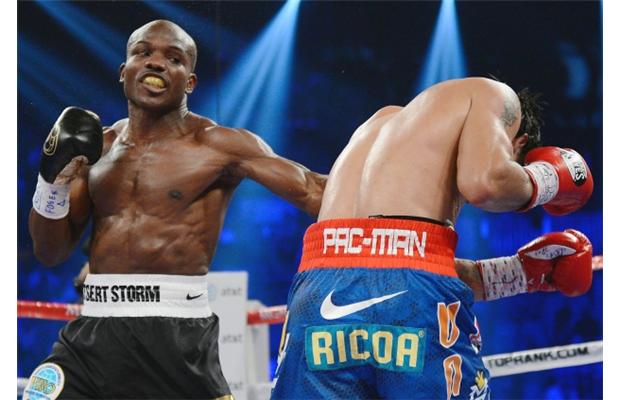
In addition to the advertising at lower levels during the event, Pacquiao proudly supported his sponsors such as Nike and Ricoa on his trunks during the bout to create ultimate exposure for those brands.  In fact, Pacquiao has used his celebrity to become a prime endorser for a variety of products and services throughout his career, even though he started in a rough position.

Pacquiao, 33, is a high school dropout who lifted his family out of poverty through boxing. In the 1990s, he fought for purses as small as 150 pesos ($3.50) — then about the cost of a T-shirt in the Philippines. Today he’s the richest Philippine congressman, surpassing Imelda Marcos, with a net worth inflated by TV appearances and endorsing products with the Nike, Hennessy Cognac and HP brands (Batino, 2012).

Photograph by: Kevork Djansezian, Getty Images

In fact, Nike created a revolutionary, state-of-the-art “wardrobe” for Pacquiao to wear during the fight, and this commitment to him as an endorser not only allowed him to fight at his very best, but it allowed Nike to showcase new products which they have been designing over the past few years.  Everything from the trunks to his T-shirt had a special purpose and was designed with him in mind.  The trunks, for example, were “MP Fight Night Trunks which featured technical fabrication at a light weight. With fabric made of 100% recycled polyester, using an average of 9 recycled plastic bottles, these trunks adhere to Nike’s commitment to serving the needs of the athlete and the planet at the same time.  Recycled polyester textiles, which can be made from used beverage bottles, have lower energy use, less raw materials extraction and less waste compared to traditional, virgin polyester fiber. At 18% lighter than ever before, just over 6 ounces total, the shorts are designed for zero distractions in the ring” (www.finchannel.com).  The T-shirt he wore was 100% organic cotton which was grown and harvested “without the use of synthetic chemical pesticides, fertilizers or defoliants” (www.finchannel.com).  These, in addition to the other innovative technologies Nike used for Pacquiao’s fight attire are likely the new era in boxing wardrobes, so it will be interesting to see if the product placement at this controversial and high-level boxing match proved successful for Nike as an advertiser and brand.

Pacquio’s massive success is a testament to his hard work and dedication, and it is no doubt that advertisers have capitalized on his successes to bring attention to their products and services over the years.  For last weekend’s fight, one would be hard pressed to look in one direction without seeing some sort of advertisement or endorsement, and this seems to be a bright move for those in the boxing world or closely related to it as a way to generate product exposure in an outside-the-box fashion without relying solely on commercials and billboards to supplement their campaigns.

Batino, C. (2012, June 10).  Controversial Pacquiao vs Bradley result angers boxing fans around the world. The Vancouver Sun. Retrieved on June 14, 2012 from http://www.vancouversun.com/business/Controversial+Pacquiao+Bradley+result+angers+boxing+fans+around+world/6759686/story.html

http://www.marketwatch.com/story/super-bantamweight-boxing-champion-teon-kennedy-to-represent-ryu-for-first-world-title-fight-at-mgm-grand-2012-06-07

http://finchannel.com/Main_News/Business/110434_Manny_Pacquiao_Teams_with_Nike_for_Upcoming_Showdown/

Posted in Uncategorized | 5 Comments

Being more Transparent might make your Business Invisible

Credit: RatbarSteward - Worth100.com

Of course the title is a joke, but the goal is to be more transparent with customers, right?  Well, what better way than to let your customers visit your entire location 24/7 from anywhere in the world.  No, I’m not talking about customers just visiting your website.  I’m talking about Google’s latest addition to Google Maps, called Google Business Photos.  This new program allows customers to visit your business, via virtual tour, similar to Google Street View in Google Maps, allowing the visitor to see everything.  They can look up, look down, move around, zoom in and zoom out. Thus, providing a tool for small businesses to knock down their walls of secrecy and be more transparent.

How it works

Google Business Photos is another tool for a small business marketer’s tool belt.  As a manager of a medical practice (that offers elective, aesthetic procedures), I try to keep up with the latest things in SEO, because it is a very inexpensive way to market my business.  I subscribe to various SEO blogs through RSS, so that I am up to date on the latest changes.  When I came across an article describing Google’s effort to make small businesses more visible in local markets using Business Photos as one method, I figured I had to seek out more information.  After selecting a Google Trusted Photographer, the following was produced for my business:


View Larger Map

Benefit to Businesses?

Well, besides being a really fun toy, this program helps to make any Google+ business page (formerly Places page) more dynamic with vivid content.  Google has opened the platform to allow you to embed a customized version into your website, which allows you to pick the size and starting point of the tour.  Also, from an SEO view, Google gives recognition to businesses that have been photographed through this program.

Now, I am not sure if this new feature will directly lead to an increase in sales; however, I plan on attempting to analyze organic Google clicks we get through Google Analytics, but it will be hard to differentiate if clicks were a direct result from visitors of the virtual tour.  If we get an uptick in clicks, without me making any other changes, then I will be happy.  I find this tool as a way to tell customers that we have nothing to hide and that we invite you to take a look around our facility.  It helps to support our branding, because we want our customers to see what we have to offer, compared to other medical aesthetic practices.

Limitations

Currently, there is a limit on the number of “panos” you can do for a single business location.  We maxed the limit with our 5,500 sq. ft. location.  Unfortunately, if we decide to make any renovations to our business, our virtual tour will remain the same, unless we pay to redo our whole tour.  Also, we run the risk of competitors looking into our entire facility, which can open the doors to imitation.  Of course, they can always “secret shop,” which we have experienced before, but this tour just makes it easier.

Looking forward

What’s next?  I think it would be safe to assume that Google might find a way for everything to connect seamlessly.  Just last week, Google converted all Google Places pages to their growing Google+ platform, which incorporates business information, reviews, photos, and now virtual tours into one location.  It seems that Google is gearing up to take on Facebook and Yelp at the same time.  These tools are important for small businesses, because many potential customers will “Yelp” a location prior to trying it.  Reviews and content play such an important role in convincing a potential customer to visit a location, because these are just a couple variables that they analyze prior to making their decision.

Interested in setting up Google Business Photos for your business?

First go to Google Business Photos.  The website will provide a list of Google Trusted Photographers.  These photographers do not actually work for Google, but have gone through a certification process in order to be allowed to photograph your business.  At the time when I started my search, there were nine photographers in Southern California; however, there are more listed now.  Of the nine I made contact with, I would have to recommend Carl Affable.  He stood out with his great customer service and excellent work with previous businesses.  Once you select a photographer and negotiate a price based on the size of the business, the photographer will take care of the rest.

Posted in Uncategorized | Tagged , , | 11 Comments