Technology and Gadgets do not = Communication

I admit that I often get sucked into the technophile sphere of influence, enticed by the latest tablet, cellphone, or social network. If you are a communicator, then you should naturally be interested in all of these things because they are the tools you use to communicate…but they are only the tools.

The field of Communication is so much more interesting than just the gadgets we currently use to communicate with. What seems to get lost amongst all the discussion of the latest electronics and communication platforms is the actual people we are supposed to be conversing with. Communicators are in the people business, and we should spend just as much time studying people as we do the communication tools.

So what do I mean? Here are some examples:

History: What better way to learn about the way people think and act than by looking to the past. I like to switch between the large, strategic views and the individual perspective of a situation. You get more out of a book if you understand who the author is and when the book was written. Was it in the moment of a major event? 30 years after? Was he or she an outside or an insider? The enormous amount of books to read on any given topic allows you to constantly switch perspectives in order to gain a better understanding of the way individuals think. This “selectivity, simultaneity, and the shifting of scale” by historians is talked about by John Lewis Gaddis in The Landscape of History.

Psychology: For this, I’m thinking more about the psychology of the individual. There are lots books on mass communication theories out there – how to communicate to large groups of people – but we should also be interested in how to understand and communicate with the individual. There are lots of self-help books about the relationship between Men and Women, but we should also dive into topics like negotiation, persuasion, and influence. If you are a corporate communicator and cannot effectively communicate to your boss, you are going to fail.

Culture: Think of culture beyond the local or national perspective. Granted, the United States is very diverse but it’s hard to understand the way people think, act or behave unless you have an idea of a persons cultural background. In lieu of spending large amounts of time in different areas of the world – although that is fun too – there are tons of books that can help expand ones thinking, Clifford Geertz’ The Interpretation of Culture and Richard Nisbett’s Geography of Thought are just a few.

Don’t get me wrong, I love gadgets too. They are the way we communicate in 2012, but it is not what we communicate.

Once you get beyond the medium, there is a whole other level of knowledge just waiting to be learned about individuals, small groups of people, and large groups of people in different locations with different backgrounds in different circumstances.

Matt Harding became famous for his Dancing Matt videos. He used technology and gadgets to coordinate and communicate with all the people who eventually wound up in his videos. What’s special about these videos is not the fact that he used a specific cell phone, posted the content to YouTube, or used Google Maps to pinpoint and coordinate the locations that he would be at for anyone to join him dancing.

What’s special about these videos is the communication and connections made between people.
Posted in Uncategorized | 1 Comment

Tablets Take a Shopping Trip

As I discussed in my last article on the blog, Making Marketing Mobile, companies have to ensure that their integrated marketing plans include concentration on the digital space.  More specifically, this focus will need to be targeted to mobile device channels to ensure that marketing messages are reaching customers where they work and play.  As more and more consumers use their tablet devices to access the Internet, any integrated marketing plan must include tablet-based tactics as a primary medium.

The iPad, Android-based tablets, and even the upcoming Microsoft Surface are all likely to continue to chip away purchase and usage shares from the traditional PC or iOS-based desktop markets.  Mobility, dynamic apps and ease-of-use are all attractive advantages that tablets have over desktops.  Consumers are modifying their purchasing behavior as the technology becomes more affordable and marketers continue to fully embrace this hardware channel.

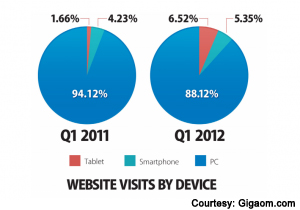
website visits by deviceMonetate, an online marketing technology company that provides analysis to many of the top e-commerce sites, analyzed close to 100 million online shopping sessions for the first quarter of 2012.  Their analysis showed that PC traffic to e-commerce sites significantly dropped by four percent.  Monetate predicts that the PC market share will dip below 75 percent over the next 12 months.

Tablets are even becoming a more direct competitor to smartphones.  The Monetate study showed that tablets are now trending ahead of smartphones in delivering the greatest amounts of traffic to e-commerce sites.  During the first quarter of 2012, tablet traffic outpaced smartphone traffic for the first time by almost one and a quarter percent. Of the tablet-based traffic, almost all of that traffic (95 percent), originated from an iPad.

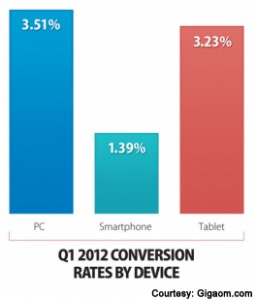
Kurt Heinemann, who serves as Monetate’s CMO, says these traffic pattern changes are conversion rates by devicelikely due to the fact that tablets “offer the best of both worlds, the portability of a smartphone but with a bigger UI that encourages shopping and browsing.”  Heinmann adds that he believes that tablets are on track to become one of the primary gateways onto the Internet for all online users.  The influence of a better user interface with tablets is becoming apparent with conversion rates once users land on an e-commerce site.  The Monetate report indicated that converted purchases on tablets are just a fraction of a percentage point behind those originating from PCs, and that tablet conversions should overtake those from PCs by 2014.


Online marketers are now beginning to understand that the tablet environment is vital to the continuing success of their overall e-commerce efforts.  Instead of a wide-brush approach, marketing teams for brands, products and services must more effectively focus on optimizing both the visual and transactional experiences for consumers.  The question is just how this process should be accomplished.

Many e-commerce sites are mobile-optimized.  That is, the sites are built to have a mobile component that is served to devices when the browser makes a server request from a mobile or tablet device.  While there are still limitations that exist with mobile and tablet browsers, improvements are being made continuously to make a user’s experience as much like that of a PC as possible.  There are now new Web browsers available from Firefox and Google Chrome that have been engineered specifically for both the iOS and Android operating systems that provide a more “full browser” experience.  Microsoft’s Surface tablet browser will be built on the Internet Explorer foundation.  Online marketing teams will need to work closely with their interactive development and design teams to continually improve and optimize all content to work more seamlessly in these new browser environments.

The New iPad

How do tablet apps fit into this equation?  That is a question that many companies are currently addressing.  Does a company simply rely on a tablet user to access an e-commerce site through the native or add-on browser?  Or do they invest the time and money to develop apps that are tailored to the tablet environment?

As we have seen, iPad apps from the App Store and Android apps from Google Play have vastly improved the user experience, as well as allowing marketers to take advantage of the hardware experience to create more dynamic and functional interactions.  Many companies have been very aggressive in the development of multi-platform apps that can engage a consumer and help encourage actual purchase conversions.

Other companies could be considered “stragglers” in that they have not made the time or resources commitment to develop robust applications to improve their own e-commerce processes. These types of companies are now playing catch-up to their competitors, and missing out on opportunities to build and grow their presence and influence in tablet experiences.  According to a Nielsen survey in early 2012, the amount of time Internet users spend with mobile iOS and Android apps is by far outweighing browser activity.  The top 50 apps consumed 58% of all U.S. total app time usage. Further analysis of the Nielsen study indicates that these trends will continue and the gap between apps and browsers will continue to widen.

From all the data examined, it appears that it would be an essential function of any integrated marketing plan to include a concentration on the tablet environment.  The studies indicate the trends towards tablet use as a primary online access tool will continue.  If your company is not up for the challenge, it would be advisable for your marketing teams to take a very hard look at the direction that your overall marketing missions is taking. Otherwise, you will find yourself on the wrong side of successful online marketing in a highly-competitive environment.

Posted in Uncategorized | Tagged , , , , , , , , , , , | 1 Comment

Is your head in the cloud? It should be.

http://www.digital-cameras-help.com/clouds.html?id=4

Long thought of as a sight, to tell daydreamers to comeback to by “getting your head out of the cloud” – advertising and marketing people may want to put their heads back in and have a look around.

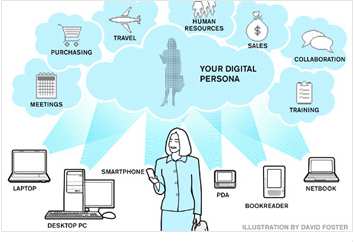
For our purposes, a cloud is a metaphorical off site data backup that stores personal data and information.  Cloud computing has been in the works for over a decade, yet there still so much information floating that it makes it hard for companies to decipher what it is (Ulander, 2012). One thing for sure is that cloud creates a seamless connection from all of your devices making all of your information accessible anywhere. It literally brings the whole world to your fingertips.

http://images.businessweek.com/ss/09/06/0604_cloud_computing/3.htm

The way people compute is evolving as technology advances and consumers are spending more time online. One popular trend is the use of cloud based computing within a company to streamline internal processes. For example, Avon recently launched an internal cloud based computing system in an effort “increase the sales and efficiency of Avon’s distribution system” (Hamm, 2012).  This system will be utilized by 150,000 sales representatives as well as accessible via smartphone and PC (Hamm, 2012). Not only does a system like this integrate the company’s system, it also is cost effective. I’d say that’s a win-win for any company.

http://www.zdnet.com/blog/apple/details-emerge-on-apples-icloud-strategy/10222

Another rising movement is the creation of personal clouds. Apple’s iCloud is a great example of how a company can capitalize off of creating personal clouds. Not only has Apple been able to generate direct revenue from storing their user’s content, they are also able to market other products within the cloud and create a more meaningful brand experience. They market their iCloud service with a simple emphasis that it is “automatic and effortless” (Apple, n.d.). Since the information stored is available everywhere you go, it encourages the use of more Apple products and a continual connection to the Apple brand.

Apple has maximized this new technology and brought its usefulness into reality as an excellent business solution. Now other major companies (for example, HP and IBM) are attempting to follow in their footsteps because they have realized that the cloud is changing everything.

Based on current theory, developing a cloud strategy is becoming a necessity to stay relevant in today’s market. Ulander’s (2012) advice is to learn “from others who have already built highly scalable, successful clouds that have helped them transform the way they deliver and consume IT resources”.  Because the cloud has endless interpretations and possibilities, each company has to come to an understanding of what the cloud shift means for them.

It’s hard for consumers and companies alike to know where to begin and to not to feel like their head is in the cloud in the information. This just goes to show more research is needed to fully understand the implications of this new technology and how it can be best utilized.

Apple. (n.d.). iCloud. Retrieved from http://www.apple.com/icloud/features/

Hamm, S. (2012). How cloud computing will change business.  Retrieved from http://www.businessweek.com/magazine/content/09_24/b4135042942270.htm?chan=magazine+channel_special+report

Ulander, P. (2012). Top 5 things the cloud is not. Retrieved from http://www.wired.com/cloudline/2012/06/top-5-things-the-cloud-is-not/

Posted in Uncategorized | 4 Comments

Give it a tap: NFC and the new era in digital marketing

You are not alone if you haven’t heard of Near Field Communications (NFC) technology or never realized that you’ve probably already used one form of it whether through a digital wallet, FastTrak pass to zip through a toll bridge, or paid for gas with an easy swipe. NFC uses RFID or a short length wireless radio frequency to send snippets of data to a receiver. Once touted by mobile device makers as the breakthrough technology for the mobile wallet system, it is now being leveraged by digital marketers to push content in very powerful and convenient ways.

Ultra-targeted mobile marketing coming soon
Source:www.gigaom.com

Here’s how it works: your mobile device contains an NFC chip that sends a wireless signal to a “tag” that has built in circuitry embedded with information, a website link for example. The tag is passive, meaning it doesn’t need power or be “on.” It is activated by your device’s identifiable wireless signal. Not only that, but it can be encased so that it is completely weather proof. Don’t fret, you can’t inadvertently activate a NFC tag that sends a Tweet to all your friends that you “checked-in” at Moe’s Tavern in the middle of the day. The user has to open the NFC app and be within 20 cm range. Some marketers have sold it as a “swipe” or a “pass.” But a steady consensus in the marketing industry is calling it a “tap.”

NFC at work
Source: www.quertime.com

Still in its early-adopter phase, NFC technology has been embraced by Google, Nokia, RIM, and rumors say that Apple will introduce the technology with the next version of the iPhone. Already, the latest Blackberry Bold and the Samsung Galaxy Nexus smartphones have NFC built in for consumers to use today. But it is not mainstream because the digital infrastructure is not built yet. Most businesses haven’t embraced or don’t even know how to use NFC technology for marketing purposes. And not enough consumers have devices with NFC built in, even though that will change very fast by 2015, when it is estimated that 500 million devices will contain the technology. But some savvy companies, with the help of new NFC digital marketing firms (yes, they’ve popped up already) are defining for the rest of us, how to take advantage of this technology.

Samsung NFC Marketing
Samsung to roll out 40,000 NFC bus shelter ads. Source: Cemusa

For example, Google offers a Google Places window sticker for business to have their customers “check-in,” read reviews, and perhaps get coupons. These NFC tags can be embedded on movie posters to provide users a movie trailer or on bus shelter ads to provide free music exclusively for users of the Samsung Galaxy SIII. In fact, Samsung plans on rolling out 50 NFC kiosks and 40,000 “smart” posters all over New York to coincide with the launch of the new Galaxy S III. NFC will also be built into business cards so that a simple tap by a phone will automatically call the recipient. T-shirts, cars, even money are in the horizon for NFC technology treatment.

Samsung Tectiles

Program your life with NFC Source:www.ubergizmo.com

Recently, Samsung announced that consumers will be able to buy NFC tags, called TecTiles, that are programmable. For instance, you can have a tag mounted near the front door of your house programmed to send you a text when your latchkey kids get home from school. As a small businesses owner, you can have the tags programmed to share your location with your customer’s network on Facebook with a scripted post (“I’m at Jennifer’s Flowers and I just got a free bouquet for being a loyal customer!”). The possibilities are endless.

Can you think of creative ways that NFC technology can be used for marketing campaigns?

Posted in Uncategorized | Tagged , , , , , , , | 7 Comments

Is The Marketing Profession Prepared For Flexible OLED (organic light-emitting diode) Technology.

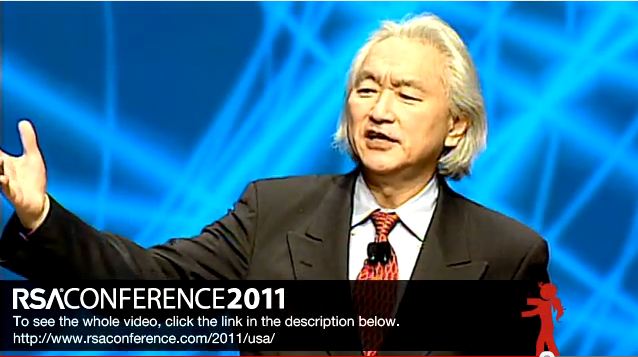
During the 2011 RSA conference keynote address, famed physicist and visionary, Dr. Michio Kaku, discussed the future of computers and the internet (RSA conference, 2011).  His speech is fascinating and his vision of biotechnology, robotics, and quantum physics could be game changers for humankind.  But the way he describes how flexible OLED technology may be used opens up a whole new world that marketing professionals may not be   (photo: youtube.com) prepared for.

OLED technology, a display technology that offers bright, colorful images with a wideviewing angle, low power, high contrast ratio and fast response time for sports and action movies, made its debut in small screens in the 1990’s (pcmag.com).  What makes the technology unique is it doesn’t require back lighting and the screens can be ultra-thin (pcmag.com).       (photo:Samsung)

Samsung announced they will be releasing the world’s first 55-inch organic light emitting OLED Smart television in late 2012 (Paracha, 2012).  This television won the Best of Innovation Award Honoree at CES 2012 for its fast response time resulting in less blurring, ability to view two channels on the same screen, and ear phones attached to 3D glasses (Paracha, 2012).  What does this mean for the future of marketing?

Samsung’s new Smart television is just the beginning of the OLED revolution.  As the new smart televisions get rolled out every year, they will get thinner and thinner.  And as the flexible OLED technology gets mastered, these televisions could become wallpaper in your living room.  This means  companies aren’t just rolling out smart televisions, but smart homes, (photo: Samsung.com) offices, department stores, libraries,                                               schools, and whatever else your                                                     imagination can think of.                                                                                                                                                                                                                                             The possibilities are limitless.  Imagine every wall; everywhere you walk contains an advertisement.  But the flexible OLED technology doesn’t stop there…

Scientists are working on getting this technology embedded in car windshields, storewindows, and mirrors (OLED-Info.com). And to top it off there are companies who are creating smart clothes with chips that can connect to all of these processors (Freudenrich, nd).  So the walls, glasses, and mirrors of advertisements will contain the things you and your friends have ‘liked’ on your Facebook page or added to your Amazon ‘wish list’.                                                                                                                                                                 (photo: techguy.org)

Did anyone see Minority Report?

Someday manufacturers could have 24 hour access to consumers everywhere they go. What may seem like science fiction could be a reality and computer engineers are working to make it a reality sooner than you think.  The byproduct of this evolution will be more information for consumers which will mean the consumer has the advantage and the manufacturers will have to be fiercely competitive.

(photo: hometheaterequipment.com)

Is the marketing profession ready for this?  If so much information is flashed at consumers all the time, how will marketing professionals make their products stand out?

References:

(1)  Definition of OLED. pcmag.com. Retrieved from http://www.pcmag.com/encyclopedia_term/0,1237,t=OLED&i=48357,00.asp

(2)  Freudenrich, C. (nd). How OLED works. howstuffworks.com. Retrieved from http://electronics.howstuffworks.com/oled4.htm

(3)  OLED technology explained. OLED-Info.com. Retrieved from http://www.oled-info.com/oled-technology

(4)  Paracha, U. (2012, May 10). World’s first OLED TV by Samsung will be available by the second half of this year. Technorati.com. Retrieved from http://technorati.com/technology/article/worlds-first-oled-tv-by-samsung/

(5) RSA conference. (2011, July 12). RSA Conference 2011 keynote-The next 20 yrs: Interacting with computers, telecom, & Ali in the. Retrieved from http://www.youtube.com/watch?v=Y6kmb16zSOY&feature=relmfu

Posted in Uncategorized | 4 Comments

Advertisers: Join The “Happy, Peppy People” in Social TV

For the past several years, it’s been hard to think of any television program that airs on broadcast or cable be referred to as “appointment television”  in the traditional sense…like when people cleared their calendar every Thursday for The Cosby Show.  Since the advent of the DVR, the rise and popularity of Hulu, iTunes episodes and networks airing their programs on their own websites, television viewing has become t.v. on demand.  Some argue that t.v. watching is dead.

The fact of the matter is, TV has benefited from internet use by television viewers…particularly around social media.  “TV has become an inflection point for social media and that promotes appointment viewing.  The interest to participate in the conversation on Facebook or Twitter drives you to want to watch live TV.”  This is according to PriceWaterhouse Coopers executive, Russell Sapienza (www.adweek.com, June, 2012). It is estimated that broadcast and cable network television will collectively claim $56 billion in advertising revenue by 2016(www.adweek.com, June, 2012).  While many viewers find that their favorite shows like Mad Men are on cable, still, broadcast is the medium to reach a large audience quickly, for many large national advertisers.  Taking a look at recent viewership of Mad Men vs NCIS, the AMC favorite attracted 2.7 million viewers, while 8.67 million tuned in to NCIS (www.adweek.com, June, 2012).

TV advertising has come a long way since Lucy shamelessly promoted “Vitameatavegamin

www.google.com/images

How exactly has the internet resuscitated television viewing, especially among teens… “Social TV.” USA Network is, in fact, planning to launch six “social TV” tie-ins, targeted to superfans (www.adweek, May, 2012). As part of their digital integration program, the network’s show, Covert Affairs will include a video-based, role-playing game generated in partnership with Capital One.  The secondary character, Augie, will get a richer backstory as a result and because this is being shot in Spain, the sponsor gets an exotic location in which to tout its services.  In Suits, Lexus will sponsor that show’s integration.  In this show, there is a game component that will allow viewers to join the show’s law firm in one of two capacities and Twitter/Facebook style social feed will be established enabling fans to talk to each other about the progress of the story(www.adweek, May, 2012).

Fans get proprietary info and in order to reach the end of the story, each user has to find a different character class to share their info.  Integrations of this type are much more complex than Lucy trying to convince viewers that Vitameatavegamin was “tasty too.”

Piper Perabo and Christopher Gorham of USA’s “Covert Affairs” | Photo: Christos Kalohoridis/USA Network

TVs Second Screen has networks scrambling

Like the t.v. signals of just a few years gone by that were scrambled and needed the proper cable box code and connection to be viewed, network execs are scrambling to develop “the next best thing” to entice viewers.  The internet and social media have irrevocably, changed the viewing experience of traditional TV (www.adweek, May, 2012).  NBC Universal recognize that the  “rules of engagement” have changed and is planning now for its second symposium on social TV slated for five months from now.  Their goal: to specifically identify how brands can benefit from  and be integrated into social TV.  Networks are beginning to realize that it is about engagement and devoted fans are their most important marketing assets.

www.google.com/images

References

AdWeek.  (2012).  ”USA to Launch 6 “Social TV’ Tie-ins Aimed at Superfans”.  Retrieved June 22, 2012 from: http://www.adweek.com/news/television/usa-launch-6-social-tv-tie-ins-aimed-superfans-140592

AdWeek.  (2012).  ”PwC Outlook: TV’s Growth Prospects Look Strong.”  Retrieved June 22, 2012 from: http://www.adweek.com/news/television/pwc-outlook-tv-s-growth-prospects-look-strong-141074

AdWeek.  (2012).  ”NBCU Gathers Who’s Who in Social TV.”  Retrieved June 22, 2012 from http://www.adweek.com/news/advertising-branding/nbcu-gathers-whos-who-social-tv-139314

www.google.com/images


Posted in Uncategorized | Tagged , , , , | 5 Comments

Don’t Get Left in the Dust by Gen Flux

They are fearless, they are tech savvy, they are not stuck in the past, and they are changing global communication. They are Generation Flux (Safian, 2012)!

Unlike Gen X and Gen Y members of Gen Flux can be any age, from any industry (Hughes, 2012).  Gen Fluxers are known for being successful and thriving in our relentlessly chaotic business world (Hughes, 2012). They are innovative and are considered pioneers (Grenningloh, 2012) because Gen Fluxers are changing our business frontiers by embracing change and reinventing themselves along with the ever-changing marketplace and new potentials of communication.

With the chaos and accelerated growth technology is experiencing, Integrated Marketing Communication (IMC) is no longer just an option!  If a business wants to stay alive, it must change with the times…and the times are changing daily! To some people, this is a frightening thought. To others, like the Gen Fluxers, it is exhilarating!

When it comes to marketing, what works today won’t work tomorrow (Morgan, 2011).  In fact, the social media you are using today may not be popular in a few years because newer and more exciting avenues of communication are continually popping up. Take for instance Mashable, (http://mashable.com/) founded by 26 year-old, Gen Fluxer, Pete Cashmore, when he was just 19 years old (Safian, 2012).  Mashable, Cashmore’s digital news site attracts more than 20 million unique hits per month and has more than 2 million Twitter followers (Safian, 2012).

Cashmore is part of a generation that knows change is inevitable and feels that businesses should embrace it (Safian, 2012).  Think ahead.  How will you market in eight years (Morgan, 2011)?  People love consistency in a brand.  If it stands for something and they feel they know, like, and trust the brand they will come, but you need to be able to reach them.  Peoples’ lives have changed so much because of technology.  Many work from home or are stuck behind a computer from the time they arrive at work until the time they head home—just to sit down at their computer again.

Just as old, established businesses have “structures and processes built for an industrial age” (Safian, 2012), many people are finding the transition to IMC difficult.  For some it is closed-mindedness, for some it is lack of computer skills, for others it is an IT department that is being resistant, and for others it is a question of time management.  But are those valid reasons to hold back your business’s growth?

There was a time when a small, quaint business was successful because people liked it.  Now, that same business can be in danger of becoming obsolete, or beat up online by disgruntled customers because it is not part of a social media network and cannot fend off those attacks.  Social Media interactions are instant, and I believe that Cashmore is being quite prophetic when he says, “You’re going to have businesses rise and fall faster than ever” (Safian, 2012).  I’ve seen it as people have resisted changes in marketing communications.

People like to relay their experiences to one another and they are quite vocal on Facebook. In my town, there are many active groups, discussing local politicians, events, businesses, and restaurants. I’ve noticed the popularity of businesses growing if the owners are computer savvy and can interact with their clients. Everyone in the world wants to connect with others but no one wants to be blasted with advertisements (Morgan, 2011) so that’s why personal interaction with your customers via online sources is so effective.

Another thing that makes business effective is passion, and passion is something Gen Fluxers do not lack.  They also do not hang onto the past as if it is the only hope for the future.  They are forward thinking and forward moving. They are not afraid of being fired or of trying new thngs (Safian, 2012), so this adds to the illusion of their power and mystique.  Cashmore says he doesn’t have any issues about throwing away the past, because if you don’t change, you give other people a chance to catch up to you (Safian, 2012).  Maybe that’s why he and so many of the Gen Fluxers are ahead of the pack, rising to success so rapidly. They embrace change and when you have no fear, it shows.  You don’t need to convince people when they can see your passion (Morgan, 2011).  If you haven’t already, it’s time to let go of your fear, embrace your passion and make some changes.  Don’t get left in the dust by Gen Flux.

Sources:

Grenningloh, N. (2012, January 22). What PR and Communications Practitioners Can Learn from Generation Flux. Retrieved from Grennimedia: http://www.grennimedia.com/2012/01/22/what-pr-and-communications-practitioners-can-learn-from-generation-flux/

Hughes, C. F. (2012, May 13). Secrets of Generation Flux. Retrieved from Talent Focus: http://www.charlottefhughes.com/leadership/secrets-of-generation-flux/

Morgan, J. (2011, November 17). Brand Against The Machine – An Interview With John Morgan. Retrieved from Bob Burg Author & Speaker: http://www.burg.com/2011/11/brand-against-the-machine-an-interview-with-john-morgan/

Safian, R. (2012, January 9). Generation Flux. Retrieved from Fast Company: http://www.fastcompany.com/magazine/162/generation-flux-beth-comstock

Image by C. Roufs

Posted in Uncategorized | Tagged , , , , , , | Comments Off on Don’t Get Left in the Dust by Gen Flux

Looking For the Next Best Deal? Click, Purchase and Shop For Less Using Groupon

Established in November 2008 as a publicity held company, Groupon’s goal was and still involves providing consumers with a one-stop location for online deals with massive discounts (Groupon). Available to consumers in more than 48 countries, Groupon offers companies the chance to market their company to people in an effort to gain awareness and introduce people to their services (Groupon). All one has to do is log onto www.groupon.com or if easier (and yes it is) use a smartphone with the Groupon app to see all of the daily and Groupon Now deals offered in their area for the designated amount of time.



As a daily (and I mean daily) Groupon user who has actually decreased the amount of deals purchased, I like what the company offers. From the local eateries in my area to the beauty, sports, fitness, retail and other deals, Groupon gives consumers such as myself a vast amount of discounted treasures to explore. I for one purchase the Groupon’s offered by The Body Shop, La Peer Beauty, movie tickets (e.g. the then $5 tickets to see The Lincoln Lawyer), $5 magazine subscriptions, yoga, restaurant deals and more. What I purchase are things that interest me and I actually use. What is also great about Groupon is that consumers have 24-hours to get a refund on any purchase, plus any expired Groupon retains its original value.

With the ups and downs of our economy, so many people (that I know) who are financially settle and just making by are using online deal sites like Groupon to explore and enjoy new products, food and adventures. Groupon has spurred other sites such as Living Social, Yipit and high-end sites Gilt City and Jetsetter to offer consumers access to a bevy of deals as well. Some of these deals include international travel to exotic locations including Fiji, Australia, Cabo San Lucas, Turkey and Morocco. Why pay a travel agent to research and book a trip when it can be done with one single click and purchase from a computer or cell phone.

Online shopping appears to have become a staple part of many people’s lives. Companies such as Groupon are taking advantage of that by giving consumers options that can’s be beat. Everyone likes a great deal, right?

Reference

Groupon’s About Us. Retrieved on June 23, 2012. http://www.groupon.com/about

Posted in Uncategorized | 9 Comments

Is it smart marketing or predatory behavior?

We all know that all fast food restaurants have kid’s menus, but not all of them have specific commercials and advertisements for children.  Now days less of them, chains like Jack in the Box (www.adage.com. 2011) do not offer toys in the kids menu, but McDonald’s still does.  So is McDonald’s conducting great marketing strategies or are they being predatory?

In 2010 a nutrition watchdog group threatened to sue McDonald’s if they did not stop using toys to lure children to its Happy Meals (money.cnn.com).  The Center for Science in the Public Interest felt that McDonald’s has been using unfair and deceptive marketing, they went beyond this to say, “McDonald’s is the stranger in the playgroupd handing out candy to children…..It’s a creepy and predatory practice that warrants an injunction” (money.cnn.com, 2010).  Well, is it creepy and predatory that McDonald’s uses their marketing to attract their young customers?  Is it or is it not a great tactic to market to kids to get them as customers while they are young and keep them as adults?  “Once on board, they would stay for life” (www.foodloversdiary.com).

mcdonalds.gi.top.jpg

McDonald’s spokesman William Whitman disagrees; “We couldn’t disagree more with the misrepresentation of our food and marketing practices” (Money.cnn.com, 2010).  McDonald’s says they are committed to offering a more responsible approach to its menu by offering more choices that include healthy choices.  But seriously, are the kids interested in the apple slices or the fries? As adults do we go to McDonald’s or Jack in the Box for their healthy choices or for the fatty delicious burgers?

Chiquita Apple Bites With Caramel are offered in Jack in the Box kids' meals.

So are organizations like the one blaming McDonald’s for their predatory behavior right? Are the fast food chains responsible for the effects that fast food have on kids, like diabetes and obesity, does the responsibility really lie on the restaurants who market to kids, or are the parents the ones responsible?  What do you think?  Can nutrition groups have a foundation for their claims, or should they be educating parents on what they should allow their children to eat?

AdvertisingAge.  (2011).  “Jack in the Box eliminates toys from kids’ meals”.  Retrieved June 19, 2012 from: http://adage.com/article/news/jack-box-eliminates-toys-kids-meals/228334/

Food Lovers Diary.  (2011).  Clever Burger King to target kids more heavily”.  Retrieved June 19, 2012 from: http://www.foodloversdiary.com/bad-stuff/clever-burger-king-to-target-kids-more-heavily/

Rooney, B. (2010).  McDonald’s warned: Drop the toys or get sued”.  Retrieved June 19, 2012 from: http://money.cnn.com/2010/06/22/news/companies/CSPI_sues_McDonalds/index.htm

Posted in Uncategorized | Tagged , , , , , | 12 Comments

Controlling the message: How professional athletes are using new media to build their own unique brands

In the world of sports, the concept of branding is now reaching far beyond the teams and leagues we watch and support. We may cheer for our favorite team every time they are in action, become a fan of the squad’s Facebook page, and follow the official Twitter feed for all the latest news.  Sports teams at all levels are taking advantage of the vast branding possibilities new media has to offer, with each setting out to create the uniformity and standards across mediums worthy of the term ‘integrated’.  But while your favorite team is busy creating an integrated branding strategy designed to keep you engaged long after you leave the stadium, your favorite player is developing a unique brand of his own – and changing the way we interact with professional sports.

In the past, an athlete could often be misrepresented in the press, based on a misconstrued quote in the daily newspaper following a poor performance.  Now? an athlete can bypass the mainstream media altogether, breaking news related to them via their Twitter account or Facebook page and rendering the media obsolete.  Shaquille O’Neal, one of the greatest NBA players of his generation, chose to break the news of his retirement himself – using his Twitter feed. This way, his mass of followers – the people directly responsible for helping him build his social media brand – would be the first ones to know of such a huge announcement.

Athletes are using social media to hold contests for fans (such as Cincinnati Reds second baseman Brandon Phillips, who used Twitter to hold contests for fans and reverse the public’s perception of him as a dirty player) to help create the brand they desire for themselves.  While we as fans are given a window into the lives of our favorite sports stars we have never had before, the athletes themselves can create their own unique brand using a variety of new media channels.

Whether it be a personal website detailing their positive contributions in the community, a Twitter feed where they answer fans questions, or a Facebook page where they post content solely for the eyes of their Facebook fans, an athlete can engage with his or her fans in whatever way they see fit.  And, if done correctly, they can create a brand that can lead to an incredibly positive public image, and future endorsement deals down the road.

What do all these avenues have in common? Each new media channel available to an athlete allows them to control the message, a valuable commodity they have never had until this point.  They can essentially create their own brand from the ground up, controlling exactly what their fans see and hear and remain at the controls of all the content.  And if they get any advice on branding, they will make sure their messages are uniform across all mediums, one of the signature signs of an integrated strategy.  Some basic branding knowledge and an integrated approach can make an athlete’s brand more famous then the team they play for, which is an incredibly powerful tool at the disposal of the 21st century sports star.

Posted in Uncategorized | 4 Comments