Click, Click…Done!

Online grocery shopping is the way of the world these days. The ability to shop online has become more than a convenience, but a necessity for me. Who has time to go grocery shopping anymore, anyway? I am an avid user of Vons.com and advocate the service to anyone and everyone who will listen. No, I don’t own stock in the company; I just feel that I can offer useful information when I hear a friend say, “I don’t know how I’m going to find time to go to the grocery store after work tonight!” That’s my queue to step in and suggest the usage of Vons.com.

As I begin delineating the benefits, from free shipping to scheduling evening deliveries after work in 2-hour time blocks, I ask myself the obvious question: why isn’t EVERYONE using this service? It makes life so much easier, especially for working moms like me who have very limited time. I even have my 10-year-old log in to our account at Vons.com to add items to the cart, in case I forget one or two of her favorites. Everyone in the household can see what’s in our virtual shopping cart and add items as they deem necessary (or desirable) before final submission. Click, click…done!

What am I losing by not actually doing the shopping at the grocery store myself? Well, for starters, I don’t get to select the produce myself. So what? As long as there’s food in the house for my family to eat, I’ve accomplished my goal. I don’t care if the bananas are a little greener than I might have selected. They’re bananas, and they’re in my house now. Unless the social relationship with my local grocer is so valuable to me (which it isn’t) that I don’t want to give it up for the convenience of shopping in front of my computer, I really can’t think of anything that I am losing by shopping online. Oh yeah, I don’t have anyone asking me to sign a petition as I enter the store or buy a can of solution I can use to detail my car—experiences I think I can live without.

What if they get something wrong or bring the wrong brand? That’s easy—Vons.com has a “100% satisfaction guarantee” in place, which ensures you are just that: 100% satisfied. If they deliver an incorrect or damaged item (or if it’s unsatisfactory for any reason), they credit you back the cost of the item…period.

So why isn’t everyone using this service?

In a state of perplexity, I have to wonder: is the consumer aware of Vons.com and the benefits of patronizing? Let’s take a look at some of their marketing communications.

Surely people notice the ambient marketing message (Young, 2010) when the Vons.com truck passes by or rides alongside them when they’re stuck in traffic.

(www.vons.com)

Perhaps the best form of marketing for a service like this is word of mouth—what I’m doing right now. A real customer achieving a real benefit and sharing real experiences. That’s worth gold in the world of marketing, as negative online chatter (Young, 2010) could have the opposite effect, dissuading customers from using the service.

Vons.com makes it too easy for the consumer. My credit card information is securely saved within the site; no searching for payment sources or plugging in numbers, just the click of a button (provided I know my 3-digit security code and the password to enter the site).
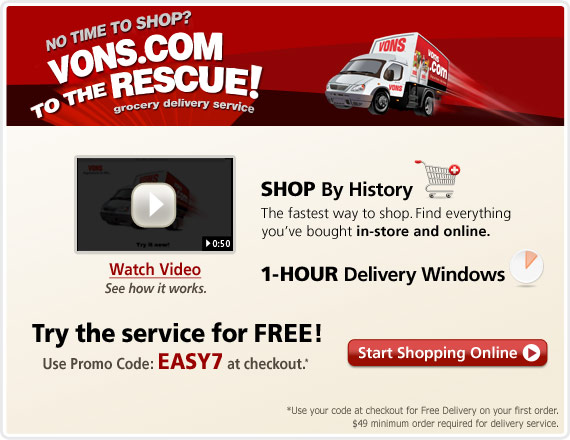
(www.vons.com)

In sum, by becoming a faithful user of Vons.com, I am satisfied with the value of the products and level of customer service I receive, I save valuable time, avoid hustling from aisle to aisle collecting my items in the store, avoid long lines and potential stress, and I get my grocery shopping done within 10 minutes.

Again, I ask…why isn’t everyone using this service?

References:
Young, A. (2010). Brand media strategy: Integrated communications planning in the digital era. New York: Palgrave Macmillan.

Vons Company Website: Retrieved from: http://www.vons.com/IFL/Grocery/Home

Posted in Uncategorized | Tagged , , , , , , , , , | 9 Comments

B.Y.O.S.: Does Social Media Marketing Work?

Have you ever wanted to design your own vehicle and share your creation with friends?  Thanks to Chevrolet, you now have the opportunity.  Last week Chevrolet launched its newest social marketing campaign, Build Your Own Spark (B.Y.O.S.).  The Spark is Chevrolet’s latest entry into the mini car segment.  Set to go on sale this summer, the Spark will come in tantalizing colors such as Jalapeno, Salsa, and Lemonade.  A small car by design, the Spark is a truck owner’s guilty pleasure.  Chevrolet defines the Spark as “a nimble, affordable, five-door hatchback that lets urban drivers live larger in tight spaces” (“2013 Chevrolet,” 2012).  The Spark is for those who don’t just want to go, but go in style. 

This is social media at its best!  Young (2010) indicates that a critical aspect to influencing is to first determine how individuals that you are trying to relate to think, behave, and live.  But how does this affect social media marketing?  Are the results even measureable?  Over 60 percent of business owners who invest in social media marketing are certain that they will see a return (Laird, 2012).  However, what about the other roughly 40 percent?  About 30 percent are still on the fence and the remaining few are completely out, believing that social media marketing is a waste of money (Laird, 2012). 

For those that love things their way, which is most of the new generation, this is their moment.  The time has arrived when Spark enthusiasts and consumers alike can now log onto (http://www.chevrolet.com/spark-mini-car/build-your-own/) to build your own Spark.  Upon first entering the website, designers can select their trim level, choose an exterior color and coordinating interior, and lastly, price it out.  After all of the selections have been made, designers can then save their personalized Spark to Facebook.  Once on Facebook, individuals either chose to save or share their B.Y.O.S. masterpiece.  When selecting “Save this Vehicle”, designers can build and save as many vehicles as they like and view them as often as they want.  For those who choose to share with friends, individuals can post the Spark on their wall, track comments, and address responses.  So my mini car enthusiasts, summer is here and Spark is on its way.  Let’s get ready to B.Y.O.S.! 

References:        

2013 Chevrolet Spark mini car is the key to the city. (2012). GM News. Retrieved June 10,

 2012 from http://media.gm.com/media/us/en/chevrolet/vehicles/spark/2013.html

Laird, S. (2012, May 23). Does social media marketing really work? [Infographic]. [Web log

post]. Retrieved June 10, 2012from http://mashable.com/2012/05/23/social-marketing-

infographic/#

Young, A. (2010). Brand media strategy: Integrated communications planning in the digital era.

New York, NY: Palgrave Macmillan

Image Source: http://www.chevrolet.com/spark-mini-car/

Posted in Uncategorized | 3 Comments

Journey to Brasil through the Marketing Magic of Macy’s

On May 16, Macy’s launched a company-wide marketing campaign paying tribute to one of the hottest countries on earth, Brasil.  The Macy’s tribute, with the tagline “Brasil: A Magical Journey” attempts to capture the essence of the captivating culture and colorful and unique fashion of Brasil (“Macy’s pays tribute,” 2012).  The Macy’s Brasil campaign unofficially began with the annual Macy’s Flower show held the last week in March and the first week in April featuring this year’s theme Brasil: Gardens in Paradise, but the true Brasil campaign did not officially kick off in full swing until May 16 (Macy’s Spotlights, 2012).  The Brasil campaign is a large-scale company-wide event that transcends several different marketing platforms.

The Macy’s Brasil campaign consists of “limited-edition capsule collections created by renowned Brazilian designers, Brazil-inspired fashion from other designers, including existing Macy’s brands, a fundraising program to benefit the Amazon rainforest, a series of lively in-store events, and an opportunity to win a trip to Brazil” (“Macy’s pays tribute,” 2012, para 1).  Not only is the customer exposed to fashion and home goods inspired by the country, but the campaign also generates excitement about Brasil as a country and gives customers a chance to donate to the rainforests of Brasil (“Macy’s pays tribute,” 2012). The Macy’s Brasil campaign is promoted heavily in the Macy’s brick-and-mortar stores with the merchandising execution of Brasil products in the front lines and featured in aisle ways and Brasil visuals in all store windows.

Beyond the stores, Macys.com has created Brasil shopping categories including “Journey to Brasil” categories and the “O Mercado, the Market at Macy’s” categories, which live in almost every family of business on the website (“Macy’s pays tribute,” 2012).  Macys.com also features a vanity URL, www.macys.com/Brasil, which takes customers to the Brasil Skava sitelet.  The sitelet features the women’s, men’s, home, and beauty categories, information about Brasil, information about the Give, Get, and Save the Rainforest campaign, a link to the Francisco Costa for Calvin Klein brand shop, a link to the interactive catalog (featuring videos, interviews, and travel tips), and a link to download the Macy’s Brasil app.  The Brasil campaign also includes heavy use of mobile marketing with the Brasil app available for download and the use of QR codes, which delivers fashion content to customers about the featured designers (“Macy’s pays tribute,” 2012).

http://www.youtube.com/watch?v=cUTmIgW0xBk&feature=relmfu

http://www.youtube.com/watch?v=tU1GfUHubvc

Macy’s consistently markets itself as an economically friendly brand, but as the competition in the market increases, it must differentiate itself as fun and fashion forward.  This campaign capitalizes on Macy’s strengths, such as their exclusive brands, while doing it with a twist using the excitement of the highly talked about tourist destination, Brasil.  Macy’s knows that to maintain its success, it must appeal to the millennial generation, and this campaign is a perfect first pitch.

References:

Macy’s. (n.d.). Retrieved from www.macys.com

Macy’s pays tribute to Brazil with multifaceted campaign launching this week. (2012, May 15). The New York Times. Retrieved from http://markets.on.nytimes.com/research/stocks/news/press_release.asp?docTag=201205151015BIZWIRE_USPRX____BW6296&feedID=600&press_symbol=105501

Macy’s spotlights the spirit of Brasil this spring. (2012, May 15). WND. Retrieved from http://www.wnd.com/markets/news/read/20516596/macy%E2%80%99s_spotlights_the_spirit_of_brasil_this_spring

Posted in Uncategorized | 1 Comment

Strategic Communications or just Communications?

The term “Strategic Communication” gets tossed around a lot and most of the time, I see it used by those in our field who want to give the impression that their plan is something larger than just a communications strategy. I’ve read many Strategic Communications plans that are nothing more than some analysis, a list of stakeholders, and some tactics directed at a communication objective.  If going back several years, many would have called this a Communication Plan. So what differentiates a Strategic Communication Plan from just a Communication Plan?

What’s the Definition of SC?

The term Strategic Communications became popular in government and has evolved over the last 5-10 years within both the Department of State and Department of Defense. The Department of Defense currently defines SC as:

“Focused United States Government efforts to understand and engage key audiences to create, strengthen, or preserve conditions favorable for the advancement of United States Government interests, policies, and objectives through the use of coordinated programs, plans, themes, messages, and products synchronized with the actions of all instruments of national power.”

I think the definition needs some work, but the part that jumps out to me as being different is at the very end when it discusses the synchronization with the actions of all instrument of national power (i.e. Diplomacy, Information, Military, Economics). This means that communicators are getting into areas that they have traditionally not been involved in, and those that have not been involved in communications are having to get into communications.

Strategic Communication is a process that involves not only communicators, but players from all different aspects of an organization. It is a process because while the communicator may often times help facilitate that process, it is rarely ‘owned’ by any single department. As a Strategic Communication planner for the International Security Assistance Force (ISAF) in Kabul, we are attempting to synchronize and coordinate all the actions – to include kinetic and non-kinetic – in order to reach our objectives. If using the U.S. definition of SC, it would mean everything falling under diplomacy, information, military and economics.

There is no one person who possesses expertise in all of these areas, so the process occurs in the discussions and synchronization  about what we are trying to achieve. It means that as a communicator – and as only one piece of the larger SC process – I have to try and get into the business of others more so that I can understand it while also attempting to get others to better understand the communication aspect.

For a non-government organization, this essentially would mean that an SC Plan would not be just about communications, otherwise it would be called a Communication Plan. A Strategic Communication plan should be a process, which involves all aspects of a company working together toward common goals. It would involve R&D, operations, management, legal, logistics, and any other department that makes up the company.

A better explanation of SC

The evolution of SC over the years has produced “little beyond the huge volume of PowerPoint slides, issue papers, and studies, with few actual measures taken to develop a synchronized, coordinated interagency national program.”[1] This is obviously speaking about SC from a DoD perspective, but the same could be said about the corporate perspective as well.

There are lots of articles and books written about Strategic Communications. I read as many of these articles as I can find, but most of them only involve the communication aspect. In my mind, this is nothing more than a re-branded Communication Plan, which we have done long before SC became the term-du-jour over the last decade.

The question that needs to first be asked is what is the difference between your Communications Plan and a Strategic Communications Plan? If your plan only involves communications and communicators, than it is probably a Communications Plan. The much harder SC route is to try and involve areas out of your lane of expertise, departments that don’t want to be synchronized, and ambiguous organizational goals that cross multiple parts of a company. If that process is identified in your plan, than in my mind we’re getting more towards Strategic Communications.


[1] William M. Darley, “The Missing Component of U.S. Strategic Communications,” Joint Force Quarterly, Issue 47 (2007), 109.

Image taken from U.S.Joint Forces Command ‘Commander’s Handbook for Strategic Communication and Communication Strategy’ Version 3.0, dated 24 June 2010.

Posted in Uncategorized | 2 Comments

You Are Now Entering The Brand Twilight Zone.

Imagine you are in a city that is known for its rich history and culture, yet as you walk down the street all you see are the same five or six logos and company names. These companies represent some of the major global brands known for their wide reach and deep pockets and they are everywhere. You start to realize that your choices regarding what beverage you can drink, what shirts you can buy and what credit card you are allowed to use is limited to these select brands. There is even a “brand police” organization that ensures local businesses aren’t displaying signs or logos that may compete against these behemoth brands. Even logos on soap and paper towel dispensers in bathrooms are covered in an attempt to keep the focus on only these approved brands. It sounds like scenario that belongs in George Orwell’s dystopian novel, 1984, but it’s really a reality that’s happening right now in London and there is nothing anyone can do to stop it.

The upcoming London Summer Olympic games have already changed the landscape of the historic city. Construction of new arenas, an Olympic park, and the world’s biggest McDonalds are impressive reminders of the impending events, but it’s the strict brand exclusion zones surrounding these Olympic venues that serve as the real indicator of the level of control Olympic organizers have over the city. These zones fall under the domain of the London Organizing Committee of the Olympic Games (LOCOG), and their job is to create a brand twilight zone where all advertisements and brands are strictly monitored to ensure you only encounter those select few who have become official sponsors of the games. Part of the International Olympic Committee’s (IOC) requirements for hosting the games requires bidding governments to introduce new legislation that goes above and beyond existing copyright and contract laws to offer increase protection to the game’s official sponsors (Addley, 2012; Hall, 2012). Many are calling London’s brand laws and limits stricter than those imposed by communist China in 2008 and see the LOCOG as setting a president for brand control in public spaces like no one has ever seen (Hall, 2012).

Map from Kosmograd.com

London’s brand exclusion zones are a 35-day, one kilometer perimeter around all Olympic venues that are stringently monitored to ensure all advertising and brands seen by any spectators, athletes and broadcast cameras are IOC approved (Hall, 2012; Kosmograd, 2012). The corporate sponsors protected by the committee represent a combined $1billion in sponsorship dollars that have been paid to the to become official partners of the games (Hall, 2012). The group includes such well-known names like McDonalds, Coca-cola, and Adidas and they want to ensure that they are getting the most for their sponsorship money (Hall, 2012). To do this, the LOCOG’s “branding police” have made sure that only Olympic sponsors have the opportunity purchase advertising, both indoor and outdoor, in the designated zones (Addley, 2012;McCabe, 2012; Dicker, 2012). Other rules and regulations aim to outlaw any unauthorized association with the games or competition against official sponsors by local businesses (Addley, 2012; Hall, 2012, Dickers, 2012). In addition to the ensuring the Olympic name and ring logo is not besmirched by local establishments, the new laws have made it so businesses who fail to pay for the privilege of using such terms like “games,” “2012,” or even the words “medal” and “gold,” will risk prosecution and large fines at the hands of LOCOG (Hall, 2012; Addley, 2012).

Are these new laws crossing the line and infringing on the rights of local businesses and the city itself (Kosmograd, 2012)? The new laws and regulations put local businesses in a particular quandary as many are too small to compete with large corporate sponsorships but also face so many IOC do’s and don’ts about branding that they are at a loss as to what they can actually do to capitalize on this Olympic opportunity (Addley, 2012). For example in the Olympic Village, McDonalds will be the only branded food outlet available and Visa is the only payment card accepted making it nearly impossible for visitors to seek out or even find alternatives (Kosmograd, 2012). Some fear that the brand limits the LOCOG enacted to secure the sponsorship contracts are having an adverse reaction of stifling the economic benefits available to local businesses (Addley, 2012; Kosmograd, 2012).

The LOCOG insists the limits are in place not only to protect corporate sponsors but to prevent the occurrence of ambush marketing at the games (Kosmograd, 2012; Dickers, 2012; Addley, 2012). Ambush marketing is a form of guerrilla marketing where companies try to promote their brands at events without paying sponsorship fees (“Playing the game; Ambush marketing,” 2012; Addley, 2012). The “brand police” have also extended their reach online, as social media will also be monitored as much as possible to protect the Olympic brand (Addley, 2012). Esther Addley’s (2012), article in The Guardian outlines how even athletes are getting a crash course in the what they can and can’t post or blog about during the games, while Twitter and the LOCOG have formed an agreement aimed at “barring non-sponsors from buying promoted ads with hashtags like #London2012” (p1). Clearly the Olympic committee is taking the issue of branding seriously by pulling all the stops to ensure visitors, viewers and social media users have a consistent on-brand Olympic experience or should I say a consistently corporate-sponsored Olympic experience.

Image from www.blowe.org

Is the LOCOG going too far, have they over-stepped their boundaries by creating geographic zones that have essentially been scrubbed of all local and non-sanctioned advertising and brands? Not surprisingly the committee doesn’t think so and cites the fact that these corporate sponsorships helped pay for the games themselves by filling in funding gaps that otherwise would have fallen on the city and its citizen’s shoulders (Addley, 2012; Ha1l 2012). Many are reeling at the lengths the games organizers are going to in enforcing these rules, citing a special website where athletes are encouraged to report any potential ambush or sponsorship infringement activities they might see in the village (Addley, 2012). Some are calling the brand exclusion zones the “privatization of public space,” (Kosmograd, 2012) while others refer to the measures as “draconian” (Addley, 2012). Regardless of how intrusive the regulations may seem, it certainly does set a precedent on how local businesses and non-sponsor brands can be systematically shutout from tapping into these types of opportunities to reach new audiences and increase sales. It will be interesting to see how the games play out in the coming weeks and what new and inventive marketing techniques non-sponsor brands will cook up to circumvent the strict rules and regulations in order to bring the brand twilight zone back to reality.

Sources:

Addley, E., (2012, April 13). Olympics 2012: Branding ‘police’ to protect sponsors exclusive rights. The Guardian. Retrieved June 08, 2012, from http://www.guardian.co.uk/sport/2012/apr/13/olympics-2012-branding-police-sponsors?INTCMP=SRCH

Dicker, R. (2012, May 29) London 2012: Olympics advertising tightly enforced. The HUffinton Post. Retreived June 09, 2012, from http://www.huffingtonpost.com/2012/05/25/london-2012-olympics-sponsors_n_1546466.html

Hall, E. (2012) London outdoes China in brand crackdown at summer Olympics. AdAge. Retrieved June, 08, 2012, from http://adage.com/article/global-news/brand-police-full-force-london-olympics/235136/

Kosmograd. (2012). Olympics brand exclusion zone. Retrieved June 08, 2012, from http://newsfeed.kosmograd.com/kosmograd/.

McCabe, M. (2012) Locog to open Olympic outdoor action to non-sponsors. Marketing Magazine. Retrieved June 09, 2012 from http://www.brandrepublic.com/news/1114677/Locog-open-Olympic-outdoor-auction-non-sponsors/?DCMP=ILC-SEARCH

“Playing the game; Ambush marketing.” The Economist [US] 5 July 2008. Academic OneFile. Web. 10 June 2012.

Posted in Uncategorized | Tagged , , , , | 3 Comments

Facebook is the Best Free Marketing Out There…Or Isn’t It?

Facebook marketing is free, right?  Post a page, get some likes and then your fans will automatically buy your product, go to your event or donate to your cause.  This is what social media is all about…isn’t it?

This is one of the most common misconceptions I hear anytime I am in a group that is tasked with promoting a company, brand, idea or event.

USA Today featured an article recently titled “Secrets of Facebook Marketing.” The article cites multiple ways to have a successful presence for your company on Facebook, including:

  • Update your page as often as possible
  • Utilize multimedia such as photographs and video feeds in Facebook updates
  • Create a conversation by posting items related to your company/product that are not a direct sell
  • Ask questions of your audience, engage in the conversation
  • Promote your product or company with the use of coupons, discounts or free products available only to those who have liked your Facebook page
  • Monitor your page regularly throughout the day and respond to questions and or concerns
  • Utilize the Facebook advertising venue, if you have funds to dedicate to this

The secret that no one tells you about a Facebook page is this – someone in your company has to do all of this work.  And successfully managing conversations and finding insights about your Facebook audience so you can successfully engage with them takes more than 10-15 minutes a day.  Depending on the size of your audience and your goals, it could very well be a full-time job for at least one person.  As your social media presence expands from Facebook to Twitter, Flickr, LinkedIn, Google+, etc., more time will need to be dedicated to maintaining and monitoring each site.

Social media is not free. As you work with your organization to determine the best way to market or promote, social media should not be used as a standard fall back. It should be fully incorporated into a strategic communication plan, including the costs associated with creating and maintaining a social media presence.

References
Komando, K. (2012). Secrets of Facebook Marketing. Retrieved at http://www.usatoday.com/tech/columnist/kimkomando/story/2012-06-08/facebook-marketing-tips/55444700/1

Posted in Uncategorized | Tagged , , | 5 Comments

Take My Money, HBO! Why HBO Would Rather Support Digital Piracy Than Take Your Money

Credit: TechnoBuffalo

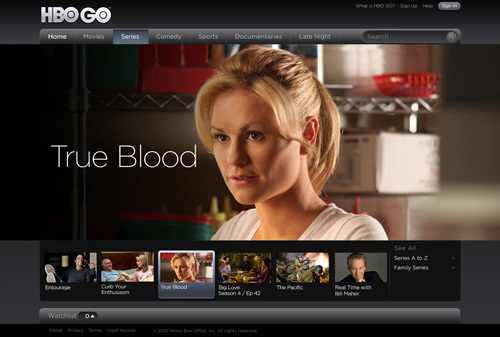
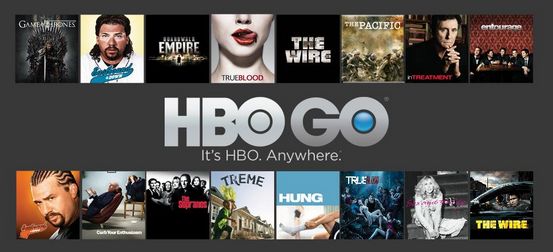
With programming that reaches 29 million subscribers in the United States (Carter, 2012), Home Box Office (HBO) has hit pay dirt with its HBO GO website and mobile application. Launched in February 2010, HBO GO has revolutionized the way its customers receive its content. It’s apparent that HBO is in touch with what their viewers want. Not only does the pay-cable network continue to justify the additional cost to cable and satellite providers by delivering quality shows such as Game of Thrones and True Blood, but they’ve also expanded their reach through their streaming video (West, 2012). HBO GO can be accessed through various devices including the Apple iPad/iPhone, Android phones, and most recently, Kindle Fire. Additionally, with the hours of original HBO content, HBO GO also offers movies and other specials. With so much content available to paid subscribers through a multitude of ways, why has HBO resisted the recent cries by non-subscribers to access their application?


Credit: Screenshot, TakemymoneyHBO.com

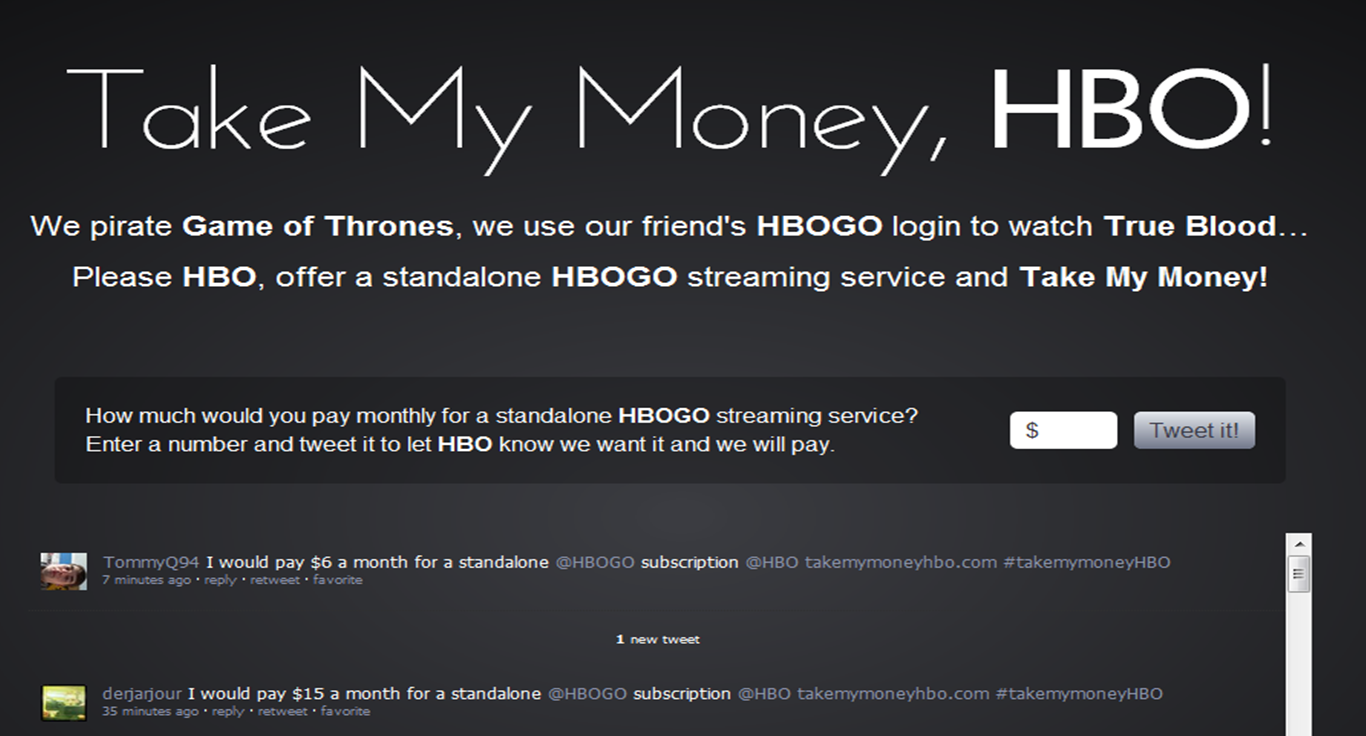
One Web programmer has started a grass roots campaign in hopes that HBO will see differently. Jake Caputo has created a site called Take My Money, HBO!, which leverages Twitter (hashtag: #takemymoneyHBO) to convince the entertainment giant that they would benefit by allowing individual memberships to HBO GO. Within the first two hours of Caputo’s site going live, there were more than 12,000 visits (Lawler, 2012). Jake and others like him want to point HBO’s attention to the fact that a lack of access to HBO GO only helps to support digital piracy of their content. As advocates against digital piracy, does it not make sense for HBO and its owner, Time Warner, to step into the standalone streaming media service? Why continue to allow non-subscribers to obtain content for free?

As a paid subscriber to HBO through DirectTV, I have in the past shared my HBO GO log-on credentials with various family members, who could not afford to pay the extra for HBO. In doing this, I’ve always felt the Devil vs. the Angel dilemma that most individuals go through when ‘helping’ someone catch up on their favorite program. I wonder then as I do now – why prevent consumers, that aren’t as fortunate as others, to miss out on quality programming? HBO, nor Time Warner, have released an official comment on this, but their Twitter account (@HBO) has referred the media to a TechCrunch article that communicates the following:


The average person would pay $12 a month, or about $145 a year, for online-only access to HBO content. But is that something HBO would be interested in?

HBO currently has about 29 million subscribers, and reportedly receives around $7 or $8 per subscriber per month. So HBO could, theoretically, get more per subscriber than it’s currently making. But that doesn’t include the cost of infrastructure needed to support delivery of all those streams, including all the CDN delivery and other costs that would come with rolling out a broader online-only service.

More importantly, it wouldn’t include the cost of sales, marketing, and support — and this is where HBO would really get screwed. Going direct to online customers by pitching HBO GO over-the-top would mean losing the support of its cable, satellite, and IPTV distributors. And since the Comcasts and the Time Warner Cables of the world are the top marketing channel for premium networks like HBO, it would be nearly impossible for HBO to make up for the loss of the cable provider’s marketing team or promotions.

Think about it: Every time someone signs up for cable or satellite service, one of the inevitable perks is a free six- or 12-month subscription to HBO. And those free subscriptions are rarely, if ever, cancelled once the trial period ends. What would happen if HBO no longer had the pay TV industry’s marketing team propping it up all the time? The results would be disastrous, and there’s no way that HBO could make up in online volume the number of subscribers it would lose from cable. Which is why, even though some users would actually pay more for access to HBO GO without all the other cable channels, you won’t see it show up as a standalone service anytime soon.

In essence, HBO has pointed out that they are just one small member of a broader Time-Warner firmament and it has much more interest in sustaining that entire ecosystem than in picking up a few extra HBO Go subscribers (Yglesias, 2012). I doubt this is the best approach, especially when innovation is so desperately needed in an industry that’s in a battle against the Netflix and Hulu’s of the world.

Credit: appscout.pcmag.com

I would like to hear your thoughts on this. Considering the popularity of the Internet, do you think HBO is making a mistake by not welcoming the additional revenue from a standalone HBO GO service? Or should HBO continue to stand by their partnerships with the cable/satellite providers, even as their business model continues to be threatened by digital piracy, Hulu, etc.?


References:

Carter, B. (2012). With homeland, showtime makes gains on HBO. The New
York Times. Retrieved from
http://www.nytimes.com/2012/01/30/business/media/with-homeland-showtime-
makes-gains-on-hbo.html?_r=1&pagewanted=all

Lawler, R. (2012). How much would the average person pay for a standalone HBO go subscription? About $12 a month. Techcrunch.com. Retrieved from http://techcrunch.com/2012/06/05/hbo-go-without-hbo/

Pendlebury, T. (2012). New site calls for cable-free HBO Go option, but it’s an
uphill battle. CNET.com. Retrieved from http://news.cnet.com/8301-17938_105-
57448421-1/new-site-calls-for-cable-free-hbo-go-option-but-its-an-uphill-battle/

West, K. (2012). True blood season 5 bonus content available through HBO go
this sunday. Television Blend. Retrieved from
http://www.cinemablend.com/television/True-Blood-Season-5-Bonus-Content-
Available-Through-HBO-Go-Sunday-43332.html

Yglesias, M. (2012). HBO go and the innovator’s dilemma. Slate.com. Retrieved from http://www.slate.com/blogs/moneybox/2012/06/07/hbo_go_and_the_innovator_s_dilemma.html
Posted in Uncategorized | Tagged , , , , , , , , | 2 Comments

Why blow up your TV set? Hybridcast is coming in 2013!

Tired of the same old TV shows with the same old programming? Sitting on the couch with your laptop or tablet just to look up upcoming episodes or televised sports events? Smart TV? No. There’s a whole new breed television coming down the pipeline.

The Evolution of TV (WeAreUPC, 2011)

What is the future of television?

On May 23, 2012, Nippon Hosou Kyoukai (NHK) made an announcement in Japan about a new integrated television watching experience dubbed “Hybridcast” which is anticipated to hit the commercial market in 2013 (Beach, 2012; Diginfonews, 2012; Buckley, 2012). Hybridcast offers a hybrid broadcast that includes both regularly broadcast cable TV video supplemented and integrated with internet content for an interactive viewing experience (Diginfonews, 2012; Beach, 2012). The video is matched with information that can be displayed alongside programming on the main television screen as well as information that can be synched for use on either dedicated tablets or other HTML5-compatible hardware and software.  Much like using the radio to either replace the announcer (Smith, 2010; Scanner Master Police Scanners Corporation) or obtain information that the regular broadcast lacks, the combination of “connected” and broadcast video are opening doors for some very interesting viewer engagement opportunities. There have been similar attempts for viewer engagement through the integration and convergence of broadcast television with social media sites like MySpace, Facebook and Twitter (Tweney, 2012). However, Hybridcast is unique in the level of its proposed integration and engagement. In an interview, NHK explains that existing commercial televisions could be modified to handle the new Hybridcast.

People already use their connected, portable electronic devices to look up products, show information and for other purposes while watching TV (William, 2007).  NHK demonstrated how they are taking this to the next level using HTML5 to engage the viewers, with suggestions including: tracking players, statistics or other information during a live sports match or game, even being able use an overlay on the television to know where your favorite player/athlete is at all times; allow viewers at home to actively participate in a televised quiz show; and track where people are on a travel program. After the break is a clip on YouTube that explains the technology, to visually understand how viewers are anticipated to interact with the video programs.

NHK Hybridcast making broadcast TV interactive (Diginfonews, 2012)

From an integrated marketing perspective, the new type of connected broadcast offers several opportunities. For example, the technology may allow for broadcast/content providers to be consistent as they connect across media. The content that is delivered to the television will be available able to be connected to tablets, laptops or other hardware that is configured to run with it, even possibly including mobile phones. The content then becomes mobile and can be manipulated to include things such as advertisements from sponsors or direct URL links to product websites or related company/product pages. If used as an engagement tool, the programming that streams alongside the program could also include surveys and other tools to help marketers understand what the viewers are most interested in. This will allow the content to be further tailored to better match their interests, and allow another channel for the consumers to come to businesses.

As this relationship with the viewer further develops, more opportunities to use principles of integrated marketing will most likely appear. The broadcast video providers will be able to learn valuable information as it establishes a relationship with viewers. The information may then be used to deliver messages more effectively, pinpointing contact points that may be included in a program sponsor’s marketing communication strategy (Kitchen & Burgmann, 2010). Leveraging this information as the starting point, marketing campaigns may be redesigned to better support each other in a more fully integrated effort – ensuring the viewers will be able to identify the same products and services away from the Hybridcast experience.

As an avid sports fan, the idea of integrated broadcasts takes on a whole new meaning for “watching the game.” Tracking my favorite athlete is appealing, and if I can also listen to the live broadcast from my radio station through the Internet and have it synched with the video, this would bring it to a whole new level. However, I will still not have even scratched the surface: maybe I could click on my favorite athlete’s name and pull up a bio, fan site, or even an online store that sells memorabilia. Having what I want at my fingertips and feeling like I am a part of the program/game/event is very appealing, and I believe Hybridcast may be just what the viewer – and the marketer – wants!

References:

Using TV as an educational tool. (1990, January 24). The Reporter, p. 5A.

Beach, J. (2012, May 24). Japanese broadcaster NHK developing “Hybridcast” platform. Retrieved from IPTV-News: http://www.iptv-news.com/2012/05/japanese-broadcaster-nhk-developing-hybridcast-platform/

Buckley, S. (2012, May 27). NHK demos Hybridcast streaming, teams up internet and cable TV for superior 3D delivery. Retrieved from Engadget: http://www.engadget.com/2011/05/27/nhk-demos-hybridcast-streaming-teams-up-internet-and-cable-tv-f/

Diginfonews. (2012, May 23). NHK Hybridcast making broadcast TV interactive [Video]. Retrieved from YouTube: http://www.youtube.com/watch?v=ThrOv2NqI00

Kitchen, P., & Burgmann, I. (2010). Integrated marketing communication. In Wiley International Encyclopedia of Marketing. John Wiley & Sons Ltd.

Scanner Master Police Scanners Corporation. (n.d.). Listen to your favorite radio broadcasters call games in sync with your tv! [Product information page]. Retrieved from Scanner Master Web Site: http://www.scannermaster.com/ProductDetails.asp?ProductCode=01-561700&Click=53438

Smith, B. (2010, March 26). Wath on TV, listen on radio: What announcers make you want to scream? [Web log]. Retrieved from PennLive : http://blog.pennlive.com/pennstatefootball/2010/03/watch_on_tv_listen_on_radio_wh.html

Tweney, D. (2012, January 9). Myspace reinvents itself as an “entertainment experience,” with help from Panasonic and Justin Timberlake. Retrieved from Venture Beat: http://venturebeat.com/2012/01/09/myspace-tv-panasonic/

WeAreUPC. (2011, December 12). The Evolution of TV [Video]. Retrieved from YouTube : http://www.youtube.com/watch?v=BWNXfoplvMQ

William. (2007, July 25). T-Mobile Wing Phone [Product review comment]. Florida: Amazon.com. Retrieved June 9, 2012, from http://www.amazon.com/T-Mobile-Wing-Phone/product-reviews/B000QTWT7W

Posted in Uncategorized | Tagged , , , , , , , , , , , , | 4 Comments

Don’t bug me, I’m pinning.

Pinterest is one of my favorite websites. And not just because when I discovered it last fall, I was a busy grad student trying to decorate my new home and plan a wedding. I like it because it’s such a great example of how something so simple, sharing images, can have such a huge impact on and potential for the internet marketing industry.

But why has it been so successful, so fast? And what does it mean for internet marketing?

First, if you need any convincing that Pinterest is doing extremely well, consider this: since launching in March, 2010, it has become the fastest website EVER to reach 10 million unique views per month (Delo, 2012). In case you’ve been living in a cave, Pinterest is an “online pinboard where users can organize and display their favorite objects from across the web” (Delo, 2012). Why has it become so popular? Experts site ease of use and the power of simple imagery (Bosker, 2012). Perhaps even more importantly, Pinterest is different from Facebook or LinkedIn in that it allows users to say “look at this” versus “look at me” (Bosker, 2012). It truly allows users to connect over cooking tips and decorating ideas, versus comparing social accomplishments via news feeds (Bosker, 2012).

What does the future hold for brands and Pinterest? Right now, it’s simply too early to tell. Pinterest is extremely consumer driven and copyright issues, along with questions on measurement, will need to be firmly figured out before it can really take off for brands (Gillum, 2012). But Pinterest has some definite things going for it that experts say indicate it’s not only here to stay, but will only continue to grow and evolve for consumers and brands alike (Gillum, 2012). Still though, business marketing can often times come down to who can think outside the box and creatively embrace new trends. Some unlikely brands have already made their outreach on Pinterest meaningful. Whole Foods, for example, has opened another door for consumers to get ideas on recipes, seasonal cooking and food pairings on their Pinterest page, among other things (Holley, 2011). Or take Klout, a company responsible for measuring online influence. They use their Pinterest boards to post pictures of “team/office events…and the products and services that its members receive based on their digital influence” (Holley, 2011). Or how about Mashable? It boasts over 35,000 followers with boards like “infographics” and “web humor” (Wasserman, 2012). For a brand that was founded on articles and reviews, they have found a way to embrace image-driven content for their Pinterest page (Wasserman, 2012). In just these few examples, it’s clear that creatively interpreting your brand can help determine how Pinterest could work for your company.

We’ll undoubtedly see more changes in the future. Does anyone remember what Facebook looked like in late 2004, early 2005? It’s hardly even the same, compared to now. And who could have guessed all the new features and options we would one day have? Especially for brands. Pinterest will most likely have its place in the future of internet marketing and it will be interesting to see how it all plays out.

References:

Delo, C. (2012). Pinterest. Ad Age. Retrieved from http://www.adage.com

Bosker, B. (2012). The secret to Pinterest’s success: we’re sick of each other. Huffington Post. Retrieved from http://www.huffingtonpost.com

Gillum, S. (2012). Five reasons Pinterest is a must for business marketers. Forbes. Retrieved from http://www.forbes.com

Holley, S. (2011). How 11 brands are reaching customers on Pinterest. PR Daily. Retrieved from http://www.prdaily.com

Wasserman, T. (2012). The 10 most-followed brands on Pinterest. Mashable. Retrieved from http://www.mashable.com

Posted in Uncategorized | Tagged , | 8 Comments

What we’ve got here is a failure to communicate

When I was a kid, there was a public service announcement that ran on TV for the Reading is Fundamental foundation for children’s literacy. The catch phrase, “reading is FUN-da-mental!” was shouted by some sort of animated, elf-like creature.

You can watch it here: http://www.youtube.com/watch?v=-Fj9vlWjLgo&feature=results_video&playnext=1&list=PLB499EFA49F214170

They have more modern, grown-up versions of the Reading is Fundamental (RIF) PSA today. But they aren’t nearly as much fun. And apparently, they aren’t quite as effective…if my recent interactions with people are any indication.

As an editor and writer, I read for a living. I read for fun. Now, I read for school. Reading for comprehension is, as the PSA noted, fundamental to successful communication. I like to think I am fairly adept at understanding and retaining what I read. Not always, but more often than not. Yet occasionally, I start to think I am the ONLY one who does.

More often than not – and sometimes daily – I struggle to understand why people no longer read. Let me clarify that: why they no longer seem to understand what they read. Many times, after conversing with a person, or sitting in a meeting, or participating in a teleconference, I am left wondering why more than one person in the room asks an inane question. I wonder why she or he doesn’t stop and think about what they’ve read before asking the question…that has almost always already been answered in what the person just read.

Just this week, I became frustrated when I engaged in an email conversation in which I tried to make a point no less than five times. Using the same words, only occasionally punctuating them with capital letters, underlines and at least twice adding the question, “are we all in agreement” I struggled in vain to make my point. It was futile. My correspondents did NOT understand.

I think I know what this is. We no longer are patient enough to make our way through a novel…or the front section of a newspaper…or even the back of a cereal box, without quickly giving up on the quest for meaning. Information comes at us so rapidly, from so many sources and in so many different mediums, and nearly unceasingly, that our comprehension simply has to suffer. I think our brains just become paralyzed, or partially so, and just snap shut after letting tiny shards of information poke through…but not too much and certainly not enough to allow for true understanding. At least I hope that’s it. I hope it’s not that we just don’t care enough anymore to try to comprehend. That would be sad.

And it’s not generational (so those of you who are picturing me as the cranky old lady complaining about the darned kids on my front lawn can just stop that now). No, this affliction knows no age. The other day, a teacher where I work (a man in his 60s who is about to retire for a second time) stopped by my office the day after an email announcement was made noting that while I was moving to Michigan, I would still be working as the Seattle school’s director of marketing and communication (remotely, of course). “We’ll miss you around here…how will we ever find someone to replace you?” he said, meaning well.

“Thanks, Steve,” I replied. “But you won’t have to replace me. I’m not really leaving. I’m just going to be working remotely. That’s what the email was all about,” I said. “Oh, I guess I didn’t read that part,” he said, sheepishly.

Sigh. I guess not.

Posted in Uncategorized | 2 Comments