Marketing, “Tingleheads,” and…..Fried Chicken?

While researching new marketing campaigns and tactics, I came across a recent commercial for Kentucky Fried Chicken (KFC) that seemed…well, it seemed a tad bit weird and it was uncomfortable to watch. The commercial features Colonel Sanders whispering softly about pocket squares, he then proceeds to bite into pieces of fried chicken and his heavy breathing and the loud crunching sound of each bite becomes the main focus of the commercial. I forced myself to watch the commercial three times because I kept thinking: “What are they TRYING to do here? Is this a parody?” I found the answer to my question in the very comments made by YouTube subscribers. A significant amount of subscribers commented that they “didn’t know whether to go to sleep or have some fried chicken.” As it turns out, one of KFC’s newest marketing campaigns is geared towards consumers who possess Autonomous Sensory Meridian Response (ASMR).

According to Gibson (2016), ASMR is a physical reaction that some people have to “certain acoustic stimuli that produces a pleasant tingling that starts in the scalp and can spread throughout the body” (p. 1), hence the nickname ‘tingleheads’. For example, some people have reactions to whispering, the sound hair brushing, page turning, the sound of someone receiving a massage, crumpling paper, and apparently also the sound of someone eating extra crispy fried chicken. Or at least Kevin Hochman, KFC’s chief marketing officer, seems to think so. He states that KFC wants to tap into a new demographic of consumers who are not aware that KFC now was EXTRA crispy chicken available (Gibson, 2016). Per Mr. Hochman: “It makes a loud sound when you bite into it, versus our original recipe. It appeals to a very different customer” (Gibson, 2016, p. 2).

While KFC’s marketing tactic may work for the “tingleheads”, it also has the potential to backfire with those customers who have negative reactions to certain sounds. Anyone else besides me find soup slurping and loud chewing to be irritating if not utterly repulsive? Anyway, the main question I’m asking myself and all of you is: Is this good or effective marketing? Would the agency pitch project your teams are working on benefit from incorporating ASMR into its campaign design? Have companies stumbled upon an opportunity that will reap financial rewards?

Personally and judging by my failure to find more than a few marketing campaigns (see links below), geared towards the ASMR community, I can only surmise that a study and further research would need to be done in order to evaluate how many consumers actually possess ASMR, so that organizations can decide whether the demographic is large enough for them to design a marketing campaign suited for that demographic. Just out of curiosity, are any of you “tingleheads?”

Pepsi ASMR Ad

Chinese Dove campaign using ASMR

ASMR Marketing Survey Roleplay  (Example)

Explanation of ASMR

References:

Gallagher, R. (2016). Eliciting euphoria online: The aesthetics of “ASMR” video culture. Film Criticism, 40(2), D1. doi:10.3998/fc.13761232.0040.202

Gibson, C. (2016). It’s national fried chicken day. is this video of george hamilton eating KFC making you tingle?: How a major brand is seeking inroads with the whisper-fetish world of ASMR. Washington: WP Company LLC d/b/a The Washington Post.
 

Posted in Uncategorized | 2 Comments

Advertising Battlefields

We are approaching the end of what has been arguably the most unusual presidential election campaign of our lives. With social media taking a stronger place in disseminating the candidates’ messages and tweet rants, Wikileaks and Russian hackers releasing confidential information about back-door dealings, and the media demonstrating it has given up its neutrality as they try to sway people’s opinions about one or the other candidate, one wonders why do political campaigns still spend so much money on paid advertising. Does it in fact have a significant enough impact on voters opinion in order to help a candidate get elected?

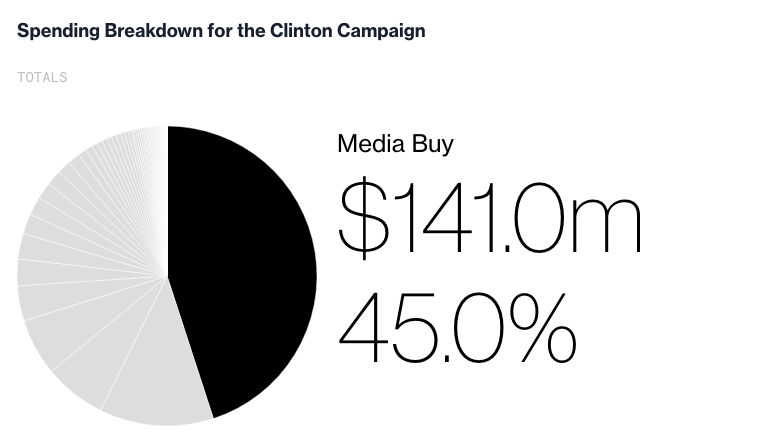
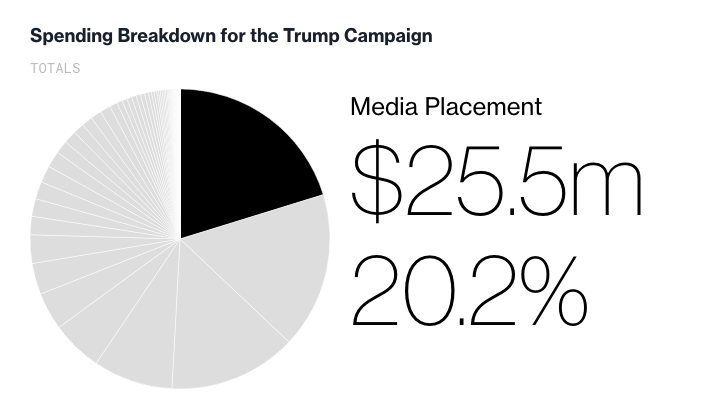
For instance, Bloomberg News reports that Hillary Clinton’s campaign has spent $141.0 million in media buys, while Donald Trump took a gamble, with “only” $25.5 million (Allison, Rojanasakul, & Harris, 2016). Regardless, still a lot of money.

Hillary Clinton's Media Buy Spend 2016

Source: Bloomberg News

Donald Trump's Media Placement Spend 2016

Source: Bloomberg News

As it turns out, there are a few reasons why politicians still invest enormous amounts of money on advertising. According to a recent study by UCLA researchers, the persuasive effects of a political ad decays in less than one week (Kurtzleben, 2015). Given the short term effects of ads on influencing people’s opinion about candidates, it’s no wonder that the advertising becomes a battlefield, with candidates trying to outweigh their opponents.

A recent article on The Hill said that after a strong campaign of attack ads against Trump by the Clinton Campaign on key battleground states, that she had gained a lead in those polls. However, the article also noted that it is impossible to know if the ads were the actual reason for the lead, especially since Trump had a few campaign stumbles during that period (Stanage, 2016).

In summary, it is nearly impossible to say for sure how much all this spend in advertising impacts the results of an election. Ultimately it seems that candidates are forced into the race for ad placements just because their opponents also are, and no one wants to test whether or not going ad-free makes a difference. This year though, Trump as the unconventional presidential runner that he is, did not focus so much on advertising. Then again, his campaign was so unusual that too many factors are at play to attribute the outcome of this election to lack of advertising.

References

Stanage, N. (August 25, 2016). Clinton buries Trump in negative ads. Retrieved from http://thehill.com/homenews/campaign/292563-clinton-buries-trump-in-negative-ads

Allison, B., Rojanasakul, M., and Harris, B. (September 21, 2016). Tracking the 2016 Presidential Money Race. Retrieved from http://www.bloomberg.com/politics/graphics/2016-presidential-campaign-fundraising/

Kurtzleben, D. (August 19, 2015). 2016 Campaigns Will Spend $4.4 Billion On TV Ads, But Why? Retrieved from http://www.npr.org/sections/itsallpolitics/2015/08/19/432759311/2016-campaign-tv-ad-spending

Posted in Uncategorized | 2 Comments

Micro-Influencers, Enjoy That Sweet Cash While You Can

Digiday announced the “rise of ‘micro-influencers’” in April 2016. This week, the site had an article that forecasted imminent doom for the micro-influencer market. What a difference a couple of months makes.

There’s no clear consensus, but Digiday, at least, defines micro-influencers as non-celebrity content producers with 10,000 to 100,000 followers, paid by brands to post about products (Chen, 2016). Posting content isn’t typically what micro-influencers do for a living—unlike the big-time influencers—it’s instead a side gig. And micro-influencers tend to post less frequently than big-time celebrity endorsers (Chen, 2016). So to some, a micro-influencer’s content has a little more street cred and authenticity.

screen-shot-2016-10-08-at-1-35-17-pm

I offer now an extremely rudimentary summation of the trajectory of influencers, because it speaks to how fickle and flashy their trajectory has been. I think it goes something like this: Malcolm Gladwell, in his 2000 book The Tipping Point, was first to described them. They were key people in networks, prominent people who could move the opinion of a community (Jenkins, Ford, & Green, 2013). Gladwell called them both mavens and influencers, and (shock) “influencers” was the name that stuck.

Influencer theory was, and is, debated by academics, but marketers grabbed it and haven’t let go—because the sway of recommendations from peers has surpassed that of recommendations from the brands themselves (Jenkins, et al., 2013).

An influencer’s clout was initially determined by number of followers, but marketers soon started looking at engagement too, conveyed in this equation (Wong, 2014):

Influence = Audience Reach (# of followers) x Brand Affinity (expertise and credibility) x Strength of Relationship with Followers

Some still sing the praises of influencer marketing—that it’s earning brands $6.50 for every $1 spent (Goldstein, 2016). These chipper marketers believe that it’s best done in blogs, followed by Facebook posts (Goldstein, 2016).

Analytics, however, have begun to reveal a point at which, if an influencer’s followers numbers get too high, engagement drops off (Caffyn, 2016). Like a reverse tipping point! The middle road influencers flourished—that new league of content wizards who built communities on topics like fashion, beauty, food, and parenting. Their organic engagement outperformed influencers who had more than 100,000 followers (Chen, 2016).

screen-shot-2016-10-08-at-4-42-14-pm

But like a lot in Web 2.0, the boom times can fold in on themselves, and that, according to a recent Digiday “Confessions” post, is what’s afoot now with micro-influencers. Strike one: Influencer platforms are throwing money at a lot of content producers, and some of that content is crap (Caffyn, 2016). Strike two: Our obsession with an influencer’s number of followers is waning. Strike three: Engagement analytics have been fuzzy for a long time, and they’re getting harder to fake, which a lot of influencers apparently do (Caffyn, 2016).

It seems like time, and analytics, first took a bite out of the big influencers, and now they might be poised to take a bite out of the micro-influencers too. I think the anonymous agency exec from Digiday’s “Confessions” series was probably right, as sad as I am to see good content producers lose an income stream: Influencer marketing is “another Wild West. Soon there will come a point where this bubble of people being paid for product placement will burst.”

References:

Caffyn, G. (2016, October 7). Confessions of an influencer agency exec on micro-influencers: ‘It’s all going to implode’. Retrieved October 8, 2016, from http://digiday.com/brands/confession-micro-influencer-bubble/

Chen, Y. (2016, April 27). The rise of ‘micro-influencers’ on Instagram. Retrieved October 8, 2016, from http://digiday.com/agencies/micro-influencers/

Goldstein, J. (2016, May 21). Influencer marketing: Worth it or a waste? Retrieved October 8, 2016, from http://www.business2community.com/marketing/influencer-marketing-worth-waste-01549023#mqwprM19J6prABIo.97

Jenkins, H., Ford, S., & Green, J. (2013). Spreadable media: Creating value and meaning in a networked culture. NYU press. Chicago

Wong, K. (2014, September 10). The explosive growth of influencer marketing and what it means for you. Retrieved October 8, 2016, from http://www.forbes.com/sites/kylewong/2014/09/10/the-explosive-growth-of-influencer-marketing-and-what-it-means-for-you/#305072fe595f

Posted in Uncategorized | Tagged , , , , | 6 Comments

Insecure and Sleep Deprived: A New Mom Shops at Night

Since the arrival of our baby girl three months ago, I often find myself sleepless in the middle of the night.  After feeding her at 2:30 a.m., it takes a moment for her to go back to sleep. When she does, I am wide awake. I know I should relax, meditate, drink some water but instead, against better judgment, I reach for my phone. I browse social media and read blogs, especially mom blogs. I search for answers to questions like, are we feeding her too much or too little? When is the right time to introduce solid foods? What are the pros and cons with vaccinations? Is her slight cough a sign of a serious illness? And there, in the middle of the night, I seek the guidance of strangers. Well, I at least read what they have to say.

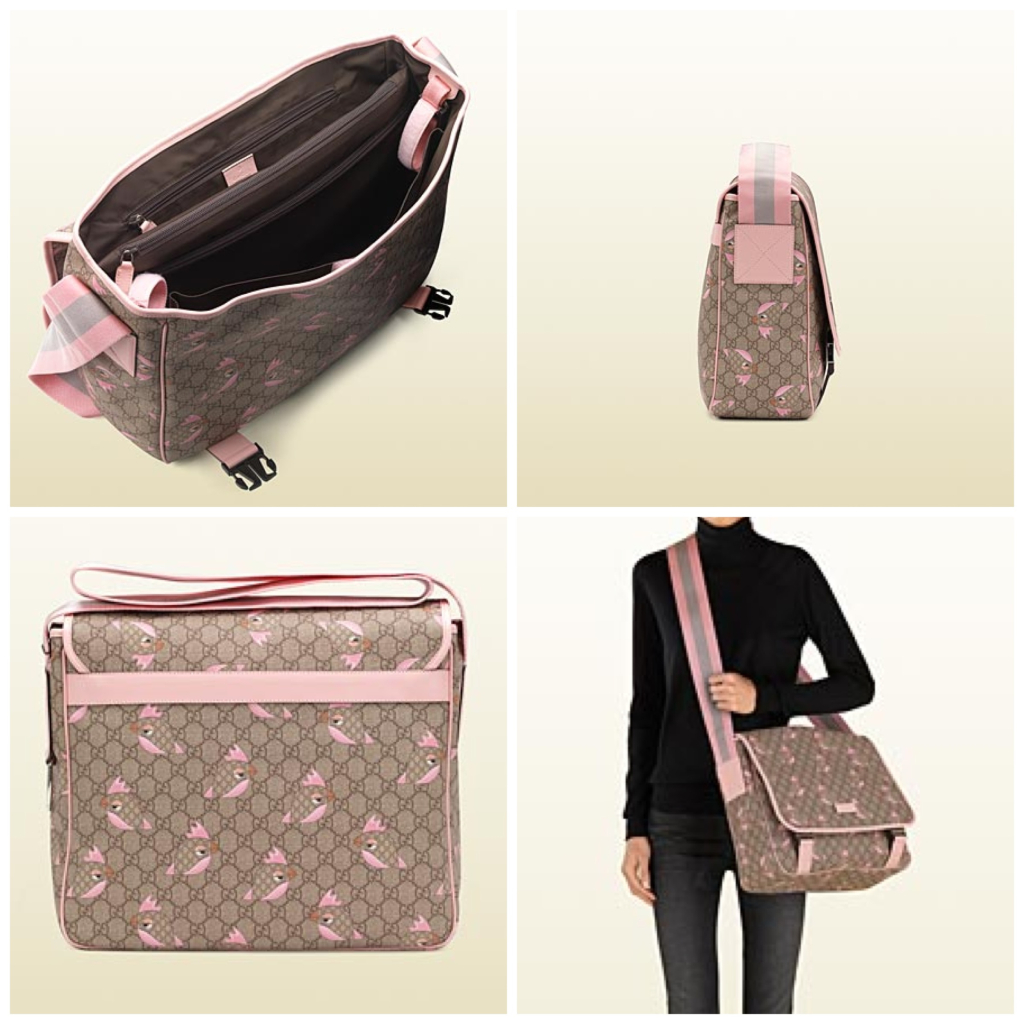
Little did I know before parenthood, how prevalent mom blogs are; today, most moms have blogs that they read regularly (Amaral, 2013). Many of these sites are full blown communities with lots of information on how to parent along with suggestions on what to buy to help in the process. Online searches for “how to” will lead to lists of “must have” items that are easily accessible with a link inside the commentaries. These are tempting suggestions for a tired and insecure new mom eager to get her baby exactly what she needs. Things like designer diaper bags (because just any old bag won’t do), bottle warmers (rinsing under warm water is too primitive), and stroller cup holders (what would mom or dad do without a coffee within reach?) all of sudden seem essential. No wonder that the bringing-up-baby business is a $23-billion-dollar industry (O’Brien, 2014) and that large brands will specifically target successful bloggers with the most trafficked sites (DeMers, 2014). This is a powerful corporate marketing tool especially considering that more than 3/4 of US online consumers trust information posted on blogs (Amaral, 2013).

gucci-gg-zoo-birds-print-diaper-bag

Lipstick and Chopsticks. Today’s Object of Desire: Gucci Diaper Bag. Retrieved from http://lipstickandchopsticks.com

In fact, mommy bloggers are the most influential among personal bloggers. Why are they so powerful? Maybe because as readers, we develop a personal relationship with the writer. Perhaps we are also especially open, maybe even vulnerable, to the impact of messages that are close to the heart, in this case our children and the burning desire to be a good parent. Therefore, opinions and suggestions on these sites might impact us just as much as those from friends and family. And a recommendation from someone that we trust is the most influential factor in making any kind of purchase (Young, 2014). Taking this reasoning one step further, the influential mom bloggers are close to being mavens to devoted readers, the term Malcolm Gladwell introduced referring to everyday influencers in our closest circle of friends and family (Young, 2014).

Before parenthood, I would occasionally find myself after a busy day at work in front of my laptop with a glass of wine for some mindless internet browsing. Did the relaxed setting facilitate online shopping of clothing I didn’t really need? Probably (you are welcome, Nordstrom). And now, are my nighttime online purchases prompted by mom bloggers tapping into my insecurities about parenting skills? Most likely. Again, the solution to a perceived need or problem, right there, accessible at the click of my fingertip. But stuff won’t bring my child health and happiness, which is what I want the most in this world for her. So I try to be a rational consumer by evaluating and comparing before making impulse purchases. But more than anything, I try to give myself a break because as a parent, what matters the most, is doing my best. For that reason, I better try to get some sleep now. I just might have some 3:00 a.m. shopping to do.


References

Amaral, C. (July 2013). Why mom bloggers are so valuable to brands. Aabaco Small Business. Retrieved from https://www.aabacosmallbusiness.com/advisor/why-mom-bloggers-valuable-brands-173022432.html

DeMers, J. (November 6, 2014). How to get mommy bloggers to bring customers to your brand. Huffington Post. Retrieved from: http://www.huffingtonpost.com

O’Brien, E. (April 15, 2014). 10 things the baby-product industry won’t tell you. Market Watch. Retrieved from: http://www.marketwatch.com

Ramsay. (July 3, 2015). How stay-at-home moms can make money blogging. [Web log post].

Retrieved from http://www.blogtyrant.com/stay-home-moms-make-good-money-blogs-online-business/

Young, A. (2014). Brand media strategy: Integrated communications planning in the digital era. New York: Palgrave Macmillan.

Posted in Uncategorized | Tagged , , , | 5 Comments

Just tell me what you want…

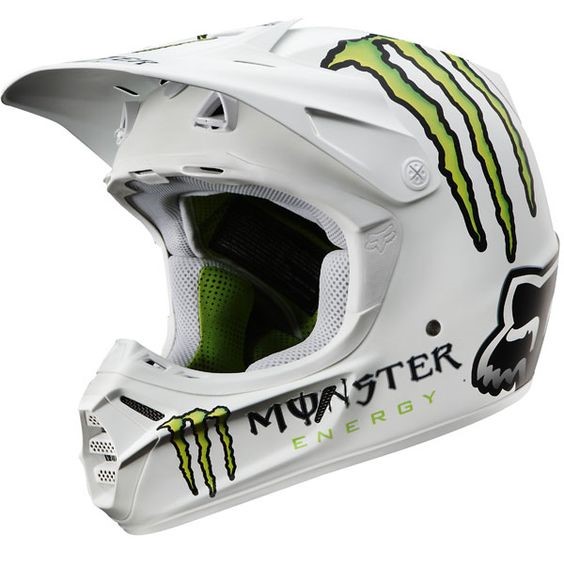
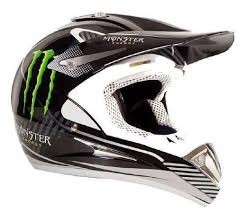
monster_fox4 monster_fox1 monster_fox2 monster_fox3I began shopping, it always begins with an idea, I was in the dominant mode of buying. Not sure what I wanted but knew I wanted to buy something… If not for me, then for the that special someone, or perhaps something for a co-worker, dirt bike riding buddy, kids etc. Didn’t know quite for sure what it would be. I try to explain to the sales staff and other store associates; who are more than willing to assist you in your quest. All asking “Just tell me what you want” …well if we knew the answer we wouldn’t be having this discussion. As communicators we have to know just about everything about everything.

So what stuck out? It was the brands, brands of products everywhere to match just about anyone’s interest ot the interest of a recipient. Since I am an off-road desert rider; there is simply such an overwhelming power of branding that goes on in the off-road motorsports world. Perhaps you’ve hear of a few of them FOX Racing, MSR (Malcom Smith Racing), MAXXIS Tires, Dunlop Tires, ITP, Troy Lee Designs and the list goes on. I noticed how there is some co-branding going on. One product branding itself with another, what stuck out above all others was Monster and FOX.


According to the Management Study Guide website, “Co-branding is the utilization of two or more brands to name a new product or the ingredient brands help each other to achieve their aims and usually this is to the benefit of the consumer”. I remember reading our textbook Brand Media Strategy (2010), that the author Anthony Young, that media planning is about influence, reaching the right customer and understanding the intangibles of how a group is going to behave and act.

The advantages of co-branding is that the risks are shared, generally result in more royalty income, great customer trust and both organizations can share in the cost of brand advertising and thus, increase the image of their brand product by having that positive association with a like reputable product. Of course, there are limitations too, especially when two companies have differing visions or missions. But, for the most part co-branding has been successful.

In the end, I settled for a couple of t-shirts with the Monster-Fox Logos, so instead of buy four shirts, I only purchased two and request have come in for more around Christmas time.

Thanks for reading. Steve Haugh

References:
http://www.managementstudyguide.com/co-branding.htm

Young, A. (2010). Brand Media Strategy: Integrated Communications Planning In the Digital Era. Palgrave Macmillan.

Posted in Uncategorized | 2 Comments

Even James Bond Can be Defeated by This Mistake . . .

The other day, I came across what I thought was a trailer for an action movie. I watched as the James Bond-like character performed death defying feats amidst moving vehicles and terrifying explosions without even breaking a sweat (Nudd, 2016). I was surprised to see what ultimately defeated this action hero in what turned out to be an Adobe Marketing Cloud spot called Secret Agent, which was recently released as part of Advertising Week.

https://youtu.be/MNmRJiRarH0

If it can happen to a James Bond-like character, it can happen to anyone.

How many times have you tried to take advantage of a special promotion or sales offer only to find that the salesperson you meet in the store has no idea what you are talking about? Or have you made a reservation online only to find out that it mysteriously disappeared by the time you reached your destination? Chances are, unless the salesperson is able to quickly find the information or consult with a supervisor, you might be out of luck, much like the character in Secret Agent.

I ran into a situation recently where I was observing a coworker in a retail store. She was attempting to assist a customer with her questions about the rewards program. The only problem was that the rewards points weren’t updated daily and there happened to be a technical glitch that made customer’s rewards point balance unavailable. The salesperson didn’t know what to do for the customer except to ask him to save his receipt and come back some other time to get the points credited toward his rewards account. Hopefully, it will be working when he returns.

This is just one example of a program that the marketing team had gone to great lengths to promote, but the sales staff were ill-equipped to implement due to a lack of communication and training. Unfortunately, when these issues occur, they can do more harm than good for the brand by hurting the customer experience, despite the good intentions of the promotional offer.

As communicators, we must consider how to ensure that every branch of our organization has the information and tools needed to provide an integrated experience. This requires marketing staff to understand the store experience and sales associates to understand the brand. Programs like Adobe Marketing Cloud (Adobe, n.d.) may be extraordinary tools to get us there, but we must also instill a standard for an integrated brand experience, an expectation for organization-wide communications, and training to enable every member of the organization to support the brand experience.


References

Adobe. (n.d.). Adobe Marketing Cloud rises to the top. Retrieved from http://landing.adobe.com/en/na/products/marketing-cloud/59361-forrester-emss-wave.html?s_cid=70114000002EvN3AAK&s_iid=70114000002JGu2AAG&sdid=4F569NLM&mv=search&s_kwcid=AL!3085!10!12221384696!21237683929&ef_id=V9iTzAAAACjtXjuM:20160926211314:s

Nudd, T. (2016, September 26). Ad of the day: Bad customer service brings down a secret agent in Adobe’s new comedy: A flashy new Adobe Marketing Cloud spot for Advertising Week. AdWeek. Retrieved from http://www.adweek.com/news/advertising-branding/ad-day-bad-customer-service-brings-down-secret-agent-adobes-new-comedy-173703

Posted in Uncategorized | 8 Comments

Resume Optimization – Go Digital to Make the Cut

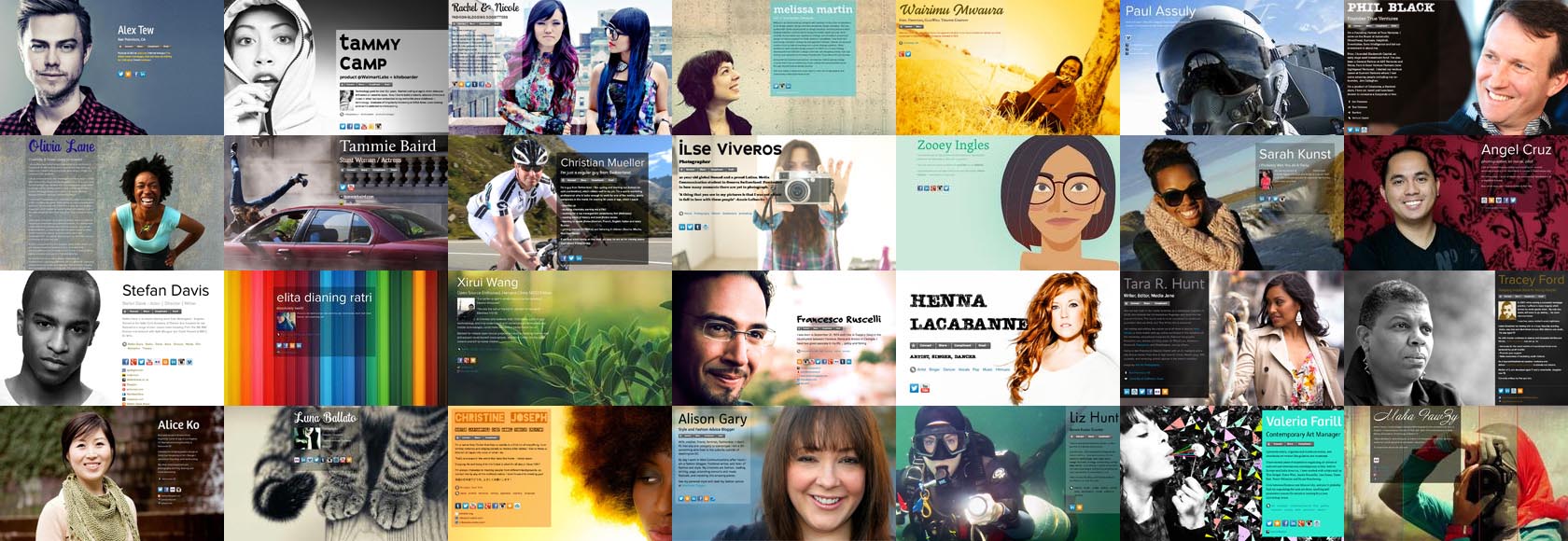
profiles-collageIf you are a student graduating soon, unemployed looking for a job or currently employed seeking a career change, the new mandate is to tailor your resume for digital appeal. Employing digital best practices will make certain your resume is delivered to the prospective employer’s inbox and boost your chances at securing the digital eyes.

More often than not, a job hunter will find they apply for a job and never receive a response or an interview invite. Prospective employers and recruiters are highly dependent on computer databases and algorithms to scan applicant resumes for a keywords and a certain format to shortlist the many applications –in some cases thousands of applicants. Databases are programmed to find the diamonds in the rough. According to Hewitt Chiu, a New-York based writer at Chiugroup.com, resume optimization can improve your response chances from a recruiter or employer. Even if you have the right skills and qualifications, the wrong format or context of your words will keep your resume in cyber land. It’s smart to start the process now to optimize your resume. Ian Siegel, CEO of ZipRecruiter (used by over 13 million job hunters) and Jerry Ihejirika author of “Your Digital Resume is Your New and Most Powerful Resume” offer a few digital best practices. Following these best practices will help you understand what works so you can make the cut and get the response.

Digital Resume Best Practices

  • Get passed computer filters. Tailor your resume to the job requirements. Resume tracking software requires the right keywords and in the right context to increase your inbox placement possibilities.
  • Be specific. Don’t generalize your experience or your skills. Showcase your skills upfront. The primary reason a resume is shortlisted because the skills match the job requirements.
  • Clarity matters. Accuracy with your length of experience is critical. Computer parsers are programmed to extract information from your resume and present the information in a hierarchical view based on the employer’s needs.
  • Detail. Detail. Detail. Add the employment experience but make certain the detail is relevant to the job requirements. Employers are looking for candidates that are a right fit and closely aligned to the job requirements.
  • Be searchable online.  Make sure your name comes up in a standard first and last name Google search.
  • Use a professional image. Project the right image for the job you seek.
  • Create an attention-grabbing format that incorporates social media websites and a link to your website or portfolio, if the job requirements call for digital experience.
  • Showcase your interests or personality.  About.me is one of six amazing tools to create the perfect digital resume, portfolio, and your personality.

Was This Helpful? Share your thoughts. If you are considering optimizing your resume, do your research. If you ready to take a leap into the digital space, Hewitt Chiu is available to help you. Hewitt is a valuable resource and experienced writer for resume optimization. Hope this helps and good luck with your resume!

References

Ihejirika, J. (2016, February 20). Your Digital Resume is Your New and Most Powerful Resume. Retrieved from http://jerryihejirika.com/your-digital-resume-is-your-new-and-most-powerful-resume/

Morris, R. (n.d.). 6 Amazing Tools to Create Perfect Digital Resumes and Portfolios. Retrieved from https://www.theladders.com/career-advice/6-tools-for-creating-digital-resumes-and-portfolios/

Walker, R. (2016, July 8). Getting Past the First Cut With a Résumé That Grabs Digital Eyes. New York Times. Retrieved from http://search.proquest.com.libproxy1.usc.edu/docview/1802450904?pq-origsite=summon&accountid=14749

Posted in Uncategorized | Tagged , , , , , , , , , | 3 Comments

Female Consumers Want More Than Pink Packaging

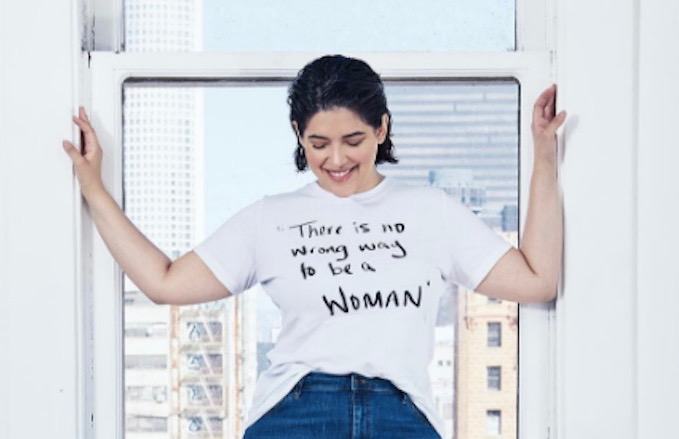
Denise Bidot

Plus Size Model, Denise Bidot promotes “There is no Wrong Way to be a Woman”

Social media is allowing brands to get immediate information about what is grabbing the attention of consumers. This information is allowing brands to stay current and helps brand better target their preferred audience. With the women leading as main purchasers in households, brands are looking for better ways to capture their attention. With immediate feedback from female consumers, brands are quickly catching on that they will need to look beyond pink packaging to get a woman’s dollar.

With hashtags like #effyourbeautystandsards, #nowrongwaytobeawoman, #leanin, and #askhermore, women are letting it be known that they want to be heard.  There has been vocal backlash about the way women are represented in the media. Brands only featuring “sample size” models in their advertising with great attention to photoshopping, some argue, is creating a damaging depiction of what women should strive to be. When girls in first through third grade wish they could be thinner, then Houston, we have a problem.

Major brands like Dove and Aerie are responding by featuring women of all shapes and sizes often without retouching. The advertisements help brands in two ways. First, the advertisements themselves appeal to a greater female audience as women feel they are able to relate the the brand and the messaging. Second, the ads generate their own social media buzz with articles praising their new advertising choices.

https://www.youtube.com/watch?v=Pqknd1ohhT4

The Dove ad employs emotional advertising to pull at the heartstrings of female consumers. Mothers speak about what they dislike about their bodies, and then their daughters are asked the same questions. The daughters seemed to have internalized a lot of the same insecurities expressed by their mothers. The ad shows the greater importance of the body positivity movement.

But it’s not just body positivity. A comment on a recent Vogue post said “I’m sick and tired of having my intelligence insulted. Like we would care about something so insipid. Unfollow.” The comment has since been deleted, but really sums up the sentiment that women want advertisers to recognize that they are more than just what they look like. A recent Secret ad event took a stab at the gender wage gap. Although some might argue the ad is a bit simplistic, at least it’s raising the issue.

https://www.youtube.com/watch?v=9ilSeJ6B5ro

Social media is providing a forum to voice what they will ultimately attract their dollar. They are seeking brands that underscore their beliefs and value them beyond their looks. If these hashtags are any implications, maybe the future really is female.


Posted in Uncategorized | 10 Comments

The Hocus Pocus of Urban Legends

I have always been a sucker for a good urban legend.  They are always so dramatic and have this teachable moment—some are scary and some are just plain hilarious.  These narratives are made interesting which allows one story teller to remember enough to tell a variation to another person (Heath & Heath, 2008).

In the spirit of Halloween, I will share one of my all-time favorite urban legends…or perhaps my story is a bunch of hocus pocus.

A couple years ago I took a trip to visit a friend in Boston, while walking past a church he decided to give me a mini history lesson.  In the era of oligarchy governments of the 1600’s, when a wealthy family would have a bad seed in the family they would often send them off to the seminary to become priest.  At the time priest were regarded very highly and this was a way a family could preserve family reputation damage from the embarrassments of their son.

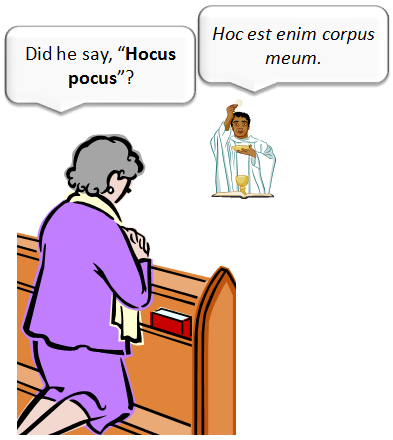
Although, there was an attempt to reform their son’s in the seminary these men would often continue their unfavorable favorable behavior, including not studying.  In that era, traditi onal catholic mass was delivered in Latin, however if a priest did not take the hocus-pocusseminary seriously they would often leave without learning proper latin.  During mass there is a sacramental portion where the priest is supposed to say in Latin “Hoc est corpus meum” which translates to “this is my body”.  However, due to their vices many priest would often forget the latin language and improvise and say hocus pocus!

When researching for this topic I could only find the portion of faux-latin translation, but let’s face it, having the version with the bad seed of the family make this urban legend much more memorable.hocus-pocus-1024

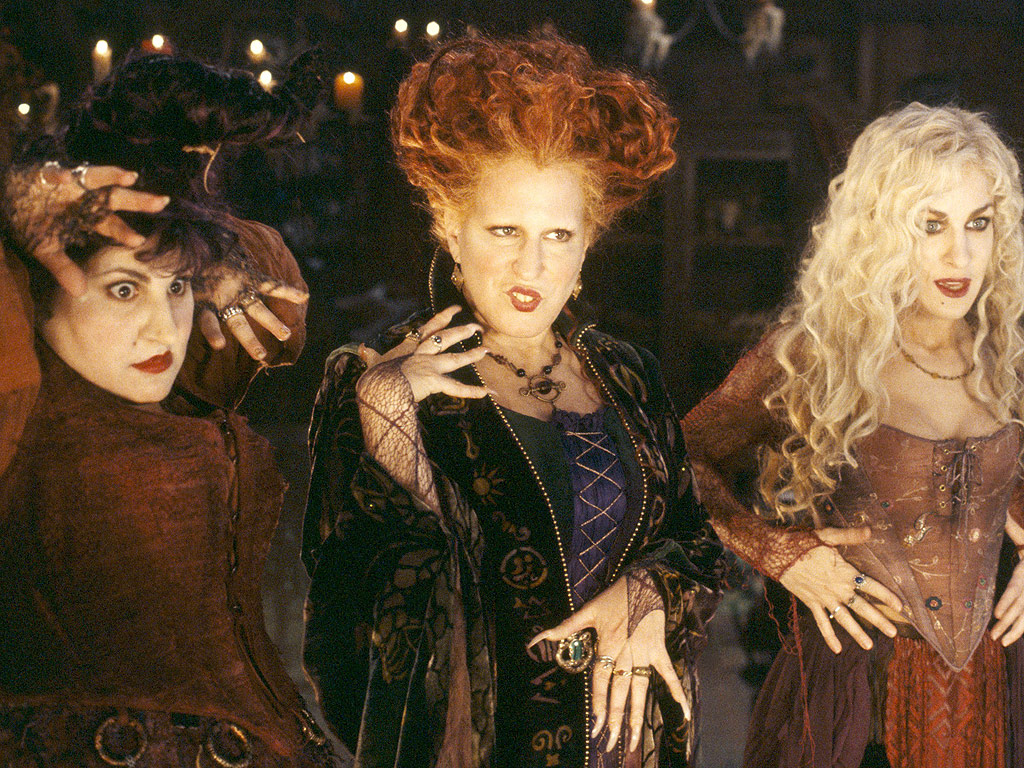
Today the word, hocus pocus, refers to a meaningless expression or to play a trick on someone.  Which makes sense considering they were making up words.  Alternatively, if you were a child in the 1990’s you may recall Hocus Pocus as the 1993 Disney movie starring Bette Midler and Sarah Jessica Parker (see image).


Heath, C.  & Heath D. (2008) Made to stick: Why some ideas survive and others die. New York, NY: Random House.

Posted in Uncategorized | 12 Comments

#doyougetwhatimsaying

When used correctly, hashtags and social media campaigns can elevate a brand. On the flip side, if they’re poorly written, they can have the opposite affect. I often find myself looking at longer hashtags and having to carefully read them to understand what they’re trying to say. Although hashtags seem like a minuscule part of a marketing strategy, they have the potential to make a large impact.

As a business owner, I understand the importance of this as I drove all of my business through social media- Instagram and Facebook. My Instagram username, Bamabina_Bakes, ties into my hashtag #BambinaBakes. I also encourage anyone who posts my work to use my hashtag in order to gain more visibility.

Just as there are strategies for large marketing campaigns, there are for small social media campaigns as well.

You’ll want to make sure you’re using your hashtag on relevant content. I wouldn’t post a picture of my incredibly cute dog and add #BambinaBakes.

If you’re using your hashtag on Twitter, be prepared for discussion. Good and bad. There are always people who may not like what you post. Larger corporations often see negative feedback on social media campaigns because the audience knows someone is reading it and running damage control.

Instagram and Facebook did not used to have an edit feature, but luckily for most brands they do. I read about Sephora’s social media mistake: They left out the U from their #CountDownToBeauty campaign… woops.

Have you witnessed a hashtag gone wrong?

Hennessy, R. (2016). Your Hashtag and Your Brand go Hand in Hand. Entrepreneur Media, Inc. Retrieved from https://www.entrepreneur.com/article/282109.


Posted in Uncategorized | 4 Comments