Search Engine Optimization (SEO) is something many businesses spend a lot of money and time on. After all, ranking high on sites like Google and Yahoo can lead to a huge boost in revenue. There was a time when things like keyword stuffing, buying mass links and duplicating websites was common practice in implementing an SEO strategy. However, in recent years many major search engines have made an extra effort to change their algorithms to work against these kind of tactics.
So what is it exactly that search engines say will rank high? Two words: Quality content. Search engines are working hard to provide their consumers with the content that is
Some people compare SEO experts to snake oil salesmen.
relevant and easy to digest. So what do they deem as “quality content”? Original, timely and relevant content with no signs of a webmaster trying to game the system.
But what does this do for the small business owner trying to fight through the clutter and get on Google’s first page? Many argue this limits a small businesses ability to compete with big contenders because quality content cost money. While others claim it makes the internet a better place.
My question to you is, what do you think? Are the new content demands of search engines making things better? Could it potentially hut small business? I would love to have some dialog in the comments below.
Have you heard of Cards Against Humanity? It’s much like Apples to Apples, but where the object of the game is to come up with the funniest most horrible phrase possible by filling in the blank or answering a random question. The self-described “party game for horrible people” would make a great gift, but it’s such a small company that it has to use creative ways to advertise during the holiday season. The game was crowd-funded on Kickstarter in 2011 and is technically free since it’s licensed under creative commons and can be downloaded to print. Cards Against Humanity (CAH) has used alternate reality games (ARG) to engage its consumers over the holidays for the past few years. “Alternate Reality Games take the substance of everyday life and weave it into narratives that layer additional meaning, depth, and interaction upon the real world” (Martin, Thompson, & Chatfield, 2006, p.6).
Last year, Santa took a vacation and left it in CAH’s hands to give gifts on the 12 Days of Christmas. For $12, participants were sent 12 random gifts, including customized packs of cards and a lump of coal. There were secret cards hidden in the lining of the packaging, and a mysterious game called “Holiday [BS]” with hidden clues to a complicated puzzle that customers work for months to figure out on Reddit. The first person or group to submit the correct answer gets a prize. CAH shared a blog post breaking down the solution to the 2013 campaign’s puzzle, which ended up being the Black and White card pairing: But Before I Kill You Mr. Bond I Must Show You ________; The True Meaning Of Christmas. This year, CAH killed Santa, and decided to launch another season of Holiday BS with a video of the funeral. For the “10 Days (or whatever) of Kwanza” campaign, $15 gets participants 10 gifts randomly delivered in December.
According to The Economist, more brands are beginning to use “Alternate reality” games to engage their audiences with puzzles weaved into a storyline told via both tangible and online platforms (Technology and society, 2009). This is a natural progression for a game company like CAH, but there have also been massive successes with movie releases, retail product launches, and fast food chain promotion. I think that this kind of quest is the future of content marketing to entertain consumers. There’s nothing like a puzzle to become top-of-mind. The CAH campaign is well integrated across its website, Twitter, Facebook, Tumblr, and Reddit, with a consistently snarky tone, much of the same content including the video of Santa’s funeral shared across platforms, and heavy use of user-generated content, particularly on Reddit and Twitter.
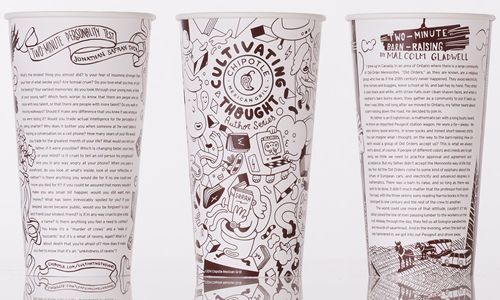
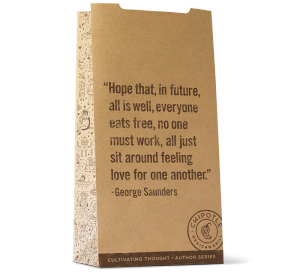
When reading the chapter Execution is the X factor from Brand Media Strategy, I come up with some interesting campaigns which impressed me with different consumer experience. The “Cultivating Thought” campaign of Chipotle has become one of my favorite marketing campaigns in recent years. Chipotle Mexican Grill launched the “Cultivating Thought” author series in May, 2014, featuring original essays written by influential thought-leaders, authors, actors and comedians on its restaurant packaging. Created in partnership with New York Times best-selling author Jonathan Safran Foer, who curated the series, these stories are meant to entertain customers while exposing them to some of the most creative and influential people of our time.You will never get bored when consuming products from Chipotle.
In consistent with the brand message of aiming to change the way people think about and eat fast food. This author series serves as an extension of the company’s mission to tell their unique story by engaging customers with thought-provoking ideas and cultural issues. Chipotle even made the statement to show that this series is different from others. It is not an advertising like other fast-food restaurants. Here is what chief marketing officer, Mark Crumpacker, said: “Packaging in fast food restaurants is typically sold to advertisers, or used to promote new limited-time menu items, but we have never used our packaging that way, instead, we have used it to entertain our customers using wit, humor and design.” Nowadays, direct message about telling people to buy products is rather difficult.I think Chiptole has smartly made a campaign by creating a new type of consumer experience instead of making actual annoying direct advertisements.
In February this year, to introduce a new line of shampoo a Swedish pharmacy installed digital billboards in the subway. These billboards were very different from most, as it was equipped with ultrasonic sensors that detect oncoming trains. As a train approached the station, the hair of the model of the billboard would get blown by the “wind” from the train as a person with long hair on the platform would, thus making her “hair come alive” (Apotek Youtube Video). This went quite viral beginning of the year and I am sure many have seen the video but here it is again:
In October, for two days, another copycat hit the Swedish digital billboards in the metro….
…but this time it was MUCH MUCH more impactful.
Barncancerfonden did an amazing job using a surprise element (as most people in Sweden were aware of the Apotek Shampoo ad and had an expectation of its ending) to deliver a shockingly impactful message that every day at least one child is diagnosed with cancer. Moreover, it creates a sudden change in emotional intensity- apparent from the looks of bystanders where they changed from being amused to being upset- that allowed an ad that only appeared in one subway station for two days to become a viral ad that received more than 2.5 million views on YouTube.
Creating awareness does not have to be come from a large media spend (although of course that helps); an idea that can emotionally move the audience to act can deliver a much higher ROI. Barncancerfoden use of advertising, technology, insights, and psychology successfully delivered to all ends of the world a beautiful message that everyone needs to be aware of.
Now this semester has only three weeks to go. I believe everyone has already started their stressful and sweet Christmas gifts shopping . John Lewis is a chain of upscale department stores operating throughout Great Britain. The John Lewis Christmas campaign has become a symbol of the start of the British festive season. For the past several years, John Lewis has been gaining profile for its annual holiday mini-movie, a heart-melting story that ushers in the festive season. Getting the stories both presented the greatest challenge and the widest opportunity to the creators of last year and this year’s £7m holiday campaign from the U.K. retailer.
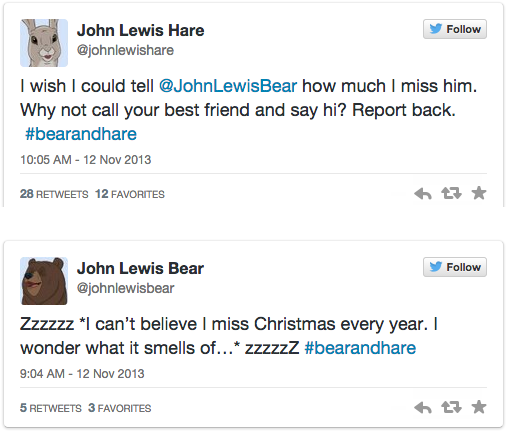
In 2013, John Lewis looked to the animal kingdom and produced a tale of an unlikely woodland friendship, “The Bear and the Hare.”
What would be the perfect gift? Nothing beats the gift of Christmas!
This campaign showed the public has a clear appetite not just to watch an ad but take pat in it, too. So, as well as an ebook and a paper version, there is also interactive app with games and other activities, merchandize, a make-your-own Christmas card app and opportunities to visit Bear’s cave in 11 John Lewis stores.
In 2014, John Lewis has picked a penguin to lead a Christmas marketing campaign which is just as ambitious as last year. The 2014 campaign is once again bidding to be one of the media events of the year, encompassing a slick TV commercial, a specially created smartphone app, story book, soft toys and in-store events including a chance for kids to see their toys brought to life with the aid of experimental gadgetry.
Everyone knows what John Lewis’s Christmas Christmas advertising is really about. It’s not about this year’s cuddly penguin or last year’s bear and the hare. It’s about inducing a warm feeling of goodness and love.
What do you think about this department store’s marketing campaign for Christmas? Which one is your favorite?
Today I am going to write about the phenomenon of the parody in advertising. No news that parodies have become an almost indispensable part of the mainstream advertising. YouTubers and bloggers all around the world are united in creating and spreading their interpretations of the ads. In fact, the more creative the idea behind the ad is the more skillful the parodies are.It took time for brands to understand how they could leverage the popularity of parodies and turn it into a free buzz and a way to entertain, engage and continue conversation with the audience. Certainly, not all parodies bear pure satire, some could become quite bitter. And although it is up to the brands to decide whether to create a “parody-proof” commercials or become skillful in their reactions to the parodies one thing is clear: brands have to face the necessity to deal with parodies. Things get even trickier when parodies are created by celebrities or other brands such were the cases with Channing Tatum for Volvo, or Google and Nestle’s KitKat. While there are lots of amazing pieces of parodies, I wanted to share the recent satire parody created by 2 great actors that I absolutely adore. Enjoy, mind the number of likes and it’s your turn to make conclusions.
There’s no question that smartphones have become an intimate part of our daily lives but I noticed that lately they’ve been getting a bad wrap as a possible danger to the privacy and security of others. For instance, the Huffington Post published a recent “Guide to not getting arrested” when using a smartphone at the election polls. Additionally, the New York Times wrote about efforts to ban Smartphones in Gyms. For a third example, many New York restaurants have launched an informal ban on taking photos of food. According to DigitalTrends, even a number of musicians like Prince, Beyonce and Bjork are banning the use of smartphone cameras at concerts. In this climate of rising concerns about the impact of smartphones on society it may be that the problem isn’t native to smartphone at all. To explain, let me take you back to the beginning of another technological innovation: the photograph.
[Cue Tardis time-travel music]
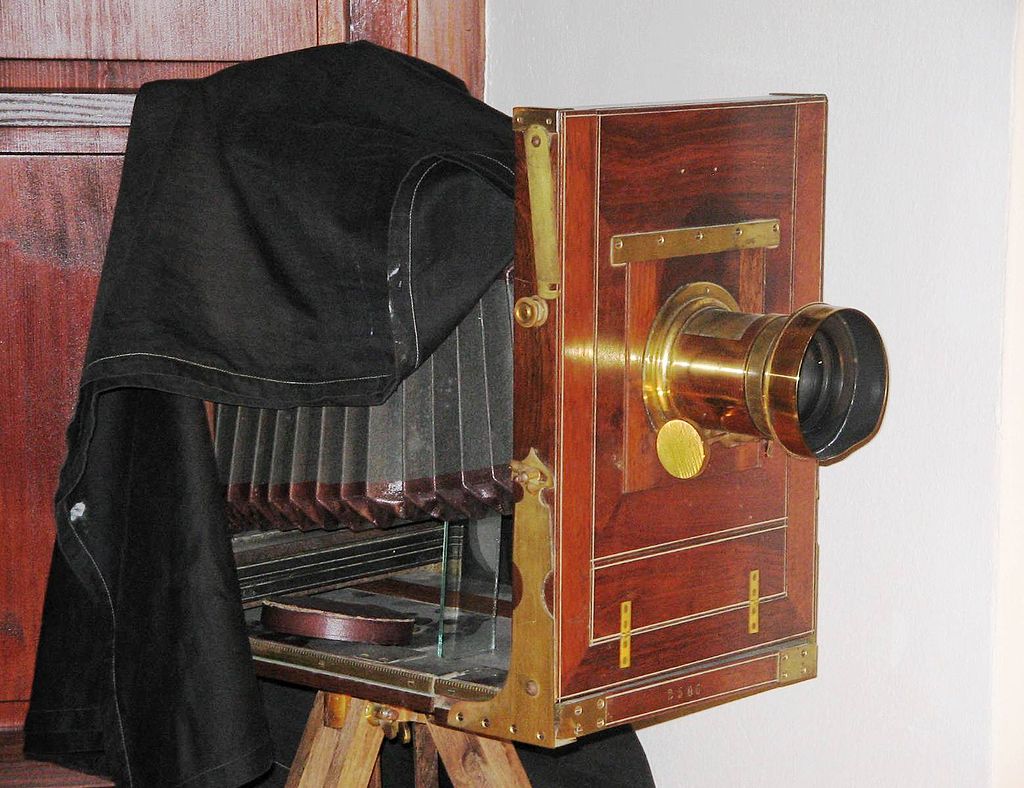
When the first compact camera was built at the end of the eighteenth century it didn’t take long for people to realize that a photo could be taken on Wednesday and placed in a major newspaper on Thursday. In short, the activities that comprise our private, personal and public lives could now be documented and shared outside of our control. Photographs were clearer and more reliable than human memory too, so naturally photos became increasingly trusted media. People loved that images could be captured and stored as momentos but the photograph endangered brands and leaders because those that would espouse a belief but fail to behave in accordance with it could suddenly be held accountable. A flurry of HIPAA and Confidentiality laws like the Electronic Communications Privacy Act of 1986 (ECPA), Computer Fraud and Abuse Act 1984 and Childrens Online Privacy Protection Act of 1998 (COPPA) were passed to protect the privacy of individuals but the social norms at the time were woefully inadequate. Today, Americans (along with the rest of the world) are still adjusting social norms to catch up with the pace of evolving technologies. In other words, like the Truman Show life is a little different when it’s spent on camera – and that could take a little getting used to.
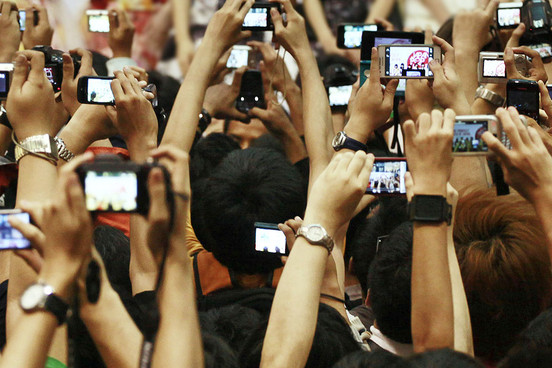
Smartphones are used to take pictures everywhere now – for better or worse.
The Smartphone was key in this process because it spawned a generation of amateur photographers. But privacy concerns haven’t been limited to smartphones. Cameras on other devices have been in the news too. According to the Los Angeles Times, Drones also bring up similar privacy concerns plus they enable photography from an anonymous, remote location. Regardless of the gadget, information can now be shared wider and with greater ease in this new world via mobile enabled social media too. Ultimately, the photograph always had the power to hold individuals or brands accountable for their actions. The difference now is that mobile has enabled the photograph to be a much more potent force for accountability than it has ever been.
But what does this mean for brands today?
Well, marketers looking to engage mobile users probably will want to be conscientious of these privacy issues and understand that the smartphone (despite all the guff it gets) is actually loved very much by most of us – so much so that statistically it’s likely that while reading this article your phone is within reach. Respecting that relationship will be a paramount concern for marketers. Photos present some other challenges too. Brands have reputations to manage so content that jeopardizes the state of that reputation may be viewed as a threat to economic prosperity. Furthermore, the matter of who owns what content factors into the legalese of it all, which impacts how images can be used in court. Remember when Facebook bought Instagram and then essentially said “now we own all your photos”?
There may have been more to that move than many of us realized.
Personally, I view privacy laws being passed as societies way of adjusting social norms. Call it a techno-cultural evolution. Ultimately, it may be helpful to differentiate smartphone activities and regulate the behavior that we want to correct. In this case our rabble-rouser is the photograph, so is it fair that laws should be levied against our beloved smartphones? Is this the only way to create social norms around new (potentially disruptive) technology or is it possible for people to regulate their etiquette through sheer decency?
In years past, television advertising was an essential part of the media mix for any brand seeking build awareness and increase market share. As a marketer with a specialty in online strategies, I have been instrumental in shifting a large portion of my organization’s local television advertising budget to online advertising – search and display. So of course, I am perched on the edge of my seat as others take the same approach. When a brand pulls from its television budget, I pray for their success because it will further justify my recommendation that we do the very same thing.
So, this week when I saw a post on adage.com about one of my childhood crushes and nerd heroes, Wil Wheaton (aka. Wesley Crusher from Star Trek Enterprise) and his involvement in a fully digital campaign for Newcastle beer, I was intrigued. Newcastle it seems is counting on Wheaton’s reputation, his geekiness about beer, and his built-in following to turn their beer into the beer of choice for nerds everywhere.
While this new campaign featuring Wheaton is funny, interesting and compelling, I wondered if there might have been other studies about the topic of TV vs. online advertising in the past few months. A quick search through academic journals turned up an article in the October issue of the Journal of Marketing Research.
Draganska, Hartmann, and Stanglein (2014) in a comparative study on brand-building via TV vs. online advertising, made one very important conclusion:
“after adjusting for the preexisting differences in brand knowledge by format, we find that all three online formats—banner ads, rich media, and online video—exhibit ad performance that is statistically indistinguishable from TV”
(p. 579).
I had to read that sentence three times for it to really sink in – we now have an academic study that states that TV and online advertising are equal for the purposes of brand building. Wow.
The article also alludes to the fact that while online advertising is now significantly less expensive than TV, as the practice of online advertising matures, costs will likely increase (Draganska, Hartmann & Stanglein, 2014). But for now, as marketers, we have before us the opportunity to build big brands on small budgets. An opportunity that I don’t intend to let pass me by. How about you?
Draganska, M., Hartmann, W. R., & Stanglein, G. (2014). Internet versus television advertising: A brand-building comparison. Journal of Marketing Research, 51(5), 578.
As we ramp up to the semester’s end, “be more dog” and embrace the fun in life sounds like a good message.
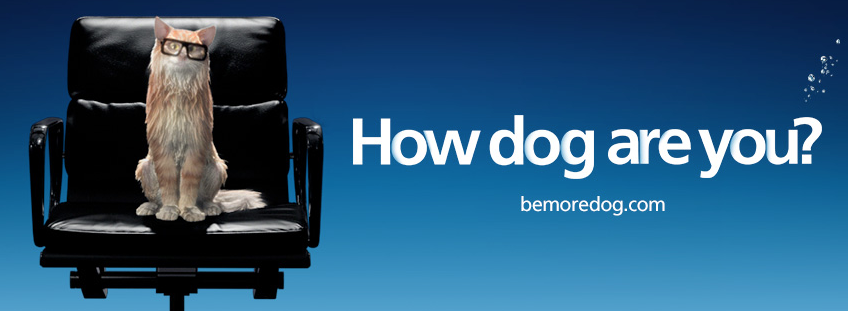
O2 is a mobile telephone service provider hoping to be top dog in the UK. O2’s Be More Dog commercial features “Ginger O2 Cat,” who is going through an identity crisis. Being aloof and indifferent is no longer as fulfilling to Ginger as it used to be, so he’s on a quest to feel the breeze in his fur and catch the frisbee of life.
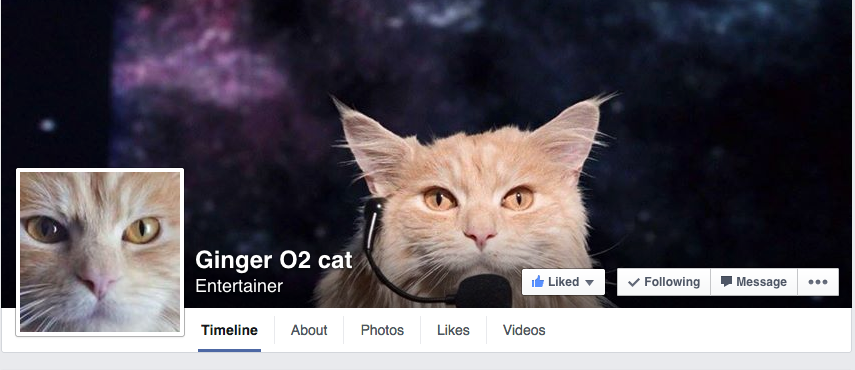
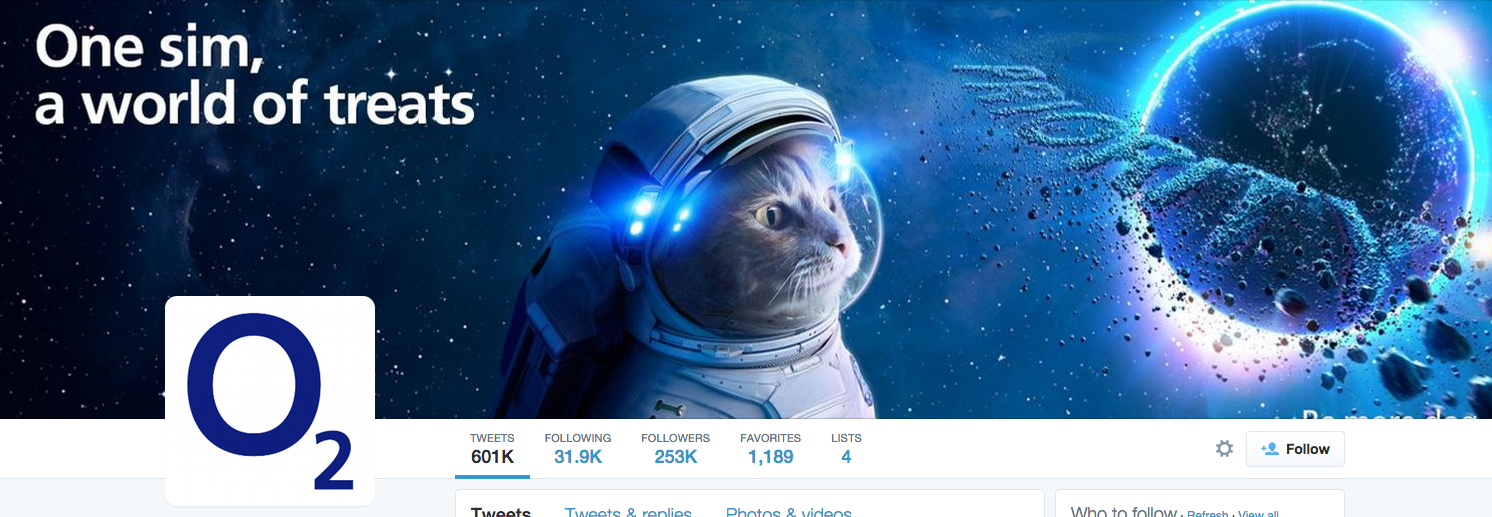
O2 features Ginger on its home page, the O2 Twitter feed, O2 Facebook page, and Ginger even has his own Facebook page. You can see here that I Liked Ginger’s personal page.
Rather than waiting for pesky 2-year mobile contracts to run out, O2 uses Ginger to encourage customers to “be less patient, Be More Dog” in its No Waiting commercials. But O2 isn’t limiting themselves to Ginger and the Be More Dog campaign and saturating their platforms with the same content.
The brand has an energetic and fun digital presence associating the brand with music, sport, food, travel, and they use high-profile celebrity endorsements for O2 Priority, a mobile service on O2 devices that allows customers access to pre-sale tickets to “some of the hottest gigs and live events.”
While we may not have much time to Be More Dog until the semester ends, there’s always two minutes in everyone’s day to watch Beyonce!
This past week we celebrated Veterans Day. While it is only one day, it is good to see we now celebrate our Veterans every day. Today, we thank those who have served. More than that, we walk up to these brave men and women, look them in the eye, and sincerely thank them for their service.
That is why I got a little tear in my eye when I saw this one day ad from the United Service Automobile Association (USAA) thanking those who dare to take the oath:
This “jab” (Vaynerchuk, 2013) never mentions the products USAA offers. It does, however, remind us about the audience it serves – and in turn, the audience that serves all of us. Along with the ads, USAA used the twitter #ThoseWhoDared to talk about, thank, and celebrate the service of individuals and focus on ceremonies to honor service members.
USAA ads have a consistency in execution in its television spots. Most in some way say “thank you” to a parent or spouse for serving, which in turn allows them to have access to these financial products. These ads are highly emotional and pull on the pride heartstrings that bind us as Americans. It’s difficult to watch these and not feel at least a little patriotic.
To my husband who served as an MP in the Army, to my dad who served in Vietnam and was spit on when he returned home, to my uncle who was in the first class of Navy Seals, to my cousin who is an Army Ranger, to my friends and the countless others I’ve never met who wrote a blank check to this country for an amount up to and including their lives – I am eternally grateful. Thank you.
Resources:
Vaynerchuk, G. (2013). Jab, Jab, Jab, Right Hook: How to tell your story in a noisy, social world.