Five Vacation Destinations Just Added

Whenever people ask me to reveal one thing that’s interesting about me, I always get stuck. I always end up saying something like, “I bet you’d never guess that I love country music.” Sure, people never would have guessed I watch Nashville religiously, but I just remembered one thing about me that may be slightly more interesting.

I’ve been out of the country about a dozen times in my life and a handful of states in the U.S. Some of my favorite places include Taiwan, Singapore, Spain, France, Japan, Thailand, Korea, and Hong Kong. The one thing that these places all have in common is McDonalds. People don’t understand it, but every time I step foot in a new country or even a new state, I MUST visit a McDonalds. Some countries will have different, special, items on the menu to cater to the local taste. I had popcorn chicken with special seasoning in Japan, a pineapple pie in Thailand, and kimchee flavored fries in Hong Kong.

Instead of searching for new and interesting dishes at McDonalds, I just came across very interesting architecture that made my vacation destination list just a bit longer:

First on the list would be a McDonalds with a view in Yang Shao, China.

mcdonalds 2 -

Second, I plan on visiting this McDonalds in an old DC3 plane in Taupo, New Zealand.

mcdonalds 3 -

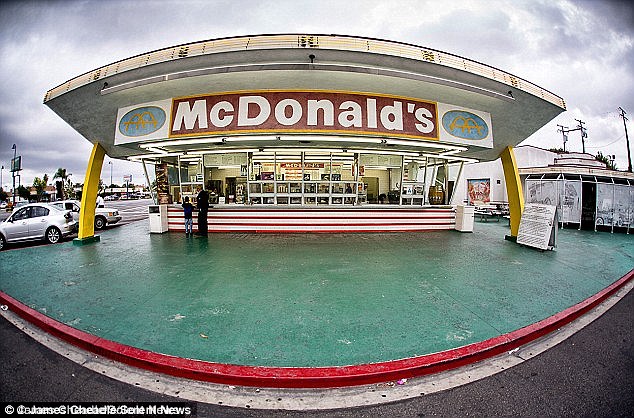
Third, this is the first McDonalds still preserved the original look in Downey, CA.

mcdonalds 5 -

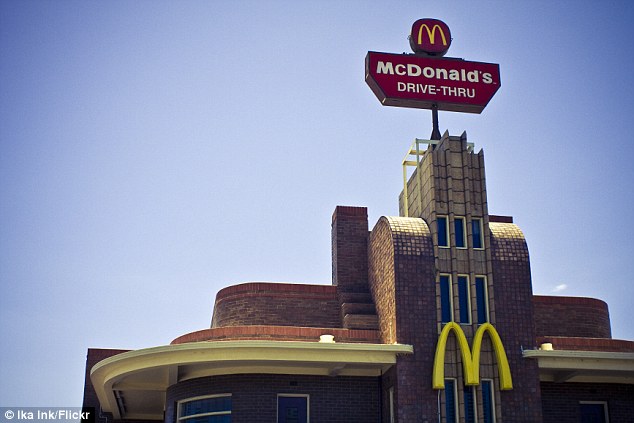
Fourth, this art deco style McDonalds is located in Clifton Hill, Melbourne.

mcdonalds 4 - georgian mansion hyde park new york

And finally, I definitely want to make it out to this Georgian Mansion in Hyde Park, New York.

McDonalds recently started changing the look of their design from the signature red and yellow to more muted colors to make it look a little more upscale. I would definitely say that the photos above are doing the trick. What do you think?

Newton, J. (2014, September 1). The turquoise arches? McDonald’s is forced to paint sign after officials say yellow ‘too garish’. Retrieved on November 22, 2014 from http://www.dailymail.co.uk/news/article-2739701/McDonald-s-forced-open-turquoise-coloured-restaurant-s-not-fast-food-giant-s-unusual-store.html#ixzz3JsGxK1Lh

Posted in Uncategorized | 11 Comments

Is Google selling the rope that we plan to hang them with?

Google is currently conducting an online experiment in alternative funding for the internet, which it has called Contributor. The program, which allows website viewers the option to a monthly fee of a few dollars to have ads removed from the site, is deemed “an experiment in additional ways to fund the web.”

When I stumbled upon this article while researching a topic for this blog post, I thought to myself “this seems to be the exact opposite direction the web is going.” Google, the company that brought me the free software platform (Google Docs) that I am writing this blog post on, is now experimenting with paying for ad-free website access.” Certainly, the old saying about how “a rich man will sell you the rope you plan to hang him with” did cross my mind as well.

After thinking about the program for a little while, I thought that the concept of paying to remove ads raises a valuable question of in regard to internet ethics: Should only those who can afford to pay, be allowed to block ads? And if the more affluent – the ones advertisers usually want to reach the most – are suddenly able to opt out of seeing advertisements, what does this mean for the future of web advertising? And lastly, seeing as how Google users pay for the privilege through Google, does it raise ethical concerns about the objectivity?

In regard to the first issue, the same issue has been raised with toll roads; the idea that the rich should not be able to buy their way out of traffic. Some might argue that being forced to view an ad is not a big deal, however, it could be a slippery slope. It could be only a matter of time before certain areas of a site are available to the ad-viewing public. Eventually, turning (or returning) the free and open internet to a pay-to-view domain.

From an advertising aspect, it also raises the question of the continued viability of online advertising. According to this article from AdWeek, 94 percent of ads on YouTube are skipped after the preroll. From an advertising perspective, if the only people who will see your ads are the people who won’t shell out $1 to make your ad go away, it serves to believe they won’t shell out the cash to buy your product either. Websites would probably claim to advertisers that the quantity of viewers may be diminished, but that the quality of those who are reached is heightened by the viewer not opting out of seeing the ad.

Lastly, should Google have the right to block ads for certain websites, but only if the site is willing to give Google a portion of the proceeds? There is no practical reason why a company would need to give Google a portion of the proceeds from the ad-removal sale. Any company can simply do this themselves. So it gives food to thought about how Google would protect this new business model. Google supporters would likely claim that the company would maintain a competitive advantage in this new business model by developing a comprehensive partnership across numerous channels to insure ease of transition from one site to another. Whereas Google detractors would likely claim that the more probable scenario is that Google will drive users toward sites that are on the payroll in a form of internet extortion.

The entire concept is odd, as Google still generates a large percentage of its revenue through ads. Are they selling us rope to hang them, setting the groundwork for internet extortion or just demonstrating, as they have done time after time, that they are far ahead of the curve.

While paying for internet is seemingly the internet returning to its roots, the easiest sign to grasp from the Contributor is that the business of the internet is constantly evolving; never content to rest on it laurels. And as things in the internet change, the more they stay the same . . .

Posted in Uncategorized | 9 Comments

Make It Personal

No matter what industry you are in, social media and marketing are bed fellows here to stay.  At least into the foreseeable future!  Optimizing your posts can be a digital marketers toughest jobs.  With so many experts, guru’s, specialists out there, it can be difficult to know which social network will work for your business, as well as what you should post on those social networks that will entice people to respond.  Often times, using your own voice to share information, some of which may not have much, if anything, to do with your business may garner attention that your post may not have had if it was focused purely on selling your product (Vaynerchuk, 2013).  As long as the story or information is posted on an established network with a receptive audience, it will go a long way to building credibility and a strong online reputation (Young, 2010).  A reputation like the owners of The Greenroom have developed over the last year or so.

Kim and Penn Holderness started the company Greenroom as a video production company specializing in unique productions for digital marketing and much more.  The Holderness family, in conjunction with their company site, also started a family blog showing of their unique sense of humor, and their creative talent.  If you’ve had a chance to visit any of the sites listed above, you may actually recognize some of the videos that the family has produced in the last few years.  They have been featured prominently on YouTube, and have been shared on Facebook numerous times by people all over the country.  The uniqueness of their comedy and their music video’s have taken the family a long way, but not once in their family videos have they mentioned their business.  It’s not until you dig a little deeper that you find out that the videos they make are actually a part of what they do for a living.  This is an example of exactly what Vaynerchuk talks about when discussing how little items that may seem meaningless at the time can bring attention to your business and allows you to prepare for that right hook (2013).

Below you will find one of their most recent videos. However, checking out the rest of their videos is recommended.


References

Vaynerchuk, G. (2013). Jab, jab, jab, right hook: How to tell your story in a noisy social world.

Young, A. (2010). Brand media strategy: Integrated communications planning in the digital era. New York: Palgrave Macmillan.


Posted in Uncategorized | 8 Comments

FaceBook changes the rules, again. To which I say “good!”

Any posts generated by a brand that appear to look too much like an advertisement will now have their reach restricted by Facebook (Peterson, 2014). The company announced this change last week, but it has not created any panic among marketers (Peterson, 2014). This makes me wonder if they saw this coming. It seems that many of them did. Maybe. I am sure that many marketers understand that the type of posts needed to engage and connect with consumers on social media cannot look like a magazine advertisement or a “buy this!” advertisement. Vaynerchuk (2013) uses his book to explain to the reader that the way to successfully use social media is to understand each individual platform, create content that starts a conversation, and understand the audience.

This seems like easy advice, right? Then why do so many posts still looks like an ad? I am sure that many of us have subscribed to the page of a favored brand only to find that instead of interesting stories or posts with relevant news, we find our newsfeed cluttered with posts telling us to “BUY! BUY! BUY!” When I see these posts I ask myself “Why? Why? Why?” While five years ago the idea of social media marketing may not have been a hot topic, this is definitely not the case today.

Chris Bennett (2014) states that having a social media presence is a “checkbox item” (para. 1) for any company. There, right there is the problem. Companies are looking to check the box that they have a social media account and then use the same advertising content from emails and magazines to fill the void. So the new rules imposed by Facebook are right on track. Many marketers may not have made much noise as they have not realized what this means. It would be interesting to see what grumblings occur a few months from now when the reach numbers are analyzed and compared to previous months.

It is probably safe to believe that the companies spending the money to create a social media strategy, upwards of $100,000, are the one’s who are trying to learn the right way to create an engaging conversation versus a bland advertisement mill (Bennett, 2014). At least I hope they are. The issue is that the companies are not taking the time to comb through the data they receive from social media. Data that Bennett (2014) says holds the key to creating engagement. It always seems to come down to time, which is why many companies have started to employ a social media specialist as part of the brand management team. This person’s job is to upkeep the many social media platforms for the company, look for ways to engage in conversations, and draw in more followers. With this becoming the norm, along with the new rules from FaceBook, I imagine that the amount of money allocated towards social media will increase as will the importance placed on doing it right.

References
Bennett, C. (2014, November 19). Social Media’s Role Will Soon Shift From Driving Awareness to Creating Revenue. Entrepreneur. Retrieved from http://www.entrepreneur.com/article/239764

Peterson, T. (2014, November 19). Advertisers shake off FaceBook’s latest reach cut. AdAge. Retrieved from http://adage.com/article/digital/advertisers-shake-facebook-s-latest-reach-cuts/295913/

Vaynerchuk, G. (2013). Jab, jab, jab, right hook: How to tell your story in a noisy social world. New York, NY: HarperCollins Publishers.

Posted in Uncategorized | 6 Comments

Pizza Hut’s Rebranding

pizzahut

I’ve been looking at the different ways that companies reinvent themselves as food for thought and inspiration for my final project in 541. Pizza Hut is has launched a major re-branding and I thought it was worthwhile to take a closer look. In a Business Insider Article titled “Pizza Hut Asked A Bunch of Old Italian People To Judge Its Pizza,” Pizza Hut pokes fun at itself, taking perhaps some of its harshest critics and having them try their pizza.

There are a few reasons why I think this works well. It is a well known fact that pizza from Italy and pizza from the United States are so different, they may as well go by a different name. While Italians focus on the quality of the ingredients and keep it simple, American’s put everything from chicken to pineapples to pesto on their pizza. Considering that Italy is the birthplace of pizza, Italians are very opinionated about what constitutes good pizza.

I like that Pizza Hut poked fun at itself by allowing the old Italian folks to look at their new pizza options with utter disdain or indifference, it was hilarious! And bringing in other “new world” things such as jeggings and EDM didn’t hurt either. It was both entertaining and effective. The narrative of the old world and where pizza came from was also a nice touch and visually, this was a great commercial ad.

What do my fellow Trojans think?

References
Griswold, A. (2014, November 22). Pizza Hut Asked A Bunch Of Old Italian People To Judge Its Pizza. Retrieved November 22, 2014, from http://www.businessinsider.com/pizza-hut-asked-a-bunch-of-old-italian-people-to-judge-its-pizza-2014-11

Posted in Uncategorized | 6 Comments

HBO Going Over The Top

hbogo__130212205841

In today’s ever changing media consumption world, one thing seems to be clear. People are starting to evaluate their cable bundle more than ever before. They look at their increasingly large cable bill, typically north of $75+ dollars, even for just one person, and wonder to themselves if they really need to have the service. A household with multiple TVs can even have cable bills north of $200+. Because cable and satellite companies like Comcast, Dish, DirecTV are having to pay more money than ever before for the rights to broadcast properties such as ESPN, TNT, USA Network, etc… they are having to increase the costs to the consumer. And because ESPN, TNT, USA Network are having to spend more money on sports programming rights, or are spending more money on original content production (versus simply buying shows in syndication) they are having to charge these cable and satellite operators more money than ever before. Either way, all of these factors are contributing to the rising costs in cable and the consumer is starting to show signs of malcontent. Some consumers are cutting their cable cords; while others, typically younger folks, aren’t ever even buying cable all together. This sudden change leads to an interesting question, if the consumer by and large decides to ditch their cable package, how can leading TV networks protect themselves and survive in this new world?

For HBO, the answer is by creating an over the top service (Hayes, 2014). HBO announced at a recent event for Time Warner Shareholders (HBO’s parent company) their intentions to make their HBO Go product available as an over the top solution for non paying cable customers in 2015. Previously, you could only have access to HBO Go if you were paying for HBO through your cable service. In 2015 they are going to make this app/service available to those individuals that don’t have cable. The price is going to be comparable to the price you would pay through your cable company, ie $10-$15 a month; so to HBO they won’t profit more or less directly from subscribers of either cable or their over the top service direct. The stated goal by Time Warner CEO, Jeff Bewkes, is to continue to play ball with the cable companies, who need HBO as part of their bundled packages for subscription, but the reality is that this is a step being taken by HBO to protect themselves in a world where consumers may rely solely on broadband to deliver them their favorite content (Kafka, 2014).

HBO wants to get the consumer in a broadband world used to paying them $10-$15 a month so that if everyone converts to the broadband based product, consumer pricing does not change, therefore HBO still sees the same revenues. Yes, this product may start out only serving the 20+ million homes that don’t have cable (roughly 100+ million homes have cable) and provide HBO a nice increase in revenue and subscription additions, but its more about their need to create products that will appeal to those who are thinking about cutting their cable subscriptions. And HBO stands to gain in subscription from this by removing the barrier of entry to their product, ie cable packages. Maybe now events like the Game of Thrones season finale won’t be the most pirated show of all time (McGregor). While surely this makes the content creators happy that people are willing to risk jail time to watch their show; HBO understands that they simply need to offer these folks a digital only service if they wanna watch that show so badly. Obviously, not all pirates will pay for the service, but some may, which only increases revenues.

To survive in a world where cable packages are unbundled, and the consumer can get enough of their content over the top through streaming services, TV networks must be mindful. They need to start laying the foundation now by creating compelling over the top products. While they can start out being products only accessible through cable subscriptions, much like HBO, over time they may want to think about letting those that don’t have cable available to buy. Then, as more and more consumers break free from cable packages, they’ll have a product waiting for them if they still deem Adult Swim, nickelodeon, etc… must have content providers. Yes, this will piss off the cable companies like Comcast, etc… but don’t worry, they’ll just increase the cost of broadband 3x and get their money…

So, what do you guys think the future of TV is? Will everything be over the top, accessible by broadband? Or will cable TV still survive as we know it 10-20 years from now?

References:

Hayes, D. (2014). Are CBS and HBO Streaming Service Plans Actual Steak or Mostly Sizzle? Retrieved from http://www.forbes.com/sites/dadehayes/2014/10/16/are-cbs-and-hbo-streaming-service-plans-actual-steak-or-mostly-sizzle/

Kafka, P. (2014). You might be able to pay for HBO without paying for Cable. All Things D. Retrieved from http://allthingsd.com/20130930/you-might-be-able-to-pay-for-hbo-without-paying-for-cable-but-youre-still-going-to-pay-the-cable-guy/#

McGregor, J. (2014). Game of Thrones finale becomes most pirated show in history. Forbes. Retrieved from http://www.forbes.com/sites/jaymcgregor/2014/06/17/game-of-thrones-season-finale-becomes-most-pirated-show-in-history/


Posted in Uncategorized | 5 Comments

Yeah….they’ve got your number.

bigdata
First, a confession; then a question. Confession: I have a longtime, rather unhealthy fetish for very luxurious, very expensive handbags. I spend an inordinate amount of time looking at websites in pursuit of my next conquest. I have visions of one day being able to, either by dint of hard work or luck at the lottery, drop a cool $20K–$40K on an Hermès Birkin bag.

Now for the question: Is it just me or does it freak other people out that you can look up some product on the Internet and then have ads for that same product follow you around from website to website for weeks, if not months? Or worse still, you can open your mailbox one day and find a direct mail piece or catalog for the very same item waiting for you inside?

I made the above confession freely to anyone who reads this blog. But really, I didn’t have to. If you work at the right company and have the right access, you probably already knew that about me. In fact, there are a lot of people who know that about me—and they know a whole lot else, because that’s the way big data works nowadays.

As a student of marketing, I’m well aware that the ability to track my online activity makes the Internet go all warm and fuzzy. And I’m also aware that I should be all for it. It being Big Data. However, when I see the sheer volume of companies that Ghostery says track me as I make my way from website to website, I do find myself feeling more than a little cyberstalked. And it is even more disconcerting to know that there is very little I can do about it. Sure, I can set Google Chrome to send “Do Not Track” requests. Yet as Chrome informed me when I did so, “Any effect depends on whether a website responds to the request, and how the request is interpreted.” In other words, a website can legally choose to completely ignore my request and its owners can then legally turn around and sell that data to anyone they want to.

The purveyors of big data would like you to believe that any attempt to regulate their industry would be the end of the Internet as we know it. One “sky is falling” type claimed that it would be “one more Big Government idea that’s inimical to consumer choice, the First Amendment, communications diversity and economic growth” (Rothenberg, 2010). Another threatened that it would lead to a day when we could no longer check sports scores the day after the big game (Zaneis, 2011). But the question of who should own our most personal data and what should be done with that data is a valid one.

In researching this article, I came across an almost dizzying array of tricks and tools that trackers use to sweep up personal information—from HTTP cookies to Flash cookies to web bugs—with each level more nefarious and harder to detect and destroy (Berghel, 2014). And the information gathered is then packaged and sold to “affiliates” and data brokers who combine your online behavior with your offline behavior, including sensitive medical information (Fomenkova, 2012).

Orwell predicted that Big Brother would arrive by 1984. He’s a little late, but he’s finally here.

References

Berghel, H. (2014). Privacy Informatics: A primer on defensive tactics for a society under siege. Computer.

Fomenkova, G. I. (2012). For your eyes only? A ‘Do Not Track’ proposal. Information & Communications Technology Law, 21(1), 33–52.

Rothenberg, R. (2010, August 9). Don’t fear Internet tracking. USA Today.

Simonite, T. (2013, June 17). Popular ad blocker also helps the ad industry. MIT Technology Review.

Zaneis, M. (2011, January 3). ‘Do Not Track’ rules would put a stop to the internet as we know it. U.S. News

Posted in Uncategorized | 1 Comment

How to turn a campus subculture into billions of sales

Do you know what 11.11 means in China? Ten years ago, November 11 was not a special day in China. But many university male students began to celebrate 11.11 as a special day for singles, simply because “1” was associated with the single person. Alibaba, the Chinese e-commerce giant, was quickly and accurately aware of the huge value from this campus subculture. In 2009, Allibaba set 11.11 as “Singles Day Online Shopping Festival”, and offered huge discounts for eConsumers on this day ( Zaharov-Reutt, 2014).

From 2009, each Singles Day Online Shopping Festival created excitement among consumers through effective communications, and the sales of Alibaba’s online shopping platforms on each 11.11 always break the records. This year, the sales on 11.11 hit a record $9.3 billion within 40 minutes after the start of its 11.11 shopping festival, which is more than three times of the sales on American Thanksgiving Day (see https://www.youtube.com/watch?v=9xYhHHT73Zc). The total sales reached $30.6 billion. Moreover, Alibaba decided to promote its 11.11 festival worldwide by cooperating with more global brands such as Juicy Couture and Costco from this year (Tam, 2014), which means more global sellers and consumers may join the celebration of Singles Day.

How Alibaba turned a campus subculture into the most important shopping festival for consumers? From this year’s marketing communications of Alibaba’s 11.11 festival executed by DDB, emotional connection, effective media mix, and brand repositioning were the important success factors.

First, Alibaba has established emotional connection with the singles by demonstrating the understanding of their various feelings and needs, and encouraged the singles to pursue happiness by taking good care of themselves. At this level, Alibaba tried to turn consumer’s desire for happiness into the shopping desire.

Next, Alibaba promoted its marketing communications across both traditional and social media earlier before 11.11. All prints, ads, and billboard utilized red background and golden “11.11” which symbolize celebration in China. Numerous sellers of Alibaba participated the discussions with consumers about how to maximize the benefits from 11.11 across social media, and suggested consumers to put the desired products into their shopping carts in advance.. Obviously, Alibaba took great efforts to make 11.11 a big day! It is a celebration, a competition, and a funny experience that every one cannot miss it.

When Alibaba make a common day become the biggest shopping festival, many competitors must want to get a piece of the action. How to differentiate Alibaba from the competitors like Amazon is always a key question for the Singles Day campaign every year.   The most successful step of this year’s campaign was that Allibaba re-posited its platforms as the high-end virtual mall for consumers to purchase global brands. This was the reason of why the sales of this year exceeded the previous records and attracted global attention.

References:

Tam, D. (2014). How Alibaba turned 1111 into $$$$. Retrieved from http://www.cnet.com/news/how-alibaba-turned-1111-into/

Zaharov-Reutt, A. (2014). China’s 2014 “11.11” and Alibaba to set online shopping record. http://www.itwire.com/it-industry-news/market/66026-china%E2%80%99s-2014-%E2%80%991111%E2%80%99-and-alibaba-to-set-online-shopping-record

Video. (2014). China’s Singles Day: Alibaba profits off holiday it created. Retrieved from https://www.youtube.com/watch?v=k_3Dz3JZ-8k

Posted in Uncategorized | 5 Comments

Oh boy – A world run by Millenials.

We are entering a new era as more and more Generation Y’ers (a.k.a. millennials) start to take over the workforce. A report by Miller, Hodge, Brandt and Schneider (2013) estimates that in 2014, 36% of the workforce is run by these confident, self-centered, tech-savvy multitaskers. What does this mean for customer service, marketing communications and the future faces of the companies we have come to know and love through the years?

This is a generation where piercings, tattoos and being glued to a smart device are not uncommon (Miller et. al., 2013). Thirty percent of millennials share (or overshare) their opinions and other personal information on social media (Miller et. al., 2013). Formal suits in the workplace are being replaced by a “business casual” dress code, and there is increasing tension in the workplace due to conflict between millennials and their baby boomer counterparts, mostly stemming from differences in work ethic (Miller et. al., 2013).

More interesting, upon inspection of songs currently in the Top 40, several of which are sung by millennials, contain the words “I don’t care”. For example, Icona Pop sings “I don’t care…I love it” and Mary Lambert sings “I don’t care if the world knows what my secrets are”. Are such lyrics reflective of the mindset of this generation?

With this in mind, I would like to provide two personal accounts of customer service, more like brand representation, which I have recently experienced in the last month. First was a trip to Sephora. Sephora usually gives its members a birthday gift during the month of the birthday. In the past, I would go to the store to make a purchase and claim my gift. The sales person would be jovial, wishing me a happy birthday and asking me if I had anything special planned. However, this year was different. The sales person, who was clearly a millennial, did not smile throughout the transaction, and did not ask me a single question, let alone wish me happy birthday. She was keen to move onto the next customer.

The second case was a family trip to Disneyland. During one train ride, my husband and I each had one of our sons on our laps. Apparently that was not allowed. In past years, a cheerful “cast member” would have approached us, smiled and made a friendly suggestion for how to handle the situation. However, this year, the cast member, who was clearly a millennial, approached us and sternly said “they can’t sit on your laps”. Now I was unsure whether that meant we would have to get the next train or if she wanted us to reshuffle to a different car. So I asked her and she replied with a sarcastic, “well, I said they can’t be on your laps.” The happiest place on earth? Not during that interaction.

Now, there is a huge chance that this is all coincidental and has nothing to do with age. I am a millennial myself, and would hate to think that I am self-centered or glued to my iPhone. However, this is where I would like some thoughts:

What differences, if any at all, do you see in the future of companies and their approach to marketing, as millennials start to take over an even larger share of the workforce.

References

Miller, Hodge, Brandt & Schneider. (2013). The Young and the Restless: Gen Y’ers in the workplace! Are you prepared? FDCC Quarterly, 63, 3.

Posted in Uncategorized | 3 Comments

The Voice – social media genius

I’ve been pondering and pondering on a topic or example of great social media use. It didn’t quite hit me until tonight watching The Voice which is a music/singing competition on NBC famous for its blind auditions, spinning red chairs, and I WANT YOU! buttons. I hope you all have at least heard of The Voice (totally one of my guilty pleasures while balancing work and school).

The show website if you’re curious: http://www.nbc.com/the-voice

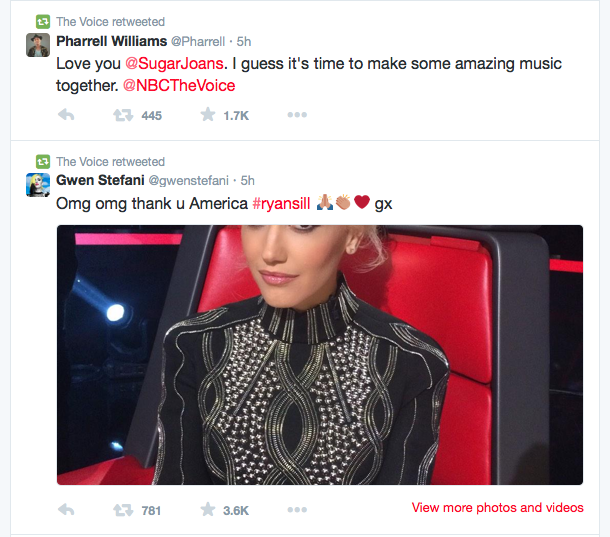
What I find genius about this show is its utilization of social media but Twitter specifically. Each judge has their own Twitter handle, where they actively tweet throughout the show, before, and after and engage in the on-goings of what is actually going on in the show. The tweets appear on the television screen as well (at least for us out West here).

SPOILER ALERT:
Screen Shot 2014-11-18 at 9.37.51 PM

I love that they got the coaches involved in the tweeting, but even better is the involvement of the audience as well. With users utilizing the hashtag #VoiceSave and the first name of the artist they are rooting for, the audience can help save an artist from elimination which has been dubbed “The Instant Save” on the show. The show’s Twitter handle also makes a “retweetable” post that would count as a vote which makes it even easier to participate.

The artists on the show also utilize Twitter handles and tweet as well. The show even created its own quirky hashtags….one of which is #Lukified which has been trending thanks to Blake Sheldon saying it on a weekly basis on air!

Compared to the other singing competitions on air, The Voice has been solid in its standing where both American Idol and the X Factor seem to be slipping away. The Voice certainly has the best integration of live television and social media, which begs the question if its social media use is part of the key to a successful reality television competition run?

The show has amazing use of Twitter and live TV which serves as a great example of dual-platform integration. I totally encourage you to watch the show just for it’s great Twitter use (and of course great music).

Posted in Uncategorized | Comments Off on The Voice – social media genius