Thank you, Mom!

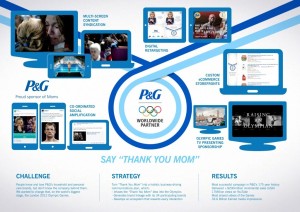
Procter & Gamble spends billions of dollars advertising its arsenal of brands, from Tide, Bounty and Charmin to CoverGirl and Pantene and Olay. But the consumer packaged goods giant also spends a great deal marketing its products’ relationships with consumers—especially moms. And so ahead of the 2014 Winter Olympics in Sochi, the CPG brand has revived its “Thank You, Mom” campaign in all its Olympic glory.

https://www.youtube.com/watch?v=57e4t-fhXDs

“Pick Them Back Up” continues the theme set in 2012 for the London Games, which featured “The Best Job,” that garnered over 21 million views. This year’s spot focuses on the physical transitions of childhood, from just learning how to walk to going on to ice skate, snowboard and play hockey—all with mom’s watchful eye there to dust off and make better any bruises.

ad_34488409_8710cac0c880236a_web

The video “Pick Them Back Up” is as warm and fuzzy as it gets. It follows four future athletes—a skier, ice skater, snowboarder and hockey player—from their first (not so successful) baby steps to their Olympic debuts. But the ad isn’t really about the athletes, of course. It’s about the dedicated moms who were there to pick them up when they fell (which is quite a lot), ice their bruises and warm their freezing toes—and send them back out to try again.

“Thank you, Mom” is  a very successful campaign. In 2012, the campaign first launched simultaneously around the world with the digital release of “Best Job,” a short film that celebrates the role moms play in raising Olympians and in raising great kids. P&G recruited award-winning director Alejandro González Iñárritu to create the film, which is the foundation of the entire campaign. It was shot on four continents and features local actors and athletes from each location — London, Rio de Janeiro, Los Angeles and Beijing. The ad campaign ran online, in social media, TV and print.

The campaign came to life through a variety of media channels and in-store with a worldwide retailer program from April through August in 2012. Olympic Games-themed P&G branded products had been featured in millions of stores across the globe. As a part of the P&G Thank You Mom promotion, P&G committed to raise $5 million to support local youth sports programs in many countries, through a portion of sales and donations from the company’s leadership brands including Pampers®, Tide®, Gillette® and Pantene®.

Posted in Uncategorized | 5 Comments

Pink slime anyone?

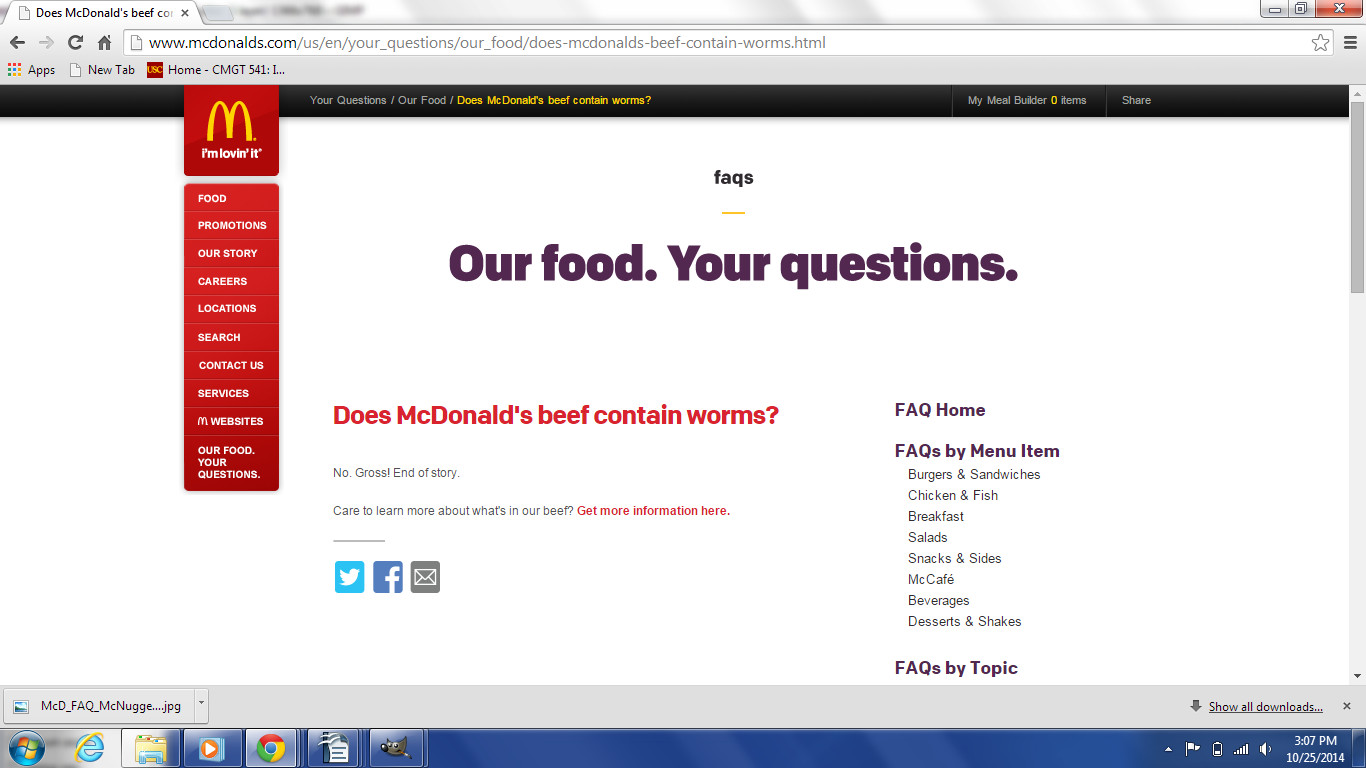
McDonalds has recently directly taken on criticisms of its food quality by calling out the claims of product laden “pink slime”, fake chicken meat, and worm tainted beef. But does the “Our Food. Your Questions” campaign really make anyone feel better about the McDonald’s product?

Grant Imahara appears in the Youtube campaign to investigate how McDonald’s beef patties are made. However this piece is far from an investigative inquiry from the press.

https://www.youtube.com/watch?v=wXgSnUmhdws

Grant asks if “lips and eyeballs are in there?” and Cargill employees proudly proclaim that there are only “beef trimmings” being ground and pressed in “patty formers”, with a “beef-in, and beef-out” process, and then the patties are frozen and boxed, “locking in the flavors”. Later, Grant inspects the patties, saying “looks like a burger”, and “mmm… that’s good”. The video culminates in a visit to a McDonalds restaurant, where a mechanism squeezes special sauce onto a bun and the “moment of truth” ends in Grant happily eating a Big Mac.

I’m not a vegetarian, and I eat McDonald’s burgers from time to time. Would I have preferred not to see this video? Probably.

Should McDonald’s be so direct in refuting claims of defective food products? Is the response dominating search results to an unfounded urban myth, or are they just showing me how my burger is actually made – which may be worse.

worms

By addressing rumors of “worms“, “pink slime” and “fake meat”, McDonald’s may be successfully exposing rumors, but are they only grossing out the consumer in the end?


Posted in Uncategorized | 2 Comments

How did Apple succeed in the marketing world without social media?

When you are using all sorts of social media on your iPhone, iPad or MacBook, do you know that the company which created all these does not even have a Facebook or Twitter account? Though all its products have a huge group of loyal users and fans, the brand itself does not seem to have much presence in social media. So how did Apple achieve its legendary popularity through marketing strategies? How well did Apple perform in telling its own story?

Two of Apple’s unique ads provide us some insights of its success.

1. The “1984” TV commercial

The TV commercial “1984” introduced the Apple Macintosh personal computer. It was aired only twice: the first time was on December 31, 1983 in 10 local outlets; and the second and only national airing was on January 22, 1984, during a break in the third quarter of the telecast of Super Bowl XVIII by CBS. This ad was made before the social media era. However, it made people think about computers, particularly making them think about Macintosh to an extent that was even higher than the way people talk about social media now. This brilliant marketing position established Apple’s image of being extraordinarily innovative, and generated social discussions about the brand without putting too much effort on large-scale advertising.

2. “Think Different”

https://www.youtube.com/watch?v=nmwXdGm89Tk

Apple’s “Think different” TV commercial in 1997 featured 17 iconic 20th century personalities in the black-and-white footage. The text corresponded to Steve Jobs’ vision for the company: people can change their life, mold it, and make it better with the products Apple offers. This successful ad not only garnered numerous awards and accolades but also restored Apple’s reputation as the company was previously losing market share to other brands. Again, this marketing campaign does not have large coverage but sparked discussions about the brand through its creative content of advertising.

Apple shows us that breakthrough products and innovative ads have the power to generate huge popularity without maintaining a presence on social media such as Facebook or Twitter. It is evident that social media is not everything in the marketing world. Simply measuring the buzz about a product on social networking sites does not provide an accurate assessment of how well a brand performs in marketing and advertising. In 2013, Apple has become the world’s most valuable brand in history according to Interbrand’s Global Brand Rankings in 2013, beating Coca-Cola, which has been No. 1 for over a decade. Different from Apple, Coca-Cola has had a long tradition of having active accounts across all social networks. Taking a different route, Apple projects its brand image through its storytelling commercials and innovative advertising concepts and becomes incredibly successful in marketing without being hypersocial.


Reference:

Bunham, D. (March 4, 1984) “The computer, the consumer and privacy,” The New York Times.

Friedman, T.  (October 1997) “Apple’s 1984: the introduction of the Macintosh in the cultural history of personal computers,” The Original.

Interbrand’s Global Brand Ranking: http://www.bestglobalbrands.com/previous-years/2013

Morrissey, B. (January 4, 2010) “Apple dominates social brand ranking” http://www.adweek.com/news/advertising-branding/apple-dominates-social-brand-ranking-101215

Posted in Uncategorized | 2 Comments

GoPro receives early Christmas from SNL!

Thanks to “Saturday Night Live,” a few weeks ago, GoPro received an early Christmas present; free and effective advertising to millions of middle-aged viewers. Colon Cancer is obviously a very serious issue as it is reported to be the #2 cause of cancer deaths in U.S. (Facts About Colorectal Cancer (2014), but if you’ve seen other videos that GoPro has posted, SNL’s edgy humor fits right in line with the edgy brand (tailored for thrill seekers).

Why blog about this?
The power of parody (hire professionals, folks) if done correctly, can be an effective tool to reach target audiences. GoPro does not primarily target 40-55 middle-aged men (me), but this “plug” was soo funny, I may just go purchase one.  Definitely, not for colonoscopies though.

“GoProbe,” a hysterical digital short featuring the most xtreme way to detect colon cancer — a GoPro camera built for colonoscopies.

The parody product’s slogan? “Go Deeper.”

To quote 44-year-old snowboarder Rawson Silver (aka, Beck Bennett): “This ain’t your grandpa’s colonoscopy.”

Thanks “SNL,” for reminding us that parody is a powerful tool to effectively communicate products to new audiences and shape new meanings (and uses) through powerful humor… “Being older doesn’t mean you can’t be any less radical, dude.”

What do you think? Brands need to find unique and unexpected ways to reach audiences and GoPro is lapping on to this “unexpected gift” by driving it through their social media channels…

Reference:
http://www.huffingtonpost.com/2014/11/03/snl-goprobe-sketch_n_6096346.html

Facts About Colorectal Cancer (2014). Retrieved November 14, 2014, from http://fightcolorectalcancer.org/prevent-it/facts-about-colorectal-cancer/?gclid=CjwKEAiA7ZajBRCpur2xi47n1zkSJADqV2Wl2TN88ia4G_WJRwdrAnsy0J-RFdZYFsiPpZCtK8RfbRoCVhLw_wcB

Posted in Uncategorized | 6 Comments

It’s that time of year again!

In case you haven’t been to your local Target or Walgreens recently…the holidays are here! With the holiday season, comes an overload of emotional marketing campaigns. This week I was treated to an ad from overseas thanks to some Facebook friends. The ad is from Sainsbury’s a supermarket chain in the UK.

Did you make it through the entire video…without getting a warm, fuzzy feeling inside? Ads such as this one are starting to pop up left and right with the start of the holiday season. Another recent ad that hit the emotional mark was created by John Lewis, a department store chain. The Guardian even created a poll for people to vote for their favorite. Here in the states, companies such as Kohl’s are also revving their emotional engines in hopes of connecting with consumers this holiday season (Rodriguez, 2014). Check out its 2014 holiday campaign:

https://www.youtube.com/watch?v=gf2xLK91Yco

Now, I must admit, I’m a sucker for emotional advertising but I don’t always think it’s the best choice for all brands, or for making the much needed sale. Even though these ads leave most consumers or potential consumers with a nice, positive feeling about the brand, marketers and advertisers should also give a better idea of what they are trying to sell. I think that sometimes the product and/or service get lost when this type of communication strategy is used. I believe that although it is important to focus on the feelings of the consumer, the company should also be concerned with communicating the brand.

I see this as a problem because what if the people never figure it out or look away before the brand name appears at the end? Without a clear idea of what is being sold, it is possible that someone might view the ad and not make the connection the company hopes for. On the other hand, some of these companies may be putting these ads together with the hope of them becoming viral and just taking off from there. Nonetheless, it continues to seem like a risk many brands are willing to take in order to appeal to consumers in a more sensitive and human way.

Without a clear idea of what is being sold, it is possible that someone might view the ad and not make the connection the company hopes for. On the other hand, some of these companies may just be putting these ads together with the hope of them becoming viral and just taking off from there. Nonetheless, it continues to seem like a risk many brands are willing to take in order to appeal to consumers in a more sensitive and human way.

In fact, these ads reminded me of a similar type of commercial I grew up watching. In Florida, Publix, a popular supermarket chain in the Southeast, releases some powerful emotional ads around big days such as Mother’s Day and Thanksgiving. Here is one of my favorites:

Guess who went out and bought the cute salt and pepper shakers? Me! In fact, these sold out in many stores. Maybe I’m just biased toward what I know and recognize but I think Publix has just the right mix of emotional advertising while at the same time making its product (food and food-related items) the main star of the ad.

So, did it work, did any of these make you want to buy what they’re selling or get you to at least feel connected to the brand? Or are you still sitting there dreaming of flying reindeer?

References

The Guardian. (2014, November 13). Who has the best Christmas advert: John Lewis or Sainsbury’s? – poll. Retrieved from http://www.theguardian.com/media/poll/2014/nov/13/sainsburys-john-lewis-christmas-advert-which-is-best

Rodriguez, A. (2014, November 9). Kohl’s upping TV spend for holiday campaign. Advertising Age. Retrieved from http://adage.com/article/cmo-strategy/kohl-s-upping-tv-spend-holiday-campaign/295764/

Posted in Uncategorized | Tagged , | 6 Comments

#AlexFromTarget: Brilliant Marketing Launch Pad, or a Dangerous Idea?

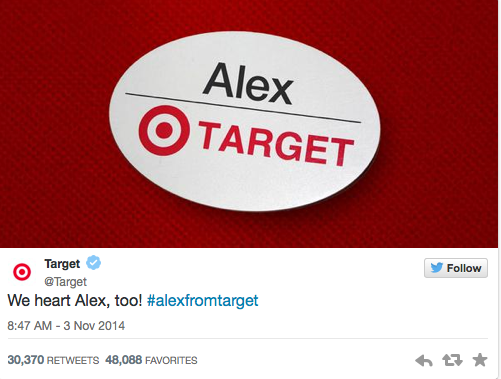
Alex Lee, a teenager from Texas, became a worldwide celebrity literally overnight when a picture of him was posted onto Twitter and went viral (Heine, 2014). The picture was posted by a teenage girl and showed Alex working at his job at a Target SuperStore. Along with the picture, the hashtag #AlexFromTarget became a trending topic (Heine, 2014). Target itself acknowledged the image and hashtag, posting the following response on their own Twitter feed:

Screen Shot 2014-11-12 at 1.39.09 PM

Image source

Alex agreed to do a live interview on the TV show Ellen, but has turned down multiple other interview requests (Bilton, 2014). Since he is still in high school, his privacy is being protected (Heine, 2014). However, from target’s perspective, the answer of what to do next is less clear. Is this phenomenon a launch pad for a successful new advertising campaign? Or would exploiting the teenager for marketing purposes be a lead to dangerous territory?

On one hand, #AlexFromTarget has already resulted in a high level of exposure for the company, completely free of cost. There is real potential to take the attention to the next level by creating a marketing campaign that comes with a built-in audience.

On the other hand, using the teen’s instant celebrity and name recognition for marketing purposes could backfire, making the company seem opportunistic and exploitative. What about the high schooler’s privacy? What about what Alex and his parents want?

I think Target should accept whatever positive marketing comes from the #AlexFromTarget phenomenon on its own, and avoid the negative implications that a new marketing campaign, based on the teenager’s instant fame, could bring. What do you think? Is an #AlexFromTarget marketing campaign a brilliant strategy waiting to happen? Or would it be wise for Target to protect the teen’s privacy and let it all blow over?

Heine, C. (2014, Nov 3). Should Target put ‘Alex’ in an actual ad campaign? ADWEEK. Retrieved from http://www.adweek.com/news/technology/should-target-put-alex-actual-ad-campaign-161193

Bilton, N. (2014, Nov 12). Alex from Target: The other side of fame. The New York Times. Retrieved from http://www.nytimes.com/2014/11/13/style/alex-from-target-the-other-side-of-fame.html?hp&action=click&pgtype=Homepage&module=mini-moth&region=top-stories-below&WT.nav=top-stories-below

Posted in Uncategorized | Comments Off on #AlexFromTarget: Brilliant Marketing Launch Pad, or a Dangerous Idea?

Do you think that Olympic sponsorships pay off for companies such as Lenovo?

Do you think that Olympic sponsorships pay off for companies such as Lenovo?

There is a interesting case that new brand without any endorsement by power brand joined sponsorship during Olympic games. In 2005, China’s Lenovo Group acquired IBM’s personal computer business for $1.25 billion (Keegan & Green, 2012). Lenovo was seeking to be more noticed in a competitive global market, being an Olympic sponsor would help them achieve that.

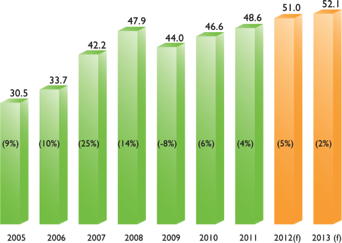
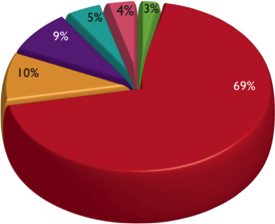
In 2013, global sponsorship expenditure worldwide rose 2% to $52.1 billion. Sponsorship activities accounted for 6% of global marketing spending in 2012; mass marketing (such as advertising) accounted for 57% and direct marketing 31% (Admap, 2013). The trend today in sports sponsorship represents significant marketing with companies spending a great deal of money on it.

Untitled  ff

aaa aaaaa

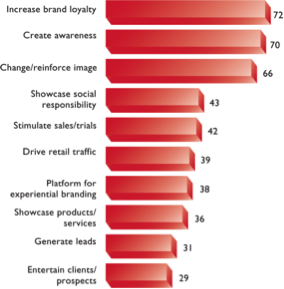
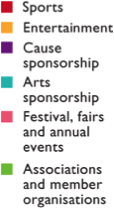
Figure 1. Trends in global sponsorship spend, December, 2012, Objectives in sponsorship in evaluation, 2012, US sponsorship by category, 2013
Note. Adapted from Admap, Adstats: Global sponsorship, 2013.

Companies spend more money for global brand sponsorship to increase their brand loyalty. As can be seen, sports sponsorships recently accounted for 69% among various sponsorships. From an integrated marketing communication (IMC) perspective, sport marketing, including sponsorship, has become an imperative for global marketers.

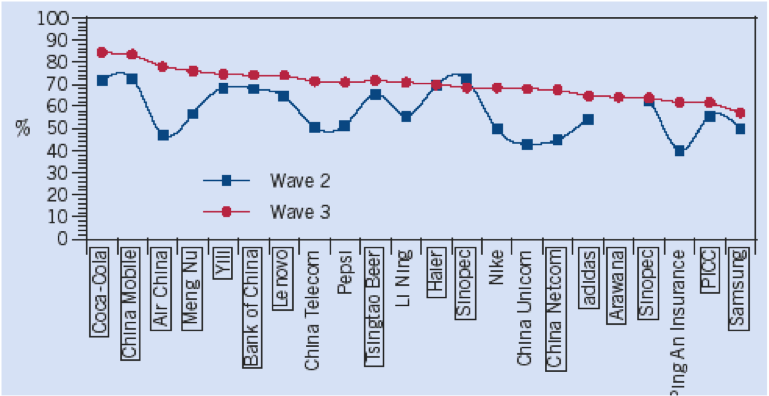
In the case of Lenovo, it was ranked #4 among 29 sponsors: followed by China Mobile, Coca-Cola, and Air China according to Beijing 2008 Olympic game sponsorship performance research (Wang, 2008). As can be seen in Figure 2, Lenovo’s recognition as an Olympic sponsor demonstrates higher index than non-sponsors.

ddd

Figure 2. Recognition as Olympic sponsor: reports compared
Note. Sponsoring brands highlighted. Adapted from Admap, 2008.

Global Olympic sponsorship marketing can give a company credibility among potential customers by showing that it can spend a great deal of money with global dominant brands such as Samsung (Olympic), Coca-Cola (World Cup), and other big brands. Customers, therefore, tend to regard sponsors as global top-tier brands. For example, Avaya, information technology (IT) company, sponsored the 2002 World Cup once. Consequently, they quickly grew into a dominant brand in the global IT industry.

For a sport sponsorship to succeed, it needs diverse and effective sports marketing programs: integrated marketing communications (IMC) including advertising campaign, public relations (PR), promotional events, and other effective activities as well as brand exposure at stadium venue. Also, IMC must have one core theme in consideration of target and positioning. During the Vancouver Olympic Winter Games, for instance, Procter and Gamble (P&G) conducted a “moms’” campaign, trying to deliver emotional message because P&G is a company that manufactures consumer goods, especially well suited for moms. As a result, P&G achieved successful result that increased 10-point favorability and $100 million in extra sales in the US (Letizia, 2013).

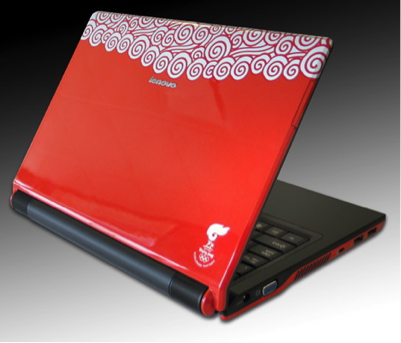
As companies deserve brand power and credibility, as in the Lenovo case (eliminating power brand IBM), they are better off getting involved in large-scale events such as the Olympics and World Cup. This increases the odds of their establishing brand awareness and preference among global customers. Also, creative and aggressive marketing actions help them boost their brands and products in the short term. Lenovo offered laptops to members of the press to show off the stylish products through the media as well the as selling limited editions to customers.

ee  rr

Figure 3. Lenovo limited edition design for 2008 Beijing Olympic

To win more market share, companies such as Lenovo should manage their brands, enhance its credentials, and boost brand awareness among customers (Wall Street Journal, 2012).

 Questions

1. What treats does Lenovo have without IBM logo?

2. Do B2B brands also need to join the sponsorship for Olympic or World Cup game?


 References

Admap. (2013, April). Adstats: Global sponsorship, 48-49. Retrieved from http://www.warc.com.libproxy.usc.edu/Content/ContentViewer.aspx?ID=0d21a6bc-65b3-4625-8976-b04e506c4772&q=global+sponsorship&MasterContentRef=0d21a6bc-65b3-4625-8976-b04e506c4772

Keegan, W. J. & Green, M. C. (2012). Global marketing. (7th ed.). New Jersey: Parson Education Inc.

Letizia, J. (2013). Sports sponsorship. ARF–Knowledge at Hand. February 2013. Retrieved from http://www.warc.com.libproxy.usc.edu/Content/ContentViewer.aspx?MasterContentRef=0fd0b679-5d8d-4673-a225-b1f2843696fb&q=sports+sponsorship

Wang. (2008). Beijing Olympic games sponsorship performance. Admap, China supplement February 2008, 29-32.

Warc. (2012, July 10). Lenovo seeks to build its brand. Wall Street Journal. Retrieved from http://www.warc.com/Mobile/News.aspx?ID=30086

Posted in Uncategorized | 4 Comments

Internet vs. Traditional Marketing

tablet
The Forbes article entitled, “Why Integrated Marketing Communications Is More Important Than Ever,” deals with the topic that retailers must not just rely on one avenue in order to get their message across to the consumer. In my opinion, you would think that in the world we live in today, all a retailer needs to do is to just market themselves to the consumer via the internet and that customers will come through their doors or to their site. However, using only one source of marketing is usually not the best advice for the retailer. For example, the article stated that one consumer demographic group, known as millennials, usually will find their deals not by searching the internet, but by looking into the newspaper. Yes, even though these millennials carry around electronic devices that enable them to search deals on the worldwide web, this demographic group prefers the physical newspaper to look for deals and get their coupons. According to Olenski (2013), “arguably the most digitally-savvy demographic on the planet prefers old school marketing methods and communications? That can’t be right, can it? Not only is it right it speaks to the aforementioned point of the importance of an integrated marketing communications strategy” (p. 1).

Overall, retailers must be able to integrate their marketing message via a wide range of media including internet, television, newspaper, radio, as well as, using the United States Post Office. Retailers should continue mailing out coupon books, flyers, and postcards using the regular postal system. The reason for using this system is because it works. Most would think that in this day and age of sending everything via email, that using snail mail would not be of any value. However, this is not the case at all. Snail mail is just as valuable as is using electronic mail in order to get your message across to the consumer. According to Beever (2012), “both email and snail mail have advantages and disadvantages. Email seems less expensive, but spam blockers and other technology issues can get in the way of delivery. Snail mail can get thrown away by administrative assistants, never to be seen by the intended recipient” (p. 1).
My question in order to continue this discussion is to ask the reader, “What do you think about this topic? Do you think retailers should just stick to one avenue when it comes to advertising or should retailers integrate a wide range of avenues?

References
Beever, J. (2012). “Email versus Snail Mail: Which is Better for Your Marketing?” New Incite. Retrieved on November 8, 2014 from http://www.newincite.com/resources/marketing-articles/email-versus-snail-mail-which-is-better-for-your-marketing/
Olenski, S. (2013). “Why Integrated Marketing Communications Is More Important Than Ever.” Forbes. Retrieved on November 8, 2014 from http://www.forbes.com/sites/steveolenski/2013/09/16/why-integrated-marketing-communications-is-more-important-than-ever/

Posted in Uncategorized | 8 Comments

How did Kony 2012 go viral?

When I was reading Jab, Jab, Jab, Right Hook, I was trying to think of one online marketing campaign that is most memorable to me in recent years, and that’s when Kony 2012 came to my mind.

Launched in March 2012, this campaign and online short film are part of a grass roots effort to raise awareness of Joseph Kony, the leader of the Ugandan guerrilla group Lord’s Resistance Army (LRA), who has committed numerous war crimes, including the ordering the abduction of children to be used as soldiers. Kony 2012 advocates for an international effort to seek his arrest.

One of the most interesting aspects of the campaign is the sheer volume of conversations it has sparked globally. The number of articles, blog posts, news reports, verbal debates and social media conversations about Kony has turned the audience’s attention to the issue, which is exactly what the campaign set out to do.

The viral spread of the campaign has also ensured widespread popularity on social media. Here are the stats one week after the release of the video:

  • 370,729 followers on Twitter,
  • 3 million fans on Facebook,
  • 2 million plays on Vimeo, and
  • 43,354,020 million views on Youtube and 2,246,157 subscribers to Invisible Children’s Youtube channel.

The video itself was well made and it was almost impossible not to be moved by it. It is, and will most likely remain for a long time, one of the most brilliant demonstrations of the power of digital media, and of how to get your message heard.

Besides the high quality of the video, there are some other lessons that can be learned from this campaign.

  1. Know your audience

Any marketing strategy needs a clearly defined target. This requires knowing who your audience is, where they are, and what motivates them. A through understanding of these factors will allow you to make informed decisions about your campaign and to maximize the benefits of each platform. Invisible Children has a solid grasp of their target, American youth. Teens and college students with deep convictions and a mastery of social channels are an excellent source of momentum in an online campaign. Viral spreading of information is crucial for Kony 2012. The goal of the campaign is to make Joseph Kony and his crimes with the LRA infamous. Invisible Children hope his newfound notoriety will lead to his capture in 2012. By using a 30-minute video that presents the conflict in Uganda in simple (as some have argued, oversimplified) terms, the message has been quickly communicated. With supporting social media tactics it was easy to share from the start–creating millions of campaign evangelists in a matter of days.

Within days of the launch, the hashtag, #Kony2012, was a nationally trending topic on Twitter, Facebook statuses reflected support for the movement, and profile pictures and wallpaper images were changed to crimson “Stop Kony” digital posters. The campaign aligned itself with a desirable identity–a young activist who is passionate about the world–and used it to quickly gain popularity via social channels.

  1. Use key thought leaders to spread the message

Invisible Children launched the video by targeting “Culture Makers.” Twenty celebrities and 12 policy makers were identified on the website, and supporters were encouraged to tweet at each one about Kony 2012. Celebrities who responded by tweeting further included Rihanna, Ryan Seacrest, Justin Bieber and Taylor Swift. Day 1 of the launch saw 66,000 views. However, it was Oprah Winfrey’s tweet to her 10 million followers that broke the one million-view mark on Day 2. By the end of the first week of its launch, the video had received more than 70 million views.

Not every brand can rely on celebrity sponsorship. However, every target demographic has key influencers, and almost all of them are on social media. A “grass roots” approach to digital word-of-mouth marketing requires discovering which bloggers, experts, and public figures your audience is listening to, and attempt engage them first. Creating brand ambassadors out of established figures lends legitimacy to your message and gives your campaign viral wings.

  1. Reach for a global appeal

One of the biggest selling points the Kony 2012 campaign has is that it appeals to a global audience. As a piece of content it speaks to every individual in every country because it covers an issue that everyone in the world can relate to: the safety of children.

As a brand and as a marketer the question you will be faced with is “how can our web video appeal to a global audience?” Admittedly creating a video that appeals to the entire world isn’t easy, but what you can do is create a video that appeals to “your” audience in “your” world.

For any marketer the audience they care about (the audience that is their “world”), is their target audience. That target audience is who your video will impact the most and achieve the goals you have set out to achieve through your Internet video marketing strategy.

In order to appeal to that demographic you need to know two things; the goal of your video and what makes your audience tick. Traditionally determining your goal is the easy part, but finding out what makes your audience tick can sometimes be a bit tricky.

The audience need to enjoy and appreciate your video otherwise the chances of it being shared online and engaged with are very slim. Research the habits of your audience through social listening tools. Try to find out what are they talking about, what they need help with and what would they like to see from your company and your niche. This will help you to generate content ideas that are very appealing to your audience.

  1. Give your audience calls to actions

While teens aren’t being told to physically pursue Kony themselves, they have been given a clear call to action outside the virtual realm. Fans became activists by purchasing “Action Kits” that included a t-shirt, posters, bracelets, stickers, buttons and an “Action Guide.” The half a million action kits sold out almost immediately.

A digital tool, the LRA Crisis Tracker website, was created to keep people engaged with the campaign and provide a source of ongoing information. The tracker displays a map and real-time updates on the movements of the Lord’s Resistance Army, including sightings, abductions and deaths. The website is also outfitted with a donation button and a mobile app, so activists can access the LRA Crisis Tracker at any time from any location.

A brand can tweet, blog and post Facebook messages all day, but if there’s no incentive for consumer interaction, there won’t be any. Decide what kind of response defines success for your campaign–whether it’s getting people to talk about your brand, buy a product, or share their experiences. Be sure to include a call to action when appropriate, such as asking fans an open question (not one that can be answered with “yes” or “no”), or urging them to share your message in a unique way. In addition, incorporating creative tools or apps that display your brand identity can be an excellent way to keep interested customers connected.

References

Cummings, S. (2012, March 15). 9 Marketing Lessons from “Kony 2012” Retrieved November 9, 2015, from http://blogs.imediaconnection.com/blog/2012/03/15/9-marketing-lessons-from-kony-2012/

Frith, J. (2012, March 16). Viral marketing – a lesson from Kony 2012. Retrieved November 9, 2015, from http://www.marketingmag.com.au/blogs/viral-marketing-a-lesson-from-kony-2012-11863/

Havard, A. (2012, March 8). 3 Golden Viral Video Marketing Lessons To Learn From Kony 2012. Retrieved November 9, 2015, from http://www.skeletonproductions.com/blog/learning-zone/video-marketing-tips/3-golden-viral-video-marketing-lessons-to-learn-from-kony-2012/

Kony 2012 [Motion picture]. (2012). USA: Invisible Children.

Planb, A. (2012, April 3). What Your Brand Can Learn from Kony 2012. Retrieved November 9, 2015, from http://socialogicmarketing.com/2012/04/03/what-your-brand-can-learn-from-kony-2012

Posted in Uncategorized | 6 Comments

Making the Most of A Moment

Brendan Jordan. The name may not immediately ring a bell but if you are active on any form of social media then you should keep reading. A little over a month ago, a new shopping center opened near Las Vegas, NV. The grand opening ceremony was featured on several local news stations. One portion of the broadcast featured a backdrop of happy children who were cheering and applauding to express their excitement. One child in particular, Brendan Jordan, took another route. He decided to perform Lady Gaga choreography as if he was on stage with her. His performance went viral. Personally, I saw several pictures of him on Instagram followed by a Facebook post which featured the below video.


I doubt I have to point out who Brendan Jordan is now. Once the video made its way to YouTube and various social media outlets, his many facial expressions were turned into internet memes (a piece of media which spreads as mimicry). The news reporters in the video began tweeting about how they were hilariously overshadowed and hoped to one day have as much confidence as he. In the meantime, his follower count on Instagram began steadily raising. The people wanted more of the teenage dancing divo. Lady Gaga even tweeted her excitement about Brendan’s exposure.

Brendan, a 15 year old from Las Vegas, NV, turned his own world upside down in a matter of 30 seconds. Considering his overnight semi-stardom, several brands began realizing the power in Brendan. It is not often that a 15-year-old gay male who is so comfortable in his own skin is featured in the media and praised for being himself. Shortly after the video made its rounds, clothing brand American Apparel held a photoshoot for Brendan at their headquarters in downtown Los Angeles. Other brands have sent him shoes, glasses and jewelry in exchange for exposure on his social media accounts. Most recently Brendan created a YouTube channel- it has one video “Brendan Jordan- Are You Gay?” which currently boasts over 400,000 views in less than a week.

Brands like American Apparel have recognized the power in Brendan’s moment. Considering he has no product to sell of his own at the moment, his followers are buying into what he likes and wears, so why not be the brand who is sponsoring him for free? These companies send him a small sampling of their product- in turn, his followers buy out the stores because they love Brendan and want to be like. A few free shirts and jackets is a very small investment for the return Brendan’s fans are likely to give them.

Posted in Uncategorized | 13 Comments