When Sports Injuries in High School Affect the Rest of Your Life
When I was in high school I played football, linebacker and running back, and I felt it was the greatest thing in the world. I looked forward to the games each week, and I was even one of the odd kids that liked practice. I truly enjoyed the competition and the hitting, but all that came at a price, though I didn’t know at the time. I was doing irreparable harm to my body, especially my knees.
In my junior year, in the 3rd game I tore my medial collateral ligament in a play where someone blocked me low and from the side of my right knee. According to California Pacific Orthopedics and Sports Medicine, this is one of the most common injuries that football players receive (2015). In 1990, when this happened to me, there was very little outside of major surgery to repair this injury, which meant 9-12 months of recovery time. All for the football gods!
Now at age 42 I wake up every day and it takes me 15-20 to get my body going without pain. As a father of 3 boys who all played football as well, I have made them wear knee guards and be aware of positions which are harder on the knee joints. I would say to all parents of potential football players in high school, the boys will love and cherish their time playing with their friends and classmates, but know that this may come at a price in the long run. For me, the price was worth it, I loved every second of playing football and even played in a mens league until I was 39. If they love it, use as much protection as possible to avoid injuries, but encourage them to play!
References
Football Injuries. (2015). In California Pacific Orthopaedics and Sports Medicine. Retrieved June 22, 2015.
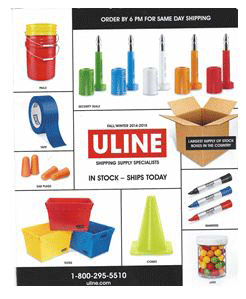
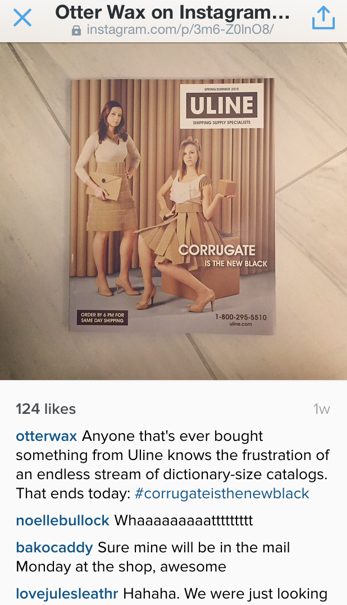
Every month this catalog hits my desk and immediately goes into the recycle bin.
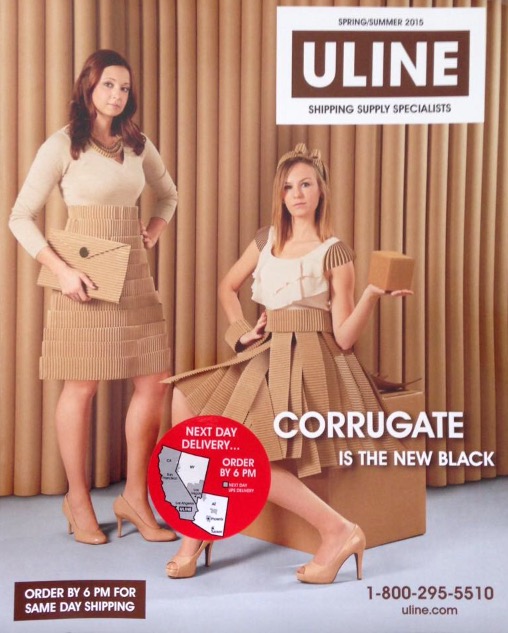
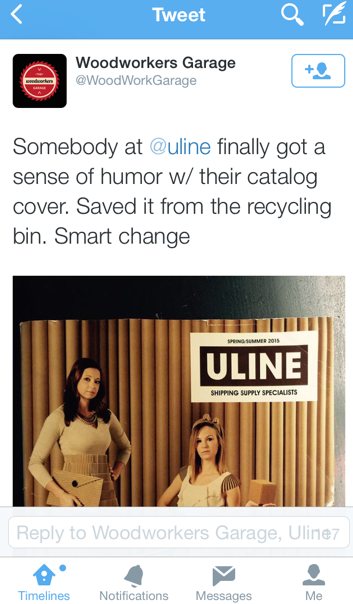
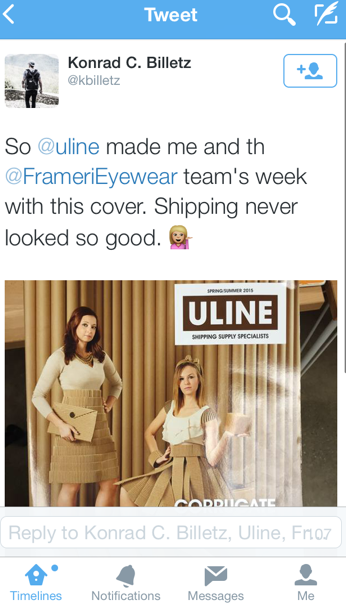
This month, something different happened and this catalog has been on my desk all week.
Uline is doing something right. Marketers agree that catalogs are still effective means of driving business (Geller, 2012). In 2013 there were 11.9 billion catalogs mailed in the United States and customers use them to make purchases online and in stores (Berliner, 2014; Geller, 2012). The key is getting consumers to keep catalogs, if they hit the recycle bin they won’t drive business.
Uline’s latest catalog was an unexpected, timely and humorous departure from their typical cover art. Humor helps differentiate a product or brand from the competition and creates an emotional connection with the consumer (Dubois, 2010). This catalog was delivered the same week that Netflix’s third season of Orange is the New Black was released, creating a timely play on words with the “Corrugate is the new black” title. They also struck the right balance by not including too much product detail and leaving something to the imagination (Dubois, 2010). Ultimately, Uline’s cover stands out in a pile of mail.
When something stands out people want to talk about it, creating additional brand awareness and the ability to reach new audiences.
It will be interesting to see what Uline comes up with next!
Sports and brands have joined forces for many years, but on this Father’s Day they have upheld an American culture that many men are familiar with. If you’re a fan of golf, consider yourself a part of this vast population who spent the afternoon cheering on talented golf competitors as they went head to head during the United States Golf Association (USGA) US Open held in Chambers Bay, Washington. The sport of golf is, as many would consider an acquired taste. However, those who have gained interest in the sport are likely to have also developed a liking to a variety of brands that drive the financial support for championship games such as the US Open, PGA or The Master’s tournament. As I sat here today supporting my father-in-law by spending the afternoon watching the USGA Open Finals together, I realized that the exposure I was receiving was not limited to the sport itself or his passion for golf, but rather to the many brand names that support the organization. Brands like Fox Sports, Callaway and Taylormade are only a few that viewers may immediately associate with the sport. Other brand names like American Express, Under Armour, Workday, UPS, Vonage and Adidas also surfaced during the US Open.
What I learned about today’s tournament that made it a unique opportunity for big brands is that this is the first time the US Open has been held in the Pacific-Northwest. Viewership was expected to be larger than previous years due to the new location. In order to expand viewership and digital presence, IBM assisted the USGA to enhance their infrastructure several years back (Joe, 2013) which makes the brand a critical player during golf tournaments. Chemi (2015) explained that investors will be keeping a close watch this year on the consumer brands that advertise during and sponsors the Open. There is a shared belief amongst traders that investors will take action by buying, selling or holding onto their stock shares after seeing the exposure of each brand to a large television audience (Chemi, 2015). Brands like IBM, Southern Company and Coca-Cola (Chemi, 2015) are three top stocks that are on investors’ radars. But there is more to be said about the brands that are exposed during large sporting events such as the US Open. Consider the viewers, fans and amateur golfers sitting around their LG or Samsung television sets watching their favorite competitors like Dustin Johnson, Jason Day, or 2015 champion, Jordan Spieth wearing golf gear from top sponsors. Be it hats, shirts or sunglasses, a subconscious brand loyalty is created.
Taking that into account, integrated marketing communications go beyond the simple message being delivered to a target audience. There is a high level of consciousness put on when and where exposure is given to the consumer. Just because a brand is closely linked with the sporting event does not make it the best candidate as a sponsor or for a commercial spot during the event. Take for example, Workday. A ten year old startup who has successfully paved its way as a leader in the cloud software systems HR and Financial industry. The B2B sales company has nothing to do with golf. However, the marketing and communication team saw a prime opportunity to pay for air time during the US Open. A lesson learned from the USGA is that knowing your audience and what they want is key to success (Joe, 2013). Workday analyzed the golf viewership and realized that as an acquired taste, the sport is closely followed by businessmen and investors and valuable brands. Brand placement in a sports event like the US Open was a clever strategy that will give exposure to the right people looking to grow their businesses.
An additional consideration to be taken when observing the connection between brands and sports is between Jordan Spieth and Under Armour. Prior to Spieth’s entrance into the golf community, Under Armour was a brand known to football fans and male consumers shopping for underwear. During last year’s 2014 Master’s Tournament, Spieth was the new, hot player who received a ton of publicity and as he interviewed, he walked around representing Under Armour by wearing their hat. Speaking to my father-in-law today, I learned that prior to watching Spieth, he has no idea what the logo on the hat was. After watching the young, new comer, he did some research and went to an Under Armour store. As he walked in, he noticed a large photograph of Spieth on the wall in the Under Armour store. As a fan, my father-in-law behaved as a brand loyal consumer would. He purchase golfing shirts, polos and hats that he could wear while playing on the course with his golf buddies.
On this Father’s Day weekend, a champion athlete proudly wore Under Armour branded apparel in front of large audiences. Now the real question… who sponsors who? Is Under Armour the sponsor for athletes like Jordan Spieth or visa versa? According to Riche (2015), “Spieth’s continual presence during the most watched tournaments and rounds of championship golf obviously create additional exposure for the Under Armour brand” (para. 6). Without the athlete, the brand would have to use other communication channels and means of advertising to get their brand name and brand awareness out to the large consumer markets. By making connections with the different sport communities, big brands, just like Under Armour, have found a way to garner massive benefits, increase the chances for brand loyalty and, ultimately grow profitability simply by sponsoring athletes through their talented careers.
So the next time you attend a sporting event or watch your favorite team and players perform, be sure to pay extra attention to the brands that represent them. Think about it? Are those brands a part of your lifestyle? Are you influenced by your consumer shopping based on the sports you watch, play or follow? Let’s not limit our brand recognition to just the clothes and shoes on the course, field or court. Instead, remember all the brands that take part in bringing the sporting event to life. Your television sets, the television station airing the event and all the other brands that paid for airtime which produced financial support for the event to take place. They all make up a relationship between brands and sports which, in turn, set a solid foundation for consumer brand loyalty.
References
Chemi, E. (2015, June 18). These stocks have a ‘golf bounce’ at the US Open. CNBC. Retrieved from www.cnbc.com
Joe, R. (2013, May 13). Three digital lessons from the US Open. Direct Marketing News. Retrieved from http://www.dmnews.com/direct-line-blog/three-digital-lessons-from-the-usga/article/293077/
Riche, P. (2015, June 22). Saving, earning millions thanks to Jordan: Under Armour’s prudent Jordan Spieth investment. Forbes. Retrieved from http://www.forbes.com/sites/prishe/2015/06/22/saving-earning-millions-thanks-to-jordan-under-armours-prudent-jordan-spieth-investment/
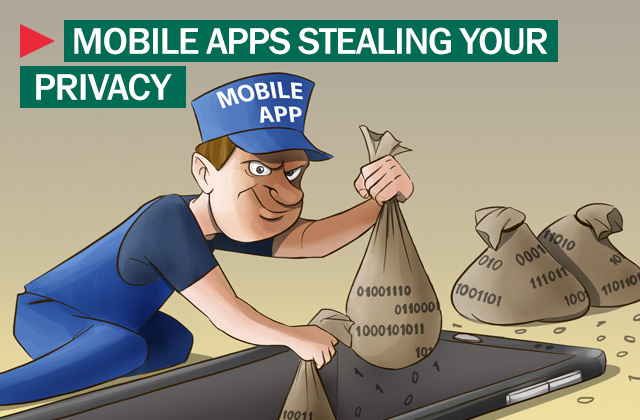
Whether you bank, tweet, or steam music on your smartphone, chances are you’ve downloaded at least one of these apps for free. Thirty million mobile apps are downloaded each day, and more than 90 percent of them are advertised at no cost. If these apps are truly free, then why is it that the mobile app market hits over $50 billion in annual revenue and mobile app designers bring home $90k per year on average (Laird, 2012)? Here are the reasons why free apps end up costing you more than you think:
Loss of Privacy
When was the last time you read through the terms and conditions before downloading a free app? Chances are, not for a while. Although the app is downloaded for free, the fine lines in its terms and conditions state that your personal information will be used and sold to advertisers and third party companies. Free apps are 401 percent more likely to collect your personal information than paid ads (Tynman, 2012). Some of the most common information collected from your smartphone includes your location, unique serial-number-like identifiers for the phone, and personal details such as age, sex, etc. Some free apps even take it a step further and are allowed access to your address books, photos, and social media accounts (Whitman, 2012).
Data Spikes and Battery Drains
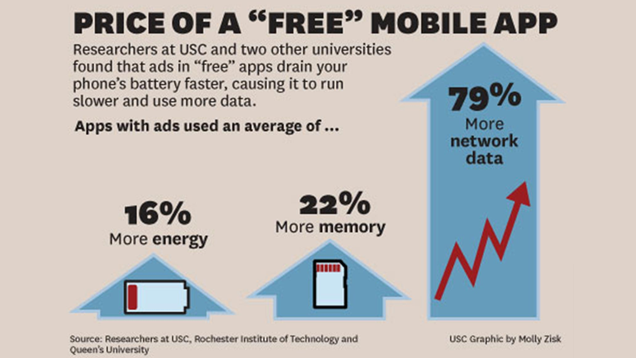
Free apps cost you big on data and battery without you even realizing it. Researchers at USC and two other universities found that compared to apps without ads, apps with ads are a big drain on your battery, take up more processing time, and also increase data usage by 79 percent on average (Pinola, 2015). Apps even use data in the background when its not being used so that it can continuously track and record your personal information such as your GPS location (Dachis, 2012).
Your Purchasing Decisions Are Influenced
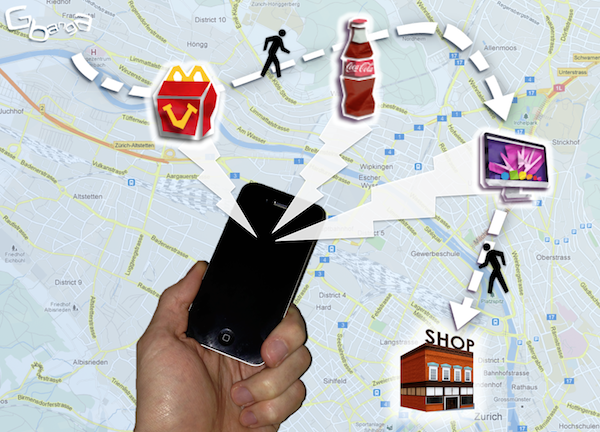
Free apps significantly rely on advertising revenue in comparison to paid apps. According to a survey of more than 1,400 mobile users, about 2 in 3 people would be likely to add a product to their shopping list if were to see it on a mobile advertisement (Pew Research, 2015). In addition, respondents also indicated that the following types of advertisements on their smartphone would most likely influence their purchasing decisions: a coupon for a product in-store (28%); sale item notification (20%); and seeing an ad for a product (15%) (MarketingCharts.com, 2013). In addition, many companies today use a feature called “geo-targeting” to track their target audiences. For example, if I was a company that wanted to sell a product to 18-24 year olds, I could use geo-targeted marketing to find out where the audience frequents and push ads to them when they enter or exit that specific location. The location of these audiences are tracked and sold by free apps that are downloaded on their smartphones (Murphy, 2011).
References
Dachis, A. (2012). How to Stop Your Smartphone from Secretly Wasting Data in the Background. Retrieved from http://lifehacker.com/5957947/how-to-figure-out-which-apps-are-using-your-smartphones-cellular-data-without-your-knowledge
Laird, S. (2012). So You Want to Be an App Developer? Here’s How . Retrieved from http://mashable.com/2012/08/27/app-developer-infographic/
MarketingCharts.com. (2013). Mobile Ads Seen Impacting CPG Purchase Decisions. Retrieved from http://www.marketingcharts.com/online/mobile-ads-seen-impacting-cpg-purchase-decisions-38286/
Murphy, D. (2011). The Geo-Targeting Revolution. Retrieved from http://mobilemarketingmagazine.com/geo-targeting-revolution/
Pew Research. (2015). U.S. Smartphone Use in 2015. Retrieved from http://www.pewinternet.org/2015/04/01/us-smartphone-use-in-2015/
Pinola, M. (2015). The Real Cost Of Free Mobile Apps: 79% More Data Use, 16% Battery Hit. Retrieved from http://www.lifehacker.com.au/2015/04/the-real-cost-of-free-mobile-apps-79-more-data-use-16-battery-hit/
Tynman, D. (2012). Those free apps can cost you big. Retrieved from http://www.itworld.com/article/2717594/it-management/those-free-apps-can-cost-you-big.html
Whitman, R. (2012). The horror: Android allows apps access to your pictures. Retrieved from http://www.extremetech.com/computing/120969-the-horror-android-allows-apps-access-to-your-pictures
I’ve now learned that my area of Houston isn’t the only place where you can’t go out for a short Sunday drive without seeing multiple mattress stores, and it has a lot to do with marketing strategy. It turns out that those stores are half billboard, half storefront. Mattress stores are eating up prime commercial real estate locations more for the marketing benefits than to attract a lot of customers, because they don’t have to attract a lot of customers. The margin on a mattress is about 50%. The employees are paid almost completely on commission and they don’t keep any inventory in store. When you buy, its delivered to you from a warehouse. Also, the mattress company doesn’t actually purchase any inventory, they just buy from the manufacturer when you order from them (Bloomberg, 2015). What this all means is that it is that the cost of opening and operating a storefront in most cases is about the same as paying for a billboard on the highway every month and its as effective to market to potential customers.
While some are betting that there is a market for online mattress sales, Mattress Firm, Sleepy’s, and others are betting that there is really no substitute for being able to try before you buy a new mattress. In some retail segments, there may never be strictly online sales.
References
Bloomberg Business (2015, February 17). Why are there so many Sleepy’s mattress stores? Bloomberg.com. Retrieved on June 21, 2015 from http://www.bloomberg.com/news/videos/2015-02-17/why-are-there-so-many-sleepy-s-mattress-stores-
Lomax, J.N. (2015, June 18). As we’re invaded by mattress stores, a UT MBA plots to move the business online. TexasMonthly.com. Retrieved on June 21, 2015 from http://www.texasmonthly.com/daily-post/were-invaded-mattress-stores-ut-mba-plots-move-business-online
As discussed earlier in the semester, companies such as Dove are solidifying their place in the market by implementing strategies that engage and empower consumers. Another organization that is employing the same tactics is Cheerios. Canada’s Multi-Grain Cheerios has recently taken up its own social cause—against dieting (Schultz, 2015). The campaign, which debuted on Monday, June 15, is sending a strong message to the media—that the leading cereal brand does not support “dietainment” (Martin, 2015, para. 5). This term created by Cheerios, a General Mills brand, is used to describe messages in the media that portray dieting as key to a fit body (Martin, 2015).
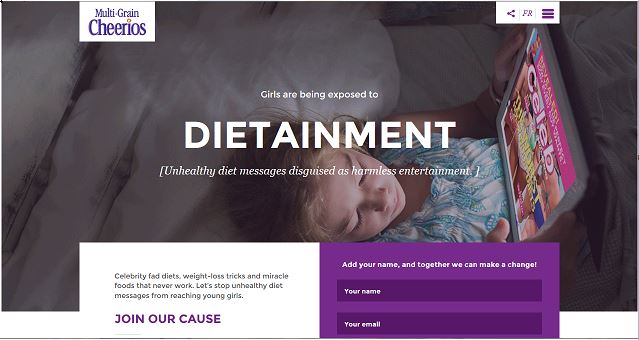
Working to reform the way young consumers and women in particular think about dieting, is not an easy task. To promote the cause, Multi-Grain Cheerios has generated several marketing communications—starting with a website that is dedicated to the campaign. The very first image found on the homepage is that of a young girl reading a celebrity magazine. The homepage also gives individuals the option to participate in the mission by signing an anti-dieting petition to end the promotion of dieting within the Canadian media (Multi-Grain Cheerios, 2015).
Multi-Grain cheerios has also teamed up with other organizations to perpetuate the powerful campaign (Multi-Grain Cheerios, 2015). The company’s marketing strategy is aligned with Coughter (2012) The Art of the Pitch. Throughout the book, Coughter (2012) reiterates the importance of cultivating an emotional connection with an audience or consumer base. From the testimonials of young girls on the website, it’s evident that the campaign is making an impression (Multi-Grain Cheerios, 2015). But, it’s interesting to consider just how much of an impact a social awareness campaign like this can have on reshaping consumer opinions and behavior.
To discover consumer sentiment toward the campaign, understanding attitudes toward the brand is a necessary first step. While long viewed as a household favorite for cereal lovers around the globe, Cheerios has been at the center of heavy criticism in the recent past. In response to the organization’s claims that the cereal is a healthy way to lower cholesterol, the FDA demanded Cheerios make marketing changes (Gilbert, 2009). According the Gilbert (2009) the FDA found the that brand’s marketing was highly exaggerated, and in violation with the Federal Food, Drug and Cosmetic Act.
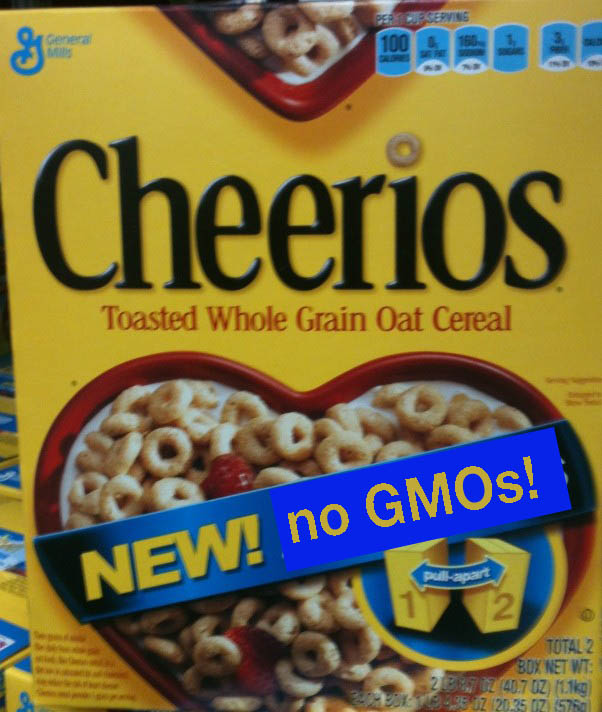
However, the FDA’s plight did not register with the public, as consumers continued to support the brand (Gilbert, 2009). Additionally, Cheerios entered the critic’s spotlight again as activists pushed the organization to remove GMOs from the cereal (Horovitz, 2014). General Mills did remove the substances from the beloved Cheerios, yet interestingly sales did not increase (Brown, 2014).
It’s apparent that the brand has had flaws in the past, but overall Cheerios has remained an American favorite as it claimed the number one spot in 2014 with its Honey Nut selection (Culliney, 2014). But how popular is the Cheerios brand in Canada? In Canada the cereal is also a dominant name in the market, holding the top spot among brands (Krashinsky, 2014). Additionally, the name Cheerios has taken on new meaning in both the U.S. and Canada because of its recent emphasis on social responsibility and emotional connection.
Following the example set in America, Multi-Grain Cheerios in Canada initiated a marketing campaign in order to promote healthy living (Morioka, 2013). The advertising effort was named “Generation Healthy” and was the start of the push against dieting (Morioka, 2013). Cheerios in Canada also started another social campaign in 2014, which features advertisements meant to highlight the brands values (Krashinsky, 2014).
With more organizations realizing the value in social responsibility, there has been an increase in integrated marketing campaigns which seek to create a deep connection among consumers. Cheerios and its other brands like Multi-Grain Cheerios, have adopted this approach and have produced empowering advertisements. These marketing communications have helped differentiate General Mills and the Cheerios brand apart from competition, engaged consumers, and served as a means of educating the public on important social issues.
Discussion questions:
What other marketing strategies can Multi-Grain Cheerios use to promote its cause?
Do you think organizations today are capable of creating lasting cultural change through social campaign efforts?
References:
Brown, A. (2014, March 20). General Mills reports no sales boost for dropping GMOs in Cheerios. Retrieved from http://www.fooddive.com/news/general-mills-reports-no-sales-boost-for-dropping-gmos-in-cheerios/241361/
Culliney, K. (2014, August 27). Cereal chartbusters 2014: Americas top 10 best-selling brands. Retrieved from http://www.bakeryandsnacks.com/Markets/Top-10-best-selling-US-cereal-brands-2014-IRI-data
General Mills. (2015, June 15). Multi-Grain Cheerios: Let’s stop dietainment from reaching our goals. Retrieved from https://www.youtube.com/watch?v=cP8yLOEaZ5A
Gilbert, S. (2009, May 23). Cheerios not that good for you says FDA. Retrieved from http://www.fooddive.com/news/general-mills-reports-no-sales-boost-for-dropping-gmos-in-cheerios/241361/
Horovitz, B. (2014, January 2). Cheerios drops genetically modified ingredient. Retrieved from http://www.usatoday.com/story/money/business/2014/01/02/cheerios-gmos-cereals/4295739/
Krashinsky, S. (2014, October 1). General Mills serves up social values in new Cheerios campaign. Retrieved from http://www.theglobeandmail.com/report-on-business/industry-news/marketing/general-mills-serves-up-social-values-in-new-cheerios-campaign/article20884081/
Martin, R. (2015, June 16). Multi-Grain Cheerios tackles diet culture. Retrieved from http://www.canadiangrocer.com/top-stories/multi-grain-cheerios-tackles-diet-culture-54570
Morioka, L. (2013, December 2). Multi-Grain Cheerios in Canada promotes “Generation Healthy.“ Retrieved from http://blog.generalmills.com/2013/12/multi-grain-cheerios-in-canada-promotes-generation-healthy/
Multi-Grain Cheerios Canada. (2013, Septemeber 20).Generation healthy-girls. Retrieved from https://www.youtube.com/watch?v=y5Kk_V3A4bE
Schultz, E. J.(2015, June 17). Cheerios to girls: Don’t diet. Retrieved from http://adage.com/article/see-the-spot/cheerios-girls-diet/299095/
It’s no coincidence that on the eve of the NBA championship finals that Under Armour hitches itself to the recently announced most valuable player in the league and now NBA champion: Stephen Curry. The two-time NBA All-Star is a sharpshooter for the potential NBA champions, but the road to glory out of Davidson College wasn’t paved with gold for Curry. Fans and media alike never predicted such a steep rise to top for the 27-year-old from Ohio.
Coming off a successful launch of the “Dark Matter” Curry One shoe, Under Armour executives have proclaimed that its basketball brand campaign will become a $1 billion brand, centered on Curry. Through premier quality and revolutionary technology, the goal is to overtake Nike as the No. 1 retail sports brand (Schultz, 2015). The global billion-dollar brand campaign, spearheaded by Jamie Foxx, creative director, will be titled The Book of Will and will highlight the underdog’s story, reflecting both the company’s history as well as Curry’s (Beltzer, 2015).
https://youtu.be/e6o8PbAsGKA
Under Armour’s declaration to build a billion-dollar brand around Curry is a bold claim. Its current basketball brand is worth about $100 million, and for the next 10 years, Under Armour will need to grow 30% each year to achieve this milestone, according to Sterne Agee & Leach analyst Sam Poser (Williams, 2015). This isn’t the only challenge facing Under Armour as they attempt to take on Nike, owner of 95% of the market for all things basketball (Shultz, 2015).
It’s the David versus Goliath: Basketball retail version. Three decades ago, Nike signed legendary Michael Jordan, which catalyzed the company as a lifestyle brand rather than simply a functional brand (Williams, 2015). Its recent celebrity signee, LeBron James, has seemingly sealed its fate as Goliath in this tale. It’s the MVP versus the current best player in the world, on and off the court: Stephen Curry vs. LeBron James; Under Armour vs. Nike; David vs. Goliath. Is it possible for Curry and Under Armour make a dent in Nike’s world?
Curry signs a multi-year deal with Under Armour
Other than established rivals, another obstacle for Under Armour is the strategy it is employing. Even though Under Armour has recently earned the No. 2 ranking in U.S. sales (Rovell, 2015), taking Nike on head-on will prove to be a tough uphill battle for Under Armour. The brand hasn’t stumbled on to uncharted territories. It’s knowingly entering in an overcrowded industry and claiming a huge return on investment; all the while it will be competing with Nike, the official uniform provider for the NFL and now for the NBA.
To stay above the fold, Under Armour should consider positioning itself where the competitive forces in the market are weakest, which can bolster long-term earnings (Porter, XXX). Finding a blue ocean – a demand in an unsaturated market (Kim & Mauborgne, XXX) – might be more beneficial for an underdog like Under Armour. Under Armour should put distance between like brands and offer an uncontested commodity that consumers value instead of relying on fashion and innovative technology to propel revenue into the 10-figure mark. Armour
What do you think about Under Armour’s brand strategy? What other challenges face this underdog?
Schultz, E.J. (8 January 2015). Under Armour has high hopes for Stephen Curry shoe launch in battle against Nike. Ad Age. Retrieved from http://adage.com/article/cmo-strategy/armour-high-hopes-stephen-curry-shoe/296517/.
Williams, T. (3 June 2015). Can Under Armour build a $1 billion basketball business on Stephen Curry? MarketWatch. Retrieved from http://www.marketwatch.com/story/can-under-armour-build-a-1-billion-basketball-business-on-stephen-curry-2015-04-21.
Is being plus size not worth creating an advertisements for? Calvin Klein and Michael Kors do both design houses have fabulous plus size lines but there are no campaigns out there for them. The Webster dictionary definition of marketing is: “the process or technique of promoting, selling, and distributing a product or service.” There are many things that can make a business a success but marketing is at the heart of it all. Is it common knowledge that without a strong marketing plan businesses could possibly be taking a huge hits. Often we are taught the value of doing a marketing plan but rarely do we see a plan that will include unique perspective such as how to approach the hearing impaired or the blind, or how companies are going to sell their products to these populations.
Not long ago, Samsung took the Internet by storm with its campaign to promote a new service in Turkey for the hearing impaired, which touched the hearts of millions of Internet users. I often question if companies even consider these populations as a demographic when doing their market research or they only do it when they have a specific product to market to them such as Samsung did.
ESPN Deportes Logo
The same way with the multilingual community, in a recent meeting I had with the social media team for the Philadelphia Eagles, I was shocked to learn they are also struggling with reaching out to the huge Spanish-speaking fan base, which they didn’t know they had until recently. My question to them was what are you going to do: translate your message or create an original message? The answer was: “we don’t know yet.” ESPN and NBA as two examples of sports outlets that have done a decent transition to Spanish–doing bilingual broadcasting in ESPN Deportes, and Noche Latina for the NBA where the objective is to create original content for the Spanish speaking populations.
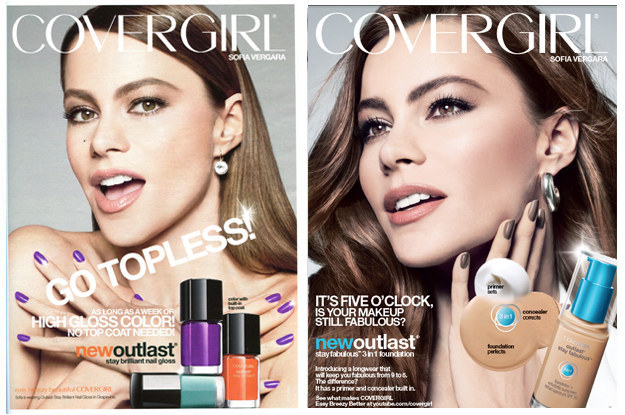
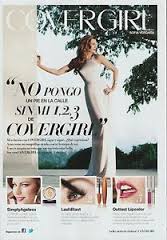
There are few products that have gone the extra mile and create a campaign geared to the populations they are speaking too. Apple was one of them with the campaign “I am Mac,” where they recreated the same ad in Chinese as well as a British version. Or cosmetic companies like Cover Girl that feature
Sofia is a great choice for marketing because she can speak to both the Hispanic market and the English speaking market too.
Sofia Vergara and Dana Garcia as Cover Girls on their ads in Spanish and English.
Don’t you think woman that are hearing impaired will love to learn about Dove’s product? Woman with a physical disability are “real woman,” too. Are they featured in their ads?… I certainly haven’t seen any on their ads. An alcohol brand like Bacardi, whose original ads where in Spanish, is another product that has done a phenomenal job with a multilingual transition–in this case from Spanish to English.
More recently, it is possible to see more diversity in marketing campaigns, at least more than 10 years ago. But marketing has been far from all-inclusive. There are so many sensibilities’ to be aware of: The fact that a group of people speak Spanish doesn’t mean they are Mexican and will identify with a sombrero and mariachi music. Stereotypes can definitely hurt your brand when trying to diversify and be all-inclusive. But is something is worth to try.
With the current media storm still surrounding Caitlyn Jenner and her journey, it is amazing to see so much support for her transition in the media. Although some media has been negative, an overwhelming amount has been positive, which is why the negative ones sting so bad.
Earlier this month El Furniture Warehouse bar in Toronto, Canada posted a graphic anti-trans picture on their Instagram account. The graphic pic made fun and mocked Jenner’s transition, specifically the Vanity Fair cover shoot. While most of the comments on media websites called for boycotts and protest rallies, one group decided to take advantage of the bars insensitivity as a teachable moment of tolerance.
Get REAL, a non-profit organization who teach about un-learning LGBT discrimination and bullying, reached out to the bar and offered assistance. Get REAL offered to hold a workshop for the organization to educate the staff on homophobia and how it is not “just a joke.” During the workshop that hosted more than 100 employees, Get REAL taught family, love, respect, acceptance and diversity.
Get REAL exemplified its message of inclusivity and acceptance by reaching out to people who were perpetuating the cycle of discrimination to educate them. The non-profit saw this as an opportunity to educate instead of an opportunity to boycott, which could potentially harm individuals who were not a part of the post.
While the bar has since removed its Instagram account, and posted an apology they remain connected to the cause. They began advocating alongside Get REAL by incorporating diversity and inclusivity into their training materials and upholding the education.
Although many may think this instance may have set the bar back in revenue, it didn’t for long because they addressed it promptly and made strides to fix it. The bar ended up receiving more publicity for this one negative post than for many of its positive ones as the the number of views on theirs accounts have spiked.
Since the initial post, the bar has participated, donated, and set an example in the LGBT community and continues to gain more support for their efforts. Also, just as important, El Furniture Warehouse has set an example of how to remedy a horrible mistake for other organizations– own it, address it, and fix it!
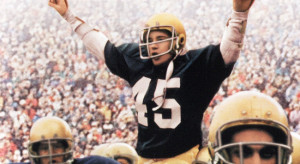
We all like an underdog. Psychology studies prove that rooting for the team, or person, that beats the odds is more appealing than the obvious winner (Heflick, 2010). Don’t believe me? Allow me humor you with one name, Rudy. Now if you haven’t seen or heard of the movie that depicts the life of Daniel “Rudy” Reuttiger, then you’re missing out on a classic, I mean seriously! Now if you’re wondering what the movie Rudy, Rocky, or The Blind Side have to do
with marketing to baby boomers vs millennials, let me explain.
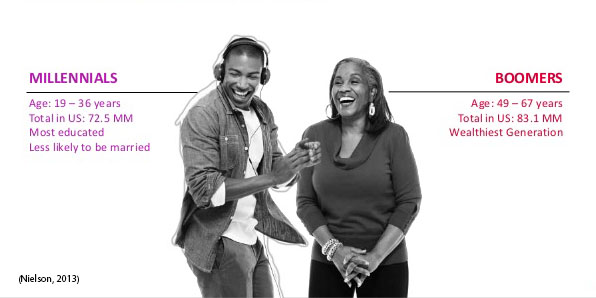
In recent years all the talk, or tweeting, amongst marketing professionals has been focused on millennials. Most of the buzz provides insightful tips on how and why to market to this group, leaving the baby boomers in their dust. Let’s face it they are the largest generation size and the most socially influential group (Spenner, 2014). Not only that, they wield $1.3 trillion in annual buying power, cha-ching (Patel, 2015). We also know that this group is connected by the digital world. In the US 85% of millennials own a smartphone, they are interested in experiences and the authentic truth behind a brand, and they consider themselves to be the misunderstood yet deserving generation (Patel, 2015; Spenner, 2014). So why wouldn’t brands put their money towards marketing to this digital and social powerhouse generation? They appear to be the safe and obvious bet for companies.
Now, let’s take a look at the other contender consumer, the baby boomer. What you might not known is that this underdog generation is actually very active in the social digital space, there are also a lot of them (76.4 million), and oh, they have money (Olenski, 2015). The B boomers (kinda a millennial nickname for them) are an affluent bunch, and Forbes recently highlighted a Nielsen report that stated, “they account for $230 billion in sales of consumer packaged goods, and make up 70% of the nations disposable income” (Olenski, 2015). Therefore, marketers are doing themselves an injustice by focusing all of their marketing campaigns on the millennials.
As a marketing professional, you are faced with the decision to focus your efforts on either the dominant and new millennials or the loyal and seasoned baby boomers. Who would you put your money with? Before you jump to any conclusions on how to boost your bottom line, consider this curve ball. These two generations are not that different.
Shocked, distraught, or relieved – regardless it’s true. These two generations are both social and their buying decisions are persuaded by this environment. The baby boomers are still the underdog when it comes to winning over marketing attention, but both generations have these three things in common:
They both research and make purchasing decision online
They are both regular users of social media #himom
They both are interested in product value
(Granderson, 2014)
What this means is there is actually no underdog (sorry). Perhaps it’s not a win-lose, David vs Goliath situation. All this baby boomer vs millenials talk should be more focused on emergent strategies in order to capitalize on both of these consumer groups. The baby boomers are adjusting and changing their consumer habits, and just like Rudy, they could still make the winning play. What’s best is to keep them both in play as the main targeted group and segment marketing campaigns as needed.
Granderson, D. (2014, February 13). Baby Boomers and Millennials: Two Sides of the Same Consumer Coin. Market Research [blog]. Retrieved from: http://blog.marketresearch.com/baby-boomers-and-millennials-two-sides-of-the-same-consumer-coin





 of the movie that depicts the life of Daniel “Rudy” Reuttiger, then you’re missing out on a classic, I mean seriously! Now if you’re wondering what the movie Rudy, Rocky, or The Blind Side have to do