Exaggeration in Advertising: Ethical Grey or Common Practice?

“Actual facts go incomparably farther than superlative exaggeration towards convincing anyone of the truthfulness of a proposition.” 

Daniel Starch (qtd. by Armstrong, 2010, p.146)


Once in a while each of us bumps into ads which overstate the product’s qualities or effects it makes. “Magic” creams, “never-breaking” devices, and other “miraculous” things promising to lose wait, make money, or become younger in no time – that’s just to name a few.

Some of them are obviously deceptive. Others are examples of puffery, or extreme exaggeration based on subjective opinion that makes the statement unreasonable (Parboteeah & Cullen, 2013). Here should be mentioned “world’s best cup of coffee”, “the ultimate driving machine”, etc., aiming high but providing no concrete evidence.

Moreover, some commercials are built as puffery over puffery, e.g. “our pizza tastes better than the best pizza in the world”

https://www.youtube.com/watch?feature=player_embedded&v=Ttde_4Eu6gU


Apparently, such things should be avoided in advertising business. Neither ethical nor legal aspects of these creative works are going to be discussed here, because most of consumers have enough common sense to see the fine line. Instead, let’s focus on those ads which contain ‘not-that-bad’ exaggeration but still fall under the category of ethical grey. Are there only a few of them, or much more than we realize? More important, in what cases exaggeration in advertising can be appropriate or justified?


First of all, exaggeration sometimes negatively affects not only consumers, but advertiser’s reputation too. Some ads are misleading, like Bayer Aspirin positioned as preferable to other brands but mostly containing… aspirin; others cause indirect harm, like “cavity-fighting” chewing gums that contain sugar (Parboteeah & Cullen, 2013). Advertising to children is a special category, where exaggeration should be avoided in any shape or form. Even though in this area creativity is a must, the statements like “this juice is a superheroes’ favorite” sound manipulative. Also, it is important to remember that children are especially sensitive to lies (Gunter, Oates & Blades, 2004).


On the other hand, are there any cases when exaggeration is “good”/acceptable? The answer is “yes” if the ad is creative but ethically harmless. For instance, exaggeration can be a part of a comic situation, or a visual demonstration of product’s benefits. There is a vivid example of the successful use of exaggeration from Cheez-It, visually comparing “the actual taste” with “the actual size”.


According to Aaker & Biel (2013), commercials of this category assume that the viewers will understand the hyperbole, and that they will recognize and enjoy the exaggeration as an advertising convention. Such ads imply that the metaphor or hyperbole would be understood by the audience and not taken literally.


Therefore, while avoiding ethical greys, exaggeration can be a common practice in advertising. Here we come to an important point – it is ok to exaggerate in cases when an ad:

– Does not distort the product’s characteristics or qualities

– Does not overestimate the product’s effects or benefits

– Doest not involve inappropriate objects/subjects/groups of people

– Does not affect anyone’s health or reputation

– Is presented with humor

– Highlights the key qualities of products/services in a creative way

– Is not manipulative or deceptive.

Anyone to add to this list?


References:

Aaker, D.A. & Biel, A. (2013). Brand Equity and Advertising: Advertising’s Role in Building Strong Brands. Psychology Press.

Armstrong, J.S. (2010). Persuasive Advertising: Evidence-based Principles. Palgrave Macmillan.

Gunter, B., Oates, C. & Blades, M. (2004). Advertising to Children on TV: Content, Impact, and Regulation. Routledge.

Parboteeah, K.P. & Cullen, J.B. (2013). Business Ethics. Routledge.
 

Posted in Uncategorized | Comments Off on Exaggeration in Advertising: Ethical Grey or Common Practice?

My So Called “Tech” Life: Does Technology = Happiness for Women?

by Anastasia Lemle-Goodwin

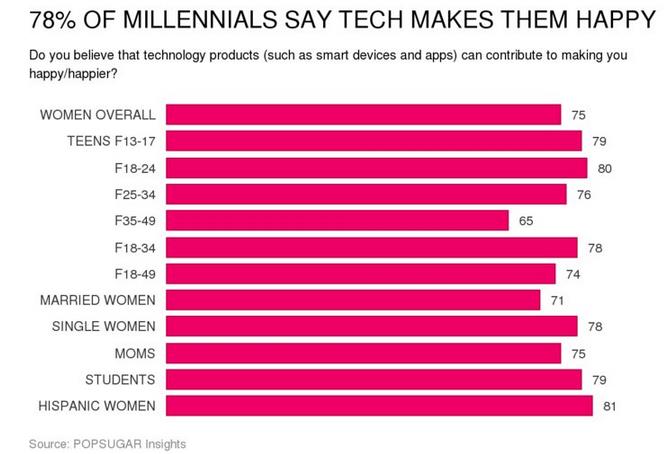
As an…ahem…middle-aged woman who was born as an, on-the-cusp, Gen-X / Gen-Y’er, I was brought up in the time before the INTERNET. Yes…..there was life before the World Wide Web and all these fancy gadgets like the iPhone and the Apple Watch. Now…I will admit that I am thrilled that I can receive data at the touch of a finger; turn off my lights from an app on my cell phone; and call my loved ones on my hands-free cell phone, from my car, using Siri while sitting in traffic. Does this convenience factor and all these techie gadgets make me happy? YES, YES and YES!  Well apparently, I am not alone. According to POPSUGAR Insights recent study “Find your Happy” (McLoughlin, 2015), 80% of millennial women, age 18-24 claim that tech devices and apps have positively impacted their lives and have brought them some semblance of happiness (McLoughlin, 2015). In my age group, 35-49 year olds, 65% of the women surveyed said that tech makes them happy. The percentages are most likely lower in this category due to family responsibilities and careers outside of the home, but are still considered high since we are a prime market that tech and e-commerce companies are paying attention to.

survey

So why does tech make woman happy? Overall, women in general aged 13-49 (62%) find that the “comfort and simplicity” (McLoughlin,2015) that technology provides “help make their lives happier” (McLoughlin,2015) .  Women who are busy with families and or with careers are  constantly looking for convenient and simple ways to navigate their lives whether it is to keep in contact with family members, i.e. their children; fitness and health tracking; social networking; or shopping for themselves or their households.

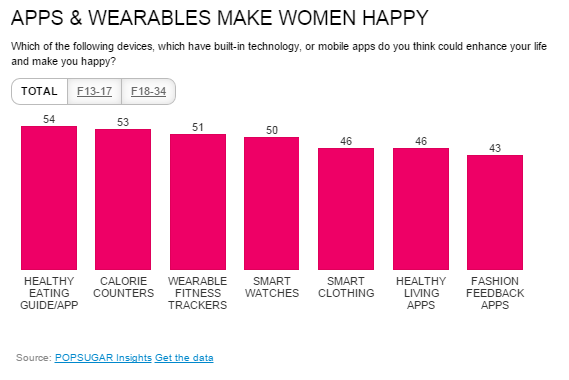
Wearables, Smearables. The Fitbit health tracker wanna-be-healthy is a growing trend amongst women. 54% or women use a mobile device to track their eating habits, caloric intake and healthy eating guides (McLoughlin,2015). Again, the convenience of on-the insta-info is by design a way to live a happier and healthier life. I can attest that when I found the health app on my iPhone I was THRILLED that I could track my entire health report!! It helps as an accountability app and has made my life so much simpler in regards to my health.  YAY!

Wearables

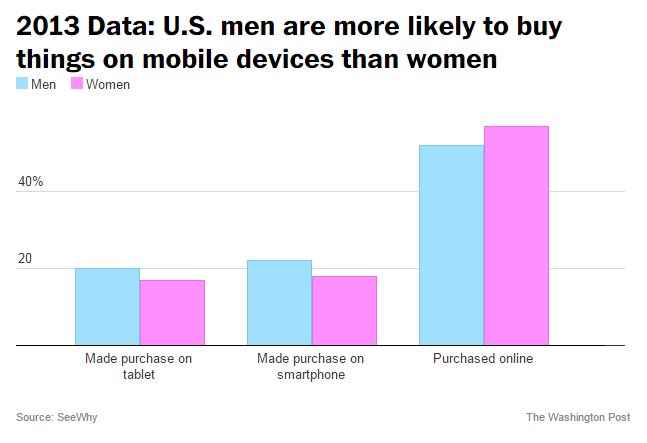
How and where are women making purchases? Glad you asked! Women, who are the prime target market of e-commerce companies, drive online shopping trends at 57% in comparison to men at 52% (Smith, 2015). A study conducted by BI Intelligence (2015) to research e-commerce trends found that men are more likely to make purchases via their mobile device in comparison to women. This is primarily due to women making more rational purchases and taking their time to browse and look for deals rather than jumping on the first sale they see (Lu, 2014). However the distance is closing as women are becoming more comfortable and familiar with smart devices and all the comfort and convenience that it provides in all areas of their lives.

2013 data


What about social media? Where does this fall on the happiness spectrum in relation to women? While some studies have shown that social media can cause anxiety or bring about stress (Leopold, 2015), POPSUGAR Insights (2015) found that social media can be a general source of contentment when women are able to receive support via social media and “communicate their life successes” (McLoughlin,2015).

So what does all of this mean in a nutshell?? Tech companies and e-marketers should realize this an opportunity to increase and diversify their marketing efforts to women.  Women are infusing technology into their daily lives for more that just online shopping. WE are a  viable consumer market that should be considered in the future of technology design and development. AND YES……TECH MAKES US HAPPY

References

Jiaxi, L. (2014, August 6). Research shows men are more likely to shop on mobile than women. The Washington Post. Retrieved on June 12, 2015 from http://www.washingtonpost.com/news/technology/wp/2014/08/06/research-shows-men-are-more-likely-to-shop-on-mobile-than-women/

Leopold, T. (2015, May 1). Can social media make you happy? CNN. Retrieved on June 12, 2015 from http://www.cnn.com/2015/05/01/living/feat-happiness-social-media/

McLoughlin, R. (2015, June 10). Her Connected Life: How Women Use Technology to Find Happiness.POPSUGAR Insights. Retrieved on June 12, 2015 from http://insights.popsugar.com/Her-Connected-Life-How-Women-Use-Technology-Find-Happiness-37675496

McLoughlin, R. (2015, May 28). 62% of women say easily finding info makes them happy with technology. POPSUGAR Insights. Retrieved on June 12, 2015 from http://insights.popsugar.com/62-Women-Say-Easily-Finding-Info-Makes-Them-Happy-Technology-37588287

McLoughlin, R. (2015, June 12). 80% of younger millennial women believe technology makes them Happy. POPSUGAR Insights. Retrieved on June 12, 2015 from http://insights.popsugar.com/80-Younger-Millennial-Women-Believe-Technology-Makes-Them-Happy-37691567

McLoughlin, R. (2015, May 29). The Benefits of Wearables, Smart Devices, and Happiness. POPSUGAR Insights. Retrieved on June 12, 2015 from http://insights.popsugar.com/Benefits-Wearables-Smart-Devices-Happiness-37596088

Smith, C. (2015, February 23). The surprising facts about who shops online and on mobile. Business Insider. Retrieved on June 12, 2015 from http://www.businessinsider.com/the-surprising-demographics-of-who-shops-online-and-on-mobile-2014-6


Posted in Uncategorized | Tagged , , , | 12 Comments

Twitter on the Hunt for New CEO

Though Twitter is still apart of the holy trinity of social media (Facebook, Twitter, and Instagram), it has lost steam over the past couple of years. A lot of criticism via Wall Street has been directed toward CEO, Dick Costolo for his lack of innovation and vision to create more users and viewership on the site. Costolo dropped this bomb right after replacing most of the board, but after constant badgering from Wall Street Costolo asked the board to replace him as well, effective as of July 1st. Since its inception in 2006, Twitter has changed from a social media site for friends to chat and express thoughts to a more of a business and news platform.


images

Twitter has recently partnered with the upcoming app, Periscope that might get more people to sign up and come back to Twitter. But with newer apps like SnapChat taking the wheel of the social media, will Periscope do well for everyday users or those with a business or television agenda? After Costolo resigned Twitter stock rose 7 percent and popular companies like Google are looking into acquiring it.  The real problem is that Twitter criticism started from within when Twitter investor Mr. Sacca created a blog post analyzing what Twitter could do to be better.  The future of Twitter is unsure and, but a rebranding of Twitter should be on the horizon. What Twitter should do to gain a broader following is subject to change as time goes on and the social media realm evolves.

images-1

References:

King, H. & O’brein A. (2015, June 11). Twitter CEO Dick Costolo quits. CNN Money. Retrieved from: http://money.cnn.com/2015/06/11/technology/twitter-ceo-dick-costolo-quits/

Goel, V. & Isaac M. (2015, June 11). Twitter CEO, Dick Costolo, is set to exit, feeling heat of criticism. Retrieved from: http://www.nytimes.com/2015/06/12/technology/dick-costolo-twitter-ceo-jack-dorsey.html?_r=0

Posted in Uncategorized | 7 Comments

Stop the Presses….Millennials are going traditional!

As we all know, integrated marketing communications is such an essential factor when it comes to advertising a particular product or service to a company’s key target audience or demographic. Having a clearly integrated message that can be delivered successfully across all media channels can have a huge impact on consumers. This is even more prevalent to a specific market that most brands and retailers are looking to reach: Millennials. According to a study done by the NDP Group, about “81% of Millennials spend their hard-earned money in a brick-and-mortar store when it comes to their retail consumption” (Olenski, 2013). What was even more interesting about this topic came from another study conducted by Valassis, which highlighted the top sources the Millennial generation look to for most of the their coupons and deals.

Which source do you think topped the chart you might ask?

Well if you guessed online or email coupons, you were pretty close as those were the second and third most widely utilized sources. But the #1 source for Millennials to get coupons and deals was through…..NEWSPAPERS (at a whopping 51%)!!!! What makes this statistic even more compelling is that this particular group of consumers is considered to be the most “digitally-savvy demographic on the planet” (Olenski, 2013) and yet they actually prefer utilizing one of the oldest and most traditional form of communication still remaining today.

Essentially what these study results mean for brand and retail advertising is that companies should not make the mistake of assuming that a particular demographic falls into a certain category and prefers one communication medium over another. In this particular case, it should not be assumed that Millennials are only interested in the latest and most digitally advanced marketing methods or platforms (such as smartphones, iPhones, tablets and PC’s), when in fact they’re taking full advantage of the more traditional marketing and advertising methods.

This article reinforced the importance of creating integrated marketing communication campaigns that can be successfully delivered across all media channels as well as be received by all demographics. In addition, companies would be wise not to assume that they know a specific demographics media communication preference. By assuming too much, companies could end up losing out on a broad market segment that could ultimately have a huge impact for their brand.

REFERENCES

Olenski, S. (2013). Why integrated marketing communications is more important than ever. Forbes. Retrieved from http://www.forbes.com/sites/steveolenski/2013/09/16/why-integrated-marketing-communications-is-more-important-than-ever/

Posted in Uncategorized | 5 Comments

LA Clippers & Sterling Scandal: Top 3 Takeaways

In April 2014, amidst the excitement of their playoff series against the Golden State Warriors, the Los Angeles Clippers brand was turned inside out. TMZ had released audio recordings of Donald Sterling (Clippers owner of 33 years) making very offensive, racial remarks. He is heard demanding his girlfriend (alleged mistress) to not bring “blacks” to his Clipper games and criticizes her for posting Instagram pictures with black people like NBA legend, Magic Johnson. The recording (http://www.tmz.com/2014/04/26/donald-sterling-clippers-owner-black-people-racist-audio-magic-johnson/) spread like wildfire, spreading so quickly on the internet, newspapers, blogs and social media sites.

As expected, an outburst of reactions came highly-charged from all different directions. The Clippers organization was now front and center, target of criticism and pressured for immediate action or reaction. One thing was clear — the Clippers needed to rebrand to survive.

The NBA and the Clipper organization’s reaction to the crisis provides us with valuable lessons. Here are some key takeaways I’ve gathered:

1) Strong and Simple Messaging is Key

la_clippers_we_are_one_web

Quickly responding to crisis (which is also critical), the Clippers launched their “We Are One” campaign. The tagline was simple, direct and effective. The 3 words were powerful and clearly expressed the sentiments of against Sterling’s inexcusable behavior. There was no need for a flurry of messaging or tag lines amidst the information overload that the public and their fans were already receiving. Instead, they needed to make a clear and simple statement.

2) Don’t Underestimate the Power of Visuals

Without a doubt, the crisis was emotionally-charged not only for the fans, but for the players and the NBA family. As a result, there was an immediate need to connect and empathize with NBA fans across the world. A press release or campaign tagline would be helpful, but it wasn’t going to be sufficient. Instead, a 30 second TV spot was released (in partnership wit the NBA) showcasing the unity and support for the Los Angeles Clippers. The commercial was what it needed to be, which was uplifting and positive.

https://www.youtube.com/watch?v=Mcm52fXvH4E

3) Leverage the Power of Social Media’s Influence and Reach

Social media was the platform used by many outraged fans, sports commentators, NBA legends and the global community to react and give their opinions on Sterling’s remarks. The Clippers recognized the key role social media would have in their efforts to rebrand. Posting their “We Are One” images onto their Twitter and Facebook accounts, they were able to garner hundreds of clicks, likes, shares and re-tweets within minutes.

Posted in Uncategorized | 1 Comment

Fake Data

Fake Data

Before taking 540 I hadn’t analyzed data since junior high school when we did exercises on data collection and surveying our friends as an introduction to statistics. Over the years, I have hired data science companies to run surveys about attitudes on particular subjects. The guys were awesome. I would explain the problem and the type of data I wanted, I handed them a large check, and poof 6 weeks later I received amazing reports worthy of publishing in science magazines. When it comes to election time and politicians expunge statistics I am always cynical of where the numbers come from and how the data is collected—biased and untrue I tell myself and tune out “fuzzy numbers.”

lies

In December of last year, I read a fascinating article in the Washington Post about how face to face interactions can change people’s minds. It was an astonishingly scientifically backed study published in Science Magazine that proved people’s prejudices can evolve. The implications were far and wide reaching.

In May of this year, while driving down the freeway I was shocked when I heard Ira Glass of NPR say he was devastated to hear the story had been retracted.  The graduate student, Michael LaCour that designed and implemented the study had falsified or at least appeared to have falsified data. I was astonished and astounded. However, it wasn’t just me that had been fooled. A series of articles, retractions, and editorials all began to appear the following week.

It all came to light because a group of students from UC Berkeley wanted to replicate the original study.  They were not getting the same participant response rates so Qualtrics. Qualtrics did not have a record of the survey or the data from the original study. It all began to unravel after this. Although the original in person interviews were real, the post interview poll results were elaborately falsified. One of the canvassers was astonished to hear about the scandal as he recalled watching the data come in from the surveys. The UC Berkeley students documented the inconsistencies and contacted the senior sponsor of the paper, Donald Green from UCLA. Within two days Green asked for a formal retraction from Science as the LaCour was unable to provide the raw data which the study was based upon.

The moral of the story is when things seem too good to be true, they usually are.

We are in living in a world of data and bad data is a part of it.  Journalists have to turn out stories faster and scientists and academics have to publish more to stay relevant. In 2014, 43 articles were retracted from BioMed Central because of falsified peer review data scandal (Washington Post).  iThenticate published a yearly blog of top 10 plagiarism cases. There is a watchdog group for plagiarism called Bad Media.

Marketers be warned bad data is lurking, unscrupulous journalists are reporting, and watchdogs are trolling to find your mistakes.

Links to Retracted Study

This American Life

http://www.thisamericanlife.org/blog/2015/05/canvassers-study-in-episode-555-has-been-retracted

New York Times

http://www.nytimes.com/2015/05/29/science/journal-science-retracts-study-on-gay-canvassers-and-same-sex-marriage.html?_r=0

Science

http://news.sciencemag.org/policy/2015/05/science-retracts-gay-marriage-paper-without-lead-author-s-consent

Retraction Watch

http://retractionwatch.com/2015/05/20/author-retracts-study-of-changing-minds-on-same-sex-marriage-after-colleague-admits-data-were-faked/

Plagiarism

Washington Post

http://www.washingtonpost.com/news/morning-mix/wp/2015/03/27/fabricated-peer-reviews-prompt-scientific-journal-to-retract-43-papers-systematic-scheme-may-affect-other-journals/

Mashable

http://mashable.com/2014/05/16/cnn-reporter-fired-plagiarism/

Watchdog Links

Our Bad Media

https://ourbadmedia.wordpress.com/

iThenticate

http://www.ithenticate.com/plagiarism-detection-blog/top-plagiarism-scandals-2014#.VXx95flViko


Posted in Uncategorized | Tagged , , | Comments Off on Fake Data

An Uncertain Future For The #Hashtag

Image by pixgood.com

Hashtagging has been an integral component in social media communication and brand engagement over the years. They are used to convert a keyword or phrase into a link that readers click on to participate in a conversation. It’s a way to stay up to date on a trending topic and join a network of conversationalists that boast, banter, or debate about a topic of interest.

I used to enjoy hashtagging, a lot. It was my way of waving my virtual hands across hundreds of newsfeeds on Facebook and shouting “Hey, look over here!” My personal favorites were #YOLO, #Selfie, or any impromptu phrase I came up with–but those were always rendered useless. Hashtags made my posts more interactive and were occasionally used to flex my comedic muscles.

But there are some who are ditching the #hashtag.

According to Coffee (2015), Shadi Rahimi, a deputy producer of Al Jazeera’s AJ+, argued that hashtagging is an unoriginal and ineffective way to gain readership. Journalists, Rami claimed, are now parting ways with hashtags on social media because they’re supposed to be perceived as objective writers, and hashtagging instantaneously stamps their digital content as editorial-based instead of hard news coverage that should be taken seriously (Coffee, 2015). At one point Twitter had considered modifying their site to minimize the view of hashtags for a cleaner appearance (Gibbs, 2014).

As unattractive as they look, it’s proven that this method of marketing has been successful in promoting a product or service. Writer Tom Spencer (2015) from PRDaily.com suggests “…83 percent of all social campaigns in the past year featured nothing more than a prominent hashtag” (para. 2). Spencer (2015) argued that hashtags could stay alive so long as the PR agency or person knows how to get creative and experiment with different keywords and placement.

I find that I limit the amount of hashtags I include on my posts now, because there’s an unspoken etiquette about using them. Too many hashtags may steer readers away from my posts and I could be perceived as someone who is crying for attention. As people become more familiar with them, Coffee (2015) concludes, “…They’re just less relevant to brand strategy as their value becomes clearer” (para. 8).

References
Coffee, P. (2015, June 10). No One Uses #Hashtags Anymore. Retrieved on June 11, 2015 from http://www.adweek.com/prnewser/no-one-uses-hashtags-anymore/115101

Gibbs, S. (2014, March 21). Twitter Could Ditch @Replies and Hashtags. Retrieved on June 13, 2015 from http://www.theguardian.com

Spencer, T. (2015, February 12). 4 ways PR and marketing pros can use hashtags. Retrieved on June 12, 2015 on http://www.prdaily.com

Posted in Uncategorized | 3 Comments

Offsetting A Negative Stigma With Positive News

Monsanto

Over the years, a lot of news has been circulating for Monsanto both negative and positive. As an example of negative press, on March 21, 2015, there was concern by the World Health Organization in regards to Monsanto’s use of glyphosate.  As a result over the potential health risk, the organization’s sub-committee published a report that added glyphosate to their list that could “probably” cause cancer. Monsanto along with several revered scientists pointed out in a rebuttal that the carcinogenic properties are not a threat to humans as the chemical is government regulated in terms of quantities allowed and that the levels and duration of exposure to become a health risk are unrealistic to encounter in typical use. While glyphosate from a purely scientific viewpoint has caused health declines in large concentrated doses to lab rats, its limited use for agricultural treatment has not been proven to be of concern.

Additionally, Monsanto in another negative news report reached at that same time a settlement agreement with wheat farmers in several states over the discovery of genetically modified wheat on their farms that migrated into their organic crops.  It is suspected for reading the transcripts that the GMO wheat seeds mixed into their organic crops through airborne means. In order to quell the unrest of these litigants, a $50,000 donation has been given to the agricultural schools at each affected state to further the interests of wheat farmers and the wheat industry along with additional payments for restitution including plaintiff legal fees fully reimbursed.

Monsanto follows a similar trends in spin strategy utilized other vilified companies such as R.J. Reynolds and Philip Morris in which to generate positive press to offset the negative stigma from opposition and public scrutiny.  In Monsanto’s communication strategy a commitment is often made to assisting philanthropies demonstrating that despite their unfavorable technology, they are committed to helping others and the environment. Within that same week, Monsanto announced they were donating land to the National Park Service used by the government for the Honouliuli Internment Camp Site during World War II. Additionally, Monsanto pledged $3.6M over three years to the National Fish and Wildlife Foundation to benefit the Monarch Butterfly Conservation Fund. Incidentally, Monsanto is the first major corporation to contribute to this fund.

Conflicting issues resulting in negative press are all too common for Monsanto as their technological process of creating GMO produce continues to vilify the company in public opinion. Utilizing chemicals such as Round-Up and other artificial chemicals do speed up the growing process and have “pest-deterrent” technologies in their products creating a larger yield of produce but concern is high over the cumulative health risks from consumption. It appears from this example that by having Monsanto communicate their commitment toward specific philanthropies, it can offset a percentage of the cumulative negative stigma from its core business model.

As a closing side thought to this matter, I find have often wondered with a growing global population of 7.3 billion people that it seems impossible to grow only organically to consistently feed that many people.  Thus the necessary evil of such methodologies like GMO are allowed. Upon harvesting produce, only a small percentage of a cumulative crop is considered spoiled from this GMO methodology, while organic produce can lose up to 30% of a cumulative crop due to thrip, soil nutrient deficiencies, animal damage and overexposure to the elements. Additionally GMO produce is more affordable by lower socioeconomic groups and impoverished third world countries.  This leaves one major question to consider:  Is there a specific level of philanthropic charity and positive news that can effectively offset the negative perceptions of a company?

References:

Wall Street Journal “Monsanto bites back at glyphosate findings”

http://www.wsj.com/articles/monsanto-bites-back-at-glyphosate-findings-1427147273

Forbes “WHO says Roundup ingredient is probably carcinogenic. Are they right?”

http://www.forbes.com/sites/alicegwalton/2015/03/21/monsanto-herbicide-dubbed-probably-carcinogenic-by-world-health-organization-are-they-right/

Monsanto “Information about glyphosate”

http://www.monsanto.com/glyphosate/pages/default.aspx

Posted in Uncategorized | 4 Comments

Lululemon: Crisis Management Through Integrated Communication

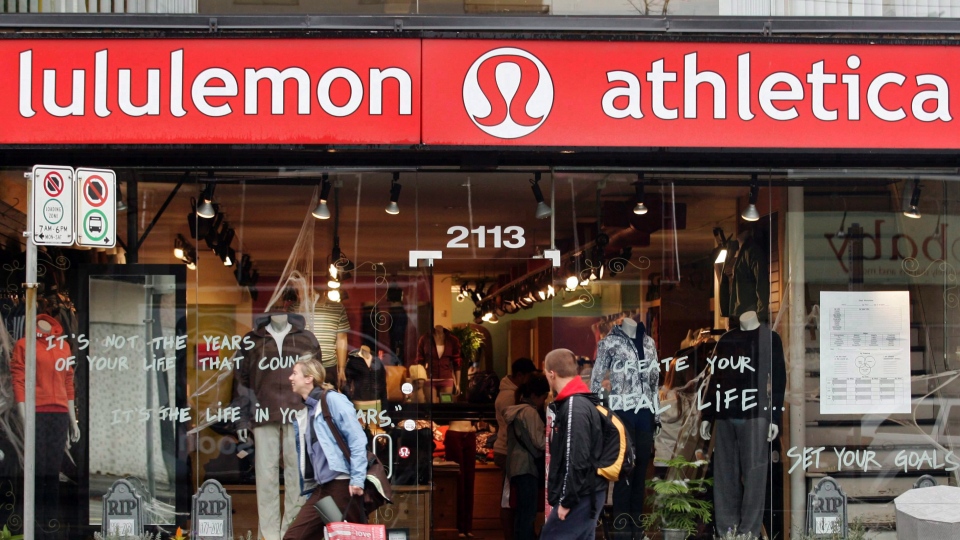
The idea had been thoroughly vetted and researched. Two years of consumer analysis led Lululemon to an idea of how to engage the Buffalo, New York community with their brand (Christmann, 2014). Upon opening their Walden Galleria store, they unveiled a floor mosaic with the words, “wide right, no goal” prominently displayed.   This didn’t resonate well with Nunie Williams, so just before going out to walk with her dogs, she posted on her Facebook and Tweeted about her displeasure (Christmann, 2014). The outrage went viral, and by that evening, Lululemon took to social media to apologize for the offense (Christmann, 2014).   The mosaic was covered with a rug until it could be torn out and replaced (Christmann, 2014). Lululemon had monitored trending social media and used the information to quickly respond to a public relations failure, limiting the damage to their brand.

lululemon2

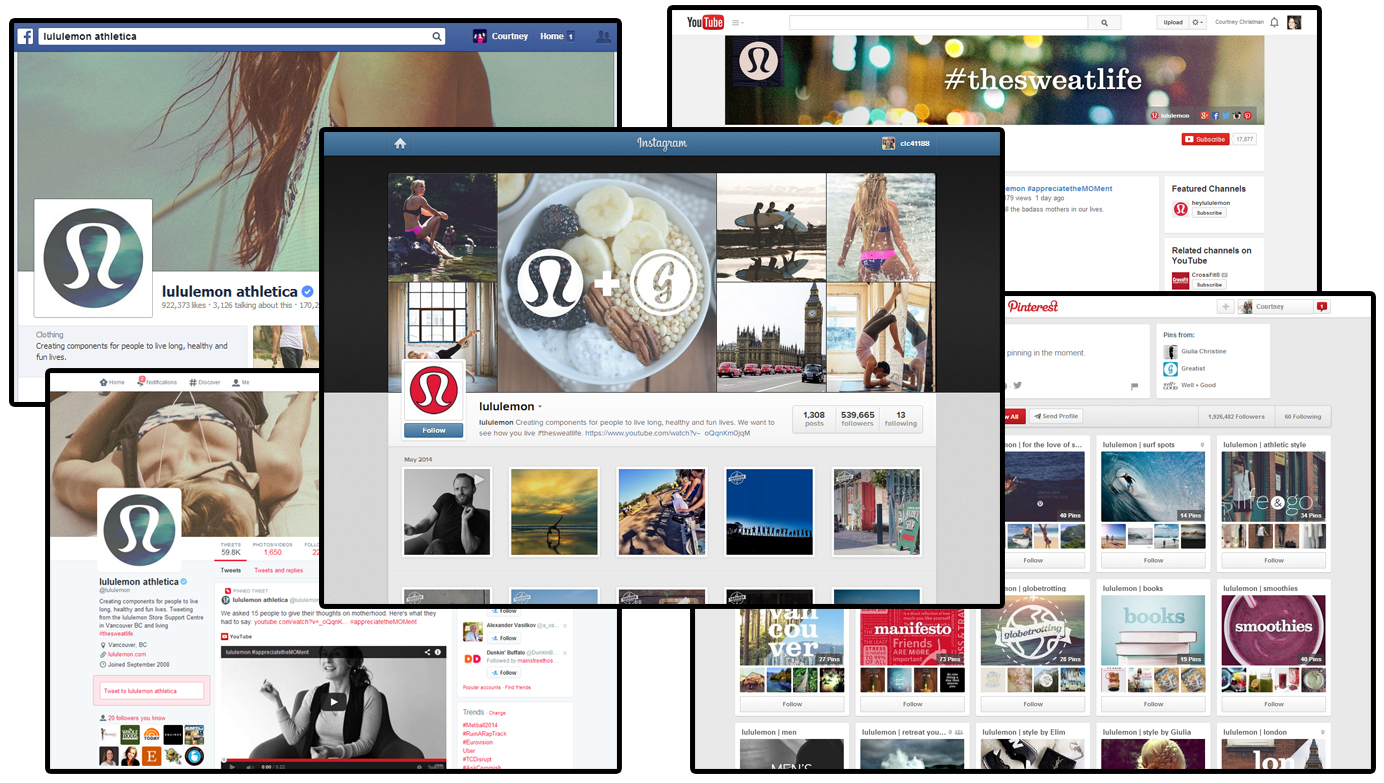
Lululemon heavily embraces an integrated marketing communication plan. They are present in all major media, including television, radio, print, and Internet. Their heavy social media presence has consistently assisted their organization in messaging with their consumers. One danger of being present in so many media channels is the risk of repetition and monotony. Brands can suffer negative associations if they simply repost the same photographs or literature pieces across various media (Creativeconcepts.com, 2015). Lululemon is flourishing on social media by actively connecting with their product’s consumers and responding to their feedback (Creativeconcepts.com, 2015).

lululemon_social_media_collage

Another Lululemon crisis that was both inflamed and addressed through integrated marketing was the aptly named “pantsgate.” Lululemon has built their brand on the image of quality and comfort. In early 2013, the yoga pants that Lululemon was selling had consumers complaining that the fabric was too sheer, and that they were see through when consumers were bending over. Social media blew up with stories of consumers being treated harshly by store employees, some even claiming that they were forced to put the pants on and bend over to prove that they were too sheer (Hsu, 2013). These stories went viral, and a brand crisis exploded.

ESQ-lululemon-yoga-pants-2013-xl

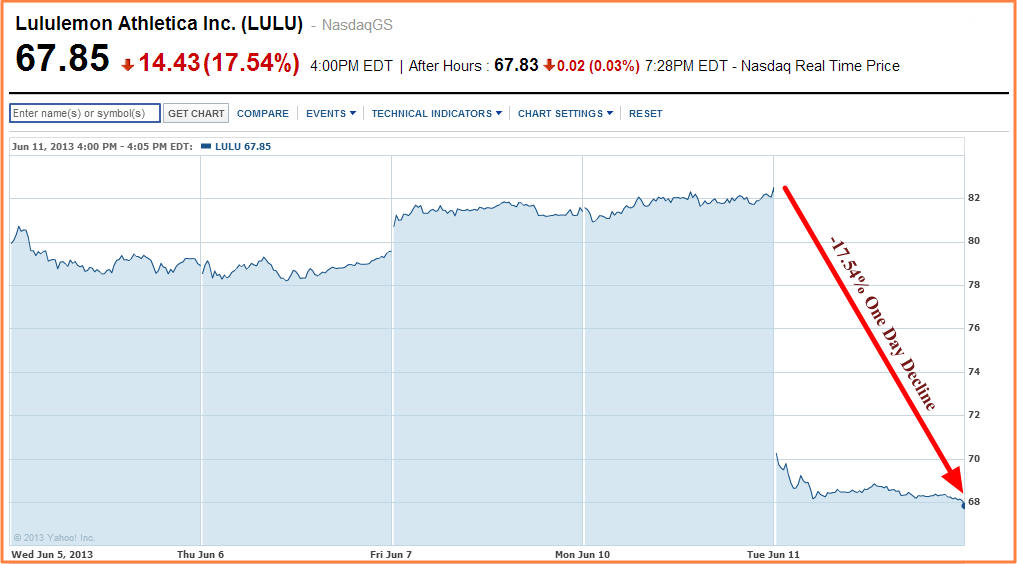
Lululemon eventually declared a recall for all the yoga pants made during that period, with no questions asked (Hsu, 2013). However, this did not come in time to avert an economic hit to the financial performance of the company. Lululemon stock shares dropped by six percent, after they reported slower than expected sales and growth (Isidore, 2013).

Lululemon-falls

Lululemon’s nimble reaction to this crisis through their integrated marketing plan helped to minimize this negative impact (Crenshaw, 2013). Through press releases and social media platforms, Lululemon provided consumers with information about why the product had failed, what they were going to do to mitigate the impact on consumers, and how they would prevent this from happening in the future (Crenshaw, 2013). This strategy has helped alter the course of Lululemon’s financial trajectory, which is once again trending up (Halzack, 2015).

References:

Christmann, S.   (2014). Lululemon received a lesson in social media. The Buffalo

News.

CreativeConcepts.com.   How Lululemon Gets Multi-Platform Content Strategy Right.

Retrieved June 9, 2015, from http://creative-conceptsllc.com/lululemon-

multiplatform-content-strategy/

Crenshaw, D. (2013).   Crisis management lessons behind the headlines.

Business2Community.

Hsu, T. (2013). “Pantsgate” to hurt Lululemon profit; customers told to “bend over.”

Los Angeles Times.

Isidore, C.   (2013). Lululemon lowers forecasts, share plunge. Money.CNN.Com.

Halzack, S.   (2015). Lululemon is finally recovering from “Pantsgate” and other

     problems. The Washington Post.

Posted in Uncategorized | 2 Comments

Diversity is Making a Breakthrough in Advertisement…Finally!

Why has it taken large companies over 30 years to begin to reflect our society’s current state in their advertising campaigns? America is supposedly the melting pot of cultures, yet until the past two years, advertisements have failed to acknowledge how diverse society has become. According to insights from Ad Age, “[a]dvertising has proved to be the last frontier when it comes to reflecting societal changes.”However, companies like Coca Cola, Gap, and Cheerios have pioneered into the diversification of their ads to include diverse models. Despite receiving some pretty heated backlash from consumers, the visibility of interracial couples and families, multi-lingual voice overs, and LGBTQ protagonists has increased.

Coca Cola’s “America is Beautiful” Superbowl XLVIII ad was notably memorable because the hymn “America the Beautiful” was sung in multiple languages and featured people of various ethnic backgrounds, ages, and sexual orientation. This commercial really captured the new American mainstream. As the Time article explains, the message and intention of this commercial was to celebrate America’s diversity-it is what defines us and makes America stronger and beautiful (Poniewozik, 2014).

Just recently, Pedigree released a new commercial “The Walk” showing how the unconditional love of a dog can mend or unite men of different ages and races. The attention Pedigree has placed on racial relations is representative of the changing landscape of Adland.

https://www.youtube.com/watch?v=MEIKZQ6wBZA

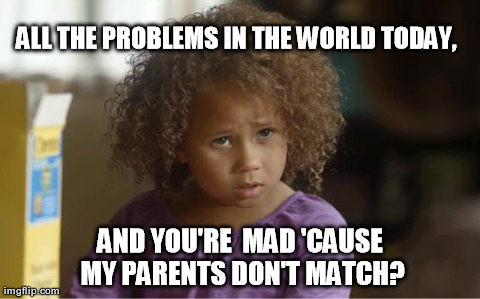
More and more companies are beginning to cast ethnically diverse people for their advertisements-which is is great! Brands, like Cheerios, are now accurately depicting the modern American family. Their commercial “Gracie” shows an interracial family discussing the newest addition(s) to the family in a cute and lightly humorous fashion. However, some people became outraged with the inclusion of an interracial marriage, directing racist comments toward Cheerios, even though interracial marriages and families have become more common (Elliot, 2014).

Gracie

Clearly the topic of diversity in advertising is still sensitive, but we can expect that more ad spots like “Gracie” and “The Walk” will begin to circulate into mainstream media over the next couple years. Notably, a big catalyst for this ad revolution is Millenials. Everyone (large and small companies) is trying to market and get buy in from this particular consumer demographic. Research shows that Millenials are more ethnically diverse, strongly liberal, and more socially progressive (Pew Research Center, 2010). Because this group is highly educated and a progressive consumer, companies are coming to the realization that they need to alter their visions to match the consumer’s identity. For now the clock has reset until the release of another diverse advertising campaign.

References:

Elliot, S. (2014, January 28). An American family returns to the table. The New York Times. Retrieved from http://www.nytimes.com/2014/01/29/business/media/an-american-family-returns-to-the-table.html

Pew Research Center. (2010). Millenials: Confident. Connected. Open to change [executive summary]. Retrieved from http://www.pewsocialtrends.org/2010/02/24/millennials-confident-connected-open-to-change/

Poniewozik, J. (2014, February 2). Coca Cola’s “It’s beautiful” Superbowl ad brings out some ugly Americans. Time. Retrieved from http://time.com/3773/coca-colas-its-beautiful-super-bowl-ad-brings-out-some-ugly-americans/ 

Zmuda, N. (2014, March 10). Ad campaigns are finally reflecting diversity of U.S. Ad Age. Retrieved from http://adage.com/article/news/ad-campaigns-finally-reflects-diversity-u-s/292023/


Posted in Uncategorized | 7 Comments