The Next Wave of Mobile Communications?

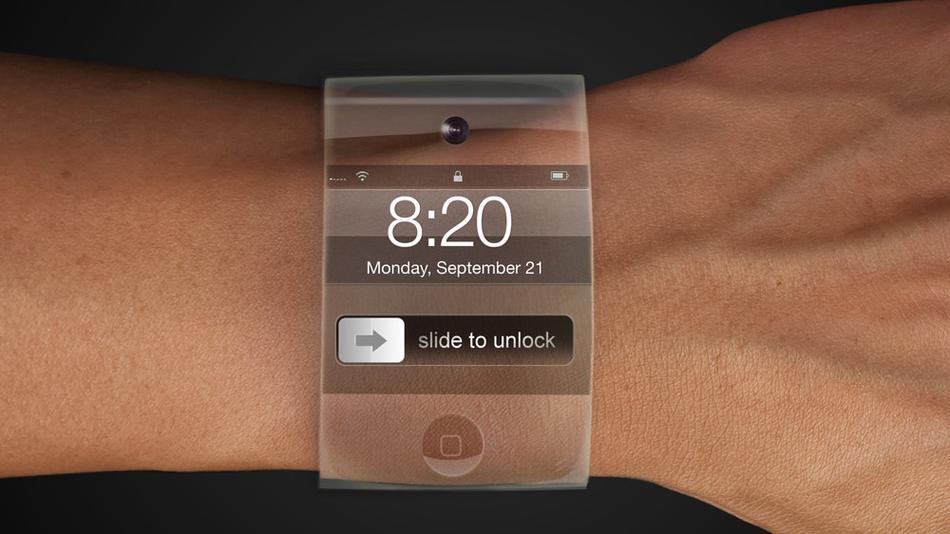
tb_2-Yrving-TorrealbaSmart watches are coming. Just as Apple made the original iPhone a fashion accessory, they may create a new market for the next must-have possession.

Currently, four manufacturers are rumored to be creating smart watches: Apple, Samsung, LG, and Google. Whichever company introduces the first model may have a significant advantage. Samsung is currently stealing a lot of market share for coolness from Apple. If they create the first smart watch, they may dominate the new niche like Apple did with their first iPod.

Smart watches will pose fresh challenges for marketing teams:

  • Entirely new genres of apps must be developed to take advantage of the possibilities. One example might be fitness-oriented apps. Swimmers would be much more likely to swim while wearing a watch than with a smart phone strapped to their backs. And every ounce matters for marathon runners.
  • A 1.5″ screen is much smaller than a smart phone’s screen, so new web interfaces and advertising methods must be developed.
  • Copywriters will be required to boil their messages down even shorter than before.
  • Designers must find images that capture the visual information with even fewer pixels.
  • Video must be crafted for an even smaller screen.
  • If the videos have sound, audio engineers will need to tweak soundtracks for even smaller speakers.

Smart watch adoption levels will probably be smaller than smart phone adoption levels. But maybe with a cool version of the now-geeky bluetooth earpiece, smart watches could also become smart phones!

Footnotes:

  • Google is unique with their forth-coming “Google Glass” smart glasses, but I predict those will not be as cool as smart watches. For one thing, the Google Glass is not compatible with prescription glasses. Another downside is that interacting with a part of your field of vision is potentially very hazardous, unless the wearer is just relaxing on a couch.
  • Sony has a Smartwatch already, but its capabilities are much fewer than the other possible watches mentioned above. Another watch in that category is Pebble.

Image courtesy of Mashable.

-Paul Merrill

Posted in Uncategorized | 15 Comments

Why E.T. liked Reese’s Pieces over M&Ms

reeses-pieces When Director Steven Spielberg wrote his screenplay for E.T.: The Extra-Terrestrial, the script called for a trail of M&Ms candies to be made for E.T. to follow, but in the movie, ultimately Reese’s Pieces became the favorite of E.T. Makers of M&Ms, the Mars company did not want to be associated with the alien character and did not want to bankroll the publicity of the film which was a Spielberg requirement (Steinbrunner, 2008). Rut-roh. Oops. Hersheys did. Reese’s Pieces sales exploded with an increase of 65% for a total of $35M in sales in 1983 (Van Biema, 1982).

“I have no doubt that if Jesus was walking around today he’d be sponsored by Birkenstock.” (Barrie, 2012)

Product placement is a form of advertising used in movies and familiar to audiences everywhere. It can add credibility and realism to the story and if done in meaningful way, can be an effective in reaching an audience, even those who are marketing-adverse. In the old days, the production designer or set dresser would just gather products and reach out to companies to get legal clearances for their use on camera.  Now of course, there are agencies and agents dedicated to product placement in film and television. A newer term that’s emerging in regards to product placement is product integration which typically refers more to product within television shows (think Coke cups on the American Idol Judges’ desks). Some brands are so essential to the movie brand that together they create an iconic image. Imagine Tom Cruise without Ray Bans in Risky Business or Tom Hanks without Fedex in Castaway.

Heineken

Not shaken, not stirred, just open with a bottle-opener.

Well, that’s what happened on the last James Bond movie Skyfall. There are few beverages as iconic to a movie franchise as the martini is to the James Bond.  So when Bond producers announced the deal with beer maker Heineken for $75 million to feature their product in Skyfall as well as other integrated marketing efforts, fans balked. Producers claim due to the high costs of the film and the director’s vision, the deal was necessary (Barrie, 2012). There are those die-hard fans who argue, that a beer is not inherent to the Bond character because 007 is a man of elegance and the vodka martini is a key part of that character (Hastings, 2012) as written by Ian Fleming. That said, many Bond movie plots have strayed far away from Fleming’s original character.  So the dilemma is that as a filmmaker, do you choose between not making a project with the scope and magnitude you think the project deserves or taking the cash and compromising a little bit of the character?

Skyfall ended grossing over a billion dollars internationally and Daniel Craig, the filmmakers Michael Wilson and Barbara Broccoli, the movie studio and Heineken seem pretty happy.

Milissa Douponce, 541 Section A

Resources

Barrie, J. (2012). James Bond drinking Heinken in Skyfall? The Independent. Retrieved from http://www.independent.co.uk/voices/comment/james-bond-drinking-heinken-in-skyfall-whatever-next-8226917.html

Hastings, C. (2012). Vodka Martini, James? No thanks, mine’s a Heineken – just one of the £28m worth of product tie-ins in the new Bond movie. The Daily Mail Retrieved from http://www.dailymail.co.uk/news/article-2210665/Vodka-Martini-James-No-thanks-mines-Heineken–just-28m-worth-product-tie-ins-Skyfall.html

Van Biema, D. (1982). Life is sweet for Jack Dowd as Spielberg’s hit film has E.T. lovers picking up the Reese’s Pieces. People.com. Retrieved from: http://www.people.com/people/archive/article/0,,20082729,00.html

Steinbrunner, J. (2008). The ten most shameless product placements in movie history.Retrieved from: http://www.cracked.com/article_16574_the-10-most-shameless-product-placements-in-movie-history.html

Posted in Uncategorized | 16 Comments

This is Story

The universe is made of stories, not atoms.   -Muriel Rukeyser

There is power in story.  Story is transformative, taking mere words and shaping them until they are woven and spun into a tapestry that paints a picture we are drawn into.  It’s why we love movies – stories connect us, and let us know we are not alone in the world.  We relate to story.

What's your story hand

When we want to get to know someone, we ask them to tell us their story – not their stats. Stats may be impressive, but stories create indelible impressions that have the potential to stay with us for a lifetime, or even to change the world.

In thinking about storytelling, I was struck by the realization that integrated brand marketing is in actuality an exercise in storytelling.  Successful branding of a product requires the understanding that underneath all of the threads there is a fantastic plot that ties it all together, and provides meaning.

storytelling

I stumbled across a video of an excellent presentation given by Nancy Duarte at TedX in 2010, called You Can Change the World.  In it, Nancy provides a fascinating look at the difference between presenting and storytelling by artfully analyzing talks given by Steve Jobs and Martin Luther King, Jr. – two men who define what it means to be world changers.  It’s eighteen minutes long, but well worth viewing:

http://youtu.be/UfQF3DXG-S4

People have forgotten how to tell a story. Stories don’t have a middle or an end anymore. They usually have a beginning that never stops beginning.   -Steven Spielberg

Although the speeches given by Steve Jobs and Martin Luther King, Jr. had an ending, their stories have not ended. Rather, their stories have created and continue to create new beginnings.  What a beautiful way to envision the power of story.

storytelling 2

I wanted a perfect ending. Now I’ve learned, the hard way, that some poems don’t rhyme, and some stories don’t have a clear beginning, middle, and end. Life is about not knowing, having to change, taking the moment and making the best of it, without knowing what’s going to happen next. Delicious Ambiguity.   -Gilda Radner

May we be brave enough to embrace the “delicious ambiguity” of our stories,  understanding that when we have the courage to move beyond ourselves and reach into the hearts of our audience we may actually change the world.

-Kellie Clinebell

Posted in Uncategorized | 7 Comments

Crystal ball: consumers, not actors, will soon be promoting brands

Promoting brands with no compensation: No wonder you were the person of the year.

Look around you, it’s everywhere. User-generated content (UGC) is one of the most effective ways marketers can engage consumers with their brands. Whether staged or real, genuine or for monetary benefits, there is a common thread: brands utilize user videos or other types of multimedia content to promote a product or cause, and that content is then used as part of a marketing campaign and circulated around the media and internet, hopefully in viral fashion.

There are numerous successful utilizations of UGC video marketing, including the Dove Campaign for Real Beauty, the Share Your Heart video campaign by CaringBridge, and Pepsi’s half-time show at the latest Super Bowl where hundreds of users introduced Beyoncé for her halftime performance. Users got engaged, created marketing content, promoted the brand, and most received no compensation in return. No wonder we were Time’s Person of the Year.

But while brands are scarce on compensation, they don’t skimp on promises. Brands use different means to entice people to market their products through UGC, some more effectively than others. Photo-sharing social network Instagram recently made headlines by trying to say that it owned licensing rights to all user images (it has since backtracked), while brands like Armani and Whole Foods ask users to take photos of themselves using their products, or to tell their stories with the possibility of winning free merchandise. This has been quite successful because thousands of users are promoting these brands within their social networks, and only a very select few of them ever receive any compensation. It’s a very cheap and effective way to reach consumers. Marketers no longer need humongous multi-million dollar budgets to reach the masses. They just need a social media presence and a clever campaign.

One of the best brands at using and promoting UGC is Coca Cola. If you were to visit Coca Cola’s Facebook page you’ll find this statement in the description: “The Coca-Cola Facebook Page is a collection of your stories showing how people from around the world have helped make Coke into what it is today.”

In other words, Coca Cola’s presence on Facebook is solely meant to solicit the creation of UGC marketing content. With such a big company dedicating its social media presence just to UGC, the future for marketing is looking more and more clear. Less actors will be promoting brands in the future, in favor of rank-and-file consumers.

-Zeyad Maasarani

Posted in Uncategorized | 17 Comments

Dynamic Content Duo = the future of Marketing + Big Data

Even though the digital revolution is well into its second decade, the ongoing ripple effects are no less impactful than the days when websites were the new kid on the block. Of course, as all of us at USC Annenberg are all too aware: Change is the status quo because technology keeps evolving.

Now, it’s the “future of marketing,” “big data,” “engagement,” and “relevance” that command attention because new nuggets about best practice are always emerging, especially when savvy thought leaders apply a bit of creativity. Last month, for example, an American Marketing Association webinar on the future of marketing proposed an interesting question: What will the Marketing Department of 2020 look like? A post on Forbes outlined 10 reasons that big data is being under utilized.

Inbound marketers hubspot laid out the top trends of 2013 and listed dynamic content, which strikes me as a fascinating connection or link between the future of marketing and the role that big data will play. By creating dynamic content – yes, it includes video, survey polls, topics of interest, hyperlinks, expert analysis, and all the other tools that draw someone to a particular brand and keep them interested – a brand marketer is tapping into curiosity, challenging schemas, and inspiring people to action because they feel something (Heath & Heath, 2008, p. 67, 84-93, 169).  It was summed up quite nicely on the webinar:

“Marketing in 2020 will be a world dominated by intelligent content that is personalized and delivered across a digital world opening up new channels for B2C and B2B through social networks; leveraging extended teams within and beyond the firewall in driving the relevant content based upon the analytics delivered by the data scientist.Dr. Chris Boorman, Chief Marketing Officer, Huddle.

When each and every interaction with a brand is captured, logged, and analyzed, then big data leads to insight (Moorman, 2013, para. 3). The chief marketing officer , presumably working with a data scientist, must deliver those insights and then incorporate them into campaigns. The result (if all goes well) creates or strengthens customer relationships, which in turn provides even more specific information to further improve big data and its ability to target effectively.

So what does this look like? One example is below, and I look forward to what others have come across as well. Welcome to 2020!

HP promo video – dynamic content and big data in action

References

Heath, C., & Heath, D. (2008). Made to stick: Why some ideas survive and others die. New York, NY: Random House.

Moorman, C. (2013, March 17). The utilization gap: Big data’s biggest challenge. Forbes. Retrieved http://www.forbes.com/sites/christinemoorman/2013/03/17/the-utilization-gap-big-datas-biggest-challenge/

Cathy Williams

CMGT 541


Posted in Uncategorized | 10 Comments

Mental Health? There’s an app for that!

bSelf-development, stress management, mood consciousness and help for finding happiness are traditionally addressed on a couch across from a therapist. However, now thanks to smart-phone technology, self-help and spirituality are as close as your iPhone.  It’s common knowledge that self-help literature is a money maker.  Just take a look at the New York Time’s Best Seller’s list and notice the large selection of books devoted to advice and self-growth.  But does it really help?  Maybe.  Self-help applications are among the most popular purchased in the iTunes and Android market.  These applications are especially popular among professionals, academics and graduate students.  Forget about $150 sessions with your therapist, now insights to a better you are just a click away on your phone.

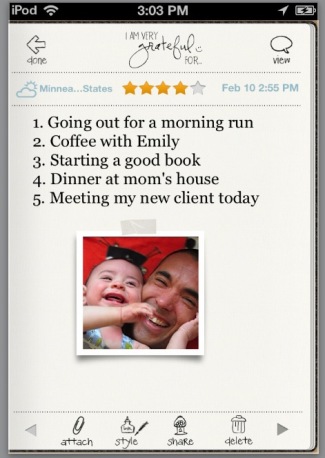
Oprah Winfrey has famously said that keeping a gratitude journal changed her life and the makers of Gratitude Journal  want to help you change yours.  Gratitude Journal was an instant hit when it debuted becoming the #1 lifestyle app on iTunes.  For $0.99, users can keep a daily list of 5 things they’re grateful for, protected by pass code, in a bulleted list on your phone.  This app allows users to easily flip through the days, email your list, and even add photos.  It even has a feature that records feelings each day so users can keep track of how your life is improving as you keep up with this daily practice.

gratitude_journal_app

Another popular self-help app is My Thoughts+, which was designed to promote self-confidence, happiness and a general sense of well-being.  Earl Nightingale said, “We become what we think about all day long”, and the creators of My Thoughts+  agree.  For $1.99  this app delivers over a thousand affirmations to inspire its users to manifest the life they desire with positive thoughts.  Users can customize the background and watch as a slide show of affirmations plays along with soothing music in the background.  This app also allows users to add their own custom affirmations or choose by categories such as health and well-being, relationships, success, wealth and confidence.  If you can’t escape to your own private zen garden, this may be the next best thing.  Check out the free option of this app that holds 100 affirmations.

my thoughtsWith smart-phone technology, perhaps escaping to a private zen garden is not as difficult as one might think.  Another popular app designed to calm your mind is iZen Garden, a digital version of a soothing zen sandbox.  For $4.99, users can enjoy all the benefits of a zen garden without having to clean up the mess.   Choose from 100s of objects, plants and creatures to place in your garden, along with options for the sound of crashing waves, fluttering butterflies or forest sounds in the background.  All this while they rake the sand. The app allows users to share their creations via Facebook, Twitter or email to perhaps to inspire others to join them in the virtual sandbox.    Chosen as one of the top 500 apps in the world by The Sunday Times of London, the Brits consider this an  App Store Essential.

iZen-garden

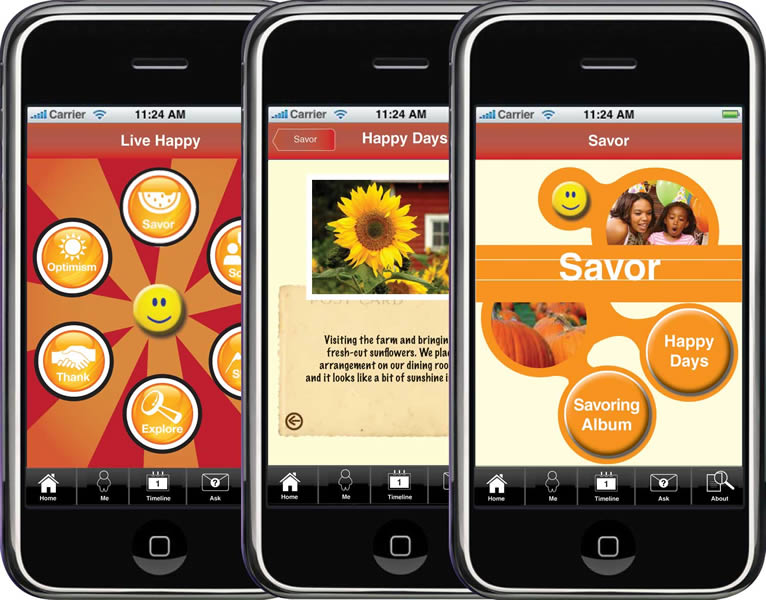
LiveHappy is an application based on the book, The How of Happiness, by UCR professor Sonja Lyubomirsky.  This $0.99 app puts her ideas into practice by helping you evaluate your goals, keep track of happy days, keep a gratitude journal, encourages you to thank people, and helps you remember acts of kindness.  There is also a built-in personality test as well as plenty of tips and tricks on conceptualizing a happier you including information about the science of happiness.

livehappy-3-phones

This last app reminds us that stress is serious business.  Not only does it block opportunities for happiness and well-being, but it is also a health risk factor for a number of illnesses including heart attacks to strokes. iStress was developed by professionals who work with individuals under stress in their daily lives. The feedback provided by clients was incorporated into this comprehensive stress management application which features a number of helpful exercises aimed at reducing stress and increasing positive thinking. This app provides several stress management activities including reading an inspirational poem, encouraging sayings, a humor page that features “stress” jokes, and an option to rate your feelings. There’s also a relaxation exercise to help users reduce their stress levels when they feel overwhelmed.

passionate-leap

While none of these applications promise mental health and wellness or can really take the place of an actual therapist, they serve to remind us to be mindful.  Smartphones and tablets help with work and school productivity and with keeping up with friends and social networks, however, through the various self-help technology available, these devices also provide access to inspiration, balance, self actualization and even quite possibly, happiness. After all, when you change your thoughts, you change your destiny.  (That last line was courtesy of My Thoughts+)  Namaste.

Posted in Uncategorized | 12 Comments

Let’s go Hauling

A recent story featured on NPR spotlighted a lucrative trend in advertising to young people through haul videos.   Teenagers are making these videos at home to share their thoughts on fashion and their latest purchases.  A quick Google search yielded a brief overview and also included a “haul” video produced by Time magazine staff to illustrate the simplicity of making one.  Also, as illustrated below in a real haul video found on youtube, the technology and expertise needed to create these videos is very basic.  The key to developing a following though, evolves from the trust and credibility these young people are able to develop with their target audience.

http://www.youtube.com/watch?v=BfzRco2_QPQ

According to The Role of Mobile and Video In the Apparel Shopper Digital Path to Purchase study released by Google and Compete last summer, this trend has increased since 2010 and the main focus has been on fashion.  This development could yield opportunities for mission-focused or socially conscious organizations to do more than product placement through the use of these videos.  Since my expertise is in education and Latinos, let’s explore a couple of scenarios related to both topics.  What if instead of doing a “haul” video for cosmetics and fashion, these young people created videos for their respective colleges?  Video tours have been used to recruit students, but the colleges typically influence these videos, so the students know these are filtered. What if instead students at a campus were encouraged to make a video that could be placed on the college’s website and used as a recruitment tool? This could lead to a more authentic experience anchored on some of the best practices showcased by the “haul videos” that include credibility, flexibility, and a fresh and cool new message.

Finally, it would be remiss of me if I did not also include an important fact for those interested in the booming Latino market.  According to the  latest Pew Research Center’s report titled Closing the Digital Divide: Latinos and Technology Adoption “Latinos own smartphones, go online from a mobile device and use social networking sites at similar—and sometimes higher—rates than do other groups of Americans” (Lopez, Gonzales-Barrera & Patten, 2013, p.5).  So, what does this mean for education?  If we are able to reach Latinos through the use of technology, we can help them understand the benefits of higher education and virtually create a college-going culture in the Latino community.  Targeted “haul” videos could be part of the solution and potentially lure Latinos to more than a product, but to a better life thus increasing our economic competitiveness and strong standing in the world.

References:

Google & Compete (2012, July). The role of mobile and video in apparel shopper digital path to purchase. Retrieved from http://www.thinkwithgoogle.com/insights/library/studies/the-role-of-mobile-video-in-apparel-shopper-path/

Lopez, M.H., Gonzalez-Barrera, A., & Patten, E. (2012, March 7).  Closing the digital divide: Latinos and technology. Pew Research Center. Retrieved from http://www.pewhispanic.org/files/2013/03/Latinos_Social_Media_and_Mobile_Tech_03-2013_final.pdf

Posted in Uncategorized | 8 Comments

Right on Target

033_target        I think it is safe to say that we all have vices that get us through the ups and downs of everyday life, school and work.  That being said, I admit mine is mindless television comedy.  However, imagine my surprise when this somewhat shameful vice offered inspiration for this week’s blog.  As I sat snuggled on the couch with my pack of dachshunds and my laptop, I geared up for some paper writing with TBS’s Cougar Town in the background.  I continued along tuning in and out as I often do, when I noticed something not entirely new but certainly a new extreme.  The Target brand was not only placed within the show, but served as a major feature to the storyline and setting (Cougar Town, 2013).

        Product placement has long been a staple in our television viewing experience, from the cereal or ginger ale used on Everybody Loves Raymond to  a new movie ad incorporated into How I Met Your Mother (Slatester, 2011).  For that matter, we have long been subject to digital advertising incorporating products into reruns of previously filmed and aired shows.  As the video from Slate News Channel via YouTube illustrates, digital advertising is nothing new, so why am I addressing it today? Previously product placement was fairly benign and ventured no further than a product placed on set in a unobtrusive way. 

        The recent episode of Cougar Town caught me off guard as it transformed the product or brand to become an integral piece of the episode (Cougar Town, 2013).  This is definitely integrated marketing to the extreme!  So how far is too far, is this type of integrated marketing too obtrusive and how often is this happening in television today?  Well as it turns out, this is not an uncommon practice.

As I delved deeply into the world of brand and product integration in television shows, I came across the following Big Bang Theory episode that aired over a year ago with the iPhone and more specifically Siri playing a key role and love interest might I add to one of the main characters (Chucknoify, 2012). 

        This begs the question, what’s next?  Will we begin to see brands and corporations managing television content and fully embedded in our programming?  Moreover, how long will consumers tolerate this level of intrusion in their television viewing?  I don’t claim to have the answers to all these questions, however when asking myself how I personally felt about what I observed, I’m astonished to say I didn’t mind it.  In both examples, I found myself relating and laughing right along and then it hit me.  As a millennial, these programs and advertising messages were targeted for people just like me.  In addition, while the incredibly overt messaging was blatantly obvious we live in an ad infused digital  world where pop ads target you in social media and Amazon recommends products that may be of interest.  However, with the integration of DVR’s and Tivo did advertisers really have a choice?  They have products that they need to sell and today’s audience simply isn’t listening like they used to.  When contemplating my television viewing over the last few years, I can honestly say that product placement has become white noise that I rarely paid attention to, well this new era of product placement certainly has me listening.  What about you?

References

Chuckinoify. (2012, January 27). The Big Bang Theory 5×14 – Raj vs. Siri. [YouTube].

        Retrieved from http://www.youtube.com/watch?v=uZwx1zDTsSI

Slatester. (2011, September 14). Product placement goes digital. [YouTube].

        Retrieved from http://www.youtube.com/watch?v=4upslJhSW68

 TBS. (2013). Cougar Town [website].  Retrieved from http://www.tbs.com/video

/?oid=965139&eref=sharethisUrl


Ramona C. Chiapa


Posted in Uncategorized | 8 Comments

Social Meditation with Oprah Winfrey and Deepak Chopra


oprah-deepak

“Hi, join me for Oprah & Deepak’s 21-Day Meditation Challenge.” That was the subject line of an email that recently caught my eye. My friend had invited me to join a three-week meditation journey led by Oprah Winfrey and Deepak Chopra.

The email described the 21-Day Meditation Challenge to Perfect Health: “Meditate and journal with Oprah and Deepak each day to embrace the vision of your best self, expand your understanding of your miraculous body, and achieve greater balance and wellbeing.” What struck me was the very last line of the email: “Join me and let’s meditate together!” I’ve never heard of or participated in an online meditation session before. Since I’m always up for trying something new, I signed up. I also figured that a little meditation might help my outlook while in the midst of a busy semester at USC.

day1

On the first day of my meditation challenge, I received an email with a link to the day’s meditation. The link launched a page with audio playback of the meditation that contained an introduction by Oprah and meditation led by Deepak. The meditation lasted 16 minutes and afterwards, I had the option to answer reflection questions in my online journal.

I must admit that I was a little hesitant and cynical about this meditation challenge. I teased my friend that he was trying to get me to go “new age” with him. I told him that with work, family and school, who has time to meditate. However, after listening to the 16-minute meditation session for Day 1, I can honestly say I felt calmer and more balanced. So, thanks to my friend for suggesting I try out the meditation challenge – and I take back all the sarcastic remarks I initially made about it.

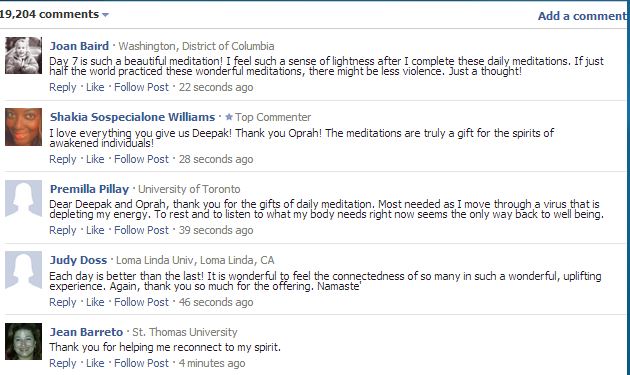
If I wanted to let others know about the meditation challenge, I could use Facebook to share this with my circle of family and friends. The 21-Day Meditation Challenge gives you the choice to register using your email address or Facebook account. Logging into Facebook allows you to let your friends and family know that you are participating in this challenge – and perhaps get them interested in this program. On the meditation website, Facebook users posted over 19,000 comments about the challenge. Comments reflect how people reacted to the day’s meditation and how it is helping them to renew, reflect and re-energize – it’s quite enlightening, actually.

fb_comments

What I like about this 21-Day Meditation Challenge is that it’s easy and accessible. I receive daily emails and the meditations take less than 20 minutes of my time. I am on Day 5 of the meditation challenge and am curious to see if I do in fact expand my understanding of my body and achieve greater balance and wellbeing. Namaste.

Sheila de Vera – CMGT 541 – B


Posted in Uncategorized | 6 Comments

Who Owns You?

As communication professionals we all know what work goes into building a sticky brand and the value attached to it. Rarely, however, do we give ample credence to our own brands; this deserves especial attention in today’s digital market place.

As noted on the Knowledge@Wharton blog, in a prescient move the Vatican set up a Twitter account for Pope Benedict XVI (the first Pope to tweet) under the guise of “@Pontifex”. Because Pope Benedict’s name was not associated with the twitter account, ownership of the posts and associated reputation is clearly established: the account refers to the person of the pope, and not the pope himself. Benedict will not have access to this account, and it is likely that Francis will resume where Benedict left off. The Vatican has set a markedly insightful precedent that all marketing communication managers should take note of.

Noah Kravitz was sued for taking his 17,00 Twitter followers with him when he left his previous employer.

Noah Kravitz was sued for taking his 17,00 Twitter followers with him when he left his previous employer.

But why is this important? In the aforementioned blog post the author highlighted a legal case in which a company settled a lawsuit against a former employee who used Twitter followers the company believed it owned for his own gain. Just in case the story has faded from memory (it made national headlines), essentially what happened was the employee maintained a Twitter account associated with both his name and the company, when he left he changed it to just his name. He then started working at a competitor and used the followers he acquired while at his ex-employer to build his new employer’s reputation The previous employer’s argument was ownership of the 17K+ followers. This begs the question, did the employee really steal the followers?

This question is still largely undecided. The case was settled privately so no legal precedent was set leaving communication professionals holding their breath indefinitely. An interviewee cited in the Wharton blog, Janice Bellace, professor of legal studies and business ethics at Wharton, claims the best we can do  to resolve the question of ownership for the time being is reference back to before social media. Her explanation is that it may be illegal to walk out of the office with a filing cabinet (or hard disk) with a client list on it, but writing down contact information in a notebook (or saving it to your phone) over the course of five years of tenure at the company most likely is not illegal.

The article continues to point out that in all reality followers probably can’t be “owned”. Unfortunately the article did not delve into why this is, but the impression given is that nothing legally binding happens between followers and an online personality. The article closes with a recommendation to set up policy and agreements such that there is an internal precedent established regarding social media accounts.

But I think there is an elephant hiding in the room: who owns you. (For anyone wondering I do believe that elephants can hide in a room. Not in the sense that it is doing so intentionally, of course, because they are ridiculously large, preposterous creatures and not noticing one takes some level of cognitive effort. Elephants hide in rooms through disavowal in the Lacanian sense. “Sure I know there is an elephant in the room, what do you think I am, an idiot? I just refuse to acknowledge its presence in respect of my own psychological comfort.” I digress though…) Who owns you, your personal, digital brand? Online participation in social media is an extension of the individual. Features like Google authorship help build this personal brand as content, images, and other information is pushed live online. An organization may not gain huge sums of money through their association with my blogging or other published content, but they could, and what is my right to that value creation? If I leave my current employer do they own both the content I produced and published online as well as my associated reputation? If I leave should it be disassociated from my personal brand?

Try as they may, elephants weren't designed for hiding.

Try as they may, elephants weren’t designed for hiding.

Much like the Twitter case we can turn to print media for an answer: when something was published in print, a newspaper or magazine for example, generally you could not retract the article. Once you said something supporting or building your employer’s reputation it was more or less set in stone. That being said, it also did not stick with you in the same way. Personal brands were not a reality. How many people in the 1980’s went to libraries to track down everything that Ivan Boesky published? Certainly not near as many as familiarized themselves with John Thain from Merrill Lynch a few years back. The digital era has made our personal brands sticky in the sense that they are always out there.

When I first authored this post I was inclined to conclude with this neuter claim, “I am not certain where I stand on this yet, however I believe that it is a conversation professionals need to start. At first blush, and maybe it is my rural upbringing, I am inclined to say that I own me and my brand – not the company I work for. When I leave it should leave with me. The thought of somebody continuing to profit off of my name after I have moved on seems inherently wrong. I have been wrong before, and may be wrong this time as well. What are your thoughts?” An insightful reviewer suggested that if I really want engagement around this I should take a stance – at the very least lean stronger towards one. I went out for a run, plugged in some Stravinsky, and thought long and hard about where I stand on this one.

So here it is. I am radically contingent. If I existentially go away nothing replaces me – at least that is what I believe; I am indeed a beautiful and unique snowflake (my ego needs this belief.) This radical contingency is not extended to my occupation, however. If I go away someone, or even something, may replace me, meaning that in this instance I am superficially contingent (kind of a jagged pill to swallow, but it’s reality.) Previously personal brands were radically contingent on the persistence of the individual at an organization as it was hard for companies to benefit from the reputation, influence, or brand of a person if he left the company. Personal brands, however, have become superficially contingent in regards to the individual – they can exist sans individual presence. I see this as one of the fundamental flaws in postmodern reality. While we strive to disassociate the signifier from the signified thus liberating the individual to own his frame of reference in regards to interpreting signifiers generally, we hypocritically oppose allowing the same hermeneutic violence’s application to ourselves. Hypocritical as it may be, I still believe that I should have some say in the image that is Nik – particularly how it is understood and profited from. Disallowing me this right is a violence in the realist sense. It strips me of my personal freedom regarding meaning and value creation. Granted I may forfeit some of this freedom given certain actions, like signing a document allowing a company to perpetuate association with my brand post departure, I nevertheless believe that personal brand ownership is real, and in regards to leaving an employer it should be at the discretion of the brand owner if that organization can continue to profit from his personal brand.

Posted in Uncategorized | 3 Comments