American Olympic swimmer Ryan Lochte has been in the headlines recently for his shameful appearance in the Rio Olympics earlier this year. Now he is trying to win back fans and the American audience on the dancefloor of ABC’s “Dancing with the Stars.” The road to redemption has been a bumpy one for Lochte who allegedly over-exaggerated a story about being robbed at gunpoint during this year’s Olympics. Lochte and two other Olympians lied about the details of the Rio De Janeiro incident. Lochte has since apologized but it came at a hefty price. Not long after the fabrication of the story came to light Lochte was dropped by all of his sponsors that included: Speedo, Ralph Lauren, Laser Hair Removal and Airweave. The brands did not want to be associated with a dishonest American Olympic athlete, even if he does have 12 Olympic medals. I agree they made the right choice. Sponsors pay athletes and celebrities a lot of money to uphold a certain brand and image. Lochte was the all-American boy, but because of his dishonorable character, he is not as highly regarded as before the incident.
According to AdWeek, Pine Bros. Softish Throat Drops has not given up on Lochte. It signed an endorsement deal with the Olympian who will appear in both commercial and print ads for the company. When news of the deal broke, Lochte tweeted out his reply to his new endorsement saying, “Thanks to all the folks at pine bros. for your confidence in me. I look forward to making you proud.” Lochte has made other headlines this week, he appeared on the Season Premiere of “Dancing with the Stars.” Lochte’s welcome on the dancefloor was not well-received. Two men rushed the stage to protest Lochte’s appearance on the show on Monday. Lochte’s name is now synonymous with disgrace. Clearly Lochte is doing everything he can to redeem himself and un-tarnish his sullied name. I feel the damage is already done. Lochte was a well-respected athlete with true talent. He had no reason to make up a story pretending his life was at risk when it wasn’t. All he did was ruin his reputation and the reputation of two other Olympic athletes. I think any sponsor that does sign him up is only doing it for the shock factor to get its name in the headlines. You know what they say, “There is no such thing as bad publicity.” I feel Pine Bros. Softish Throat Drops is doing just that, capitalizing on Lochte’s downfall. The relatively unknown company has everything to gain and nothing to lose. According to AdWeek, Lochte’s ads for Pine Bros. will include the tagline, “Pine Brothers Softish Throat Drops: Forgiving On Your Throat.” The word “forgive” is visibly in the ad. Pine Bros. does not want to shy away from the bad publicity, but rather embrace it and deal with it head on. Both Lochte and Pine Bros. hope with time buyers of the throat drops, and the American public, will also forgive Lochte. I personally feel it is too little, too late.
Do you ever wonder why your iPhone slows down after a couple years, especially before a new iPhone release? Is this a trap or a creative business strategy? This phenomenon is known as the ‘iPhone slow’ and has consumers around the world Googling what the heck is going on with their phone. Harvard University student, Laura Trucco, conducted a study that found the search term ‘iPhone slow’ spiked drastically around a new iPhone launch .
The answer is actually quite simple: Apple’s software. Each year Apple launches a software update, providing bug fixes, interface changes, new features, and the like. Those who want the latest technology give in to the iOS update, which ultimately take up more space and require more power. If you have an older iPhone it will become sluggish; that is where the new iPhone comes in. Apple has the ability to control their operating system, so why not take advantage of it.
Additionally, Apple has already saturated the market so it is imperative they continuously engage their consumers. Having an iPhone that will last a lifetime would be a bad business move. Take Nokia’s brick phone, how well did that work out for them.
If you are like me and many other loyal iPhone users, it is beneficial to know what settings to change with the current iOS update, as some do not carry over.
Stop tracking your location
Restore touch to unlock
Limit the lock screen
Disable raise to wake
Update your message settings
For further information on settings and locations click here.
References:
Rampell, C. (2013). Cracking the Apple Trap. Retrieved September 16, 2016, from http://www.nytimes.com/2013/11/03/magazine/why-apple-wants-to-bust-your-iphone.html
Stenovec, T. (n.d.). How Apple Gets You To Buy New iPhones Over And Over Again. Retrieved September 16, 2016, from http://www.huffingtonpost.com/2014/10/13/apple-new-iphones_n_5967626.html
Zolfagharifard, E. (2014). Does Apple deliberately slow its old models before a new release? Searches for ‘iPhone slow’ show a spike ahead of launches. Retrieved September 16, 2016, from http://www.dailymail.co.uk/sciencetech/article-2709502/Does-Apple-deliberately-slow-old-models-new-release-Searches-iPhone-slow-spike-ahead-launches.html
Even those who can’t distinguish a megabyte from a megapixel know that Apple deleted the headphone jack from their new iPhones. Critics and comedians are relentless in making the decision the joke de jour.
While the pundits debate the merit of the change, something more interesting is top of mind for me: the importance of all those white earbuds and cords to Apple’s identity.
Think about it.
Those little white capsules announce to the world that the person connected to them is using an Apple product. Not a generic Android or Windows device from myriad competitors. No. Those simple white pills scream: I’m an Apple user.
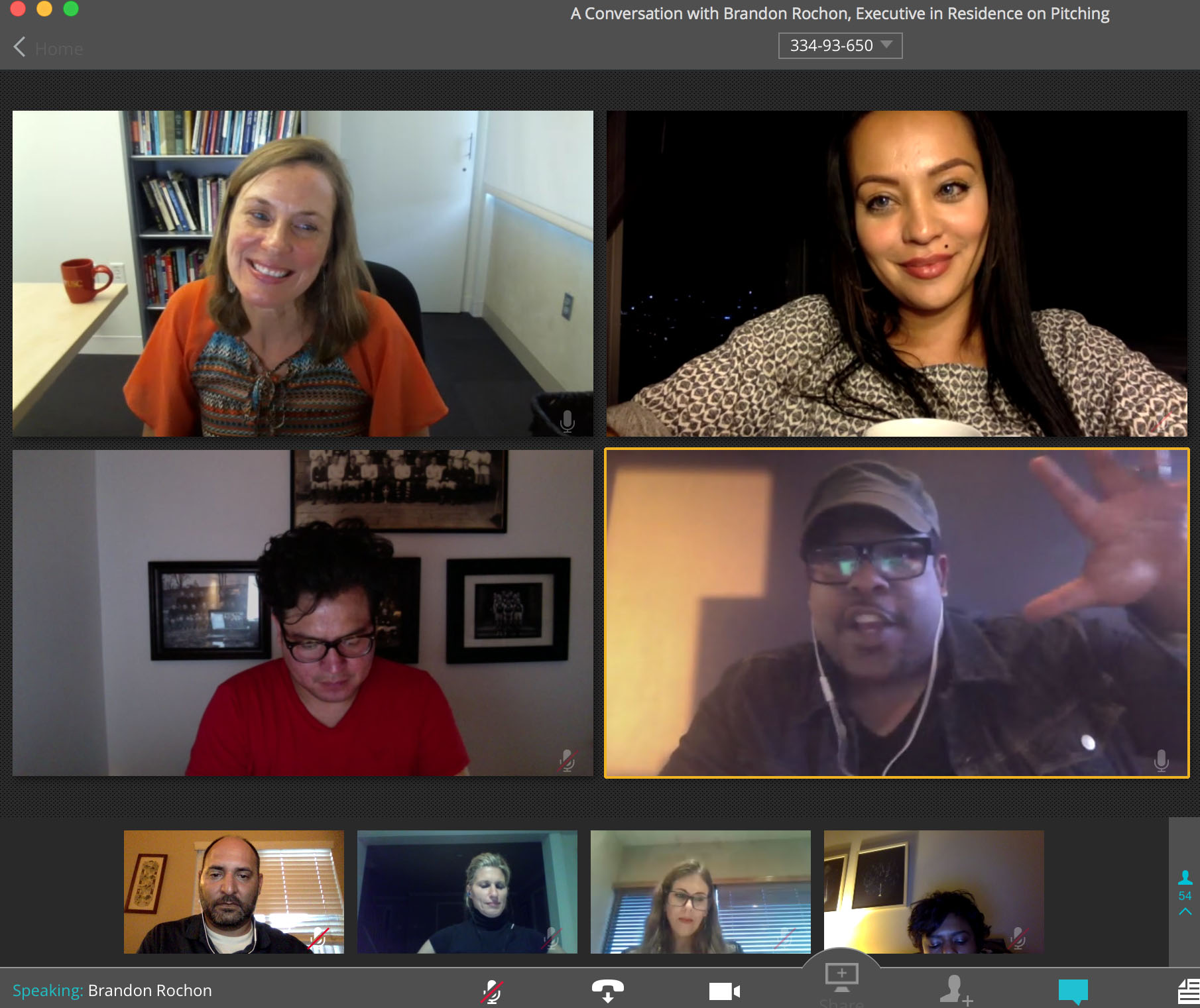
Take for example Brandon Rochon, the star of this week’s CMGT-541 live session. He’s an advertising executive and creative director whose clients include Red Bull and Samsung. But, in addition to his high energy and pitching advice, Mr. Rochon delivered a persistent endorsement throughout the call. He was rocking the white earbuds of Samsung’s competitor.
See for yourself:
Ad exec Brandon Rochon presents to CMGT-541 students during a live session on September 15, 2016. He may have pitched for Samsung, but his headphones show whose product he really uses.
Some in the tech press have questioned why Apple continued to include wired headphones with their new iPhones even as they pitch wireless as the present.
Quite simply, those white earbuds are a vital part of the Apple marketing plan. I’d argue that they’re potentially of even-greater importance than the upbeat commercials illustrating how the actual products change people’s lives. Even in their wireless state, Apple’s new Air Pods are skillfully designed to retain their distinct appearance.
It’s nuance. It’s subtle enough to pass without much notice. It’s also vital.
Apple has created a signature with their white headsets and they’re not about to give it up.
Consider familiarity with logos such as those from Nike, McDonalds, FedEx, or any of the globe’s top brands. White earbuds are just as iconic. Their pervasiveness in public spaces reinforces Apple’s brand and serves to facilitate consumer-to-consumer endorsements.
While completing my post for this week’s discussion “Ethical Ads?” surprisingly I came across some unethical ads while I was reading an article discussing the unethical ad that I was researching…so I thought to use this blog post to continue the conversation.
As you may have read, I submitted a distasteful ad from the “Got Milk?” campaign that discussed how milk can help women with their PMS symptoms, by poking fun at boyfriends who can never seen to “get it right” while their women are suffering from the symptoms of their menstrual cycles. After seeing the ad, I clicked through on a section of text that focused on areas where the campaign had received backlash, which brought me to an article on Salon.com.
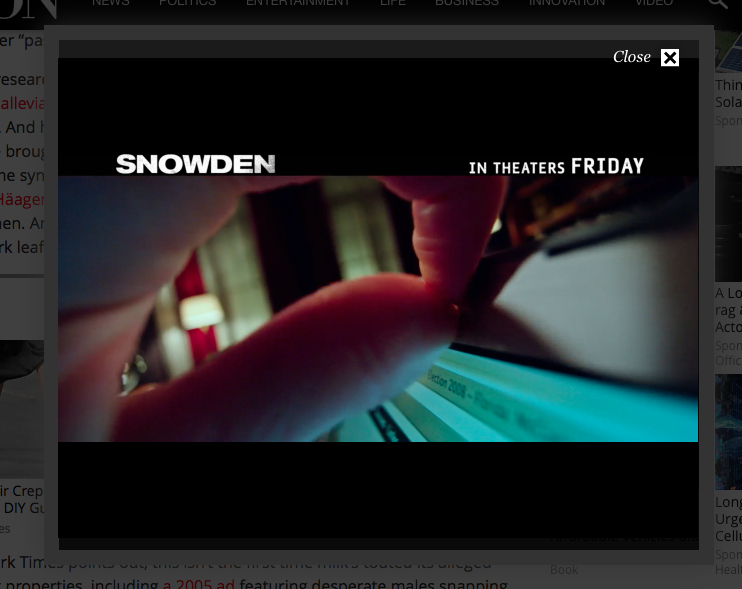
When I first entered the site an ad about the new “Snowden” movie popped up. I found this normal because a lot of sites have ad pop-ups when you first enter. However, after no more than 7 additional seconds on the site while reading the article, the “Snowden” pop-up came on my screen again, and took over the webpage until you made it through 5 seconds of the ad, when you were allowed to click out. Ok, now I was started to get a little annoyed. I scrolled down once on the article to keep reading and then scrolled down a second time, and again, the image popped up. At this point, I think I am justified to be annoyed with the ad. Being on a site for roughly 20 seconds and having the same pop-up appear multiple times is just annoying marketing.
Luckily, the article was short so I was able to escape the site, but I almost wish I had stayed on a bit longer to run a test to see just how often that pop-up appears. I’m curious to hear from you all about some of your pop-up ad horror stories. Or any sites that are big abusers of pop-up ads, so we can all save some sanity and avoid them.
Before reading the article, “ Online advertising ethics. Questionable uses of online advertising,” (Spirizzi, 2016) I’m not sure I would have classified, or thought to have classified, pop-up advertisements as unethical. But when you encounter a website that turns the user experience into a stressful and unpleasant experience, I think you run the risk of crossing that fine line of what is ethical.
References:
Spirizzi, M. (2016 Jan. 19). Online advertising ethics. Questionable uses of online advertising.The Balance. http://advertising.about.com/od/onlineadvertising/a/guestethicalads.htm
Williams, M.E. (20 July 2011). “Milk’s sexist new PMS-campaign.” Salon. Retrieved on 14 Sept. 2016 from, http://www.salon.com/2011/07/12/milk_sexist_pms_campaign/
Every time I step foot at Target I get this feeling of excitement and the feeling of being anxious wondering how full my shopping cart will get by the time I get to the checkout line. I get the rush of excitement knowing that there are new things to browse and select for purchase. Additionally, I get anxious…well for the obvious reason that many of us have when shopping at Target…Why can’t I just EVER stick to my Target shopping list and continue on with my day? It never fails that every time I go to Target I spend way more than I need to. I was at the store the other day and I started thinking to myself what makes Target a better convenient store than its competitor say…Walmart? Why is it that when I go to Walmart I actually stick to my shopping list and I have no desire to spend more than I need to. Is it Target’s store color being red that is highly attractive and lures me to make a u-turn when I drive past the store? Is it the big bull’s eye symbol that hypnotizes me to walk down every aisle? Is it the wide-open space of the store and how big and bright it is? Or is it the customer service I receive and how well the store is organized and well stocked? Perhaps it is a number of those things that makes Target the go to place versus other convenient stores.
For one Target sets the bar high with its very knowledgeable staff and the customer service they provide. They are easy to locate throughout the store because of their uniform style attire (red shirt and khaki pants). In addition, the stores are always clean and they have such affordable kid’s clothes that are very trendy and I might add very cute, not to mention the house décor items that are oh so contemporary and fashionable; but most importantly it is affordable. They are notorious for their in-store displays and one of the smart marketing tactics they have designed is the $1/$3 bin that is displayed at the entrance of the store. Those bins get me every time purchasing unnecessary knick knacks that I hardly ever use, but they get me!
Another thing that makes Target stand out from the rest of its competition is by offering various discount components by veering into the digital and mobile undertaking of the Target Cartwheel app, which is a savings program that you use at the store where you can save from 5% to 50% off at checkout. You select the items for purchase, scan the barcode on your phone while at checkout and instantly you save money. Another component offered is the Target Red card, which is a credit/debit card that you use when purchasing items and you will get 5% discount towards your completed purchase. As an avid shopper, the 5% discount comes a long way for savings.
Keep this in mind you will never ever stick with that Target shopping list so might as well not even have a list and enjoy the shopping experience that is offered. Target creates an experience to shop more than you anticipate and return sooner than you think.
Source:
Leinbach-Reyhle, N. (2014, August 28). How Target stands out among its discount store competitors.Retrieved from Forbes website: http://www.forbes.com/sites/nicoleleinbachreyhle/2014/08/28/target-shopping/#2412768969c7
For the last few years, I have noticed that in the Asian market, more and more emotional ads have been emerging that are truly engaging, memorable, and gives me the feels. Some has outright put me into tears.
Here’s an example from a life insurance company, MetLife:
Also very touching. Had me to tears. Bernas… what sort of company is that? Do they sell life insurance too? Maybe medical insurance? Guess what? They sell rice. A commercial about rice and I’m balling watching this commercial.
Here’s one last example:
Would you have guessed that TrueMove H is a mobile cellphone company from this commercial?
So the point of all these sad, emotional, inspiring videos. They are great entertainment and provide a lot of value in terms of social marketing, but do any of these videos make you have any sort of brand perceptions about these companies? If you could buy Bernas rice, was that commercial effective for you to buy only Bernas rice? And if TrueMove H was an option as a cell phone carrier here in the United States, would you sign a contract with them?
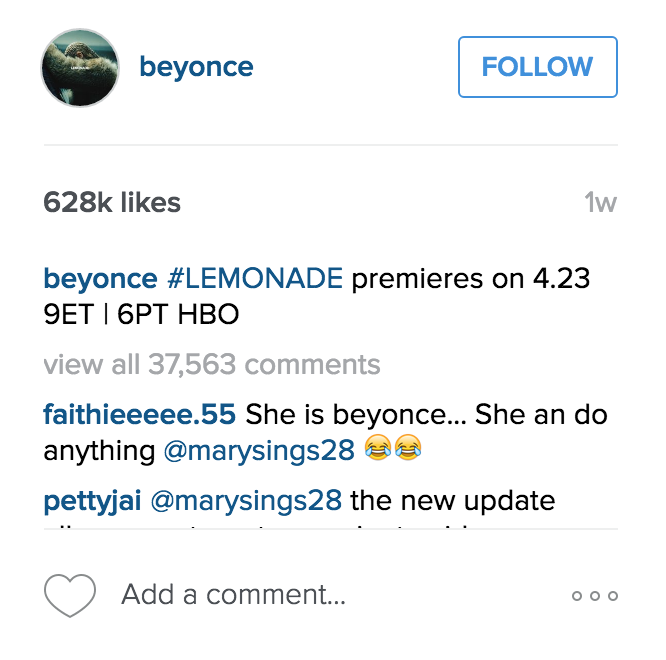
Last Saturday, Beyoncé unexpectedly posted a premiere of its upcoming album “Lemonade” on Instagram several hours before the release. She had been kept this project as a secret from the public until the last minute. Her surprising announcement was like a huge bomb that detonated all social media platforms and attracted over 70k comments and one million likes merely on Instagram. Many people interpret her action as a marketing ploy, which appeals creating surprises to ignite conversations and attract public attention. Although this announcing strategy cannot take all the credit for the unprecedented buzz generated by the album, admittedly, it’s eye-catchy and full of creation.
It is not the first time that artists adopt this strategy to promote their artworks. And it’s not even the first time Beyoncé releases albums without advance notice. Back to 2013, She almost used the same way debuted her self-titled album. And After that, Drake, A$AP Rocky, Lil Wayne and Miley Cyrus followed this trend.
However, surprises don’t only happen when an artwork is released. Actually, surprise, as a natural buzz creator, has been widely utilized as a marketing tool by many companies. Thus, this kind of marketing is also called “Surprise Marketing” or “Surprise and Delight”, a process that “marketers build the value in the product or service through genuine excitement, anticipation and surprise”. Research has proved that surprise and delight is one of the most effective marketing strategies that can create long-lasting emotions and memories for individuals and further improve consumers’ brand loyalty. This method works because it appeals to human nature that people are “thrill-seekers” who enjoy being exposed to new stimuli. The stimuli can lead people to desired behaviors. In the marketing context, it means purchasing products. Surprise marketing usually appears in the form of providing surprising gifts and treats to consumers. For instance, unexpected coupons, free products or maybe fancier, free trips are all surprise marketing strategies. In this way, marketers embed long-lasting and positive emotions, experience and memories regarding the brand into consumers. And also, such strategies can certainly generate buzz and word-of-mouth at a very low cost.
The above companies’ surprise and delight marketing seems to be different with Beyoncé’s partially because Beyoncé’ s surprise focuses more on a spiritual level rather than the concrete material level. Besides, Beyoncé ’s surprise covered a wider range of people whereas companies’ unexpected rewards can only create very strong influence on people who actually receive the treats. One possible reason can be that Beyoncé, with her influence and fame can be compared to a super popular brand in the business world, maybe like Apple, whose actions can be emotive to the public. Thus, a surprising event or product release can attract enough attention. However, most brands, not too popular or too unheard, don’t have that kind of power. Thus, material encouragements seem to be a more effective and feasible way to implement surprise marketing.
No matter what size the influence scale is or how effective it is, it causes no harm to create some surprises that are much cheaper than advertising. And maybe marketers don’t even spend too much time and effort planning surprises. Just adding some mysteries to their sweepstakes strategy can be a very basic surprise marketing temptation.
References:
Sisario (2016). The value of surprise? For some artists, it’s a springboard to No. 1. Retrieved fromhttp://www.nytimes.com/2016/03/15/business/media/the-value-of-surprise-for-some-artists-its-a-springboard-to-no-1.html?_r=1
I have recently learned about Marketing Automation, named one of the 7 marketing tactics a company should be doing. While I may be late to the game, I can’t help but question if these one stop services are destroying the relationship between company and consumer. Marketing Automation allows a company to pay a service to provide customer analytics, keep a record of website traffic, manage emails, and much more.
IBM owns one of the most popular Marketing Automation services, Silverpop. This service in particular believes through their work can strengthen customer loyalty and create the “perfect customer experience”. I am all for convenience when dealing with companies, but what will happen to the human element in building an empire from the ground up? While this may be a smart tactic for small business’s who do not have the resources to manage all aspects of their growth, does it diminish the mom and pop feel of customer assistance?
Another part of me feels as though Marketing Automation is hitting home for a lot of customers. Many businesses, small and large, aren’t meeting the needs of their consumers who want to be treated right. The automation of marketing campaigns may allow for a business to better serve their customers better through a back seat approach.
Whatever may come from these Marketing Automation services, one thing is for sure; Marketing is only beginning to evolve.
Music festivals, including Lollapalooza, Sasquatch, Coachella, and EDC Las Vegas have attracted sponsors from ever sector, from transportation (Uber) and fashion (H&M) to soft drink (Coca-Cola) and telecommunications (AT&T) (Rubinstein, 2015). According to market research, by the end of 2015 brands will have collectively spent upwards of $1.4 billion, up nearly 5% from the previous year, sponsoring music festivals, venues, and tours in North America (Sherman, 2015). This increased spending will outpace the projected 2015 expenditures in all other property segments, including the sports industry (4.4%), the causes sector (3.7%), and the overall percent increase in sponsorship spending (4%) (“Sponsorship spending on music,” 2015). Jack Flannery, an analyst for the digital marketing agency Rise Interactive, suggests the trend in music and festival sponsorships is largely driven by two key factors: “continued interest in national music festivals and a growing appetite for regional music festivals” (2013, p. 3). Hilary Stout, an editor for the New York Times, offers another reason for this growth: music festivals attract a large millennial audience, the most sought-after generation of consumers by brands (Stout, 2015). With brands from many different sectors flocking to music festivals, and new entrants announced every year, the trend in brand sponsorship begs the question, what makes for an effective music festival-brand partnership? To answer that question, this posts adopts a conceptual framework based on the branding (Dawar & Bagga, 2015) and celebrity endorsement literatures (Till & Busler, 2000).
First, perhaps the simplest definition of a brand is this one: the way consumers currently perceive an organization, product, or service (Dawar & Bagga, 2015). The two-fold goal of branding is to (1) position organizations, products, or services in such a way that they occupy a “distinct and valued place in the mind of the target market” and (2) keep and attract new consumers by promising superior value, as well as by delivering satisfaction (Young, 2014). For example, Electronic Dance Festival, or EDC for short, has become the world’s most popular music festival extravaganza—and one of the world’s biggest festival franchises (e.g., EDC UK, EDC Las Vegas, EDC Japan)—by delivering on its promise to showcase not only “some of the hardest working producers, but [also] a massive playground full of carnival rides, performers, and some amazing art installations” (King, 2015).
Given the importance of brand image, companies need to think strategically about how they create sponsorship deals that are favorable to both parties’ brand image. A useful dimension on which to ensure a successful match between two concepts (e.g., a brand and an endorser) is fit. Fit, also referred to as appropriateness, relatedness, belongingness, or similarity, is “the perceived connection between a brand and an endorser that drives predicted endorser effects” (Till & Busler, 2000, p. 3). Studies suggest that perceived fit between an endorser and brand can significantly impact consumers’ attitudes and purchase intent (Till, Stanley, Priluck, 2008). For example, Till and Busler’s (2000) experiment demonstrates that an athlete, as an endorser for an energy bar, is more effective and more likely to influence consumers’ brand attitudes than an attractive actor. The match-up interaction in this case is undeniable because the athlete has a greater connection with the endorsed product.
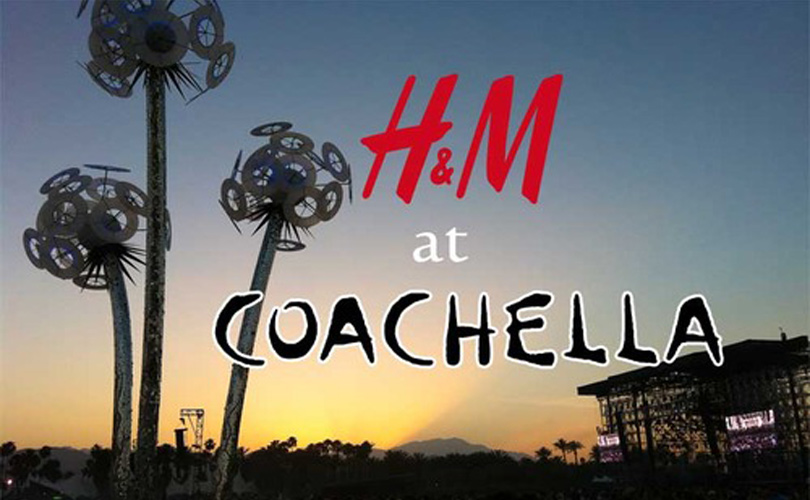
The perspective taken here is that when applied to a brand’s endorsement of a music festival, the variable “fit” may play an important role in match-up effects. Specifically, when the image of a brand is congruent with the image of a music festival, match-up interactions should positively impact brand attitude and, conceivably, purchase intent. A case in point is H&M’s recent brand activation at EDC Las Vegas (Glazer, 2015). A pioneering Swedish retailer, H&M has built a powerful brand identity around the following characteristics: youthful, dynamic, and innovative (McIntyre, 2015). This brand image is evidenced in the company’s trendy collection, target demographic (e.g., 15-40 year olds), and seven commitments to sustainability: “Provide fashion for conscious consumers, Be climate smart, Reduce, reuse, recycle, Use natural resources responsibly, Choose and reward responsible partners, Be ethical, and Strengthen communities” (H&M Conscious Foundation, 2010).
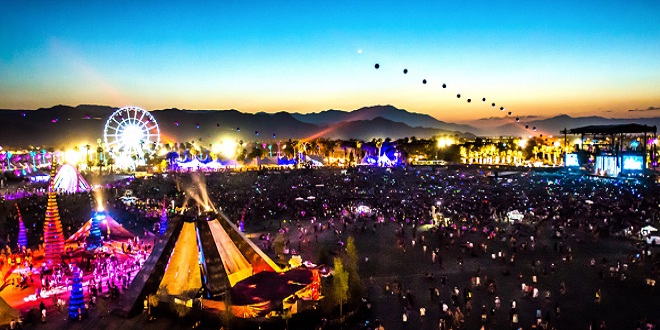
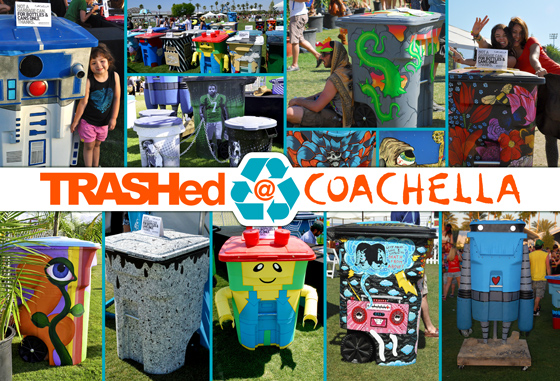
Similarly, Coachella, an annual music and arts festival held in Indio, California, has constructed a brand image associated with contemporary pop culture and has become an influential force, setting the tone for trendy, youth cultural styles (Hampp, 2015). Moreover, since partnering with Global Inheritance, a Los Angeles-based non-profit organization that takes action on global issues, Coachella has developed a forward-thinking approach to sustainability (Murphy, 2015). For example, Coachella launched a carpool service for festival goers to reduce CO2 emissions and transformed ordinary recycling bins into works of art in an effort to encourage Coachella attendees to recycle (Murphy, 2015). Hence, when H&M announced that the brand was one of the official sponsors of Coachella 2015, consumers reacted positively. One individual, who commented on this sponsorship online, wrote: “Love that H&M will be at Coachella,” while another person said, “makes sense that a clothing company like H&M would be at Coachella” (Glazer, 2015). H&M teaming up with Coachella likely “[made] sense” to Coachella attendees because in their minds there is a strong associative link, or fit, between both brands.
As more brands pursue sponsorship deals with music festivals, venues, or tours, it will become increasingly difficult for one brand to stand out amidst the clutter. Consequently, businesses that hope to add music festivals to their marketing strategy need to think critically about the value of a such a partnership.
Ding, H., Molchanov, A.E., & Stork, P.A. (2010). The value of celebrity endorsements: A stock market perspective. Marketing Letters, 22(2), 147-163. doi:10.1007/s11002-010-9117-y
Fink, J. S., Parker, H. M., Cunningham, G. B., & Cuneen, J. (2012). Female athlete endorsers: Determinants of effectiveness. Sports Management Review, 15(1), 13-22. doi:10.1016/j.smr.2011.01.003
Recently, I had great pleasure reading the #GIRLBOSS written by the CEO of Nasty Gal, Sophia Amoruso. Being one of the most successful business women in the United States, she is now in charge of a $100 million plus online fashion retailer with more than 350 employees. But she is not always lucky. When she was in early twenties, she had been broke, directionless, and working a mediocre day job. This book is about the journey of how she started there and come to where she is today.
1. It isn’t what you do, but how you do it.
In the book, Sophia briefly explains the “business model” she used that brought her success with Nasty Gal when she was first starting off with her eBay vintage shop. Although there were many shops that sold the types of items she sold, hers was more successful for one reason, she put a lot of hard work, effort and thought into each and every item she listed for sale. From finding and styling models to wear the clothes, a good photographer to take the thumbnail shots, to using her knowledge of fashion and style to write awesome listings filled with styling tips, Sophia put effort into each and every aspect of her sale. This is a great lesson to learn because it really doesn’t matter what your job is, or what your business is, if you think about and put real effort into what you do, it will pay off! There is no substitution for hard work, even on the internet!
2. You don’t get what you don’t ask for.
This is a powerful one, especially for women to learn and really understand. I think ladies have a tendency to shy away from asking for things because we don’t want to come off one way or another, but when you boil it down for your business you won’t make any money or get any customers if you don’t ask for the sale or ask for the business. Sophia seemed to get everything she asked for, and while that may not be a fool proof strategy for your business, sometimes asking is the first step to getting what you want.
3. Never live above your means.
As someone who lives in a capitalist society, I witness commercialism and marketing all day every day! Things from food to luxury goods are thrown in your face and to be honest, I often find myself wanting everything I see, but that is no way to live. Sophia really does a nice job explaining that while she was building her business, she was very frugal and almost refused to spend money. Although she doesn’t really analyse this decision much, I believe it had something to do with her previous freegan lifestyle, mixed with a sense of apprehension that at any moment the rug could be pulled from under her and her business could fall apart. At any rate, this is a great lesson for young women (all women, and men too) to learn! You can’t spend money you don’t have, and you shouldn’t spend all the money you earn either. It’s common sense, but I think coming from a nation in massive debt, it’s apparently an important tip we are consistently missing!
4. Find ways to keep your goals in your face so that you’re manifesting magic!
This lesson is one I employ and believe in, whole-heartedly! I do believe in magic, and I believe that magic is something you make for yourself. How? Well, by keeping your goals front in center in your face, as well as hidden strategically within your daily life, you begin to ingrain them into your psyche and over time that results in you actually taking steps and actions to make those goals real. For example, in the book, Sophia talks about making specific goals into short phrases that she would use as her passwords for her computer. Unconsciously, everyday, she would be reaffirming those goals whenever she typed her password. Eventually, those goals in password form became one with her mind and her mind started acting accordingly so that she could achieve the goals. Now, none of this is science of course, that’s what makes it “magic” because it’s unknown. But boy does it work! Give it a try in your own life and see what benefits you reap by making your own dreams come true!
5. Don’t waste your time obsessing over people and things you can’t control.
This is another one of those difficult life lessons to learn, especially for women, whether you run your own business or not! The world is a really big place and there are billions of us living on it. Of course, from time to time, we are going to come across people and things we don’t like, and unfortunately, sometimes these things are unavoidable, as much as we wish we could just run away from them. They may be people or problems right in front of us that we can’t escape, and it’s so easy to fall into the trap of obsessing over them, wasting our own precious time thinking and worrying and guessing about outcomes we aren’t a part of. If we stopped focusing on the things we can’t control and started minding our own business and focusing on our own lives and the things we can control, we could do so much more. I know this is hard, I struggle with it too, but keeping your nose down and focused on your own work and your own life will really yield you so many benefits!
6. Define failure and success on your own terms.
In the book Sophia explains that failure is a concept of our own design. To fail means something different to each person and that definition is something you have established for yourself. When you go into a situation open-minded with the intent to learn and grow and experience something new, there is no failing at that. Letting go of expectations and results that are weighing us down really help us to lighten the load and soar higher. Likewise, success is also something we define for ourselves. If I asked each and every one of you to give me the name of a successful person in the world, I bet I would get more than one name. Why? Because what success looks like and means to each of us is different, so define your own success and redefine failure to something that doesn’t exist!
7. You can’t take back your actions, so be smart about what you do!
My favorite quote from the book was when Sophia wrote “There is no AutoCorrect in life— think before texting the universe.” This was a very powerful message in my opinion because in our digital day and age I think many of us do and say things online and forget that our words and our actions have meaning in the real world. In life, there is no going back, the only option is forward, so it is so important to make sure you are thinking before taking action. Sophia documents some unsavory parts of her history within the book, things she’s done that she isn’t proud of, and these are things she has to live with. We all have things in our past that we wish we hadn’t done, and hopefully if we are lucky, these things didn’t have permanent or ongoing repercussions. Life isn’t easy, it just wasn’t designed to be, so it is very important that if you want to be happy in life and achieve all your goals that you stay focused, learn from your mistakes and try to make as few as possible of the bad kinds as you go along.