Starbucks 2015: Marketing Convenience

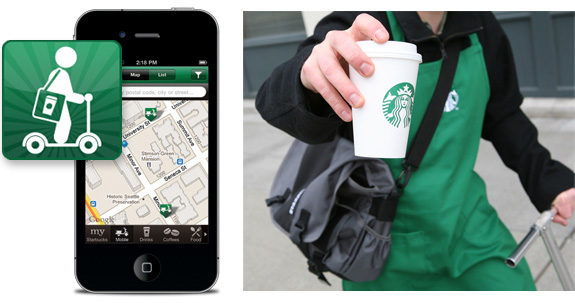
In an effort to rally support after disclosing lower than expected sales this quarter, Starbucks announced that it is working on an app that will enable customers to pre-order beverages and eventually, have them delivered to you (Choi, 2014). They say that the pre-order feature should be ready first (Spring 2015), and that the delivery feature should be ready by end of 2015 (Choi, 2104). Their goal is to help enhance the experience for customers by having drinks warm and ready for people when they come through the door, and ultimately, allowing them to bypass long lines (Choi, 2014). A delivery feature will take convenience to the next level by having drinks brought right to your doorstep at the touch of a button; this feature however, will only be available in select cities (Choi, 2014).
starbucks

In fact, CEO Howard Schultz bullishly likened the new convenience feature to a pumped up version of e-commerce, “Imagine the ability to create a standing order of Starbucks delivered hot to your desk daily,” Schultz said. “That’s our version of e-commerce on steroids,” (Little, 2014). However, Starbucks isn’t the only company marketing convenience. Apps like Instacart (grocery delivery), GlamSquad (hair & make-up services), Soothe (massage), Washio (laundry pick-up), and Google Shopping Express (pretty much everything else), all market convenience, by delivering some sort of product or service to consumers (Carson, 2013).

This surge in popularity for convenience apps might be telling us something about our culture today, and potentially what businesses should focus on next if they want to retain market share. It’s almost as if people simply don’t have the time to keep up with the demands of work and/or school, family, as well as personal needs anymore — and still have time to enjoy life. Perhaps that’s the reason why apps marketing convenience seem to be popping up everywhere: they are helping people get their lives back, one errand at a time.

What do you think about the new Starbucks app? Will you use it? Is convenience marketing a fad, or is it here to stay?
Starbucks_logo_2011

References

Carson, H. (2013). Convenience – there’s an app for that. Retrieved on November 6 from http://onboardly.com/startup-pr/convenience-theres-an-app-for-that/

Choi, C. (2014). Starbucks plans delivery after sales fall short. Retrieved Nov 6 from http://www.huffingtonpost.com/2014/10/30/starbucks-delivery-mobile_n_6079528.html

Little, K. (2014). Starbucks just announced big news about delivery. Retrieved on Nov 6 from http://www.cnbc.com/id/102138924#.
Posted in Uncategorized | 3 Comments

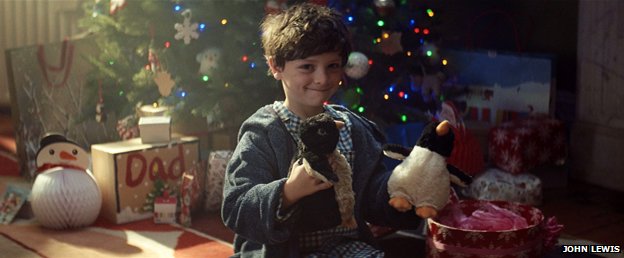
John Lewis did it again with a Penguin!

_78761597_624_john-lewis

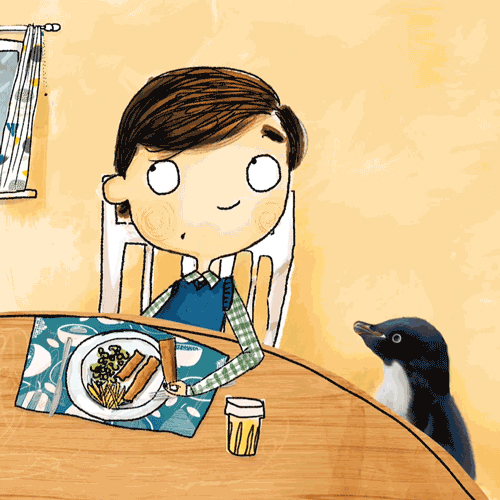
The British retailer, John Lewis, has made headlines for itself since 2006 by putting out an annual short film holiday advertisement. Over the years, the John Lewis holiday ads have become a cultural institution of sort that signals the beginning of holiday season. Critics have questioned whether John Lewis can keep doing its great job. This year, the retailer used a loving story of a boy and a penguin.

There are a few things you can always expect from a John Lewis Christmas ad, said BBC News. Emotive narrative, heart-warming music, vague moral to the story, and most importantly, not showcase anything about the department store itself.

https://www.youtube.com/watch?v=iccscUFY860

This year’s ad featured a young little boy and his pet, a penguin, pursuing daily activities as best friends do– football, trampolining, decorating the Christmas tree, play toys, read books, and go to the park. After watching TV together a few times, the boy discovered the penguin’s longing for a female companion. So, the boy bought a female penguin for Christmas!

At the end of the ad, there is a twist that the penguin is actually a stuffed toy, with the tagline–Give someone the Christmas they’ve been dreaming of. The background music sings “it’s real love” repeatedly.

The ad generated a lot of buzz on Twitter. Most responses for this ad on twitter are positive. “LOVE. John Lewis did it again! Not sure what it says about my state of mind but I shed tears on the bus watching it!,” twitted by Elaine Hallam in one tweet.

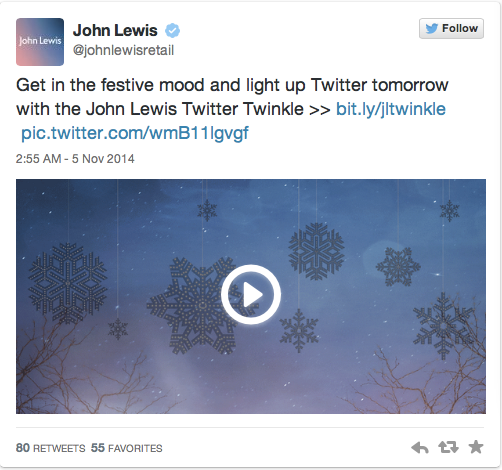
Besides the launch of the ad itself, John Lewis did a great of work before and after the launching of the ad on social media, which I think can be a great example of integrated marketing communication. Before the launch, the company introduced a Twitter app called the Twitter Twinkle that post festive messages from fan account.

Twitter Twinkle

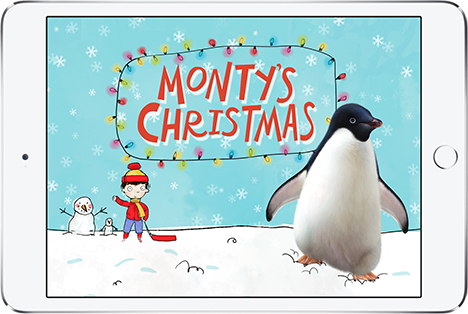
After the launch, fans can follow the adventures of  @MontythePenguin and @MabelthePenguin on Twitter. John Lewis also offer a companion children’s book, an online game, e-book, and stuffed toys and other merchandises along with the campaign launch.

image.axd1image.axd


References:

http://www.bbc.com/news/blogs-magazine-monitor-29906347

http://www.brandchannel.com/home/post/2014/11/06/141106-John-Lewis-Holiday.aspx

Posted in Uncategorized | 3 Comments

Nike, LeBron James, and a message

In class this week our topic is Creative Strategy so I thought I would talk about the new Nike ad campaign with Lebron James. The ad’s focus is not on a product but conveys a message far greater than the new shoes being released.  It also speaks to an emotional creativity in marketing.

http://youtu.be/n6S1JoCSVNU


Background: “The new two-minute Nike “Together” commercial that debuted Thursday night to coincide with the Cavs’ season-opener, is getting a lot of national buzz.  Shot in Cleveland under a shroud of secrecy earlier this month, it combines heart-of-the-city sentiment with feature film lighting and editing techniques, all underscored by an emotional, escalating mantra: “Hard Work! Together!”” (O’Connor, 2014).

This commercial has a really good narrative about being homegrown, leaving, and then maturing and returning home to be a focal point of pride and optimism for the city. I think the way it shows the relationship of sports and community in a realistic, organic portrayal is a very powerful force. It makes people feel connected, and it makes something like buying the shoes or t-shirt or whatever  LeBron James wears seem like a natural part of being in the tribe of something meaningful.

Another interesting topic that I want to talk about is the relationship between an ad agency and a company. Widen & Kennedy have been marketing Nike since 1982. Do you think a long lasting relationship like this allows an ad agency more creativity and freedom?

What makes a campaign like this so successful? Do you think it is in line with Nike’s business goals? In my opinion, these kind of marketing ads create something that I want to be part of.


Posted in Uncategorized | 1 Comment

How Brands Can Take Advantage of Instagram Direct

Instagram Direct has been available for brands for quite some time now and bloggers and brands everywhere are making sure to take advantage of the feature to increase engagement with followers and customers! However, not all brands are aware of the potential of this Instagram feature and how they can make the most out of this photo sharing opportunity.

Almost a year ago, Instagram, our beloved photo-sharing app, announced a new feature – Instagram Direct. With the new app update, Instagram users now have the option to share photos and videos with just one person or a select group of friends (up to 15 at a time), rather than to all their followers. After sending a photo, the user will be able to find out who’s seen the photo or video, see who’s liked it, and watch the recipients commenting in real time as the conversation unfolds.

How Brands Can Take Advantage of Instagram Direct:

  1. Contests and Special Deals – Since Instagram Direct will give brands the opportunity to reach out to their followers on a more personal level, it makes it more simple to notify a contest winner or offer a select group of followers a special deal or message. Being part of a smaller group or individual messages has the power to make their followers feel special (wouldn’t you?) and could lead to higher sales conversions for their business.
  2. Exclusive Content – With this new feature, brands can message customers and followers that are active on Instagram with exclusive content for them to utilize for themselves or share with their friends and family. It’s a great way to network with those who are helping you build your brand! Brands can also send bloggers and customers behind-the-scene photos of events or even a private thank-you messages. It’s a great opportunity to deepen the relationship with customers and followers – especially with new members. This will also be greatly beneficial to increase brand loyalty.
  3. Customer Service – If brands promote their business on social media, they already understand that a big portion of their job is to listen to customers and followers and provide answers to their inquiries. Instagram Direct gives brands the ability to reach out and communicate with followers directly and ask them how they can help make their purchases online or offline an easier transaction.

Have any of you used Instagram direct for personal or business? How do you think brands and companies can leverage from using this tool?

Posted in Uncategorized | Tagged , | Comments Off on How Brands Can Take Advantage of Instagram Direct

Warfare marketing & its play with emotions.

Of the many emotions that promotional efforts can trigger, the surprise effect is considered the core element of guerrilla approach (Hutter & Hoffmann, 2011). As per Hutter & Hoffmann (2011), when perceptions are met with unexpected disconfirmation, it results into an emotional retort, surprise. The audience is amazed when a pleasant event or sight crosses their mundane lives. According to Hutter & Hoffmann (2011), implementation of marketing ideas at unusual locations, building sized posters, digital screens, ambient advertising and other such ideas evoke surprise emotions in the public. Such an audience cannot obviate themselves from inferring the marketing messages (Hutter & Hoffmann, 2011). Coca Cola’s Happiness Machine campaign will help us understand the element of surprise in guerrilla marketing.

A vending machine was installed before the final exams in the cafeteria at St. John’s University in Queens, New York (Aaker & Smith, 2011). This machine distributed surprises instead of just normal sodas. For instance, when one student paid for a coke, the machine dispensed many cokes. Others received a 10 inch sandwich, balloons, flowers and even pizza. Aaker and Smith (2011) say that the surprised students were elated with joy and the spirit in the cafeteria looked nothing less than a festive celebration. Facebook statuses, tweets, instagram pictures about this event were posted, shared and liked by the students and in two weeks, the video commercial was watched more than two million times (Aaker & Smith, 2011). Traditional coke advertisements during the American Idol show and those on television reach more public but spreading joy among a segment of its audience with stunts such as the happiness vending machine established a deep emotional association between the brand and its customers. No print advertisement or television commercial can create such sentiments into the consumers. There was surprise and then there was a strong connection with the brand. This marketing event cost less than $50,000 but gathered tremendous appreciation for its concept and objective from marketers, customers and other corporations (Aaker & Smith, 2011). Super bowl ads or big building posters are predictable, with this Coca Cola achieved people’s smiles. Coca Cola’s happiness machine also justifies Levinson’s (2014) explanation of the extensive use of technology to implement guerrilla marketing ideas. Coca Cola crafted its message in an effective manner and made sure its audience understood what the brand believes in, in spreading happiness. It found the right emotion at the right time and gave the students delightful little surprises that made them forget the stress of the finals. Every attention-gripping story does not need to have life and death instances; all it needs is originality and clarity of ideas to surprise people in unexpected ways.

Margolis & Garrigan (2008) state that guerrilla marketing has proved to be successful for all size of businesses around the globe. They believe that this strategic form of promotion has set itself as a benchmark for economical marketing (Margolis & Garrigan, 2008). The WestJet Christmas miracle, Nikon’s Paparazzi campaign and Coca Cola’s Happiness Machine are all examples of modest budget marketing efforts that paid off with their novel idea and unpretentious implementation. It all captured one emotion, surprise, which led the audience to appreciate the brand and its communication. Levinson (2014) clearly states that guerrilla marketing should align with technology, only then it will be fruitful, otherwise it’s not guerrilla at all. Technology is the need of the hour. This warfare marketing makes efficient use of technology in all forms to ensure successful marketing efforts. Overall, guerrilla marketing strategy has the ability to create a publicity snowball; it manages to capture attention of the press and the audience for good or not-so-good reasons.

References

Hutter, K. & Hoffmann, S. (2011). Guerrilla marketing: The nature of the concept and propositions for further research. Asian Journal of Marketing, pp. 1819 – 1924

Aaker, J. & Smith, A. (2011). The dragonfly effect. [Review of the Stanford social innovation, 2011], pp. 30 – 35

Margolis, J. and Garrigan, P. (2008). Guerrilla marketing for dummies. Hoboken: NJ,Wiley Publishing, Inc.

Levinson, J. (2014). Guerrilla marketing with technology. Retrieved on October 29 from http://www.gmarketing.com/articles/167-guerrilla-marketing-with-technology


Posted in Uncategorized | 3 Comments

Your Personal Apology

2

Will a sincere apology make you feel better when you have to end up a trustful relationship?

O.b. tampon is a brand under the parent company of Johnson & Johnson. In 2010, due to a distribution problem, it had to go off the shelves. Women were very upset about the sudden loss of their brand. In fact, the loyal fans of this feminine hygiene product became outraged. They were buying up all the boxes of o.b. tampon they could find and those remaining boxes were even selling on Ebay for as much as $80. Furthermore, some of the fans created a website and called for women to boycott all Johnson & Johnson products.

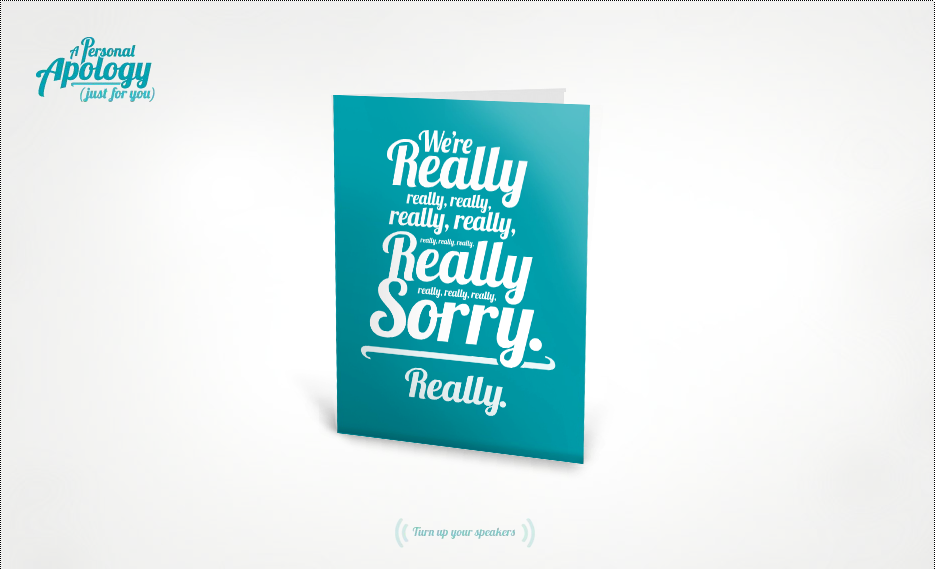
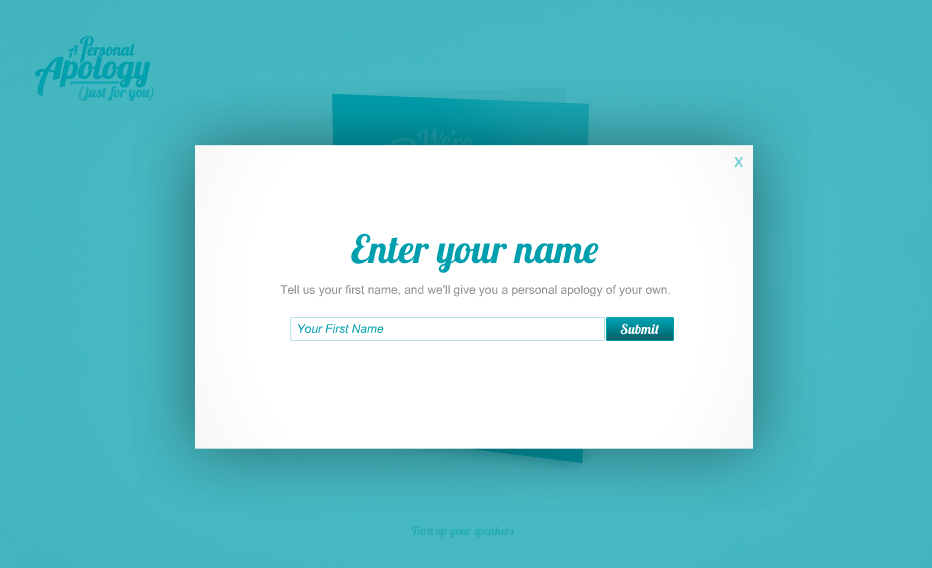
This was never expected by the company and the market was asking for actions to save its consumers and the brand image. Therefore, a campaign was created to apologize to every woman personally. It developed a customized song and music video apology for each person in the o.b. database. The customer who received the link to the website only needed to type their names in the input field and click enter, and their personal apology from the o.b. tampon would show up. After watching the video, consumers were prompted to clicke for a o.b. tampons coupon or could share their personalized video or the link.  This marketing campaign took online personalization to a whole new level. In the video, the user not only hears their name sung by the handsome singer, they also see it on the sheet music, written in rose pedals on the beach, sky written in the clouds, tattooed on the arm of the singer, and on a hot air balloon floating across the sky. All these elements with the hilarious lyrics turned this heart-broken moment into a joyful event.

1

The site was originally sent out to the 65,010 customers in the o.b. database. Social aspects were added to the site allowing those 65,010 users to share the video and thelink with their friends on different social platforms. Within 3 months, the site was share on Facebook over a million times, and shared on Twitter 1.8 million times. The site generated 27 million unique visits and this campaign won awards across areas such as Public Relations, Digital Marketing, Crisis Management Marketing and Advertising.

This marketing campaign is truly brilliant back in 2010. Now 4 years have passed, I am wondering, what can be improved about this campaign if it is going to release in 2014. What’s your opinion?

Posted in Uncategorized | 4 Comments

Jabs and Right Hooks of Halloween Horror Night

Anyone who has been to this year’s Halloween Horror Night at Universal Studio? I went there last Friday and it scared me a lot….. Anyway, back to the topic. After reading Jab, Jab, Jab, Right Hook, I felt it would be interesting to look at how Halloween Horror Night (HHN) was doing on social media.


Facebook
https://www.facebook.com/HalloweenHorrorNights
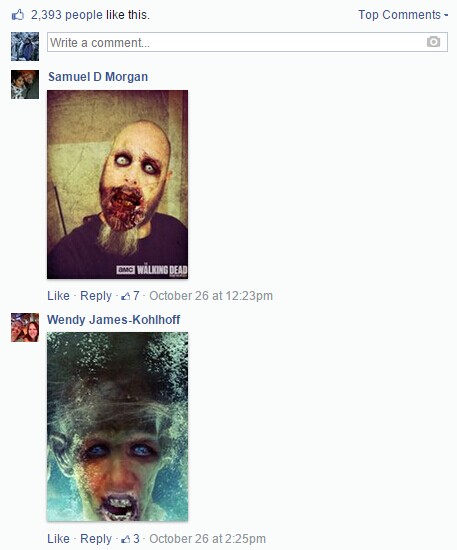
On average, every picture of HHN on Facebook has more than 1500 likes and less than 100 shares. It seems like there is still plenty room for improvement next year.The jabs they posted are basically peeks of their scareactors and the scene of the park; the right hooks are the counting downs of the ending of the event. One of the best Jab posts I found is this:
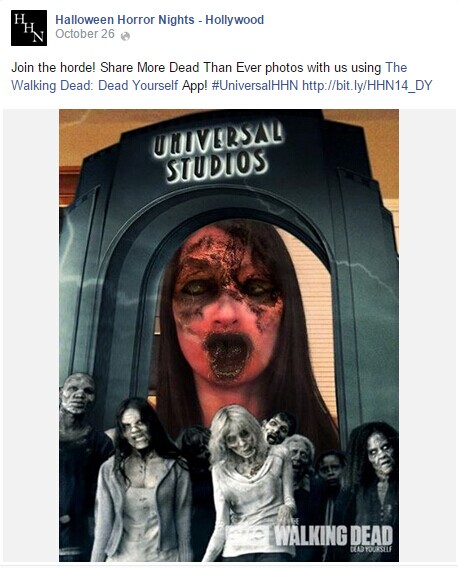
“Join the horde! Share More Dead Than Ever photos with us using The Walking Dead: Dead Yourself App! #UniversalHHN http://bit.ly/HHN14_DY”It is really an interesting way of engaging audiences and the picture they posted has clear logos of Universal Studios. What’s more important is that, people are actually responding!

appAPP2


Twitter

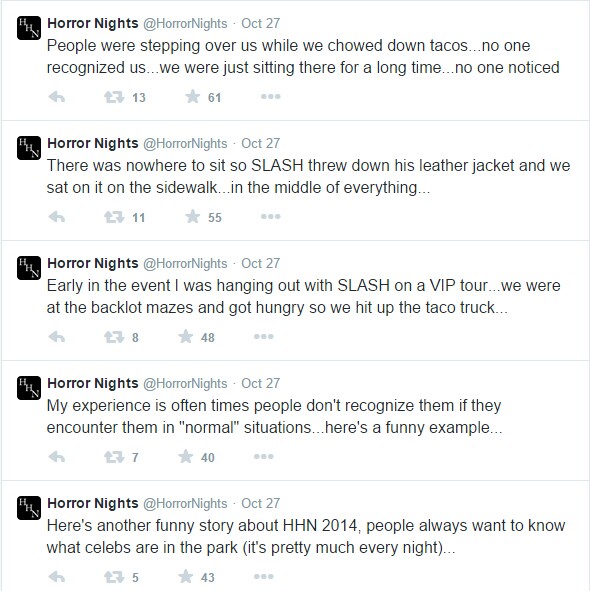
In general, HHN is not doing well on Twitter. In the last few days of the event, it tweets several times about the “password for night” (which I have no idea about) and boring ineffective right hooks like “see you tonight….”. Furthermore, they did not respect the word limits on Twitter by using 5 to 6 tweets to do one storytelling…..

twitter

Obviously, the re-tweets and responses are not as many as those on Facebook’s. But at least they created a distinguish hashtage #UniversalHHN…


Pinterest & Instagram
http://www.pinterest.com/explore/halloween-horror-nights/
http://instagram.com/horrornights
I also found HNN’s Pinterest and Instagram page. However, I am not sure if it is a good idea to put horrible pictures on artsy social media sites? Take a look of the pins and pictures and tell me what you think!

Posted in Uncategorized | 3 Comments

Diet Coke- Stay Extraordinary

Recently, Coca-Cola Israel launched an fully integrated marketing campaign with the help from Gefen Team, Q Digital and HP Indigo for its sub-brand, Diet Coke. The campaign centered around the idea of “millions of one of a kind bottles.” Similar to Coca-Cola’s “Share a Coke” campaign where it created 250 unique bottle labels that feature consumers’ names, Diet Coke’s campaign created 2 million unique bottle designs. The campaign is made possible though a unique algorithm that can generate millions of designs automatically. The uniqueness of each bottle highlights the idea that each Diet Coke lover is one-of-a-kind. In addition to bottle designs, the campaign also extends to billboard ads, point-of-sale, TV, partnership, and social media marketing communications.

The campaign is successful because it not only aligns with Coca-Cola’s core values, but it also captures the essence- “stay extraordinary”- to the brand. Its marketing communications also reflect the same idea as well. The campaign’s hundreds of billboard ads each features an unique bottle design, highlighting the value of each bottle. The campaign’s point-of-sale marketing provides a more engaging interaction with each customer; the field team provide the consumers’ with branded gifts that match their design. The campaign is also very clever in choosing a topic that easily sparks and generates earned media; owning an one-of-a-kind bottle encourages consumers to showcase their designs on social media. Despite all the strengths, the campaign has a major weakness: the idea of an one-of-a-kind bottle design has been used more than once in the past, making the idea not so unique after all. In addition, because the designs are computer generated, it is very likely that some consumers would receive very similar bottle design as someone else. Ultimately, the campaign is deemed successful because it increased sales, brand preference, and purchase intent.

http://www.adweek.com/adfreak/diet-coke-prints-2-million-unique-labels-latest-stroke-packaging-genius-161042

Posted in Uncategorized | 5 Comments

“I’M AS MAD AS HELL AND I’M NOT GOING TO TAKE IT ANY LONGER!”

Ok, I’m not going to ask anyone to get up out of their seats and go to the window and scream “I’m as mad as hell and I’m not going to take it any longer”, as Peter Finch’s character Beale proclaimed in the 1976 movie Network; but like me, I hope you’re mad as hell about the barrage of political advertising during the election seasons, which seems to increase election by election. I cringe at the thought of the upcoming 2016 U.S. Presidential election and without a doubt, I’m sure direct mail will break more records in advertising spending. For instance, Senator Cory Booker, from New Jersey spent over $4.6 million within 4 months during the special election in 2013. According to Steinhauser & Yoon (2013), during 2012, the average cost that winning candidates spent during an election year was $10.3 million. If that’s not enough to make you scream out the window, the Vital Statistics on Congress reported that it typically takes an average of $1.6 million to win a House seat, and reportedly that is an increase of 344% since 1986 (2013), and that doesn’t include advertising from candidates from the State and Local elections…now that makes me not only scream out the window, but also contemplate whether I should jump.

If I wanted to start a dialogue on the political realities in America I would likely talk about the premise that you either have money or have the ability to raise money in order to serve your community or nation as a public servant. Just to be clear, I believe this is a sad truth that most us of know; however some of us still hold on to the idea that if you dream and work hard enough, you can grow up to be President one day…well maybe, but raising about $40 million will go a lot further in attaining your goal. Depressing.

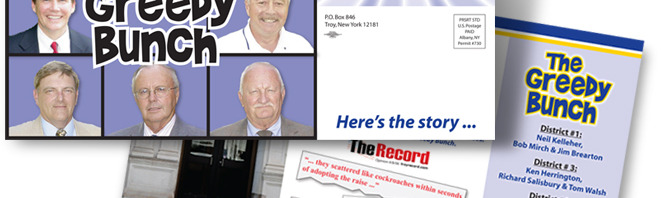
greedy-bunch-featured

Since I am screaming about political advertising, lets review the one thing that effects every one that has a mailbox or mail slot – direct mail advertising. As time approaches Election Day, mailboxes are crammed full of last minute political messaging, as if we haven’t heard or seen it before. As noted by Issenberg (2011), traditionally campaign managers stockpile funds for a last minute deluge of advertisements aimed at the undecided voters. Considering TV and radio ads are normally booked, the most reliable and economical media is direct mail…lovely. Just when you thought everyone was moving to the digital arena, campaign managers, outside fundraisers, and political party affiliates continue to turn to mailers, mainly because of cost and the connection with their audience. According to the Federal Election Commission reports, the political machine spent at least $150 million on direct mail during the 2014 election cycle.

So with that said, when is enough, enough? In other words, how many spaghetti noodles do you throw on a refrigerator until one sticks? Who knows…and apparently campaign managers don’t have the answer either.

Reference

Federal Election Commission (2014). Retrieved from http://www.fec.gov/press/campaign_finance_statistics.shtml

Issenberg, S. (2011). The secret weapon of modern political campaigns: The mail. Slate. Retrieved from http://www.slate.com/articles/news_and_politics/victory_lab/2011/12/ u_s_postal_service_changes_how_they_ll_affect_the_2012_campaign.html

Malbin, M., Mann, T., Ornstein, N., & Wakeman, R. (2013). Vital statistics on Congress. Brookings and the American Enterprise Institute. Retrieved from http://www.brookings.edu/research/reports/2013/07/vital-statistics-congress-mann-ornstein

Parti, T. (2014). An unlikely survivor in the digital age: Direct mail. Politico. Retrieved from http://www.politico.com/story/2014/08/an-unlikely-survivor-in-the-digital-age-direct-mail-109673.html

Steinhauser, P., & Yoon, R. (2013). Cost to win congressional election skyrockets. CNN Politics. Retrieved from www.cnn.com/2013/07/11/politics/congress-election-costs/

Posted in Uncategorized | 19 Comments

What happens in a UBER car, stays ina UBER car: creative or bad marketing choice?

Being a college student, especially at a school like USC known for its “party life” during the weekends, many times you may find yourself at the verge of making the decision between going out with your friends and having to stay home because of the risk of getting a DUI. I say this because going out at night at a school like USC many times involves drinking with friends and, given the dimensions of the city, this may jeopardize the driving privileges of any student. Besides all the discussion that this topic may generate at an ethical and moral level, I want to focus on the reality and on the practical side of the issue. Many times, in order to not forgo the opportunity of going out with friends and enjoy the college experience, students take the risk of getting their license to be taken away. Since 2009 this risk has been immensely decreased thanks to one of the most successful invention in the latest years: UBER.

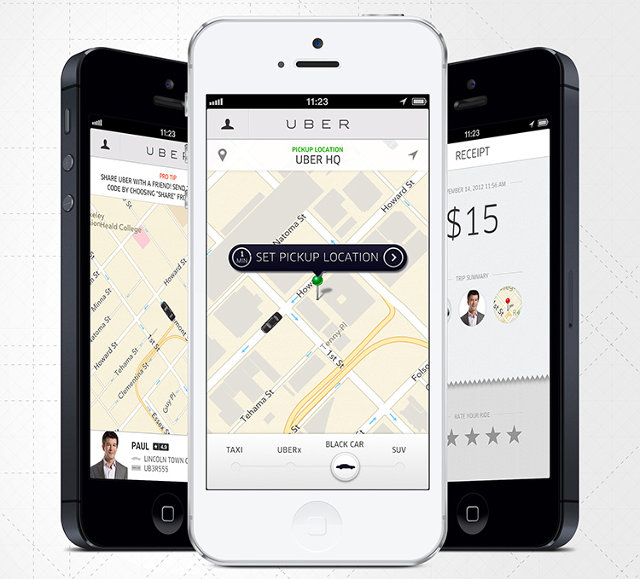
To say in a better way, those who launched UBER didn’t reinvent the wheel, but combined and proposed services that already existed in a new and unique way. They combined the classic taxi service with the latest smartphones’ technologies through an app. For those of you who are out of the college-party scenery, UBER is a taxi service that allows users to call a driver through the subscription to a free app. This app shows the user how many cars are available, how far they are and it also let the user estimate the cost of the fare. Moreover, the user is able to track the route of the assigned car thanks to the mapping ability of smartphones. A user is also able to choose different types of cars: UBERX (normal sedan cars), UBER XL (big suv that fit up to 8 people) and UBER black (more luxurious vehicle for those who desire a more fancy drive). The app also allows the user to contact the assigned driver through calls or text; also it doesn’t require the driver to receive any on-hand payment, since each UBER’s user’s profile is connected to a credit or debit card.

If you go on a college campus the word-of-mouth marketing that UBER receives between the students is very strong, positive and effective. At least here at USC the majority of students that I have met have used and would use UBER again. Despite this form of marketing, UBER is trying to be known by a broader demographic than just college students. Therefore the company needs to implement different marketing campaigns that capture the attention of the targeted demographic. In order to do this, the company used a rather unusual method. I say unusual because, despite the fact that other companies have used the same method, UBER gave it a twist that is quite risky.

In one of the latest episodes of the hit NBC show “Chicago PD” UBER was featured. As the title suggests, the series shows the work of a crime investigation unit at the police department in Chicago. For this particular episode the unit was investigating on a kidnapping case where two college students were kidnapped from a UBER car after the kidnapper had beaten the driver to death.

http://www.nbc.com/chicago-pd/episode-guide/season-2/chicken-dynamite-chainsaw/204

In the episode one the officer answers his boss question about what UBER is by giving a very detailed description of the service; description that is seen by all the viewers of the hit show. This is a clear marketing strategy that the company adopted in this case, since it incorporated a sale pitch of the service into the dialogue of the plot of the TV episode. In my opinion this was a good idea because the detailed description captured the attention of the viewers of the show, which they are older than college students, given the content of the show, and who have a particular interested for detailed criminal cases which will allow them to remember what UBER is about.

So far nothing new and too risky; the risky part is the fact that the company was associated with very serious crimes that were committed in a company vehicle. This association is very risky because it may create the idea in the minds of the viewers that what happened to the girls and the driver could happen to them if they would use the same taxi service. If people like me, who have used UBER multiple times and are very familiar with the safety of the service, may not be very touched by such mentioning of the company in the show; new and potential customers may have a distorted image of what the company is really about and may even get detached from the willingness to sign up for the service.

If I agree with the fact that UBER should expand its marketing to a much older demographic, I also believe that this particular marketing strategy wasn’t really the right thing to do. UBER should probably try to attract customer attention with more traditional marketing methods or with a different portrayal of the company image on a very successful TV show. For example, I would make the main protagonist’s UBER ride to be one the main reason why he was able to solve the case. Moreover, in more calm and mellow shows, I would make the protagonist use UBER as their taxi service.

I would like to know what you think about this marketing strategy: is it effective and why? Should the company keep using the same approach or should the company change it? What does the company should do to attract a broader demographic


The link for the “Chicago PD” episode in which UBER is mentioned can be found below the “Chicago PD” picture. Pay particular attention to the first 10 minutes.

Posted in Uncategorized | 12 Comments