Know Your Audience: Recruiting Latinos to College

A recent report by the Pew Hispanic Research Center titled Second Generation Americans: A Portrait of the Adult Children of Immigrants got me thinking about how marketing and advertising agencies will use this research to inform new ad campaigns for Latino and Asian audiences. The profile of the about 20 million adult children of immigrants, most of which are Hispanic and Asian, should spark conversations in consumer marketing and advertising circles given that these second generation adults “have higher incomes; more are college graduates and homeowners; and fewer live in poverty” (Pew Research Center, 2013, p.7). These socioeconomic characteristics translate into higher buying power for these communities.

The report included a caveat about the gaps that still exist between the respondents. For instance, Bachelor’s degree attainment rate for Latinos is only 21% compared to 55% for second-generations Asians. However, the report does highlight that despite these gaps of those in household income and poverty rates among second-generation Hispanics and Asian Americans “within each group, the second generation is doing better than the first on most key measures of economic success” (Pew Research Center, 2013, p.14). Given my experience in working with Latinos and the higher education sector and the tremendous growth in Latinos under the age of 18, I will focus on that community and how some of the findings might impact the way we meaningfully recruit and market to Latinos.

One of the key phrases that kept running through my mind as I read the report was “know your audience” so resources such as those constantly published by the Pew Research center should be helpful to market researchers who want to know more about Latinos in general. As this report points out, second-generation Latinos are completing higher education and have higher incomes than first-generation Latino immigrants. This alone should be helpful to colleges and universities who are trying to recruit more Latinos to their campuses. Some of the marketing and outreach budgets should include a strategy to reach second-generation students and their families.

In terms of identity, most second-generation Latinos had a connection with their “ancestral roots” and 37% described themselves as simply American. This means that when connecting with students, higher education institutions should understand that many second-generation Latinos are balancing cultural identities between the parents’ homelands and their own. They are as American as apple pie, but they also might enjoy watching Sabado Gigante with the abuela or futbol with la familia. In writing this, I was reminded of a powerful clip created by New American Media for Univision where the importance and diversity of the Latino market is masterfully highlighted:

http://www.youtube.com/watch?v=pQnhuj11zgI
Admission officers who work on marketing strategies should Latinize content and tone without overdoing it since many of these kids might see trough inauthentic connections. Since about 78% of Latino adults believed that hard work could help them achieve their goals, they will more than likely be interested in career and college graduation outcomes, so this messaging should be present in various communications.

As for la familia, 26% of Hispanic second-generation adults are in interracial marriages (Pew Research Center, 2013, p.11) and 52% believe that their group gets along with other racial and ethnic groups, so they are more likely to have diverse friends. Therefore, college admission officers should embrace learning about prospective students and connect with their families through on-campus events. Marketing collateral and web content/pictures should speak and welcome the diversity in this community.

Finally, since “eight-in-ten second-generation Hispanics say they can speak Spanish at least pretty well” (Pew Research Center, 2013, p.12)a marketer might want to learn more about code-switching. The notion of simply advertising to Latinos in Spanish should be completely reconsidered. Second-generation Latinos are straddling two cultures and in some cases, like in language, they absorb much more in English than they do in Spanish. This is not to say that you simply rely on ads designed for the general market, you need to Latinize or once again go back to the rule of thumb and get to know your audience. By knowing them, targeting messages, speaking to their interests and needs, and using the right channels you might be able to capture their buying loyalty or a “commit” if you are a college recruiter.

References:

Pew Research Center (2013, February 7). Second-generation Americans: A portrait of adult children of immigrants. Retrieved from http://www.pewsocialtrends.org/files/2013/02/FINAL_immigrant_generations_report_2-7-13.pdf


Posted in Uncategorized | Tagged | 11 Comments

Who Moved my Hovercheese?

Life passes at megabit speed. We have organized, streamlined and prioritized our days to maximize our time effectively balancing work, school, raising families, exercising, and, hopefully, playtime.  Time-efficiency increases by avoiding commercials watching TV on demand, skipping ads to immediately play your online video, or paying for the “No Ads” version of an app on my phone.  Companies, sensing a slipping advertising foothold thanks to our desire to escape when gifted with a break, are forced to step outside of the box to find creative new ways to buy time in our broadband stream of consciousness. Don’t they have an app for that? Funny you should ask…

“We’re on the driver’s side”
(C) 76

These days, companies have found innovative ways to mesh their products, their company vision statements with your ultimate escape and speak directly to their customer by creating image ads masked as phone apps.  The 76 gasoline company did a great campaign that immediately spoke to customers telling drivers that 76 hears them and understands what they deal with daily while in their car fighting traffic. There are enough worries but where to buy gas shouldn’t be one of them – “We’re on the drivers side!”  Now I didn’t do a formal scientific study, but I could swear that on a gameshow the other night, Survey said that “bickering kids” in the backseat comes 2nd only to people with road rage.  76 answered this call creating the Quiet Game to help drivers find peace of mind without having to turn this car around.  Ironically, 76 also created a road rage-relieving app – check it out: http://www.76.com/RoadTools.aspx

Mobile Apps of Mass Destruction
(C) Cheetos (R) Brand

Sometimes adults simply want a reprieve from the threat of their own crazy lives.  Cheetos recently faced down this challenge with their “Mobile Apps of Mass Distraction.”  They brilliantly blend their lighter than air cheese product with the technology of the iProducts to create a hovercheese that one moves around obstacles by blowing on your microphone and tilting your iProduct to direct it and avoid being crunched.  In a second app, the personality of their Chester Cheetah’s roars as he declares a thumb war!  To reward loyal customers and players, the opportunity to scan codes off of purchased products will reveal extra game challenges and characters.   To learn more, of course, “Like”  their page: https://www.facebook.com/Cheetos.

Again, the goal here isn’t to corner people at the water cooler to push products on consumers, but to keep the conversations going on a more intimate, friendlier level and remind them that the companies look out for their customers – traits one often wants to share with their friends.  So, friends, have any friendly fun (or distraction from studying) to share with me?

by Sarah Harris


SOURCES:

Anonymous. (2013, February 5). Re: Cheetos brand extends social presence with new
‘Cheetos Mobile App of Massive Distraction’ games [PepsiCo global employee
newsletter]. Retrieved from http://goo.gl/ODIi1 

Anonymous. (2011, December). Re: Quiet Game App [Venables Bell & Partners website].
Retrieved from http://www.venablesbell.com/work/quiet-game-app

Posted in Uncategorized | Tagged , , | 17 Comments

Marketing forever changing: good luck marketers

We’ve all heard the cliché: the arrival of the internet changed marketing forever. But perhaps more correctly, the internet has made it so marketing is forever changing. Some brands like Nike and Apple have embraced this paradigm wholeheartedly, evolving every step of the way to maximize their growth potential and harness various aspects of the internet’s power to create user communities that champion and promote their products/brands, while those who were too comfortable with the ways of the past bit the dust.

Some, like Antony Young in his 2010 book titled Brand Media Strategy: Integrated Communication Planning in the Digital Era, attribute the changed game to two major online phenomenon: Google and Facebook. Targeted advertising on the web has helped brands reach their potential clientele with pinpoint accuracy and metrics. This is true, but one part of the equation I believe could continue to change things: the rise of readily-available in-network user reviews on the internet.

Gone are the days of romanticized advertising where brands are the only voice speaking about their products. “About six in 10 (59%) online shoppers say user-generated customer product reviews have a significant or good impact on their buying behavior,” (MarketingCharts Staff, 2011). With the looming introduction of Facebook Graph Search, this figure is bound to rise, along with the trust/credence that potential customers put into these reviews because the reviewers are part of potential customers’ social networks.

And that may only be a small speck of change in what is now becoming a dynamic online marketing environment where those who get too comfortable fall behind very quickly. A user article recently shared on LinkedIn titled “9 marketing strategies you must stop using now” preached against strategies that were championed by Young and his likes in 2010 as game changers, like keyword-based SEO, saying they are now obsolete and counterintuitive. It’s crazy how fast things are changing. The skills we are developing today as marketers could be worthless in just a few years. It’s almost a crapshoot for us communication professionals trying to navigate our career journeys through unchartered waters.

Marketing professionals who were reaching the pinnacle of success just two years ago trying to target users through search engines and other keyword methods, are now refocusing their efforts on working with users to build online communities and guide the development of viral media. They know they need to facilitate the creation of genuine, positive online reviews as a part of integrated marketing communication efforts.

And this is only a small piece of the pie, as Kitchen and Burgmann said in their 2010 academic article titled “Integrated Marketing Communication.” Brands need to use as many tools/touchpoints as possible to reach their audiences. And with the way the internet is going, these touchpoints are going to infinitely grow as time wears on. Will brands be able to keep up with all the modes of advertising, or will they try to play it safe and perhaps fall behind? Only time will tell. But one thing is for sure, it’s going to be one heck of a ride for us marketing/communication professionals. Good luck.

Zeyad Maasarani

References

Kitchen, P. & Burgmann, I. (2010). Integrated marketing communication. Wiley International Encyclopedia of Marketing. John Wiley & Sons Ltd.

Lewis, K. (2013, February 4). 9 marketing strategies you must stop using – now. IMediaConnection.com. Retrieved on February 10, 2013 from: http://www.imediaconnection.com/article_full.aspx?id=33546&buffer_share=8778c

MarketingCharts Staff (2011, September 1). Customer reviews affect 6 in 10 online shoppers. MarketingCharts.com. Retrieved on February 10, 2013 from: http://www.marketingcharts.com/direct/customer-reviews-affect-6-in-10-online-shoppers-19019/

Young, A. (2010). Brand media strategy: Integrated communications planning in the digital era. New York: Palgrave Macmillan. Chapters 2 and 3.


Posted in Uncategorized | 5 Comments

IMC Breakdown – you’re all wrong.

If you’re a fan of Integrated Marketing Communications or if you do it for a living,  you’re probably as sick as I am of knowing that ALL marketing models have gone to hell since “the advent of social media” –   arguably the most abused phrase in marketing-related articles the pat 5-6 years.

It’s also likely that your inbox is clogged with tons of articles with “The top X [insert favorite social medium or topic]  tips every Marketer/CMO should know” . You probably get a chance to read maybe 20% of these articles and either share them with peers, clients, etc and bookmark the rest for future use on papers or presentations; if you’re a smarter user you just probably delete them. (I’m in the former category).

Another annoying kind of email is  “Get the biggest bang for your buck on [insert favorite social media or topic]”. In short, every day many people claim to have found the holy grail of consumer understanding and Marketing ROI.

Unless you’ve read the two articles on this post, you’re all wrong; dead wrong.

The Funnel is dead

Continue reading

Posted in Uncategorized | Tagged , , , , , , | 2 Comments

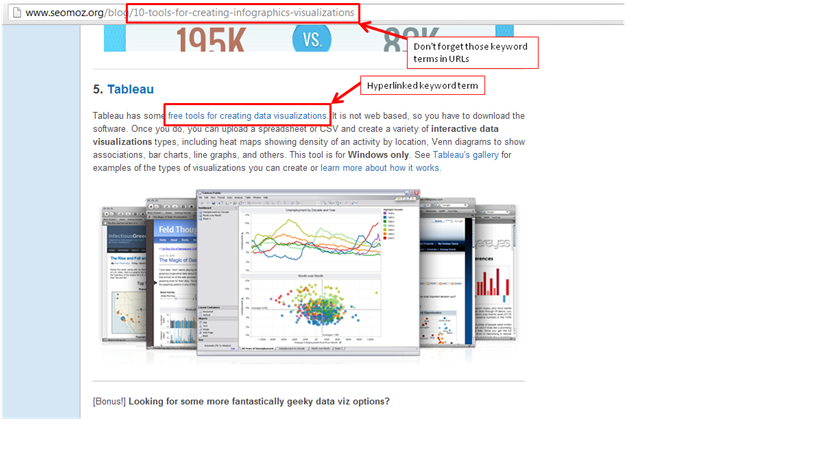
Blog SEO Keyword Term as URL and Title

How to use keyword terms in URL

Posted in Uncategorized | Comments Off on Blog SEO Keyword Term as URL and Title

Dart Your Attention

By Ramona Contreras Chiapa


I sat reading on the couch earlier this week with the television on providing soothing ambient noise, when a commercial sparked my interest and immediately drew my eyes off the pages I was reading and directly to the screen.  The commercial was so engaging and its concept so new that I found myself rallying my husband and rewinding the commercial for a second viewing.  To my amazement, Dodge has cleverly transformed the traditional registry into a “crowdsource[d]” (Ross, 2013) affair.  In one ingenious act, they have made buying a car a social movement integrating their marketing efforts across multiple mediums and ultimately connecting with consumers.  Couples and individuals can design the car of their dreams and get family and friends to chip in for the overall purchase or individual parts (Chrysler Group LLC., 2013).  Not only does this concept drive potential customer’s to Dodge’s website, it also directs a consumer’s extended social community there as well further sparking additional interest and awareness.  This marketing opportunity also partnered Dodge with its customers in a philanthropic way by inspiring people to fund a car for a family in need (see link below).

Car for a Family in Need

This movement also extends a registry beyond the typical wedding or new baby and opens the possibilities up to teens just turning 16, a new college graduate etc.  According to a press release issued by Dodge, “Establishing an online registry is another example of how Dodge continues to create ‘New Rules’ with the Dodge Dart,” said Oliver Francois, Chief Marketing Officer, Chrysler Group LLC. “The registry is designed to make the process of configuring and buying a new Dart more social than ever, in a way that has never been done before. Now, ‘New Rules’ transcends not only how we design, build and market a car, but redefines how consumers can purchase a new vehicle by mobilizing friends and family to help” (Chrysler Group LLC., 2013).

Think about the car commercials you have seen over the last few years and try to remember just one that connected with you personally or attempted to connect with consumers.  In looking back, I recall a lot of test drives on winding roads but nothing that speaks to me until recently.  Hearing Dodge speak about a “new” way to buy a car and seeing the flash of a newly married couple caught my eye, being a newly married couple myself.  I immediately felt connected and as a result tuned in.  This new campaign shows that Dodge understands the concept of integrated marketing communication and the importance of connecting with its customers.  They have started the conversation, are you listening?

Dodge Dart registry. (2013). Retrieved February 10, 2013 from     http://www.dodgedartregistry.com

Dodge. (2013, February 10). How to change buying cars forever [Video File]. Retrieved from http://www.youtube.com/watch?v=BCfxOWLuNwU

Ross, J. (2013). Dodge Dart registry helps you crowdsource money for your next ride. Auto Blog. Retrieved February 10, 2013 from http://www.autoblog.com/2013/01/23/dodge-dart-registry-helps-you-crowdsource-money-for-your-next-ri/

Posted in Uncategorized | Tagged , , | 10 Comments

Introduction to SEO for Blogging

Introduction to SEO for Blogging

Twenty years ago reaching the masses was arduous; as it turns out it still is today, which is why reading a current introduction to SEO for blogging regularly is an important practice for any communication professional. The available media were limiting on many fronts including frequency (the most frequent being newspapers, remember those? If not here’s a newspaper you can order…), reach (how many people read the same newspaper?) and likelihood of getting published. Today the last hurdle has been resolved thanks to the Internet; however the others remain very real. One cannot simply toss a blog on the net and reach 397 bazillion people. It requires work, and for the time being the majority of that work is search engine optimization (SEO). What follows is a beginner’s guide to optimizing a blog for the friendly algorithms (and people) over at Google.

Keep Blogging Simple

Before I get too far into this I want to relate a short story from my professional experience as a marketing analyst at Sprint Marketing. I don’t mean to sound boastful, but we are really great at what we do thanks in large part to a leader with exceptional experience and expertise in the field of online marketing, particularly SEO. For whatever reason, however, clients still tend to question our recommendations from time to time. One client who recently launched a new website along with a blog disregarded our advice to implement a blogging tool or content management system (CMS) such as WordPress. Our standing recommendation for blogs is to use WordPress – even for custom blogs. Developing off of this platform or a similar CMS ensures that most of the common SEO pitfalls of blogging can be avoided. What was the result for this client? They sunk thousands of dollars in developing a blog that wasn’t even as recognizable online as a basic WordPress blog. Moreover, it lead to management time being devoted to resolving issues surrounding the blog as well as burned up valuable consulting time to get it working correctly. The major take away? Start with what works and develop from there. Better yet, let somebody else do the development for you; I recommend checking out some of the best WordPress plugins for B2B SEO, and then decide if you can really afford to do better.

First Steps to Blog SEO Success

The first step to blog SEO success is determining what terms the blog post will rank for. These terms should be common search terms related to the blog content. Once they are decided upon they need to be seamlessly built into the content of the blog. These terms are called keyword terms; blogs rely on keyword terms to rank high in Google and other search engines. Ideally a blog will not target multiple keyword terms. At most it should have 2-3 major keyword terms with variations of the keyword terms built into the blog content.

Use Keywords in URL

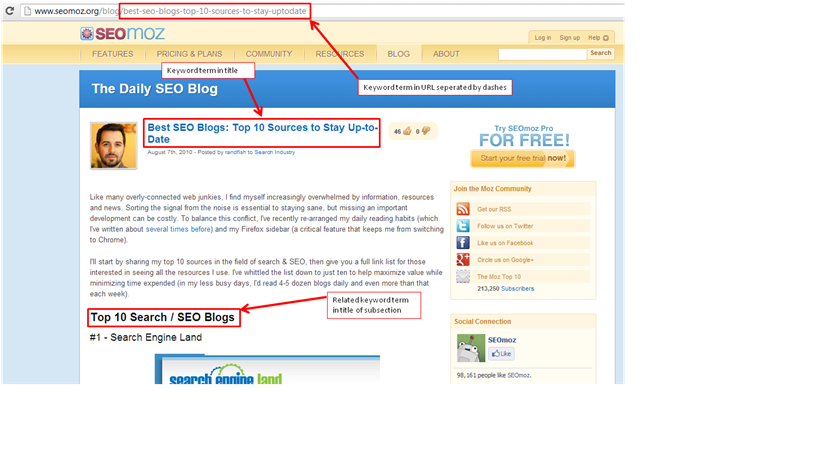
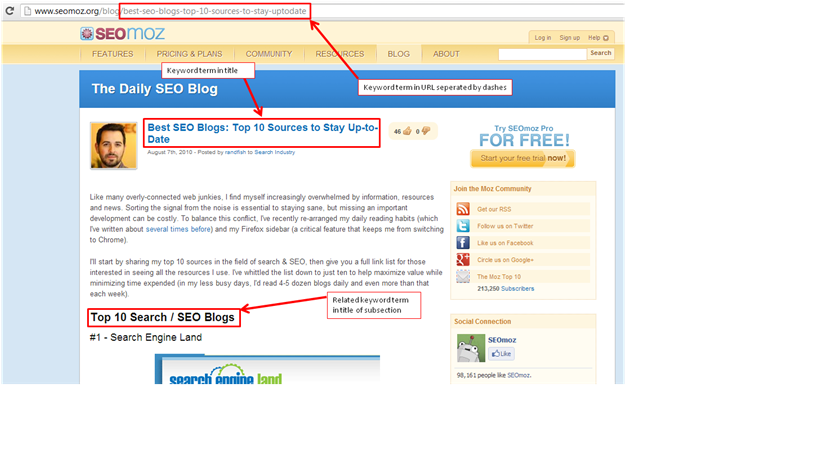
Using a major keyword term in the URL structure and title of a blog is very pleasing to search engines.

The second step to SEO success is linking. Linking means creating hyperlinked keyword terms in the content that the blog is meant to rank for in web searches. These links should be both internal and external. Internal links link back to the article itself as well as other articles in the blog. External links are designed to pull in the SEO power of external sites. To help this blog rank higher for “how to do SEO for a blog” a link (like the one in this sentence) should be placed in the text that links to a known authority on the topic. Ideally that linked keyword term will not only be content found in the article it links to, but also a keyword term people are likely to type into a search engine. It is easy to overdo it, however, so keep internal and external links to a healthy minimum. 1 link for every 100 words of content is a good guide, unless the copy is exceptionally long.


Build keyword terms into the body of online content and link for SEO success

Internal and external linking can greatly improve the visibility of a blog for search engines.

More than links and keyword terms, sharing blog content will ensure its long term success. The algorithms that produce the results seen in search engines care as much, if not more, about how popular a site is (determined by followed links and search results clicked) and the amount of time people spend on the blog. A blog needs readers to perform well – and not just Facebook, Twitter, and other social media friends following it without spending time on the site. Some ways to garner real traffic is by including links to reputable bloggers’ sites, getting the same bloggers to syndicate content on their sites, and leaving the blog open to comments.

Additional Blogging SEO Tips

  • Use a keyword research tool like the one found in Google Adwords.
  • Add keywords to an RSS feed to stay on top of the most current content on the web.
  • Participate in online conversations around the blog topic and link back to the blog in posts.
  • Break the copy up with related images, videos, and other media.
  • Don’t forget to add tags to the media!
  • Follow your competitors and their readers for inspiration – and to help with originality (this blog may never rank well because a very high number of blogs exist already covering this same topic).
  • If you are not using a blogging platform like WordPress which does it automatically for the site, be certain to block duplicate content.
  • Load an analytic tool, such as Google Analytics, on a blog to know what content is getting traffic then build off successes.
  • Title and URL structure should reflect the main keyword term of the blog. This should also be the URL for the blog. For example, a blog with the keyword term “why I am awesome” hosted at www.amazingnikstuff.com would ideally have the URL www.amazingnikstuff.com/why-i-am-awesome/.
  • Use Google authorship to build a strong reputation as a blogger.
  • Make sharing easy by having social buttons built into the blog.
  • Return to this introduction to SEO for blogging regularly and seek out more advanced materials to keep your skills fresh.
Posted in Uncategorized | 4 Comments

Facebook Fatigue

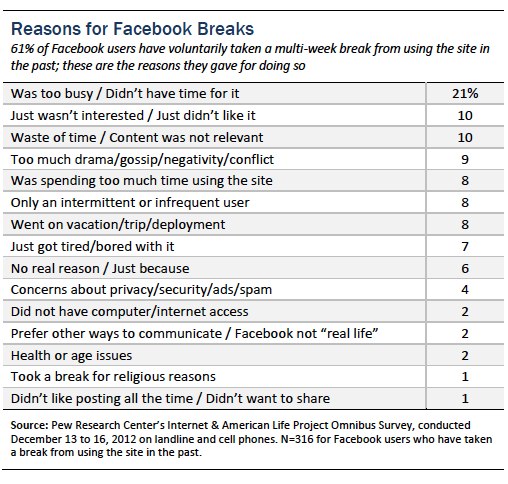
“Facebook fatigue” is a phrase coined to explain a recent wave of boredom that appears to be setting in for many of the site’s members.  If you find yourself needing a Facebook hiatus from time to time because you don’t value your co-worker’s status updates about her cat’s surgery or you are growing weary of seeing photos of the unremarkable food your friends are eating, fear not friend, you are in good company.   A new survey taken by the Pew Research Center’s Internet & American Life Project, revealed that taking a “vacation” from the social network giant is actually commonplace (King, 2012, para. 3). Despite boasts that it has more than one billion active members, the activity of the Facebook membership is questionable.  The survey found that more than 25% of U.S. Facebook users say they plan to reduce the amount of time they spend on the social network in 2013 (King, 2013, para. 4).  Moreover, the study reveals that 61% of those surveyed take extended breaks from Facebook for various reasons, however the top three were being too busy (21%), lost interest 10%), or just thought it was a waste of time (10%) (Van Grove, 2013, para. 3).  A quick glace at the reasons listed may sound like something you have said yourself.

(Credit: Pew Research)

The implications of these Facebook vacations are vast and perhaps foreshadow a shift happening in social media. The Pew study suggests that more and more adults are finding Facebook irrelevant (Van Grove, 2013, para. 10).  Should the trend continue or grow, the worrisome result is the decrease of site traffic which directly impacts revenue gained from site advertising (King, 2013, para. 5).   Unless Mark Zuckerberg’s company figures out a way to keep its users active on the site and  the mobile apps, more of its active users could take longer breaks or leave altogether, a fate seen with formerly hot social networks like Friendster and MySpace (King, 2013, para. 10).

If the cool kids are really over Facebook, where are they going?  

Few social networks have enjoyed the success of Instagram or Pinterest and there is plenty of buzz around a hot social application called Snapchat.    Instagram is an immediate lifeline for Facebook, as it was identified in the their 10-K annual report given to the Exchange commission, as one of the places where today’s youth are spending more of their time (Van Grove, 2013, para. 7).

Pinterest is a popular scrapbooking site that recently reported it has 48 million users.  They are ready to seek an injection of capital, more partnerships and have plans to go international (Tam & Ante, 2013, para. 1).   The company is currently analyzing its advertising system potential in hopes to uncover how the massive Pinterest traffic can convert to sales from which Pinterest may eventually be able to take a cut.  Jeremy Levine, a member of the company’s board said “They’ve gotten past the point of being successful with consumers in a big way [and] at some point, the business has to make money.” (Tam & Ante, 2013, February, para. 3).

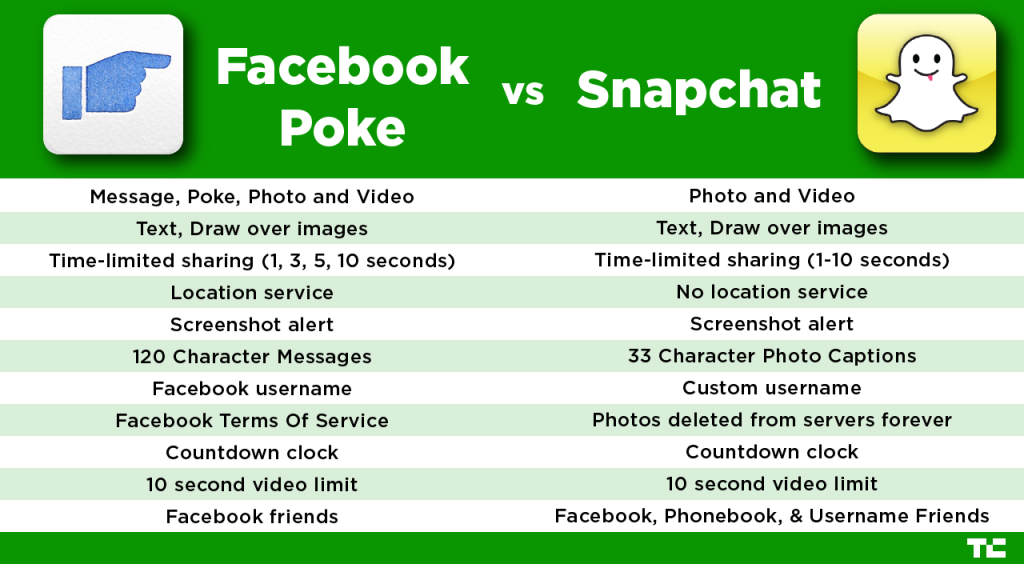
Snapchat is a hot new social application that lets users send photos that self-delete 1 to 10 seconds after being viewed.  In the U.S., Snapchat was the second-most popular free photo and video app for the iPhone in early February, just behind YouTube and ahead of Instagram (Gillette, 2013, para. 4).  App Annie, an analytics company listed Snapchat as the 19th most popular free app overall (Gillette, 2013, para. 5).

Snapchat’s website claims that more than 50 million snaps are sent every day. Many experts report it is part of an apps trend that aims to provide “a fleeting, ephemeral social experience” (Gillette, 2013, para. 8). The idea is in direct contrast to the model of the major social networks (think Facebook), which typically preserve users’ interactions to better leverage them for marketing purposes. “There is a real demand out there. Facebook has really failed on this front because Mark Zuckerberg, in his DNA, thinks that all data has hidden value and preserving this stuff is really, really important,” says Viktor Mayer-Schönberger, a professor at the University of Oxford (Gillette, 2013, para. 5).

The Snapchat phenomena has inspired competitors to build similar products.  In December Facebook unveiled Poke, a Snapchat-like app that allows users to send self-destructing media. However, the competition from the social media giant appears to have made Snapchat stronger.  In January tech industry blog TechCrunch named Snapchat the “Fastest Rising Startup” of 2012 (Gillette, 2013, p. 3).

This post will self destruct in 5… 4 … 3… 2….

References

Gillette, F. (2013, February 7).  Snapshot and the erasable future of social media.  Bloomberg BusinessWeek.  Retrieved from: http://www.businessweek.com/articles/2013-02-07/snapchat-and-the-erasable-future-of-social-media

Kelly, H. (2013, February 6).  Most Americans take breaks from Facebook.  Retrieved from: http://www.cnn.com/2013/02/05/tech/social-media/facebook-breaks-pew/index.html

King, R. (2013, February 5).  Pew: Facebook ‘fatigue’ plagues more than two-thirds users.  Retrieved from http://www.zdnet.com/pew-facebook-fatigue-plagues-more-than-two-thirds-of-u-s-users-7000010855/

Tam, P. & Ante, S. E. (2013, February 5).  As pinterest grows, startup seeks 2.5 billion valuation.  The Wall Street Journal.  Retrieved from:  http://online.wsj.com/article/SB10001424127887324900204578286274194291126.html?mod=dist_smartbrief

Van Grove, J. (2013, February 1).  Facebook teens might be so over us.  Retrieved from: http://news.cnet.com/8301-1023_3-57567252-93/facebook-teens-might-be-so-over-us/

Van Grove, J. (2013, February 5).  Study: Facebook Fatigue- It’s Real.  Retrieved from: http://news.cnet.com/8301-1023_3-57567745-93/study-facebook-fatigue-its-real/

Posted in Uncategorized | Tagged , , , , , | 14 Comments

Super Bowl 2013 Ads Rock Social Media Integration

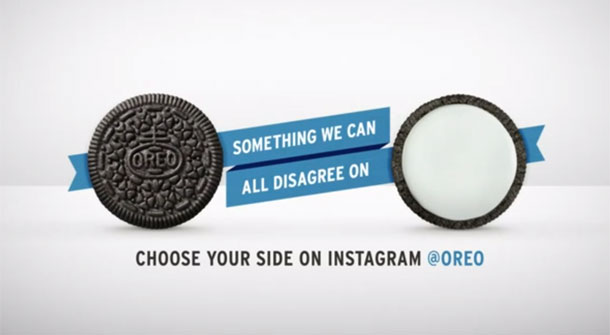
My favorite Super Bowl commercial this year was for Oreo.  They successfully provided a commercial that was entertaining, and called viewers to action.  Plus their campaign is consistent across Facebook and Twitter.  They got people talking about Oreo online, with friends, re-sharing the video, and placing their vote about Oreo on Instagram.

The television commercial spot during this year’s Super Bowl cost Oreo $4 million according to Mashable.  But Super Bowl spots should be valued even higher with the successful integration across media achieved by some brands.

For example, during this year’s game, 24.1 million Twitter Tweets were sent about the game, which is an increase of 13.7 million over last year (MediaPost).

An ad such as that by Oreo, connects with viewers, engaging them with the brand and a sense of nostalgia and loyalty for why you love the product.  In this case, the commercial directly addressed viewers, requesting they share their favorite part of the Oreo on Instagram.  They connected their campaign directly to other media.  Social Media provides the opportunity to blend content across media, taking advantage of user generated content, and for some brands like Oreo, a strong preexisting fan following.

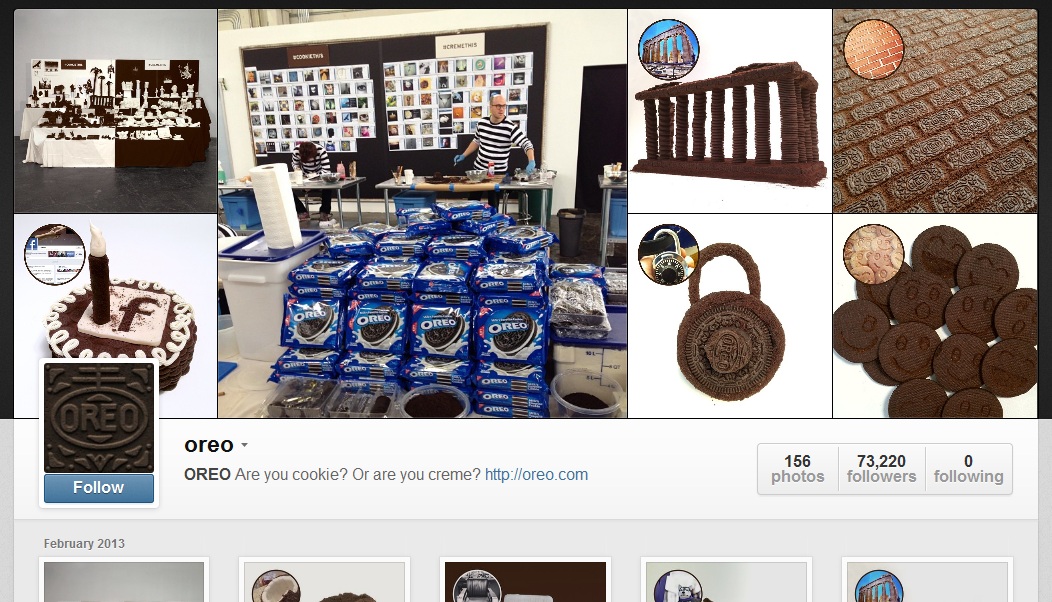
Screenshot of Oreo’s Instagram page instagram.com/oreo

Searching “#oreo” on Instagram turns up thousands of results, with new posts generated every hour.  Oreo did something new with their advertisement, and they managed to extend their investment beyond those 30 seconds – which is priceless.

Oreo’s Instagram account followers list has increased by tens of thousands since the advertisement ran.  Reps told Mashable they had around 2,000 followers before the Super Bowl, and as can be seen in the image above, they now have over 70,000.  Integration across platforms is extremely valuable to brands, because they can have direct contact with customers, 24/7.  Social Media connections enable organizations to send messages directly into the palms of customer hands on any computer or smartphone device.

Oreo also took advantage of the power outage during the Super Bowl with a timely tweet “Power out? No problem. pic.twitter.com/dnQ7pOgC” (see image).

So, what do you think?  Is Oreo’s integrated marketing campaign on the right track for integration across media?

And which do you prefer, Cookie or Cream? #Oreo


Posted in Uncategorized | Tagged , , , , | 6 Comments

A Superbowl Baby Called Hope

By Melanie Lawson

I, along with millions of other Americans, watched the Superbowl last Sunday hoping the 49ers would win while also looking to see some great commercials.

As I was chatting with friends and refueling on snacks before the game resumed, or wait, did this air during the 30 minute power outage? Either way, I turned and looked at the television when I caught a glimpse of a Clydesdale filly lying in a stable.   The commercial continued with the filly progressing through early life and forging a strong bond with its owner only to be sold and become a Budweiser Clydesdale. Three years later, the owner travels to see the Budweiser Clydesdales in parade and be reunited with his long lost friend.  The commercial concludes with the man hugging his horse and then cuts to a screen saying that I could have a say in naming the filly using twitter; how awesome is that!

My name is Melanie Lawson and I am a sucker for Budweiser’s Integrated Marketing Communication (IMC) strategy.  The Budweiser Clydesdales are infamous and have appeared in Budweiser’s advertising campaigns for years.  Although Budweiser has deviated from the Clydesdales a few times in advertising (remember the Budweiser frogs?) the Clydesdales have been a consistent part of Budweiser’s brand. Budweiser’s image has been consistent and their recent Superbowl ad reinforced the brand, hooked the audience, and then went a step further by asking the audience to participate by naming the filly.

Nearly everyone has had a special bond with an animal at some point in their life and therefore can easily identify with the Clydesdale commercial.  And who doesn’t love baby animals? Showing the filly first thing in the commercial automatically draws everyone in.   If for some reason you didn’t immediately recognize the filly as part of Budweiser or identify with the bond between man and animal, then Budweiser attempted to engage you by asking you to help name the filly.  Of course they’re assuming you’re active on Twitter and know what a hash tag is.

Although I didn’t immediately go to Twitter and submit a name or order a Budweiser as my next beverage, the commercial accomplished one of its goals by immediately capturing my attention.  The Budweiser logo didn’t appear in the commercial until multiple seconds in, but I immediately knew the ad was for Budweiser because I had seen previous television ads, billboards and web ads with Clydesdales which is the goal of Budweiser’s IMC approach.

So next time you find yourself hooked to an ad on television, catch yourself and ask if you too just became a victim of an organization’s IMC strategy. Before you saw the logo, did you know what product or brand was being advertised?  How many times have you seen this ad before? Have you seen it in print as well as on television?  Or perhaps you became hooked because of an emotional connection to the characters in the commercial or the company was suddenly asking for your opinion through a social medial channel.  All methods are part of the sly IMC approach.  Oh…and yes, the winning name for the filly is Hope.

Posted in Uncategorized | 4 Comments