Do you love your car, your iPhone, your PC?

Are you part of a brand community? If you are a devout Apple product user and you see someone else using an iPhone or working off their iPad, do you identify with that person and think that you have something in common with them? You may even take it one step further and actively seek out others who covet similar brands, engage in discussion boards, blogs even face to face meetings where you form personal connections with others based on the simple fact that you both own or like the same brand. Strong bonds and actual communal sub-groups can form from brand admirers (Muniz & O’Guinn, 2001).
Since brand communities are not geographically bound and are founded in social relationships that are formed from the affinity for a certain brand (Muniz & O’Guinn, 2001), it’s only natural that these communities should evolve into the social media space (Hollingshead, et al., 2012). Although social media platforms would seem to be a natural place for brand communities to form, Hollingshead, et al. (2008) report neither brand users nor companies have fully utilized social media sites to promote and grow brand communities.
So, I ask you to think about a brand that you like, I mean really, really like. It can be a car, clothing, food or even and organization, like Livestrong. What lengths would you go to show your love for this brand and would you seek out others who also had an affinity for this brand? If, indeed, you do have a brand that influences you, do you wear their message on your body in the form of a t-shirt, hat, wristband? Do you have a sticker on your car that claims your support of a non-profit or a political party? Now, let’s take it one step further. If you do have these things and are proud of the fact that you own or support something, would you or do you engage with others who also support this? If so, you are part of a brand community.

Brand communities act pretty much like other communities, without the taxes. Members of brand communities discuss what the like about products, suggest ways to make products better and some even go so far as to protect and help each other in times of need. Muniz & O’Guinn (2008) tell an interesting story about a member of a Saab brand community. An individual saw a car broken down on a dark highway. He noticed, as he passed, that the car was a Saab and stopped to help the motorist. He reported that if the car had been any other brand, he would’ve kept on driving. That, my friends, is a prime example of a dedicated brand community member. This person put themselves in danger simply because the disabled car was a Saab. Does the helper think Saab drivers can’t be serial killers? Let’s not forget that Saab driver or not, someone needed help, and if it were not for the Saab logo glinting off the brand community member’s headlights, the person in need would have had to wait for someone else to come along – maybe a Ford, Toyota, Nissan or BMW brand community member.

So, if you love a brand or support a cause, I encourage you to seek out others who love it just as much. Start a Facebook page or Twitter account and engage like-mined folk. You might make some friends. You might even be saved from spending a cold, lonely night on a deserted highway.

Muniz, A. M. & O’Guinn, T. C. (2001). Brand community. Journal of Consumer

Research, (27), 412-432.

Hollingshead, A. B., Sanders, W. S., Kim, Y. J., Meng, J., & Pade, C. S. (2012).

Interactivity and social media integration in online brand communities: An

analysis of the top 100 global brands. University of Southern California

Posted in Uncategorized | 1 Comment

Driving the Swedish Twitter Bus without a License

Hello Sven, here are the keys to the bus. Now remember, you’ve got nine million people to drive around and we’d really, really appreciate it if you didn’t crash into anything.

Flag courtesy of goscandinavia.about.com

Earlier this year, Sweden (yes, the country) turned over their official Twitter account to ordinary citizens. The program, which is officially known as Curators of Sweden was the brainchild of the government’s Swedish Institute, the official tourism entity, VisitSweden and a Swedish communications firm, Volontaire. To qualify as a curator, Swedes have to be nominated by someone other than themselves, they must know what Twitter is and how to Tweet, and they have to Tweet in English (hmmm, target audience anyone?).

Their goal is to promote the diversity and unique characteristics of their country through the eyes and the mobile devices of its citizens. In a true democratic fashion, each week, a different Swede is selected to represent the country in the Twittersphere with no limits or rules. The only words of warning come from Tommy Sollén, VisitSweden’s social media manager, who imparts these words of wisdom when handing over the keys:

“Please, do this with some dignity — remember that this is an official channel and there are a lot of people reading this, so don’t make a fool of yourself.”

It is a pretty bold move for a country to trust its citizens with unrestrained 140 character stream-of-consciousness Tweets. It must have gone pretty smoothly because it wasn’t until June that the world took notice. One of the Curators Tweeted a few, not exactly offensive, but basically quizzically ignorant comments about Jews (IMHO as a member of the Judean tribe). Her comments weren’t so much anti-Semitic, as from someone who has lived in isolation her entire life. The 27-year-old curator, Sonja Abrahamsson, is from a tiny town in northern Sweden where as she puts it “Where I come from there is (sic) no Jews, everyone is related and owns a tractor.” OK, moving on…

Erik Iseberg, 18, was one of the first curators. Casper Hedberg for The New York Times

But it was this and a few other curator missteps (or mistweets) that caught the media’s attention and one fake pundit in particular, Stephen Colbert.

When the story of Sonja Abrahamsson broke in the middle of June, Stephen Colbert was quick to swoop in. It wasn’t so much what she tweeted, but that, in his characteristically bombastic way, he wanted a turn at the Sweden Twitter account. Since then Colbert has launched a Twitter campaign to become a Swedish curator with the hash tag #artificialswedener and with all the publicity that’s been sparked @Sweden’s followers have grown from 28,000 to nearly 70,000 as of this writing. As is the nature of Twitter, ideas spread fast. The Netherlands, the City of Leeds (UK) and a host of other whereabouts have established their own rotating curating projects.

So is Twitter the future marketing tool for travel and foreign diplomacy? Or will that bus likely be driven off a cliff? I supposed that depends on the attention span of @Sweden’s followers.


Abad-Santos, A. (13 June, 2012). Don’t be surprised if Stephen Colbert takes over Sweden’s Twitter Account. www.theatlanticwire.com/entertainment/2012/06/dont-be-surprised-if-stephen-colbert-takes-over-swedens-twitter-account/53476/
Lyall, S. (10 June, 2012). Swedes’ Twitter voice: Anyone, saying (blush) almost anything. New York Times. Retrieved from http://www.nytimes.com/2012/06/11/world/europe/many-voices-of-sweden-via-twitter.html?_r=2
Maltais, M. (12 June, 2012. Guest tweeters on Sweden’s Twitter account stire up controversy. LA Times. Retrived from http://www.latimes.com/business/technology/la-fi-tn-sonja-tweets-on-jews-sweden-20120612,0,5893563.story
Novacic, I. (12 June, 2012). Sweden project lets citizens tweet for nation. ABCnews.com. Retrieved from http://abcnews.go.com/blogs/headlines/2012/06/sweden-project-lets-citizens-tweet-for-nation/
Posted in Uncategorized | 2 Comments

How Much Of An Influence Do You Have Online?

Klout is an online company that seeks to measure a person’s influence online.  It does this using a 1 – 100 point scale.  Those who are more influential receive higher scores (Klout Website).   However, is it possible to really measure a person’s influence online?

The Mechanics of Klout

A person can find out what their Klout score is by registering for free at www.Klout.com.  Klout will then ask you to link your Facebook, Twitter, Google +, Youtube, Instagram, and an assortment of other social media sites to your Klout User Profile (Klout Website).  The thought is that the more active you are on social media sites the more influential you are online.

Klout Topics

In addition to receiving an overall Klout score, a person can add Klout topics of influence.  Topics may include interests such as marketing, fitness, or even style.  Anyone on the internet can help a person acquire a higher ranking on each of these individual topics by giving them a +K (Klout Website).  It acts similar to a Like on Facebook.  The more +K’s a person receives, it is believed that the more influential they are on that particular topic.

Quantity over Quality

In essence, Klout is rewarding people who post a lot or receive mentions on sites like Facebook and Twitter.  But does this really measure influence since Klout does not distinguish from the quality of the information disseminated by these individuals.  After all, it is the frequency of postings and mentions that is at the heart of a person’s Klout score.

Klout obviously uses an algorithm to calculate a score.  But, it is not clearly known what factors influence the score, and by how much.  This is likely proprietary information and not something Klout is willing to share with the public.  Such a practice is common and understandable given that Klout does not want to allow for similar companies to copy what they are doing.  But, it does beg the ultimate question, can a company even quantify a person’s influence online by giving them a numerical score?

Reference

Klout Website. (2012).  Retrieved from www.Klout.com.

Joshua Sutterfield

Posted in Uncategorized | Tagged , , , | Comments Off on How Much Of An Influence Do You Have Online?

For Sports Fans, Twitter is Changing the Game

For Sports Fans, Twitter is Changing the Game

How has social media, and specifically, Twitter, affected the way we experience sports today?

Sports on Twitter


As an avid sports fan, I can attest to the reliance on my mobile phone to gain immediate access to the information that I’m looking for on any given Sunday (or any day of the week, for that matter). Twitter provides anytime, anywhere access to sports information without ever stepping foot in a sports bar. A quick glance at my Twitter timeline reveals:

SCHEDULES AND SCORES

FANTASY PLAYERS / PLAYER STATS

NEWS / INFO / TRADES / DRAFT PICKS / NFL COMBINE UPDATES

PLAY-BY-PLAY DETAILS posted by sports league or team websites (NBA.com, NFL.com, Lakers.com), reporters (ESPN.com), etc.

To further exemplify the impact of social media on the sports world, and the importance to the lives of sports fans everywhere, this year marked NBA TV’s 1st ever Social Media Awards, hosted by Shaquille O’Neal and Rick Fox on June 21, 2012.

NBA Social Media Awards

Awards Categories included the #Trendsetter Award, the Most Tweeted Sports Moment, the LOL Award and the Big Award for best use of social media.
The Big Award-Best Use of Social Media

There are also advantages to sports organizations that use Twitter. It’s the ultimate tool for instantaneously disseminating communications to the masses; whether good news or bad (I recall hearing of famed Penn State Coach, Joe Paterno’s firing on my Twitter timeline before any other media outlet). Engaging fans and followers allows them to feel closer to their favorite teams or athletes, and sports organizations can receive instant, honest feedback from fans without the cost or time involved in running focus groups. Twitter gives sports organizations access to a captive audience who is, ultimately, their target audience; we choose who we follow, after all.

Posted in Uncategorized | Tagged , , | 4 Comments

IBM Augments Consumer Reality

For years, marketers have tried marrying the shopping experience with technology using tools such as QR codes and barcodes. However, this trend has yet to gain traction. But IBM wants to make this fusion of technology and consumer experience a reality, or an augmented reality to be exact.

Augmented reality is the latest in high-tech marketing tactics that aims to enhance consumers’ physical world with computer-generated sensory inputs, such as sound, photos, videos or GPS (Mashable, 2012). IBM is taking this innovation to a new level by allowing shoppers in a grocery store dictate their menu before even stepping foot in an aisle.

The application by IBM, being tested by unnamed retailers in the United States, allows consumers to download the software and input dietary preferences. For example, if a shopper lactose intolerant, they may enter that into the app, thereby narrowing their food choices. Once in the store, the consumer hold up their mobile device, pointing the camera at the shelves, and the device will point out what products fit the shopper’s specific needs.

The software recognizes consumers by their phone number of loyalty program numbers, thereby allowing them to store information for future shopping experiences. The application recognizes products on the shelves by color, shape and other features to determine what products fit the shopper’s needs.

Not just a dietary tool, the device may also be used to address personal pricing, environmental and religious preferences as well. IBM believes the augmented reality application will catch on with consumers faster than QR code or barcode scanners because of the how easy it is to use the application.

What’s more, this new marketing tactic is relatively inexpensive for retailers as consumers supply the technology to support the software.

Whether or not augmented reality will take hold like social media or interactive television is still to be determined. But one thing is certain: what was once an idea only found in moviebuytheway.annenbergcourse.orgrt,” augmented reality is redefining consumer engagement.

References:

Neff, J. (2012). IBM tests ‘augmented reality’ app. AdAge online. Retrieved from http://adage.com/article/digital/ibm-tests-augmented-reality-shopper-app/235724/.

(2012). Augmented reality. Mashable online. Retrieved from http://mashable.com/follow/topics/augmented-reality/.

Posted in Uncategorized | 4 Comments

Who Reads Texts? Do you QR?

Mobile, video, social media, social networking and QR code mar­keting isn’t an option any more. Without it, your business may fail” (Koenigs, 2012)

Buy The Way

Recently I had the opportunity to attend a webinar hosted by Bob Serling, marketing coach and founder of Profit Alchemy.  At this meeting he presented Mike Koenigs, author of Instant Customer Revolution, which contains real life stories on the subject of capturing, converting and closing sales with his new tool for integrated marketing, using smart online and mobile marketing (Koenigs, 2012).

I’d like to share some of the facts from Koenigs’ book, which were also discussed during the webinar.  I think these are significant points to ponder for all businesses and marketers alike (Koenigs, 2012).

  • 96 % of ALL TEXT MESSAGES are opened.
  • 88% of ALL VOICEMAIL MESSAGES are listened to.
  • 69% of consumers will use a business if it is on a SOCIAL NETWORKING site.
  • 1 in 8 people on the planet are on FACEBOOK.
  • A client is 22 times more responsive if you follow up within FIVE MINUTES.
  • Over 6 billion MOBILE PHONES will be in use by the end of 2012 and 15 Billion by 2015.
  • 78% of customers use 2 or more CHANNELS before purchasing.
  • 30% are using 3 or more channels (mobile phone, tablet, Internet, voicemail, social media…)
  • Most small businesses only use EMAIL to market themselves.

A little over a year ago I received an email from Serling that said, “When it comes to marketing your business online, NOTHING compares to the power of email” (Serling, 2011).  He explained that email is used to generate invitations for LinkedIn, Facebook, Twitter and just about any other social media, but he also suggested that businesses mix their media when appropriate (Serling, 2011).

The time for mixing media has come, and the need for diversity is enormous.  Many small business owners want and urgently need help (Koenigs, 2012).  They know that traditional marketing alone won’t work anymore, so Koenigs has created a tool that either they can use, or we, as marketing consultants can use to help these businesses jump headfirst into the electronic marketing age.

The system he developed can generate emails with instant responses, send out Quick Response (QR) codes, texts and instant access to video links.  All of these services are available individually through other companies, but it is expensive and frustrating for business owners to try to coordinate all of them to work together.  If you are interested in learning more about his system of combined services and how it works, Koenigs’ free book can be downloaded for a limited time at: http://instantcustomerrevolution.com/. (Otherwise you can purchase it later.)

One of the things that intrigued me, because I am not as quick as others with technology, was that with Koenig’s system you can fairly accurately pinpoint the demographic who is responding by the way that they are responding to your communications (Koenigs, 2012).

  • People in their 20s scan QR codes.
  • People in their 30s-40s text their responses.
  • People in their 40s-50s reply on web pages.
  • People 55-70 phone in with their information.

I hope this information is useful for future marketing.  For fun, I visited a free site and created a QR code for the Buy The Way Blog site (the image at the beginning of this blog).  Today I discovered that someone else had done the same thing about a year ago. Oh well, great minds think alike!  Anyway, if you have a QR reader on your smart phone, give it a try.  If you don’t have one yet, it’s time. You will see QR codes and contests with QR codes everywhere, maybe even on your soda cup!  Free QR reader apps can be downloaded onto your phone. Download one and have some fun!

You can create your own FREE QR codes at this site: http://quikqr.com/

If you are interested in learning more about QR codes and how to grow your business with them here is an excellent article: http://www.socialmediaexaminer.com/how-qr-codes-can-grow-your-business/

Resources:

Koenigs, M. (2012, July 1). Instant Customer Revolution. Retrieved from http://instantcustomerrevolution.com/

Serling, B. (2011, April 24). Brain Fuel Bulletin #15.

Posted in Uncategorized | Tagged , , , , , | 8 Comments

Veterinarians Are Marketers Too

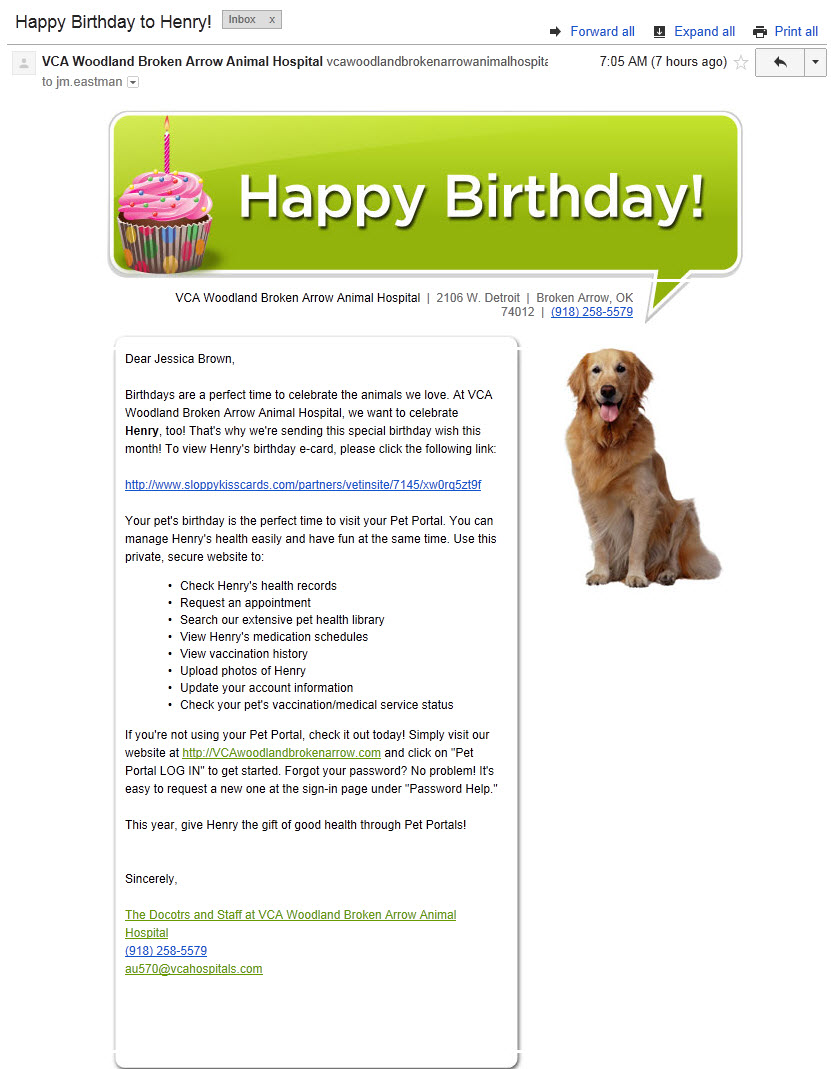
Have you ever forgotten your dog’s birthday? Of course you have (well maybe you haven’t). But most people don’t remember their dog’s birthday. Today, I was one of those forgetful people until I opened my email. My marketing savvy vet sent a happy birthday eCard to my French Bulldog, Henry.

At first, I smiled and thought “amazing marketing, Woodland Vet Clinic.” And then, remorse set in. I forgot my dog’s birthday. And my vet had to remind me.

As Young (2010) suggests, marketers must use the consumer pathway in order to drive consumers to purchase. And just six months after Henry’s last visit, the vet continued the consumer communication with an email during the “relationship building” phase (Young, 2010, p. 55).

This happy birthday email acted as a “relationship building” tool because it “made me feel special” (Young, 2010, p. 55). But not only did the email build my trust in the vet, it was a platform for alerting me to additional services. I realized, on top of forgetting his birthday,  that he needs a check-up in a couple of months. If I needed to be proactive, I had the information to call the vet right then.

However, I did the second best thing. I advocated my vet’s services and kind gesture in a forward of the email to my family. Young (2010) suggests this is the last step in the consumer pathway. Through my intrapersonal and interpersonal reaction, my vet mastered its marketing efforts.

Overall, this experience teaches three lessons:

  1. The consumer pathway works when done right.
  2. Small, personal gestures make a big impact with advocacy ripple effects.
  3. I need to get my dog a treat for his birthday!

References

Young, A. (2010). Brand media strategy: Integrated communications planning in the digital era. New York: Palgrave Macmillan. Chapters 4 & 6.

Posted in Uncategorized | 8 Comments

Saying Just Enough to Work: Film, Folk Art, and Facebook

No one has (as of yet) formally authored a “Basic guide to social network communication”, but there are volumes there that are waiting to be written. Unfortunately, those who need to read that typ of enlightening document the most won’t bother unless it is sent to them in 144 characters or less. Narrative, and by that I mean strong story arc narrative, may still exists in cyberspace, but it is generally so chopped up and fragmented that it becomes little more than impressionistic glimpses into the mundane lives of our “friends”. What is ironic about this shift in communication is that it may have more to do with a type of poor editing that is occurring in a social networking environment and not entirely to do with poor content. I would like to look at 3 narrative examples for discussion.
The Silent Film

When your palette is limited, your narrative has to be stronger. Conversely, if you have a robust arsenal of “flash” you can get by (for a little while) with poor narrative. Consider the story telling and interest generated by both early silent films and contemporary quality cinematic movies. What every one of them needs absolutely is a good narrative in order to have any hope at being successful in the long run. Certainly, there is the influx of interest when there is a new technology employed. Just as there were throngs of people standing in line to see the spectacle of early filmmaking, and record breaking crowds standing to see the midnight showing of films like Avatar, it all fades very quickly if there is not the internal narrative to back up the smoke and mirrors. We are drawn to narratives because they intrinsically lead us somewhere and we gain as travelers on that road. Unfortunately, we can be easily tricked into thinking that we were on a journey of story, when all that we actually were involved in was a short lived technological flash in the pan. And that can be the case whether you film is a century old artifact, or the latest 3D extravaganza.
So, if good narrative is that important, what makes a good narrative?
Folk Art

Folk art is at its core an exercise in narrative. I will refrain from leaning too heavily into a discussion on high art vs. craft, but in this case, folk art illustrates the idea of narrative well. The specific genre remains potent in American culture because of the way that it can infuse the nature of the creators and their story with that of the viewer. It tells us something about the people who made it in a personal way that other art forms do not. That information we interpret as narrative and we are invited to add ourselves into the stream of that narrative. Folk art offers very specific looks into the culture that we may or may not understand fully, but we can appreciate because they are honest reflections of the specifics of the story teller. This helps makes for a strong narrative.
So, if narrative is important, and good narrative is about glimpses into the specifics of a story, then how are Facebook narratives failing?
Not all Facebook narratives are failing. But many more than should be, are. We can all think of one, two, or many of our friends who use their status updates more like journal entries than communication. You probably know that ones that I mean, but they generally leave you with the feeling like they were not really spoken to you (and let’s be honest, you probably didn’t even come to mind when the author hit POST). This type of flawed communication may not be the fault of the content, but rather a fault in editing on the part of the author. If social network posters can get past the flashy medium and ask themselves “What is the story that I am trying to tell” and then ask the second, but equally important question “is it specific or meaningful enough for anyone to connect with?”, then they may be well on their way to posting something that graduates from the realms of diary entry and gets closer to a content driven narrative.
The Haunted Castle

Posted in Uncategorized | 1 Comment

Samsung’s Olympic Sponsorship Translates to Employees

I’m going to tout my own company’s efforts today. I’ve been more in tune to the Olympics this year than I have been in year’s past. Maybe it’s because I was planning on going until a little thing called “pregnancy” put a damper on those plans. Maybe it’s because my company, Samsung, is a worldwide Olympic sponsor and the Games have been on everybody’s minds lately. Maybe it’s a combination of both, but either way, I think Samsung has done a good job of bridging the gap between what’s going on in the external world and ways employees can get involved too.

First, Samsung Headquarters in Korea has been running regular stories on our global intranet all about the Olympics. Today (June 29), two stories are featured on the main page. Headquarters also ran a contest to send people to the Olympics. North American Headquarters has encouraged all employees in North America to amend their email signatures to include the worldwide Olympic partner logo. Posters have also been updated in my building to reflect all previous Olympic sponsorships, and conference rooms at North American Headquarters are the names of previous Olympic host cities.

At my location in Dallas, we hosted a “Road to the Olympics” show where employees could participate in some Olympic-type sports and measure how they would do against an actual Olympian. For example, a bike station was set up, and employees would virtually race an Olympic athlete on a virtual Olympic course. We also got to practice wheelchair basketball, field hockey, rowing and several other sports.

We are also in the midst of planning Olympic watch parties in our café; at any time during the Olympics, employees will be able to go to our café to watch the events and enjoy drinks for free.

Externally, we are promoting the Olympics on the Samsung.com Web site and through the new Galaxy S III marketing campaign. The GSIII is the official mobile phone of the Olympic Games, and the marketing campaign highlights that.

All in all, the employees at my company are feeling the Olympic spirit, thanks to the integration of PR, marketing and internal comms. We are creating brand synergy and making the employees feel like they are part of something bigger than just Samsung Mobile, and that’s one of the most important things we can do.

Posted in Uncategorized | 2 Comments

The Rabbit and the Hare

University of Virginia

The University of Virginia is one of America's elite public universities.

Stunning the campus, the state and higher education, the University of Virginia’s governing board forced the resignation of its first female president. Citing “philosophical differences of opinion” President Teresa Sullivan will step down August 15 after two years and two weeks on the job. University Rector Helen Dragas described the resignation as a mutual agreement reached on June 9. Dragas indicated the board desired “bold and proactive leadership” to help it tackle financial pressures, resource allocation decisions and online delivery challenges (Kapsidelis, 2012). However, according to those familiar with university politics, there was no prior indication of dissatisfaction with Sullivan’s performance – an indication of the Board’s lack of transparency and communication in their management of the University. George Cohen, law professor and chair of the faculty senate, said “It’s a complete surprise” (Kapsidelis, 2012). Immediate past chair of the faculty senate Robert Kemp, professor in the McIntire School of Commerce, agreed, saying “I had no insight into what caused this” (Kapsidelis, 2012).

Helen Dragas University of Virginia

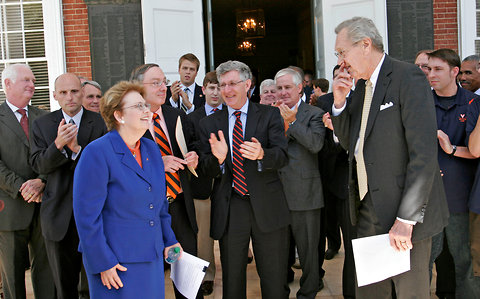
University of Virginia Rector Helen E Dragas (pictured) was central to the ousting of Teresa Sullivan. Photo courtesy Sabrina Schaeffer/AP

As it turned out, members of the Board of Visitors had been disconcerted by the way in which prominent universities such as MIT, Stanford and Harvard have embraced online education and worried the University of Virginia was being left behind (Pena-Perez, 2012). Sullivan was aware of the concerns but preferred to address them gradually in a collaborative environment rather than the “aggressive top-down approach” favored by Dragas and others on the board (Pena-Perez, 2012). The ouster of Sullivan was orchestrated for months behind-the-scenes, out of the public eye. Sullivan’s absence of purposeful, swift steps was not raised at any of the board meetings – members were contacted individually to make the case for removal.  When the news broke, the reasons offered seemed vague and unsatisfactory. As the public furor rose, Dragas conceded the matter was handled poorly, in particular by not debating the president’s standing in a public board meeting and not adequately explaining the need for change (Pena-Perez, 2012). Even Virginia’s governor weighed in on the lack of transparency and discussion regarding the actions of the board. Governor Bob McDonnell (R) had warned board members if they didn’t resolved the matter by June 26, he would ask for their resignations (Sizemore, 2012).

Teresa Sullivan, reinstated as president of University of Virginia. Photo courtesy Jay Paul for The New York Times

Sixteen days after forcing her resignation without a public hearing or vote, the board reinstated Sullivan during a special meeting of the board of visitors (Sizemore, 2012). Four days later, Governor McDonnell reappointed six Board of Visitor positions and announced two new senior board advisers, newly-created positions established by the governor (Caldwell, 2012). While the board may have resolved the immediate communication crisis, it remains to be seen what the long-term impact of their mismanagement will be.

Sources

  • Kapsidelis, K. (2012, June 11). U. Va president to resign in ‘philosophical difference’ with board. Richmond Times-Dispatch. Retrieved from http://www2.timesdispatch.com/news/2012/jun/11/tdmain01-uvas-president-to-resign-ar-1979397/
  • Perez-Pena, R. (2012, June 26). Ousted Head of University Is Reinstated in Virginia. The New York Times. Retrieved from http://www.nytimes.com/2012/06/27/education/university-of-virginia-reinstates-ousted-president.html
  • Sizemore, B. (2012, June 27). UVa Board of Visitors reinstates university President Teresa Sullivan. Roanoke Times. Retrieved from http://www.roanoke.com/news/roanoke/wb/310708
  • Caldwell, J. (2012, June 29). Governor McDonnell Announces UVa Board of Visitors Appointments. Governor Bob McDonnell. Retrieved from http://www.governor.virginia.gov/news/viewRelease.cfm?id=1314
Posted in Uncategorized | Tagged , , , , | Comments Off on The Rabbit and the Hare