A little bit on partnerships and cars…

This gallery contains 1 photo.

In present globalized world the notion of partnership and its advantages seem no more surprising. In fact, partnership on all levels, including public and private has always been part of our history. Governments establish partnerships and change their respective legislations … Continue reading

XXX
More Galleries | Comments Off on A little bit on partnerships and cars…

The NBA’s all-inclusive new ad campaign

Fancy yourself a basketball fan? Well, the NBA certainly does as the multibillion dollar company recently signed a lucrative media deal that increases its budget for marketing to target casual fans.

The new campaign, which made its debut on October 12, was inked by Pam El, the NBA’s newly-instated chief marketing officer and centers itself around themes of involving everyone. Called “Everybody Up,” the campaign aims to bring together anyone even remotely interested in the sport, and to help do that, the company has reached out to new networks to air their commercials. Previously, the NBA held its early-season commercials to TNT and ESPN only, the two companies most of their games appear on during the season, but now, commercials will also air on BET, CNN, VH1, TBS, and other unnamed ones.

The commercial that went live October 12 was called “Roll Call,” and it persuades any fan of the sport to get ready for the upcoming season — no matter their location, appearance, age, etc. The commercial depicts many different type of people and places — from Mexico City to London, from cheerleaders to players, coaches, and fans alike — coming together to enjoy the sport.

This commercial sends a clear message, one that the NBA has made in the past: it is a family-friendly company welcoming of everyone, no matter what uncontrollable characteristics are part of them. For example, years ago, the NBA launched a similar ad campaign reprimanding those who use slurs when referring to gay people after some of its players were caught using them. Unlike the NFL, which is known for having many anti-gay players who have no qualms about using slurs in locker rooms, the NBA shows more tolerance.

https://www.youtube.com/watch?v=8z7EOG8z_e0

This raises questions as to why the sports world is against homosexuality, but the NBA’s last and recent campaign has shown the company is open-minded compared to its football counterpart. My questions are: should other giant sports companies launch similar campaigns even if it would displease some of its players and fans? Do you think these types of campaigns are useful when it comes to showing open-mindedness, or are they tacky and forced? Why or why not?

Sources:

http://adage.com/article/cmo-strategy/nba-s-marketing-aggressive-cmo/295354/
http://www.sportsbusinessdaily.com/Daily/Morning-Buzz/2014/10/10/nba-ads.aspx

Posted in Uncategorized | 5 Comments

Beware: Red Bull does NOT give you wings!

Red Bull would send you either a $10 check or $15 worth of its products if you purchased one can of Red Bull energy drink in the past twelve years. No proof of purchase necessary. A few plaintiffs in New York and California realized that Red Bull had neither gave wings nor helped boost their performance and reaction speed. Red Bull settled the class action law suit for $13 million to avoid the “cost and distraction of litigation”.

Disclosure: I am not a fan or consumer of energy drinks or shots.

Benjamin Careathers of New York, representing the class action, claimed he had been drinking Red Bull since 2002. The suit also alleges that Red Bull falsely advertises its superiority with two-decade long slogan “Red Bull gives you wings” and claims about increased performance and concentration. And this is consistently repeated in all media executions and channels.

Is Red Bull being unfairly targeted? Red Bull has been a dominant vanguard of the Energy Drink industry that grew to nearly $7 billion in 2013 according to Forges. 5-hour Energy makers have also been sued by Oregon, Vermont and Washington for “deceptive and misleading” advertising such as “Hours of energy. No crash later.” More states are expected to follow suit, citing health concerns unsubstantiated by FDA.

Does Red Bull law suit set a dangerous precedent? I can think of a few brands that have thrived on similar exaggerated claims. Unilever’s Axe Body Spray has done remarkably with its playful Axe Effects campaigns. Angels (models) fall from the sky for an average-looking Axe body spray user in one of its TV ads.

https://www.youtube.com/watch?v=9EKLR894oMs

Nike’s shoe brands endorse world’s best athletes so as to be associated with and suggestive of extraordinary performance. How about a non-aspirational brand like Dell with its slogan “The Power to Do More”?  More important, how does an advertiser use puffery without being accused of falsehood?


http://www.forbes.com/sites/greatspeculations/2014/05/08/energy-drinks-could-be-the-growth-driver-for-coca-cola-in-the-domestic-market/

http://www.businessinsider.com/red-bull-settles-false-advertising-lawsuit-for-13-million-2014-10

http://www.today.com/health/5-hour-energy-drink-makers-sued-false-claims-1D79944518


Posted in Uncategorized | 5 Comments

Forget your story, tell me mine


Dove - Dad

Ads for Dads
On the YouTube Ads Leaderboard for June 2014 both Dove and Johnson & Johnson had advertisements that made the list. The ads talked about the importance of dads and used story to connect emotionally with their audience. However, one was a clear winner for me. I cried when I saw the Dove commercial because it connected with me deeply through a well executed story (and other factors like work stress, school stress and lack of sleep).

Studying film making as part of my undergraduate degree and spending a good portion of my professional life working on short documentaries has made the art of story telling very important to me. It is through story that we connect with each other and make sense of the world. The advertising world has utilized the power of story to connect with their audiences. Yet the stories that are told do not always connect as deeply as intended. So what is the key to telling a story that connects deeply with the audience?

The Loser

Distinctly Dad. A film by Johnson & Johnson.

Johnson & Johnson told their three dads stories interspersed with a psychological expert reinforcing the importance dads play in their families. Each story represented a different segment of society and talked about the powerful relationship between child and father. It was beautifully shot and had a strong continuous narrative in each story.

This long form commercial was well executed, but lacked a truly deep connection with me. The message in this film is reinforced with real stories and expert opinion. This film contains both an inspirational and educational feel but has a feeling of being better than real life. The film comes across as overly positive and idealistic because the hard times portrayed in the film fail to carry the emotional weight that accompanies them in reality.

The Winner

Calls For Dad #RealDadMoments | Dove Men+Care

How many words do you need to tell a story? Dove Men Care came up with a powerful story using only one spoken word over and over again. To support the one word there are only two written sentences in the entire commercial. That one word is the same one that has changed my world: Daddy.

Although this story is not a continuous narrative, it builds a combined narrative of glimpses into the times “Daddy” is called. They display moments of comfort, trust, excitement, adventure, laughter and pain. Through these simple glimpses there is an emotional connection that is built.

For me the emotional connection is not just remembering moments with my three boys but also remembering moments with my dad. It inspires me to make more of those positive memories with my boys and be a better dad. It challenges me to embrace being there for my kids even when it’s annoying and inconvenient. It accomplishes what Johnson & Johnson was trying to do while doing it in a shorter time with fewer words. How is this possible?

The key to Dove’s video that connects on a deeper level is because of their very skillful use of ambiguity. By utilizing actions rather than words and telling lots of stories that combine to form the same story, the audience is pulled in by their memories.

Dove didn’t just tell a story, they told my story and connected me with millions of dads all over the world.

Posted in Uncategorized | 10 Comments

Is “Yippee” enough to win over “Choosy Moms?”

I have a secret.

Sometimes I take a spoon, dip it into a jar of peanut butter and eat it.  That peanut butter spoon makes me so happy. It’s sweet. It’s salty. It’s just plain yummy. And peanut butter is healthy, right?  It’s all good.

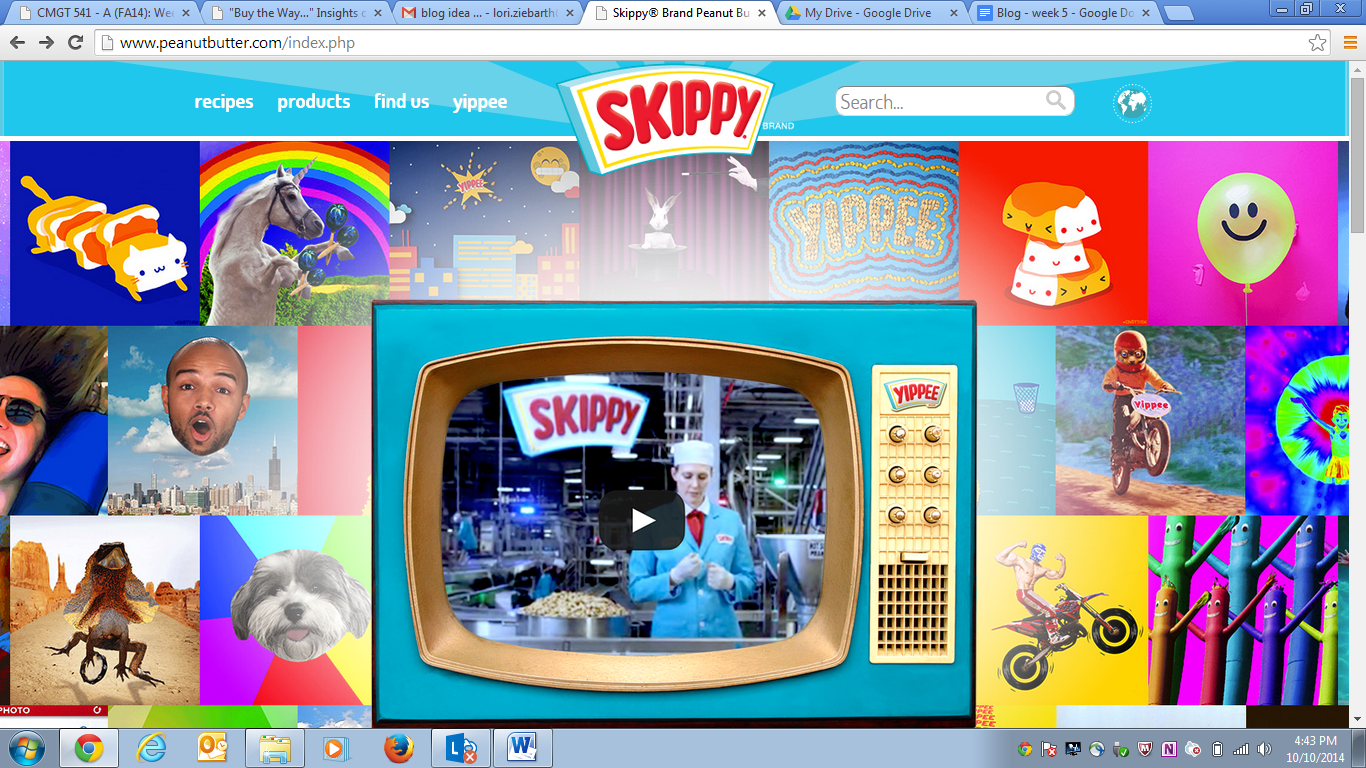
I’ll bet you have always wondered what was in the jar of peanut butter. An ad agency in my backyard, Minneapolis-based BBDO created a new ad campaign for Skippy, the brand’s first tv spot in more than five years (Phelps, 2014). The tag “Skippy … Yippee” headlines an ad that shows only fun peanuts go into Skippy peanut butter. (Ahh, now we know!)

The ad turns the well-known “Yippie, Skippy” phrase around. It’s a simple and memorable slogan with an ad that tells a story (Heath, C & Heath, D, 2007). There also is consistency across media as its social media sites the new http://peanutbutter.com have the same fun look and feel as the ad.

Peanutbutter.com screenshot

Peanutbutter.com screenshot

Skippy has a big task on hand: try to carve into Jif’s share of the $2 billion (that’s with a “b”) peanut butter market. Right now, Jif holds about 55%, while Skippy only 22% (Phelps, 2014).

You are probably wondering what happens to the non-fun peanuts. They make their way to an office party held in the company’s cafeteria. #boring.

See the full ad on YouTube:

http://www.youtube.com/watch?v=jg1ksjr6VfI

Resources:

Heath, C & Heath, D. (2007). Made to stick: Why some ideas die and others survive. Random House.

Phelps, D. (2014, September 22). Business: StarTribune. Retrieved from StarTribune website: http://www.startribune.com/business/275856261.html

Posted in Uncategorized | 3 Comments

We are all going to die.

Friends, I fear death.  I’m not going to dance around it, ok?  If I was given the choice between dying at some point and living forever, I’d most likely choose the latter.  Granted, most of that choice is motivated by my desire to see the Chicago Cubs win the World Series, and I’m expecting that to happen around 2137 (mark your calendars!).  With that in mind, I made the crucial error of watching this video a few days ago:

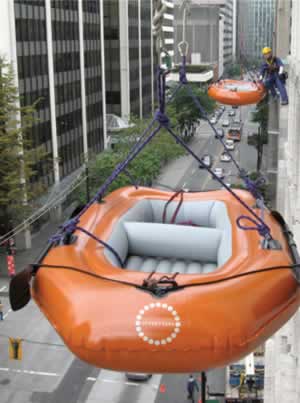
This was a colossal mistake, but it did intrigue me on how companies are responding to one of the most discussed and worrisome possible ways we might all die: Global Warming.  My search on how marketers are approaching this angle led me to the image below.

15680092
c/o http://www.allbusiness.com/wild-crazy-marketing-ideas/15677076-7.html

This image was part of a marketing campaign by Canadian organization, Offsetters, to demonstrate how global warming would lead to the flooding of coastal cities like Vancouver, where the campaign originated (Kiley, 2014).  In addition to the life rafts hanging from buildings, Offsetters placed lifeguard towers in parks, and placed life vests, along with operating instructions, under park benches.  This was a cheap, eye-catching campaign to raise awareness on how global warming will directly impact coastal residents.

With this image in mind, I wondered whether corporations were doing anything to stem the tide (pun…sorry) and roll back the damage we’ve done to the planet. Already public sentiment has fallen in line with the belief that global warming is a reality – research shows that 74% of Americans believe global warming is affecting the climate in our country, and 54% believe humans are the primary cause (Aarons-Mele, 2012). The same research also shows that corporations should begin leading the charge to reduce carbon emissions and footprints, and, fortunately, it seems that corporations are getting the message. Accoring to Aarons-Mele, clean energy is becoming the standard for many large corporations, including AT&T and General Motors (2012).

Even more encouraging, though in a slightly weird way, is that corporations are beginning to see that demonstrating environmental responsibility is good for business and their brand. This stems from companies realizing that global warming is directly impacting their ability to produce cost-effective products, and that companies must scramble for market share within the environmentally-friendly segments of their industry (Ritholtz, 2014). So, let’s just think about that for a moment…

Companies are realizing that becoming environmentally responsible is good business. Sure, they may not be trimming down on emissions for the “right” reason, but at least they’re doing something. Hopefully, the trend continues, but, in the meantime, I am going to go buy a lifejacket.


References:

Aarons-Mele, M. (2012, December 12). What can marketers do about climate change? HBR Blog Network. Retrieved from: http://blogs.hbr.org/2012/12/what-can-marketers-do-about-cl/

Kiley, D. (2014). 10 wild and crazy marketing ideas that worked. All Business. Retrieved from: http://www.allbusiness.com/wild-crazy-marketing-ideas/15677076-1.html

Ritholtz, B. (2014, January 27). Global warming battle is over market share, not science. Bloomberg View. Retrieved from: http://www.bloombergview.com/articles/2014-01-27/global-warming-battle-is-over-market-share-not-science

Posted in Uncategorized | 2 Comments

CVS bans tobacco!

On February 5, 2014, CVS, the second largest drugstore chain, announced that it will discontinue selling tobacco products by October 1, 2014. This involved slowly removing cigarettes, cigars, and chew throughout this time frame. The projected loss of sales totals 2 billion dollars!

This story made my heart so happy! Reading these stories each week has made me very cognizant of the importance of social and corporate responsibility. It is unfortunate but true, that news we hear is often negative. President Larry Merlo says “the sale of tobacco products is inconsistent with our purpose – helping people on their path to better health (CVS, 2014). The company also officially renamed itself “CVS Health.” Although this financial loss is quite significant, it is a step to better our society and finally a step in the right direction of holding companies accountable to higher standards. In recent years, markets products to families. Tobacco products have no place in bettering family health or well-being.

Additionally, this positions CVS to emerge in the health care industry with a glowing visibility, which potentially could increase partnerships and introduce new health products to be sold in their stores.

Furthermore, CVS is helping smokers quit. It was announced by Larry Merlo in his press release that a campaign will be launched in spring to aid smokers in quitting.

What I am interested in, is if you believe competitors will gain or loose by the immediate effects of removing tobacco products. I would also like your opinion on whether or not other chains that promotes wellness, such as Walgreens, should have the corporate responsibility to make the same choices that CVS has made.


http://www.cvshealth.com/research-insights/health-topics/this-is-the-right-thing-to-do


http://www.usatoday.com/story/news/nation/2014/02/05/cvs-will-no-longer-sell-tobacco-products/5207853/


http://www.cvshealth.com/research-insights/health-topics/this-is-the-right-thing-to-do


Posted in Uncategorized | 3 Comments

What Data-Obsessed Marketers Don’t Understand

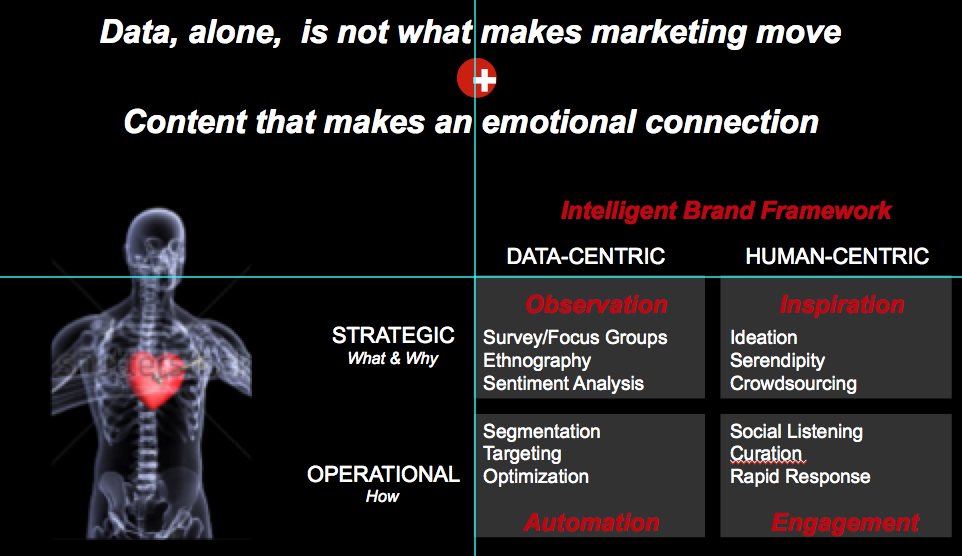
As big data has become an important factor in marketing field, the marketing communication strategy should be both effective and efficient using big data. It means that only data-driven approach alone is not what makes marketing move. For effective and efficient delivery of marketing communication, there should be a content that makes an emotional connection with customers.

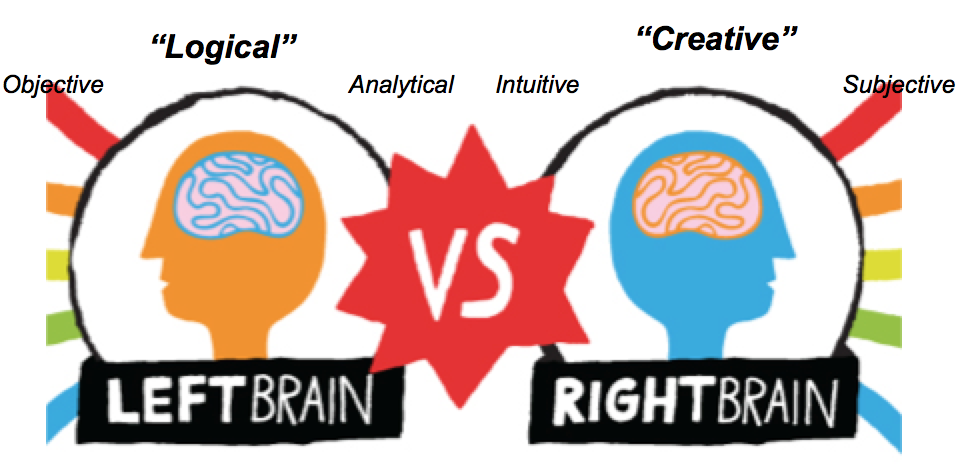
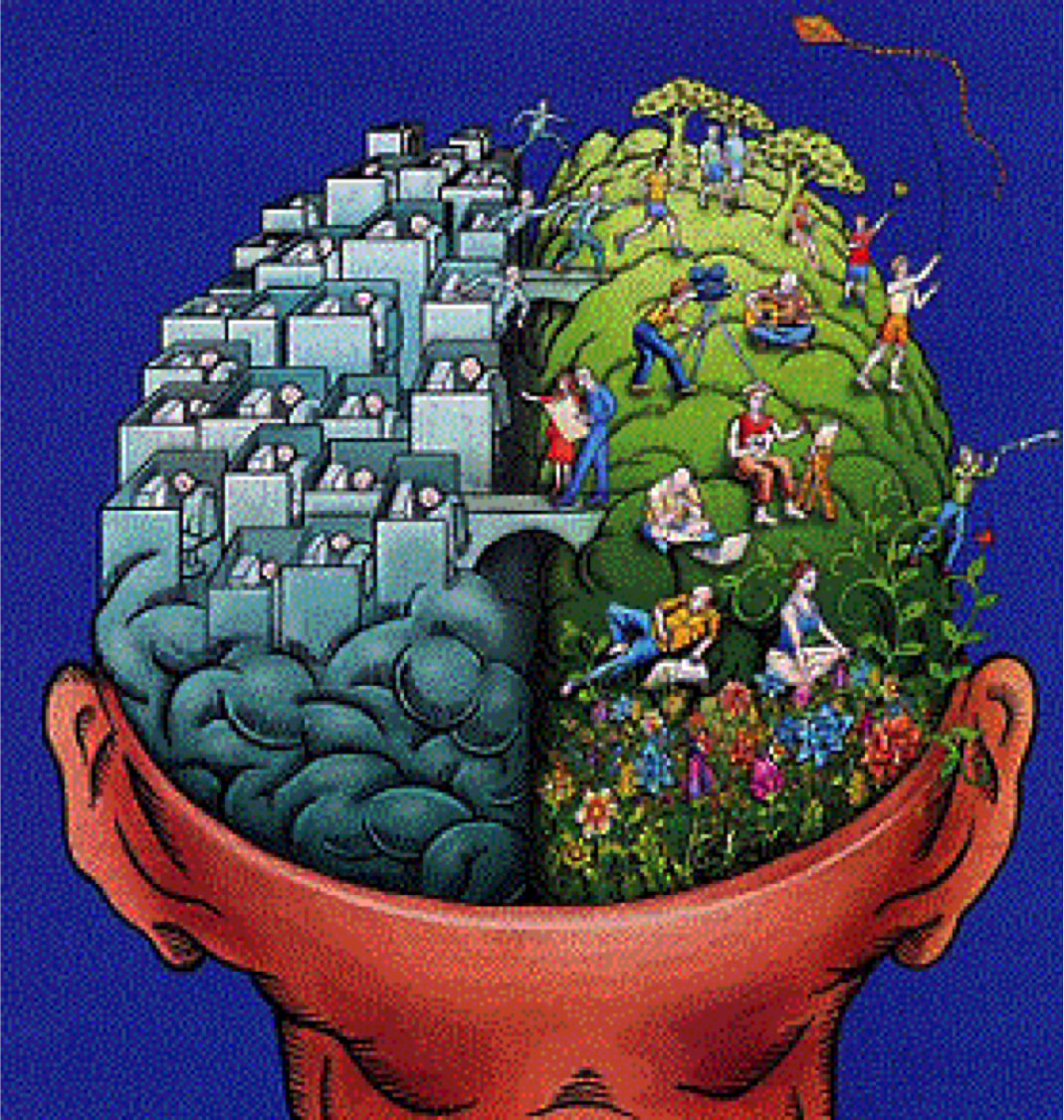
This is why people believe today’s obsessed marketers are at risk of cultivating only half of a brain (Soroman & Frank, 2014). Before we get into that, people are aware of our both brains have different jobs. “Left brain for logical thinking and right for creative thinking.”

Screen Shot 2014-10-08 at 8.09.30 PM Untitled

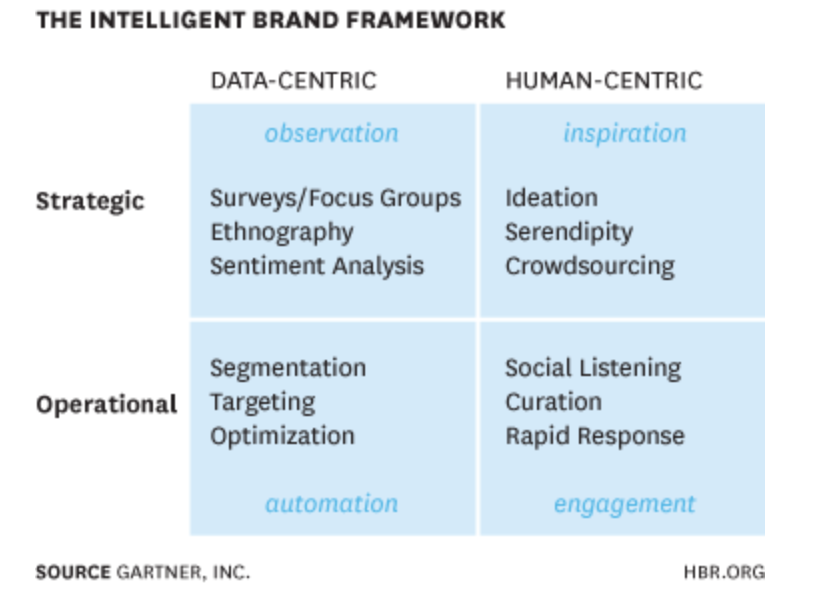
According to Sorofman & Frank (2014), they developed the intelligent brand framework to provide a structure for thinking about marketing investments across creative and operational disciplines, using a combination of data-driven and human-centric approaches.

Screen Shot 2014-10-08 at 8.00.09 PM

Data-Centric is where data sources being gathered for marketers to see patterns, make predictions, measure results, and other activities for optimization. Therefore, this area is called “observation.” Marketers can obtain customer’s insight in this area. For example, famous marketing company, P&G should be in this quadrant. They conduct a lot of researches before and after a launch of new product.

Next is Human centric and strategic area, called “inspiration.” Marketers use crowdsourcing to collect intelligence of human beings. Customer’s decision making process and emotional touch are taken in this area.

Third quadrant is data-centric and operational area. With collective data, marketers do segmentation, targeting, positioning and other many operational works in this area. It’s called “automation.” This area is about usual operations for marketers.

The last area is called “engagement.” In here, brand messages become authentic human dialogues, so many social interactions are occurred in this quadrant. Ultimately, brand is being humanized here. For instance, the companies that make efforts on listening to customer’s voice with real time to increase their loyalty and advocacy are in good position for engagement with their customers. Various communication activities including marketing communication are performed in this quadrant, especially, emotional bonding performance with its brands.

Screen Shot 2014-10-08 at 8.10.34 PM

In conclusion, to build a strong brand and successful marketing communication campaign, marketers must look over every four quadrants by using brain and heart as well, meaning by strategic and emotional balancing each other. Only data-driven marketing can cause lack of authenticity in communication message.

Questions

1) Which quadrant is more important for a new brand?

2) Is is possible to represent every quadrant?


Reference

Sorofman, J. & Frank, A. (2014). What data-obsessed marketers don’t understand. HBR Blog Network, Retrieved from http://blogs.hbr.org/2014/02/what-data-obsessed-marketers-dont-understand/?utm_source=feedburner&utm_medium=feed&utm_campaign=Feed%3A+harvardbusiness+%28HBR.org%29

Posted in Uncategorized | 5 Comments

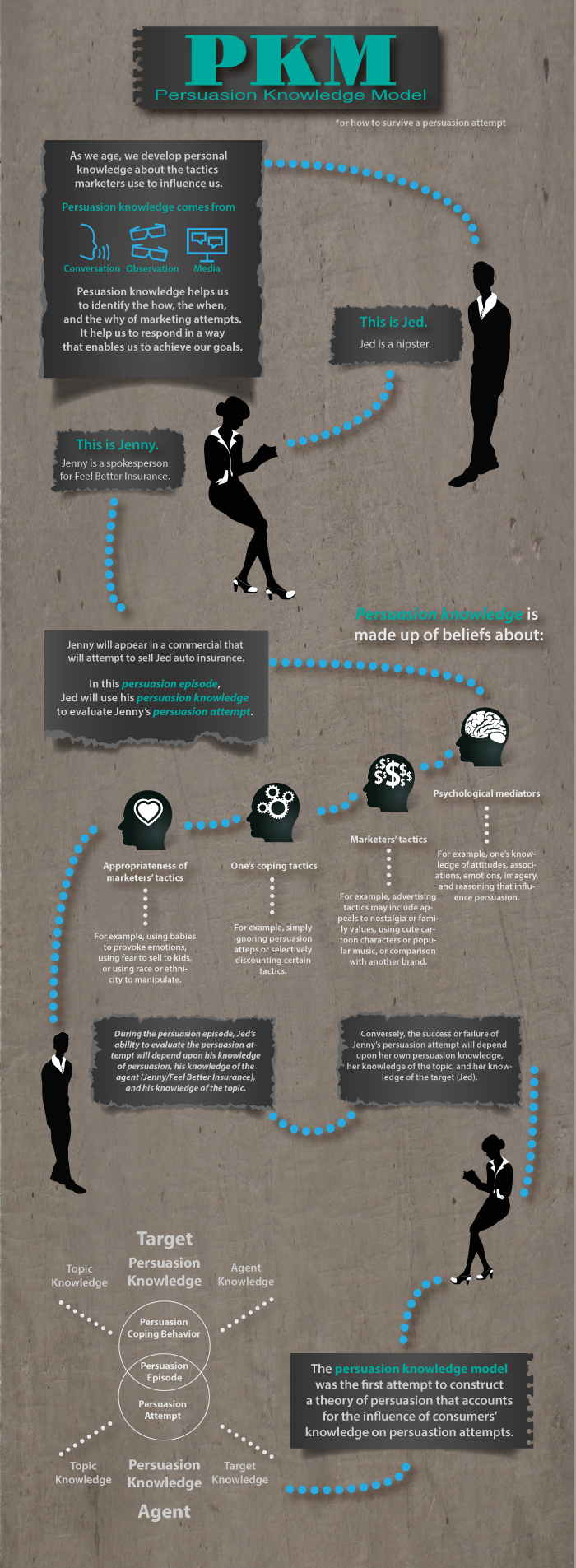
Jed and Jenny: A story of persuasion

I thought it might be fun to use an infographic to illustrate an important communication topic. The Persuasion Knowledge Model was the first theory of persuasion to account for the knowledge possessed by a message’s receiver in the outcome of the persuasion attempt.

Persuasion-Knowledge-Model

Reference

Friestad, M., and Wright, P. (1994). The Persuasion Knowledge Model: How people cope with persuasion attempts. Journal of Consumer Research, 21(1), 1–31.

Posted in Uncategorized | Tagged , , , | 3 Comments

Offensive Strategy

At what point does “edgy” become offensive? Do social themes become diluted when they are integrated into promotional campaigns for commercial sales? Is poor taste relative to our cultural perspective or universal? And who gets to decide? As we’ve learned from both our studies and our experiences as consumers and humans, we each approach the answers to these challenging questions through our individual filters, our unique “image” as Kenneth Boulding’s 1956 iconic book The Image proposes. This image is formed via a complex formula of values, direct experiences and cultural appropriateness, but is there common ground, a place within social boundaries where we can all agree? It is a difficult area to define let alone predict, and inevitably as communicators, we can misstep.

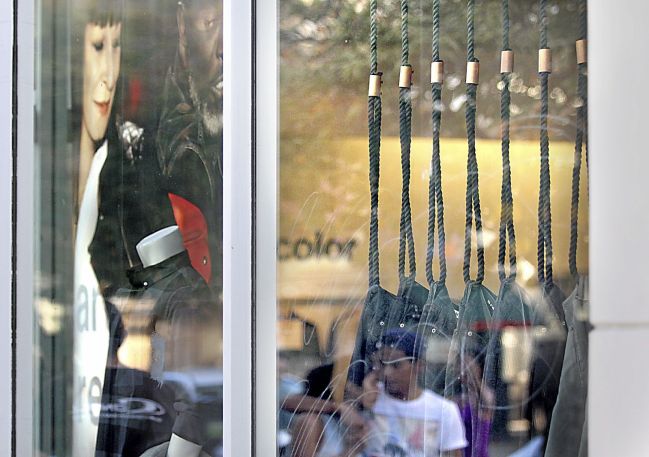
Several days ago, the Gap, that iconic American clothing brand that recalls timeless style and easy nostalgia, landed squarely in this fuzzy gray zone of acceptability – and on the front page, above the fold, in our local daily paper, the Santa Cruz Sentinel. In promoting its ‘1969’ black denim jeans, the Gap’s corporate marketing team went with a civil rights theme, complete with black nooses for, um, hanging the jeans prominently in a window display. Next to the nooses was a photo of actor Michael Williams, an African American well known for his role as “Omar Little” in HBO’s “The Wire.” Elsewhere in the store, signage declared “Black is a color” and “Don’t be afraid of the dark.” Either of these two slogans could have driven its own campaign sans the racial symbolism: black is technically the absence of color, but the idea could generate some cool ‘cosmic black hole’ vibes; and, the second one conjures up spooky stories around the campfire – a very nice framing opportunity around a fall campaign. Yet corporate creative added a third message with the nooses that seems to color (pun intended) the other slogans unnecessarily with racial overtones: black is worthwhile, and dark equates scary. It’s not stated, but it does take us there when presented as a whole with Mr. Williams’ portrait and the aforementioned nooses.
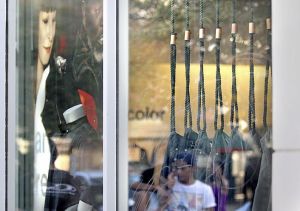
The Gap window display in downtown Santa Cruz, California. Photo: Shmuel Thaler

The Gap window display in downtown Santa Cruz, California. Photo: Shmuel Thaler, Santa Cruz Sentinel

The gist of the local news story was that many community members were offended and upon inquiry with the store’s employees, at least one resident received agreement that the concept was “pretty terrible” but nothing was to be done since the concept came from corporate. A follow up story by a local NBC affiliate TV station reported that the store employees “quietly altered the way the ropes were attached to the jeans” eliminating the offensive “noose” visual. But the question of intent remains: was Gap genuinely trying to elevate the conversation of race as they promoted their ‘1969’ line of jeans? Or were they just trying to be visually clever for their young and hip target audience? Did it work? In a way, whether intended or not, it did.

The Sentinel reporter, Kara Guzman, checked in with University of California Santa Cruz psychology professor and researcher Anthony Pratkanis for his take on the display. Pratkanis, renown for his research on subliminal messaging and advertising, confirmed that controversial ad campaigns are popular with young audiences and can contribute to a brand’s image. He felt the concept was likely meant to be controversial. Guzman also spoke with Simba Kenyatta, a well-known and respected local community organizer and founder of Santa Cruz County Coalition to Overcome Racism. Kenyatta, who is African American, was not offended. Why? Because the knots on display were not “hangman knots.” He goes on to say “I have to pick my battles and this isn’t one of them.” He then describes what he endured growing up black in Indiana and his direct experiences with the race riots of the late 1960s. It was these experiences that have led Kenyatta, who is also the president of the local chapter of the NAACP, to teach his son about how to respond to a policemen and stay safe, and to watch him navigate the very real racism in this “progressive” town.

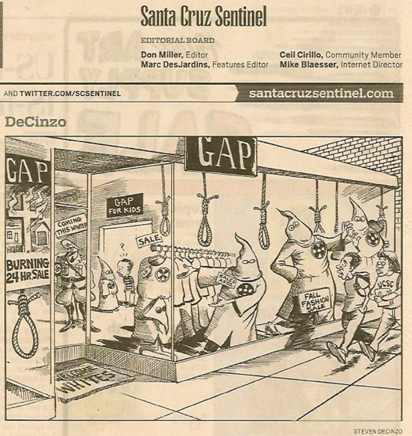
So what did the Gap achieve? Publicity? Check. Conversation around race? Check. The follow-up stories and the political cartoon by controversial artist DeCinzo (below), served to extended the conversation. Despite what our sensibilities tell us and the intent of the marketing concept, there can often be more to an issue than whether or not a choice is offensive. I, for one, am thankful for the conversation and prefer dialogue over silence every time. What do you think?
decinzo-gap cartoon

References

Boulding, K. E. (1956). The Image. Ann Arbor, MI: University of Michigan Press.

Gap store in Santa Cruz changes black jean display. (2014, September 24). KSBW.com. Retrieved from http://www.ksbw.com/news/central-california/santa-cruz/santa-cruz-gap-store-changes-its-hanging-black-jeans-display/28233058

Guzman, K. (2014, September 24). Gap display hits racial cord. Santa Cruz Sentinel, pp. A1, A4.

Guzman, K. (2014, September 24). Santa Cruz Gap’s new normal campaign: jeans, a T-shirt and a noose? Santa Cruz Sentinel. Retrieved from http://www.santacruzsentinel.com/santacruz/ci_26593255/santa-cruz-gaps-new-normal-campaign-jeans-t

Michael Kenneth Williams. (n.d.). IMDB.com. Retrieved from http://www.imdb.com/name/nm0931324/?ref_=ttfc_fc_cl_t11

 

Posted in Uncategorized | 5 Comments