You’re on Coke

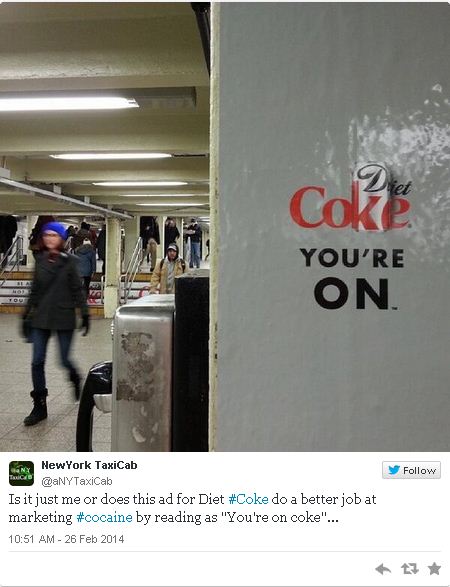
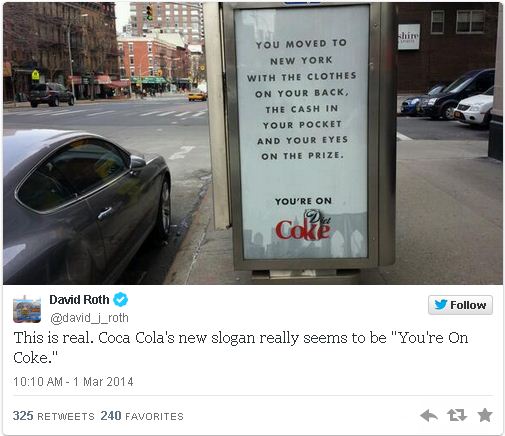
Coca-Cola’s latest campaign has created stir in the Big Apple and San Francisco.  The simple white posters with black lettering have been displayed at local bus stops and subways and have gained notoriety, curiosity, and controversy from onlookers.  The writing depicts a scenario of a person moving to the Big Apple or San Francisco with the clothing on their back, cash in their pocket or portfolio in hand, the eye on the prize, and a concluding “You’re on Diet Coke” phrase (Mancuso & Montgomery, 2014).  The campaign was created by well known Manhattan-based advertising agency, Droga5 whose clients include Unilever, Kraft Foods, and American Express (Droga5, 2014).
coke3

Some are presuming the “You’re on Coke” message is referring to the narcotic drug cocaine but Coke is denying the claims stating this statement is for the young achievers who experience “You’re On” moments that may include a first date, job interview, or speaking in front of a large audience (Wasserman, n/d).  The commercial that features Taylor Swift supports the G-rated version Coke refers to but the photos taken of the simple white posters with black writing, which are displayed through the cities and exploited on Twitter, show a hidden PG-13 rating.

Diet Coke, You’re On

In 1886, a pharmacist named John Pemberton created Coca-Cola, referring to it as a “brain tonic” (May, 1988).  The original recipe used coca with cocaine but company spokesmen stated the narcotic aspect was removed.  Fast forward to 1988, an article in the New York Times, revealed the importer and exporter of the cocoa used in Coke but claims there are strict regulations on how the product is used and the removal drug process is overseen by authorities (May, 1988).  A beverage industry analyst, Emanuel Goldman commented in this article by C. May (1988): “This is an old hat to people in the industry, when you have a good product you change it as little as possible.” (May, 1988).  In defense, cocaine was a legal drug up till the 1914s and it was suggested that the drug wasn’t completely removed until the 1929s (Palermo, 2013).  No one can confirm this claim for sure because the Coca-Cola recipe is a secret and is privately held by the Coca-Cola Corporation (Palermo, 2013).  So the debate continues, does the message from Coke refer to a secret additive or was it a simple punctuation placement, or lack of, that threw the campaign off?  You decide.
coke


Reference

Droga5. (2014). About. Retrieved from: http://droga5.com/about/

Mancuso, V. & Montgomery, M. (2014). Badvertising: Doctors horrified by Coca-Cola’s new ads mocking cocaine addiction. Retrieved from: http://observer.com/2014/03/badvertising-doctors-horrified-by-coca-colas-new-ads-mocking-cocaine-addiction/

May, C. (1988). How Coca-Cola obtains its coca. New York Time. Retrieved from: http://www.nytimes.com/1988/07/01/business/how-coca-cola-obtains-its-coca.html

Palermo, E. (2013). Does Coca-Cola contain cocaine? Live Science. Retrieved from: http://www.livescience.com/41975-does-coca-cola-contain-cocaine.html

Wasserman, T. (n/d).  Diet Coke: No, our ads aren’t drug references. Mashable. Retrieved from: http://mashable.com/2014/03/04/diet-coke-ad-drugs/
Posted in Uncategorized | 6 Comments

Taglines (by Erika White)

Taglines: A Sign of the Times or a Pastime?

Be brief or be gone. This is something we’ve all probably heard directly or indirectly as we’ve acclimated to various workplaces. Everyone, especially management, is pressed for time. So much so that more and more people have started referring to time as their “most precious resource.” But, in a constantly connected world, how long is long enough and how short is too short? Advertisers seem to be trying to answer this very question.

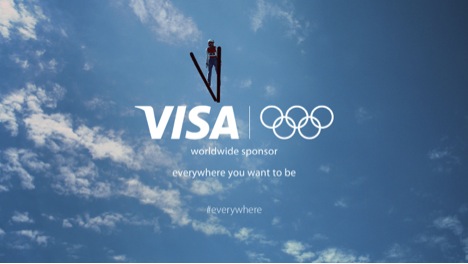
Recently, Visa Inc. announced that it would be retiring its global tagline “Go” and resurrecting a shorter version of a tagline that the Company previously used in the United States (Elliott, 2014). Visa’s “new” global tagline is “Everywhere you want to be.” This may sound familiar to many of you since the Company previously used “It’s everywhere you want to be” for their tagline in the U.S. While the removal of a single word may not seem that significant, the decision supports a trend towards shorter taglines—a trend supported by a variety of companies including Alka Seltzer and Masterpiece Theatre who have cut a word or words out of their taglines recently (Elliott, 2014).

Visa creative activiation

While some companies have tightened taglines to accommodate a world that is short on time, the trend of tightened taglines began well before this year and last. For instance, Dodge changed its ad slogan from “Grab life by the horns” to “Grab life” in 2007 (Wert, 2007). The transition had a different motive associated with it—to attract more women to the brand. Coke also transitioned to a more inclusive tagline in 2009—Open Happiness—to broaden its appeal (Yohn, 2013). Coke chose this short and sweet tagline to keep up with brands that were transitioning away from declarative statements in their taglines and towards lines that were more inviting (Yohn, 2013).

Whether a brand is shortening its tagline to save its audience time, to market to a new audience or to appeal to the changing needs of its audience, the fact is that brands have been shortening taglines for years—some brands, such as Starbucks and Apple, even to the point that they don’t have one (Yohn, 2013).

As a consumer, do you think taglines are trying to keep up with us or dying all together? Please share some of the taglines you find most memorable and the years they were launched. Maybe our perceptions of taglines have changed over the years and we’ve been too busy to even notice…


References

Elliott, S. (2014). Visa trims slogan to expand meaning. The New York Times. http://www.nytimes.com/2014/01/13/business/media/visa-trims-slogan-to-expand-meaning.html?hpw&rref=business&_r=0

Wert, R. (2007). Dodge needs women: Chrysler brand shortens slogan for her pleasure. Jalopnik.com. http://jalopnik.com/251767/dodge-needs-women-chrysler-brand-shortens-slogan-for-her-pleasure

Yohn, D.L. (2013). The Death of the tagline: Flexible branding is the new name of the game. Adweek.com. http://www.adweek.com/news/advertising-branding/death-tagline-152255

Posted in Uncategorized | 6 Comments

Coca Cola – Warm & Fuzzies or Pins & Needles?

Coca-Cola

Think for a moment of a Coca Cola ad – I doubt there’s a reader out there that can’t do this; snuggling polar bears, soccer goals, popping red bottles, or people uniting are some themes that may come to mind. Some examples are on their YouTube channel. While the marketing team are coming up with inspiration creatives, what’s going on in the real world? The post challenges Coca-Cola’s marketing authenticitydoes Coca-Cola really value and advocate for the betterment of society or are they masquerading while they pillage the modern world?

Just before visiting India in May of 2013 I saw this Coca Cola ad dubbed Small World Machines. My warm fuzzies were {literally} out of control. Shareen Pathak sums up it’s success in Ad Age, “Coke has hit on a good formula for creating heartwarming online clips celebrating, basically, the kindness of strangers” (Pathak, 2013). Take a look and experience this warming moment…

I showed this ad to various people I met in India – thinking I was bringing a message of peace and positivity. I was rather surprised to realize that of the 10 or so people I showed (including a friend, a couple tour guides, shuttle driver, hotel concierge…) two of them outwardly liked the message, others were amused and then 3 didn’t even finish the ad! It was the ambivalent and seemingly offended responses that got me thinking. I ended up asking my favorite tour guide, a fantastic scholar: why aren’t these guys jumping up and down like me!? He kindly reminded me that most Indians and Pakistanis have negative feelings towards one another, and that this ad might be so far as to say it’s offensive (keep in mind though, he liked the ad). Confirming his point, a 2013 BBC report indicates that 54% of Pakistani’s have negative feelings towards Indians and 45% of Indian’s hold negative feelings towards Pakistan (BBC, 2013). My tour guide said that the ad oversimplifies and belittles the deep rooted conflicts between the countries… and after I heard him say that, I began to realize, I think I agree. After all, how do you think the american population would react if we had Small World Machines connecting the U.S. with Iran?

CocaColaIndia

In addition, my guide pointed out that there are several plants in India that cause water shortages in the local villages in which they are placed. Turns out there are 58 plants in India, with one likely to shut down in a few days in Varnasi (a sacred place along the Gangis River) because of it’s impact on the local water supply. (AAP, 2013)

As if this isn’t enough discouragement, Coca-Cola recently stated that they believe global warming is bad for business (Davenport, 2014)… I don’t know about you, but shouldn’t this be reversed??

This ad still gives me the chills, but I can’t decide if the feeling I got was warm & fuzzy or pins & needles. As the people lover and aspirational thinker, I still love it; writing this post, I still get goosebumps over it’s message. But as a marketer I thought about how it impacts other people. Who is the target audience for this ad? Is it for the Americans like me who want to believe peace really can be as simple as opening a Coca-Cola can? Or is it the people of India and Pakistan who have been in violent territorial and political disputes since 1947? Or the people of India who can’t drink water because it’s too expensive, so now have to buy Coke? Who?

This ad won 6 Lion Awards one month after it’s release (PR Newswire, 2013) and in 2013 Joe Tripodi accepted Coca-Cola’s first Cannes Creative Marketer of the year award, one of the highest esteemed awards in marketing. “The legacy we want to leave is of a brand and company that does good things for the world and speaks to optimism, positivity and happiness.” (Moye, 2013). While I believe this is the legacy they want, I wonder if the legacy will instead be nothing more than their revolutionary creative ideas that mask the the reality of their global destruction…

Resources

AAP. (25 January 2014). India threatens to demolish Coke plant. MSN NZ. Retrieved from http://money.msn.co.nz/businessnews/world/8789022/india-threatens-to-demolish-coke-plant

BBC World Service. (22 May 2013). Views of China and India slide while UK’s rating climg: Global poll. Retrieved from http://www.globescan.com/images/images/pressreleases/bbc2013_country_ratings/2013_country_rating_poll_bbc_globescan.pdf

Davenport, C. (23 January 2014). Industry awakens to threat of climate change. New York Times. Retrieved from http://www.nytimes.com/2014/01/24/science/earth/threat-to-bottom-line-spurs-action-on-climate.html?hpw&rref=us&_r=0

Moye, J. (25 June 2013). Work that matters: Coca-Cola named creative marketer of the year, wins 20 additional Cannes Lions. Coca-Cola Company. Retrieved from http://www.coca-colacompany.com/stories/work-that-matters-coca-cola-named-creative-marketer-of-the-year-wins-20-additional-cannes-lions

PR Newswire. (18 June 2013). Leo Burnett Worldwide wins 18 Cannes Lions in media and outdoor. Retrieved from http://www.prnewswire.com/news-releases/leo-burnett-worldwide-wins-18-cannes-lions-in-media-and-outdoor-212069521.html

Shareen, P. (10 June 2013). See our favorite work from Coke, Cannes 2013 creative marketer of the year. Advertising Age. Retrieved from http://adage.com/article/special-report-cannes-2013/favorite-work-coke-cannes-2013-creative-marketer-year/242013/

Posted in Uncategorized | 7 Comments

Dispensing Brands One “Coin” at a Time…

Picture this. It’s Valentine’s Day 2014 and you are walking down a street with your sweetie. Suddenly…

http://youtu.be/RjMhZFhD0tI

As part of their ongoing global Open Happiness campaign, Coca~Cola installed a vending machine in Turkey to encourage couples to #shareacoke on one of the most romantic day of the year. This machine is one the latest Happiness Machines that beverage brand {which is currently ranked 3rd as one the most recognized brand globally (Interbrand, 2013)} has installed in various markets to continue to spread its simple message that opening a can of Coke can release a sense of happiness (Brooks, 2014).

Brands are starting to explore vending machines as part of their integrated marketing communications efforts. Globally, the beverage giant Coca~Cola not only utilizes them to conveniently dispense its products but their Happiness Machines also reinforce and maintain brand/product recognition. In the latest out-of-home advertisement innovation, vending machines are establishing a new trend in cultivating brand awareness and increased revenue generation.

At the recent 11th annual Digital Signage Expo, the exploratorium on digital vending machines was at forefront of the convention. The new wave of machines also concentrated on enhancing consumer experiences (Martin, 2014). Featured at this year’s event was global coffee brand, Costa Coffee, who presented coffee machines with interface options such as touch screens, mobile payments, and NFC- near field communications. Near field communications allows a consumer to purchase goods with their mobile device by a mere tap (Strickland, 2013). All this functionality allows vending machines to capture consumer demographics which can provide a brand with vital consumer information.

In addition to creating consumer brand experiences, these new vending machine also serves as adverting platform for brands that are common to vending. Another expo highlight was Mondelez International’s Diji-Touch vending machine. Becoming a leader in vending machine innovation and technology, their machines displays fantastic digital ads; product nutritional value; has analytical software that will allow for real time inventory controls and even thanks the consumer for their purchase (Martin, 2014). The machines also act as a virtual store shelf. The consumer can select a product featured in the machine and get a 360 degree view. Since Mondelez dispenses multiple brands, the digital space that is featured on the machines can be used to generate brand awareness – regardless of the machine’s product inventory.

So the next time you are grabbing a quick snack, you may get a lot more than just a bag of chips…you may also get a personalized Coke and a smile. As a Pepsi girl, I totally would LOVE to have my name on a Coke can!

Thank you!

References

Brooks, R. (February 18, 2014). Invisible vending machines surprised lovers on Valentine’s day. Retrieved from http://www.psfk.com/2014/02/coca-cola-couples-vending-machine.html#!wK8ft

Maras, E. (February 1, 2012). Mobile payment revolution begins. Vending Marketwatch.com. Retrieved from http://www.vendingmarketwatch.com/article/10614061/mobile-payment-revolution-begins

Martin, C. (February 18, 2014). Vending machines go digital, mobile payments included. Media Post. Retrieved from http://www.mediapost.com/publications/article/219735/vending-machines-go-digital-mobile-payments-inclu.html?edition=70001

Martin, C. (February 13, 2014). Mobile shoppers to face more interactive screens in stores. Media Post. Retrieved from http://www.mediapost.com/publications/article/219467/mobile-shoppers-to-face-more-interactive-screens-i.html

Stickland, K. (March 25, 2013). Coca-Cola to increase use of mobile phones for payments and rewards at vending machines. NFC Times. Retrieved from http://nfctimes.com/news/coca-cola-seeks-increase-mobile-payments-and-rewards-vending-machines

Best Global Brands 2013. Retrieved on February 21, 2014 from http://www.interbrand.com/en/best-global-brands/2013/Best-Global-Brands-2013.aspx

Posted in Uncategorized | 4 Comments

LEGO Movie Another Example of the Power of Promotion

The LEGO Movie's main protagonist

The LEGO Movie’s main protagonist

When is a movie not a movie? When it’s a commercial conceived, constructed and distributed to sell a product. Case in point, the new LEGO Movie is the latest example of a movie being more than just that. The LEGO Movie debuted to a handsome $69 million box office opening, as well as to critical success (Sava, 2014). But the real coupe is not for what this movie means for the motion picture industry, but what it will do to sell the little plastic bricks.

The Danish LEGO group was foundering in the early 2000s (Greene, 2010). The company had invested in areas where they lacked expertise, such as in co-producing Galidor: Defenders of the Outer Dimension, an original TV show that strayed far from their core success (Greene, 2010). They also suffered decreases in demand for many of their mainstay toy kits. A change in strategy, moving away from traditional toy designers, toward the finest art school graduates resulted in the ballooning of the number of custom LEGO parts from 7,000 to 12,000 in just seven years (Greene, 2010). This also meant that supply costs increased and made it nearly impossible to determine the profit margins from each kit sold. But since about 2005, LEGO has done a masterful job bringing the company back from the brink. While much of the heavy construction (pun intended) was completed by refocusing on the design of their products, their most recent resurgence is largely due to the company’s perfected art of blending advertising and entertainment (Sava, 2014).

Licenses have helped LEGO regain form

Licenses have helped LEGO regain form

Licensing agreements with merchandising juggernauts like Star Wars, Marvel and DC, have led to new product placement entities including TV shows, video games and now movies, where instead costing the company money, the commercials become an actual profit center for LEGO. Imagine, LEGO customers were shelling out $50-$60 to buy a video game that inspired them to go out and spend more money on the toys the games were based on.

Product placements in movies is certainly not a new idea, but the movie as the product placement is a growing phenomenon. The previously mentioned Star Wars is probably the pinnacle case of a movie as the source material for creating demand for a product. Over the years, more than $20 billion worth of Star Wars merchandising has been sold (Block, 2012). To date, totals for all six Star Wars movies, including their multiple re-releases, have only reached a paltry $4.5 billion (Box Office Mojo, 2014). It’s no wonder why Disney paid over $4 billion dollars last year for the license to make more of these movies.

The success of Star Wars has led to a number of motion picture imitators, from Hasbro’s Transformers, G.I. Joe and Battleship, to Disney’s Toy Story and Cars. Each of these movie franchises, whether hit or miss, were created for the express purpose of reviving merchandising sales in products. What do they all have in common? They are all based on toys, and for the majority of them, they were critically successful, but there’s more to it than just making a good movie. Each of these properties come with a built in nostalgia factor (Sava, 2014). Whether LEGO’s bricks, or Toy Story’s Barbie dolls, they tap into the notion of parents passing on elements of what brought them joy as kids, to their own children.

transformers

Transformers and Battleship are modern examples of movies as product placement

Transformers and Battleship are modern examples of movies as product placement

The LEGO Movie tells this story quite literally. Without spoilers for those of you who still plan to see it, the plot of the movie ties directly into a father-son relationship, much the way Toy Story has tugged at our heartstrings over the years.

With the LEGO Movie, LEGO’s resurgence is all but complete. The box office success of the movie has already resulted in the announcement of a sequel in 2017, and increased market share for the toys are likely to follow. After all, who could resist running out to the toy store to buy a set after spending 100 minutes watching a commercial on all the cool stuff you can create with them.

Who can resist movie stars and toys?

Who can resist movie stars and toys?

For companies, the idea of getting your customers to pay for your commercials, and then pay for your “real” products has to be enticing. It takes the idea of efficiency to a whole new level. For entertainment’s sake, let’s just hope that the resulting copycats fall more in line with critical success of Toy Story and the LEGO Movie, than they do with Battleship.

References

Block, A. B. (2012, February 9). The Real Force Behind ‘Star Wars’: How George Lucas Built an Empire – The Hollywood Reporter. Retrieved February 21, 2014, from http://www.hollywoodreporter.com/news/george-lucas-star-wars-288513

Greene, J. (2007, July 23). How LEGO Revived Its Brand – Businessweek. Retrieved February 21, 2014, from http://www.businessweek.com/innovate/content/jul2010/id20100722_781838.htm

Sava, O. (2014, February 11). Why The Lego Movie is the perfect piece of product placement · For Our Consideration · The A.V. Club. Retrieved February 21, 2014, from http://www.avclub.com/article/why-the-lego-movie-is-the-perfect-piece-of-product-201102

Star Wars Movies at the Box Office – Box Office Mojo. (2014). Retrieved February 21, 2014, from http://www.boxofficemojo.com/genres/chart/?id=starwars.htm


Posted in Uncategorized | 5 Comments

This month Facebook turned 10 years old (Oremus, 2014). Our daily lives are now filled with retweets, trending topics and likes. I think everyone can acknowledge the ground-shifting, wave-making changes social media has wrought on personal interactions, social connectivity, journalism and marketing. This week PBS aired “Frontline: Generation Like” (2014), which explored the invasiveness of the social media marketing world that is captivating teens to an extent where they are becoming willing players in viral marketing campaigns, gaining attention and building their own celebrity brands.

Screen shot 2014-02-21 at 8.54.17 PM

Correspondent Douglas Rushkoff explored social media as a tool of empowerment for teens to gain a voice in a cluttered online world (2014). Teens are finding their voices through engaging with marketing campaigns – whether liking Oreo on Facebook or gaming their way to top fan status for Hunger Games: Catching Fire teens are playing into the hands of marketers amplifying strategic promotions (Koughan & Rushkoff, 2014). One marketer, Bonin Bough, likened this proliferation of marketing engagement, as “the biggest change we have had in communicating with consumers in our lifetime – to stand on the sideline is not an option” (Koughan & Rushkoff, 2014). Rushkoff (2014) noted, “this is where the currency of likes turns into actual currency.”

However, “Generation Like” only scraped the surface of the psychological motivations for the social media addiction of the youngest members of the Millennials. They are responding to the basic teen needs of attention, self-empowerment and validation (Koughan & Rushkoff, 2014). But, the scope is so much bigger – and viral. “Generation Like” is responding to the pervasive celebrity commodity culture, which has developed with reality television and the need for fame. The teens that have reached large social media audiences are content with accepting sponsorships and schilling for corporate brands to attain celebrity status and perks.

Tween capturing selfie for instagram.

Tween featured in “Generation Like” capturing selfie for instagram.

The celebration of celebrity has created a generation seeking only fame for fame’s sake. In fact, two of the tweens interviewed started in social media to share their respective talents – skateboarding and singing. However, once they secured a following, they simply had to “be” to be liked, praised and grow their “brands”. Their social media connections become their “fans” and the sponsorships they receive are aligned with their “celebrity” status. This concept was only amplified by the inability for teens to define what “selling out” means.

I don’t know about you, but this is one Millennial that felt really old watching this documentary.

References

Koughan, F. (Producer/Writer), & Rushkoff, D. (Producer/Writer/Correspondent). (2014, February 18). Generation Like [Television series episode]. Frontline. Boston, MA: WGBH.

Oremus, W. (2014, February 3). Facebook was born 10 years ago. Here’s what it looked like. Slate. Retrieved from http://www.slate.com/blogs/future_tense/2014/02/03/facebook_10th_anniversary_social_network_turns_10_looks_back_at_its_history.html


Posted on by Anastasia | 4 Comments

Fast Fashion & Marketing for Longevity

Many fashion magazines are way behind the curve in the new digital era. The development of fast fashion in the global fashion industry has lead to the need for brand expansion in the style print media category. The Internet has provided several opportunities for major brands to extend their print offerings through traditional websites, new mobile apps, partnerships with like companies and digital versions of their publications on iPad, Kindle, Nook and Zinio.com. The integration of the marketing efforts can be seen in cross platform initiatives that engage the reader through moving images and static pictures.

The most recent marketing effort for fashion has come through a new app called ASAP54, created by Daniela Cecilio. ASAP54 is basically Shazam for fashion and curates any item you take a picture of and goes on a search to find the identical handbag, shoe or LBD. In addition, the image recognition technology can match a print or connect you with a live sourcing personal shopper to help you find your item in their vast catalog via their mobile app. Another technology that has erupted on the scene is the new app by debut print magazine Porter, the magazine by Natalie Massenet of Net-a-Porter. The Porter magazine app will be revolutionizing the print industry as it allows the consumer to shop direct from the pages of the magazine (Binkley, 2014).

Although, the fashion industry has yet to come up with a way to hurry along the turn around time between the runway and the rack, some companies are combatting this by marketing new brand extensions to keep loyalty and drive a so-called fledgling print industry with the movers and shakers of tomorrow.

20120925-123921Condé Nast created the Condé Nast College of Fashion and Design and opened its doors to bright fashion students from around the world in January 2013. Curating a Vogue Foundation Program that takes one year to complete and a Vogue Fashion Certificate (10 week program), the college has attracted great attention through the ads placed in its signature publications, as well as in global newspapers such as the New York Times. In the article, Mr. Newhouse, the Chairman of Condé Nast International, wanted the company to put forth an idea that wasn’t solely at the mercy of income from print ads or selling copies of magazines on newsstands (Guttenplan, 2013).

Condé Nast College of Fashion & Design – Video

According to the principal of the London based CN College, Susie Forbes, there are talks of extending the brand even further to include campuses in Shanghai, China and India as well. The brand intends to use education as a marketing tool to promote its titles (brands) as experts in their own fields. This includes technology via its Wired brand and others (Guttenplan, 2013). Really, the company believes this could be what Condé Nast leads with for its future. From a marketing perspective, this is genius. Not only is the company extending brand loyalty but they are almost cultivating their readers to think and aspire to be the brand, by taking them through the paces in college.

Many college students are loyal to their schools and have school pride for years after graduation. Some buy season tickets to games, while others buy school gear. Imagine students who continue to purchase products every month, from a wide range of titles (magazines/newspapers/clothes featured in those publications, etc.) and the word of mouth that these young fashionistas are now blogging about on a minute-by-minute basis.

Have you seen any great crossover marketing from a print publication like the Porter Magazine app allowing customers to shop directly from the magazine pages (byway of pushing them back onto the Net-a-Porter.com site) or the brand loyalty integration of the Condé Nast College? Please share.

References

ASAP54 (2014). ASAP54. Retrieved February 20, 2014, from http://www.asap54.com/

Binkley, C. (2014, February 4). Net-A-Porter launches magazine. Retrieved February 20, 2014, from http://online.wsj.com/news/articles/SB10001424052702303442704579362900001314062

Cameron, C. (2014, February 11). Net-a-Porter goes to print with layar. Retrieved February 20, 2014, from https://www.layar.com/news/blog/2014/02/11/net-a-porter-goes-to-print-with-layar/

Condé Nast College Of Fashion & Design (2013, November 19). What the students say [Video file]. Retrieved from http://www.youtube.com/watch?v=IEAIwvDGXqA

Dressful.com (2014, February 11). Review: Porter magazine. Retrieved February 20, 2014, from http://www.dressful.com/9066/porter-magazine-review

Guttenplan, D. D. (2013, May 19). Condé Nast school offers front-row view of fashion industry. Retrieved February 20, 2014, from http://www.nytimes.com/2013/05/20/world/europe/conde-nast-offers-fashion-industry-courses.html?pagewanted=all&_r=0

Marco (2012, September 25). Conde Nast College of Fashion and Design. Retrieved February 20, 2014, from http://manofthecloth.co.za/news/conde-nast-college-of-fashion-and-design/

Shopper, T. (2014, February 8). Miss Terry Shopper embraces T-Commerce. Retrieved February 20, 2014, from http://www.powerretail.com.au/miss-terry-shopper/miss-terry-shopper-embraces-t-commerce/

Posted in Uncategorized | 7 Comments

Wet Seal Lets Teen Borrow Its Social Channel for Weekend

WetSealLogo

How could a multimillion-dollar fashion brand hand the reigns of its social media channel to a 16-year-old girl? Because it knew she would have a better shot at speaking the site language.

Meghan Hughes, aka MissMeghanMakeup, probably did a little more than you and I this past holiday. She baked cookies, played with her pup, went to a light show and, oh, communicated with several thousand people who followed her every movement. Through short-lived pictures and quick notes to followers, Meghan represented the Wet Seal brand in outfits the brand hoped her audience would covet.

Wet Seal’s marketing higher-ups sanctioned this attempt to attract fresh crowds to the brand’s new Snapchat account, likely holding their breath the entire time. Fortunate for them, any negative posts would forever disappear about 24 hours after posting.

Go All the Way
Despite its brave tactic, Wet Seal toe-dipped with this effort. The brand could have taken a more aggressive stance with the content and even created environments and activities for Meghan that were a bit more enviable than baking dessert and petting Fido. Send Meghan on a date. Wait until her birthday party to hand her the camera. Put her in charge of a Wet Seal fashion show.

So how can the adults who oversee marketing departments of today continue to take advantage of emerging social channels? Be authentic. Wet Seal’s best move was to create dialogue between the same demographic — Meghan and her thousands-deep peer group. If monitored, this tactic of employing individual youth bloggers or teen panels can prove successful, particularly in emerging social spaces where authenticity is valued higher than flawless execution.

Reference
Delo, C. (2014, January 16). How to build a brand on Snapchat: Hire a 16-year-old. Retrieved from http://adage.com/article/digital/build-a-brand-snapchat-hire-a-16-year/291124/

Posted in Uncategorized | 3 Comments

Big Brother Hits the Mall

Big Brother Hits the Mall

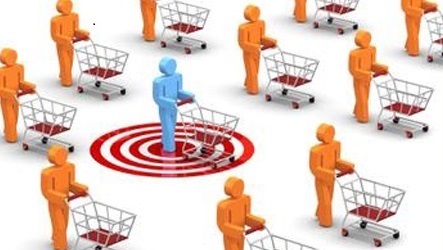
I travel a lot and I depend heavily on the GPS on my phone for directions and apps such as Yelp.  Whether I’m walking through a city, driving from the airport to my next meeting or looking for a good shoe store, my phone has become an indispensable navigation tool. That GPS has a more insidious use; it allows retailers to keep tabs on me as I shop, via tracking devices spread throughout stores (Dwoskin & Bensinger, 2013). When I try on dresses at Nordstrom, a “data manager” may collect my shopping habits.  If I spend a little extra time in the shoe department, someone may be taking notes. And then there are those occasions when I have an ice cream/potato chip/cookie craving; someone might be tracking my binge.

 tracking-shoppers

Picture retrieved from http://www.theretailintelligence.com/how-shopper-tracking-is-creating-a-new-retail-experience/

Currently about 1000 retailers use GPS tracking to monitor my shopping habits and the habits of shoppers all over the country. This allows them to make decisions related to merchandising, display and even shoppers eating habits; ultimately the goal is to boost sales and get a leg up on the competition (Dwoskin & Bensinger, 2013). During the holiday shopping rush, retailers used GPS data to shift shopping traffic to less frequented parts of the store simply by moving the most desirable merchandise to that new location.  One firm used 2012 Black Friday tracking data to determine that shoppers who arrive at the mall around midnight leave the mall around 6 in the morning, often in search of breakfast. In response, mall restaurants opened early this year, to encourage shoppers to stay longer and spend more money (Dwoskin & Bensinger, 2013).

Many retailers fail to notify customers that they are being tracked, despite an outcry over privacy concerns. Retailers insist that personal data is not gathered, or they remind us that tracking is nothing new; for years, data gleaned from credit cards and loyalty cards have allowed retailers to tailor their offerings to a customer’s needs (T-Cuento, 2013).

Concerned shoppers don’t want someone looking over their shoulder while they are shopping for underwear; for many people it evokes images of Big Brother from the Orwellian novel, 1984. Yet, firms such as Macy’s, Wal-Mart and Home Depot plan to rollout the technology to gather data and provide shoppers with targeted information, such as merchandise locations (Dwoskin & Bensinger, 2013).  While that might come in handy the next time I’m looking for donuts, I’d rather keep some things to myself.  If you feel the same way, educate yourself through the research of organizations such as The Future of Privacy Forum (http://www.futureofprivacy.org/). Speak up and let your retailer know you object; Nordstrom shoppers made an impact by protesting the retailers tracking.

Meanwhile, if you’re just looking for donuts, you’ll find them in aisle 9.

Dwoskin, E., & Bensinger, G. (2013, December 9). Business. Tracking Technology Sheds Light on Shopper Habits. WSJ. Com. Retrieved January 14, 2014, from http://m.us.wsj.com/articles/SB10001424052702303332904579230401030827722?mobile=y

T-Cuento, 2013, April 9). How shopper tracking is creating a new retail experience. Theretailintelligence.com. Retrieved from http://www.theretailintelligence.com/how-shopper-tracking-is-creating-a-new-retail-experience/

Posted in Uncategorized | 2 Comments

Disney’s Magic Bands: Brilliant or Marketing Miss?

As a marketer, I’m fascinated by the conversations taking place around big data, analytics, personalized experiences…and privacy. Since I first heard about the Disney Magic Band project, I’ve been anxiously watching from afar. This is an initiative that is so fabulous on one hand while so very controversial on the other. On the surface, the new program from Disney takes the best of big data to offer the ultimate in personalized consumer experiences. The privacy concerns surrounding the program, however, are already sparking quite the industry – and consumer – debate.

images-1
Disney Magic Bands
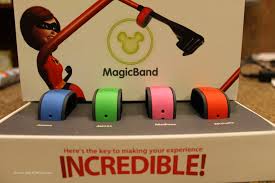
aim to reinvent the guest experience at Disney parks. Imagine a world where you can reserve a time for your favorite rides in advance; no cash is required anywhere in the park; you and your family are greeted by name everywhere you go; and, Buzz Lightyear makes a special effort to seek out your son or daughter for a quick photo opp since “Mickey knows” that is your favorite character.  With the introduction of these personalized “bracelets” this experience can be yours…for a price 😉

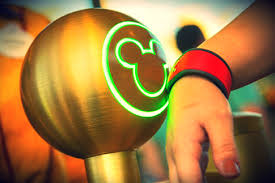
Each Magic Band is assigned and personalized for every individual in your group – including children.  The bands contain RFID technology, so not only can you use the bracelet to enter your hotel room, gain entrance to the park, and purchase merchandise and food during your visit, every move you make is tracked by Disney via these wearable devices.  If it is your birthday, Mickey and friends will know and may break out in song as you enter Tomorrow Land.  Fall in love with the cozy sweatshirt embroidered with Winnie the Pooh? No problem, just swipe your band and the sweatshirt is yours! Even waiting for a FastPass is a thing of the past. With the Magic Band, you can reserve a FastPass time on your favorite rides up to sixty days in advance and gain entrance to the ride with the swipe of your wrist.

images
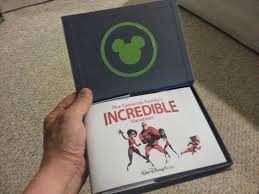
In examining this program from an integrated marketing perspective, Disney has thought of every detail…from the messaging, to the packaging, to the online experience, to how the program comes to life in the park. Here is a video that walks through one guest’s reaction to the “Incredible” package:

http://www.youtube.com/watch?v=xTTftMHRjAQhttp://

images-2
While this personalized experience sounds wonderful on so many levels, I can’t help but wonder how consumers will respond long term.  As a marketer, the ability to track this level of “move by move” data is fascinating.  As a consumer, however, I must pause and ask how much is too much? Who will have access to this data? How long will they keep this data? What else besides the “obvious” is Disney tracking that I don’t know about? How do they plan to use this data?

One article on the new Magic Band program, in particular, raises some interesting questions. John Foreman, Chief Data Officer for MailChimp blogged about his MagicBand experience and extends the conversation to what other companies are doing with sensor data, cell phone data and other types of tracking technology to not only influence the online experience, but the consumer experience in the “real world.”

With the recent Google acquisition of NEST, for example, Foreman points out that Google not only knows when we’re online, they can now tell when we’re home. Hmm. As a NEST user, I’m not sure what I think about that…

Forman also describes an in store experience where the sales associate may offer to show you a pair of earrings to go with that necklace you purchased last week…how did they know?

While I am the first to admit to being a technology geek and am personally *very* excited about the new applications now possible by advancements in sensing technology, I can’t help but wonder if we’re starting to go a bit too far? In some cases, my view is yes. In other cases…sign me up! I personally think Disney’s Magic Bands will be a hit since the whole Disney experience is meant to be over the top. I’m just not sure I want my “real” life to feel like a Disney experience every day.

I’m with Foreman on this one.  Data and personal privacy is the new frontier. While there are some novel and interesting applications on the horizon, as an industry, we have a lot of work to do to figure out where to draw the line.  And, as marketers, we need to drive the conversation.

I’d love to hear your thoughts!  Please post your comments here or shoot me an email at kelly.schwager@usc.edu. You can follow me on Twitter at @kellyschwager

Tweetable Takeaways:
“Data and personal privacy are the new frontier. As marketers, we need to drive the conversation” @kellyschwager

Resources:
Barnes, B. (2014, January 7). At Disney parks, a bracelet mean to build loyalty (and sales). New York Times. Retrieved on January 19, 2014 from http://www.nytimes.com/2013/01/07/business/media/at-disney-parks-a-bracelet-meant-to-build-loyalty-and-sales.html?_r=0

Beyond Main Street (2013, December 19). Disney’s My Magic Bands – Experience + New Package with Flash Drive Unboxing [Video]. Retrieved on January 20, 2014 on http://www.youtube.com/watch?v=xTTftMHRjAQ

Disney (2014). My Disney experience. Disney.com. Retrieved on January 14, 2014 from https://disneyworld.disney.go.com/plan/my-disney-experience/bands-cards/

Foreman, J. (2014, January 18). You don’t want your privacy: Disney and the meat space data race. GigaOm. Retrieved January 18, 2014 from http://gigaom.com/2014/01/18/you-dont-want-your-privacy-disney-and-the-meat-space-data-race/

Murphy, A. (2013, November 4). The good, the bad, and the ugly of Disney’s Magic Bands. Theme Park Insider. Retrieved on January 14, 2014 from http://www.themeparkinsider.com/flume/201311/3756/

Smolan, R. (2014) The human face of big data. Website. Retrieved January 20, 2014 from http://humanfaceofbigdata.com/

Storm, D. (2013, January 9). Big brother Mickey Mouse to monitor behavior via Disney’s MyMagic+ RFID wristbands. Computerworld. Retrieved January 19, 2014 from http://blogs.computerworld.com/privacy/21610/big-brother-mickey-mouse-monitor-behavior-disneys-mymagic-rfid-wristbands

Posted in Uncategorized | 8 Comments