Does Adam Sandler Really Eat Popeye’s? Do You Care?

Have you ever watched a television show or movie and seen the actors drinking a Coke, working on a MAC, wearing Ray Ban sunglasses or eating pizza right out of a Pizza Hut box? If you haven’t seen these particular brands, chances are very good that you have seen some other brand subtly, or perhaps not so subtly, injected into the show. Now, the question really is, did you think to yourself, “Wow, that really cool character likes that thing, so I must go out and buy it”? If you did, product placement has been an effective form of advertising.

Product or brand placement are components of a term called branded entertainment (Young, 2010). Branded entertainment is a tactic used by marketers to answer the public’s ability to skip over commercials with the use of TIVO or DVR (Young, 2010). Since movies don’t have commercials, what better way to get a product recognized, even coveted, than to pop it into a celebrity’s hand, on their body or in their refrigerator?

Does this form of advertising work, or is the public getting wise to these mini-commercials? According to Ahmed (2007), this is debatable. Ahmed says brand placement can be effective, because it can’t be skipped over. It’s not disruptive, has the star factor and contains a sly, subliminal factor. Conversely, Ahmed (2007) says product placement may not work, as consumers are aware that’s it’s really just a commercial and feel manipulated. Plus, the cost of product placement is immense, ROI is almost impossible to measure, and this type of advertising does not come cheap. Celebrities and studios are paid big bucks by brands to be “featured” (Young, 2011), and some television shows have taken brand entertainment to a whole new level. 30 Rock, for example, took a light-hearted jab at this platform (Young, 2010). With Liz Lemon (played by Tina Fey) saying in response to Jack Donaghy (played by Alec Baldwin) picking up an acquaintance’s Verizon phone, “Cuz that Verizon Wireless service is just unbeatable! If I saw a phone like that on TV, I’d be like, ‘Where’s my nearest retailer so I can get one?” Fey then holds up the phone and says to the camera, “Can we have our money now?” (Young, 2011).

Even with Ahmed’s (2007) valid points of why product placement may not work and 30 Rock’s in your face parody, Brand placement does not seem to be slowing down. The Brand Channel (Brand Channel, 2012) holds an annual Brand Cameo awards session, with winners in categories such as: Most Overall Placement, Worst Placement and Best Product Placement Stunt Double. A few of the 2011 winners are – drum roll, please…
– Apple for Overall Product Placement
– Hot Wheels for Worst Product Placement in The Green Lantern
– TGI Friday’s for Best Role in a Supporting Product Placement in Zookeeper
The other winners can be seen here: http://www.brandchannel.com/home/post/2012-Brandcameo-Product-Placement-Awards-021312.aspx

So, the jury’s still out on whether branded entertainment actually works. Nonetheless, it’s a creative way for advertisers to slip their products into your favorite shows and movies and get around the innovation of TIVO and DVR. Personally, I enjoy counting how many brands I can recognize in my favorite TV shows. Popeye’s Chicken anyone? (Just Press Play, n.d.)

References

Ahmed, M. (2007). Does product placement work? Retrieved from:

Does product placement work?

Brand Channel (2010). Retrieved from: http://www.brandchannel.com/home/post/2012-Brandcameo-Product-

Placement-Awards-021312.aspx

Just Press Play (n.d.). Retrieved from: http://www.justpressplay.net/images/stories/little_nicky_popeyes.jpg

Young, A. (2010). Brand media strategy. New York, NY: Palgrave Macmillan.

Posted in Uncategorized | Tagged , , , , | 2 Comments

Capitalizing on Insecurity and Convenience

Southern California has a culture of convenience. That’s not news. From the area that originated McDonalds and was once replete with drive in movie theaters it is not surprising that it would also be the local and proving grounds for innovations in convenience. After all, if you could do it from your car window why would you want to do it any other way?  

Now take this type of logic and apply it to an industry that is replete with history and tradition.  American Thoroughbred Horseracing.  This is an industry that is older than baseball and it has functioned with little innovation or change over the last 200 years.  Typically horse racing tracks do not rely on flashy “newness” to attract and to keep their client base.  They rely on tried and true.  This is even the case in Southern California at the Santa Anita Racetrack where I spend a good amount of time watching and wagering on races.

Racetracks around the country have been battling with dropping attendance for the last number of years now and track wagering was in a decline.  Ask any young person who has tried to go to a race track and make a bet and they will likely tell you that it is not a very user friendly or intuitive process.  In fact it is downright frustrating to do if you are new at it.  This is because wagering is done through a process of filling out a slip, standing in line, communicating your slip to a teller and then recieving a receipt for your wager.  All this is done while hordes of other race goers push in behind you waiting their turn.  If you don’t like crowds (and who does?) then it is a stressful experience.   I will be the first to admit it is not now, nor has it ever been a very pleasant experience for most, but it is just how it was always done.

Well it looks as though Santa Anita racetrack has caught up with the times and is making strides to alleviate the insecurities of their patrons and cater to the convenience of the new smart phone toting crowd.  What they, and many other race tracks around the country have done this year is opened up the betting process to be completed via a smart phone from the comfortability of your grandstand seat (or your couch at home for that matter). Xpressbet is a free service that allows wagers to be made with few clicks on your phone and money withdrawn from and deposited into your banking account.  This system, rolled out in December of last year has skyrocketed wagering at many racetracks.  At the same time it has allowed for a general reduction in wagering staff and thereby decreased overhead for the tracks.  It is becoming successful so rapidly, I believe, because it has eliminated the insecurity that many race fans feel about approaching a wagering window to make a bet.  There is no line waiting and no fear of losing your stub,  just instantaneous response.

The primary ways that the system is being advertised is through a mix of radio, web, and print advertisements at the tracks themselves.  At Santa Anita for instance there are posters and signs posted around saying “Why leave your seat?”  or “Spend more time at the paddocks and less at the window” playing upon the convenient features of the service.  I predict that the system will continue to grow in popularity and that only the dyed in the wool racing purists will be approaching an actual wagering window 2 years from now.

Posted in Uncategorized | 6 Comments

Click Goodbye to Kodak

One of the earliest birthday gifts I remember getting was a 110mm camera from my 6th grade math teacher in Middle School. Continue reading

Posted in Uncategorized | Tagged , , , | 12 Comments

Create Buzz with Connectors

What creates a “buzz” for a product? How do certain small companies become popular within months after toiling in relative obscurity? What gets millions of people talking and spreading the news about a new fad that is labeled as a “must have”?

I’d say the most prominent heroes in America today are no longer the powerful politicians or the superstar professional athletes. America has a love affair with the entrepreneur. The genius that allows people to launch a product or idea that spreads like wildfire and makes a celebrity out of those involved.

Instagram went from a seed of an idea into a 1 billion dollar acquisition in the span of 18 months. How does that happen? Sure, the products often meet a need or fill a unique niche, but there are marketing devices fueling these trends.

Word of mouth, or buzz, marketing often plays a role in creating this phenomenon of fast growing companies and must have products. Young (2010) observes that today’s advertising industry is one characterized by increasing accountability and transparency. Firms are not only looking for effective advertising, they want efficient advertising: more bang for the buck. When a simple ad, tweet, image, or video can incite a wave of conversation and interest the return on investment improves exponentially.

I’m a sales professional in health care and there is an old axiom in sales: “most selling takes place when the sales rep is not present.” Advertisers realize that consumers are not as receptive to direct advertising. The best person to influence a consumer is another consumer.

Buzz marketing is an attractive strategy for several reasons. Consumers are filtering and blocking ads at an alarming rate (Young, 2010) because they are increasingly impatient and less receptive to direct advertising. Word can spread much more quickly in the 21st century because of the social media and technology as referenced by Young (2010) when mentioning Obama’s “Hope” campaign in 2008. Word-of-mouth is the ultimate “soft sell” (Barry, 2010) because the firm is removed from the conversation entirely when consumer-to-consumer communication is the vehicle.

One method of spreading the word, or beginning a trend, is highlighted by Malcolm Gladwell (2000) in The Tipping Point. Gladwell (2000) asserts that trends are often sparked by connectors, those who have large networks and wield considerable influence. In the past few years firms have been using these connectors to begin aggressive buzz campaigns.

Who are the most common used connectors? Yes, you guessed it: Celebrities. Michelle Obama’s fashion sense has been the spark that has launched the careers of up and coming designers. “Obama’s wardrobe created $2.7 billion in value for 29 brands worn over the course of 189 public appearances from November 2008 to December 2009 (Ciccone, 2011).”

Celebrities aren’t the only connectors. Tech start ups have been enlisting college students as brand ambassadors to start word of mouth campaigns on college campuses (Rosman, 2012). In both instances, a strong buzz is created with minimal cost to the firm or brand. Obama doesn’t charge a fee from designers and college students often are willing to work for free for a chance to put “Brand Ambassador” on their resume.

As social media and technology increases the strength and size of networks, word-of-mouth campaigns will continue to be an efficient and effective advertising strategy.

References

Barry, P. (2008). The advertising concept book: A complete guide to creative ideas, strategies, and campaigns. New York: Thames & Hudson.

Ciccone, A. (2011, December 9). Michelle Obama fashion choices: A boon to some small designers. The Huffington Post. Retrieved from http://www.huffingtonpost.com/2011/12/08/michelle-obama-fashion_n_1123723.html.

Gladwell, M. (2000). The Tipping Point. New York: Little, Brown, and Company.

Rosman, K. (2012, April 4). Big Marketers on Campus. The Wall Street Journal. Retrieved from http://online.wsj.com/article/SB10001424052702303816504577321594090033560.html.

Young, A. (2010). Brand media strategy: Integrated communications planning in the digital era. New York: Palgrave Macmillan.

Posted in Uncategorized | Tagged , , | 4 Comments

Got a Problem? There’s a Crowd for That

Written by Megan Samuels


Need a centuries old mathematical theorem solved or a consumer-generated commercial for a product? No problem, there’s a crowd for that.

What’s Crowdsourcing? Crowdsourcing is like outsourcing, but different. Instead of hiring an outside firm to, say make shoes or iPads, crowdsourcing relies on non-specific volunteers all over the world to perform the task via the Internet. The volunteers are not usually paid for their efforts, but projects are often incentivized with cash, prizes and/or recognition.

The term, “Crowdsourcing” was coined by Jeff Howe in Wired magazine in 2006, but it’s actually not a completely modern concept. In the 1870s, an Oxford philologist by the name of James Murray had a little project he needed help with so he took out ads in newspapers for assistance. The task? Only to index and find quotations of usage for every single known word in the English language. No biggie–and in just 60 or so years, it was finished, becoming what is now known as the Oxford English Dictionary (OED).

Obviously, things get done much faster over the Internet! There’s a modern version of the OED project that nearly everyone who goes on the Internet unknowingly participates in. Did you realize that every time you prove you’re human by entering a CAPTCHA code, it’s more than likely you are transcribing text from old books that optical character recognition was unable to pick up? It’s called “ReCAPTCHA”, a crowdsourcing project developed at Carnegie Mellon University.

Crowdsourcing for Fun and for Free: Many of our favorite online resources only exist because of Crowdsourcing. Wikipedia anyone? I don’t know about my fellow students in the MCM Program, but I have at least 10 Wikipedia references in my research papers. Granted there’s probably a fair amount of inaccuracies, but topics often include references with links, and those links lead to even more information on the subject you seek. It’s a good thing.

So is there a marketing potential for crowdsourcing? Ask the Doritos people about the Crash the Super Bowl campaign www.crashthesuperbowl.com. A Google search for this campaign receives around 6 million hits. Also referred to as “participatory marketing” the campaign has continued for the past five years and has garnered publicity and buzz way beyond any marketing budget could have hoped for. The $25,000 prize for winning is a mere pittance compared to the brand equity Frito-Lay has been able to bank. And as Frito-Lay Chief Marketing Officer Ann Mukherjee puts it, “I have 25,000 ads in the can…and they’re free!” Click here to watch a few. They’re pretty funny:

Doritos DIY Ads

In a similar campaign, this one through Facebook, Harley-Davidson launched the “Fan Machine” where fans can submit ideas based on a brief generated by the agency Victor & Spoils.

Crowdsourcing has its detractors, especially ad agencies and graphic design firms as the ad campaigns. Crowdsourcing sites like 99designs.com allow businesses to hold contests to see who comes up with the best logo from a pool of designers from all over the world. The payout to designers is pretty low and agencies feel that it is taking business away from them.

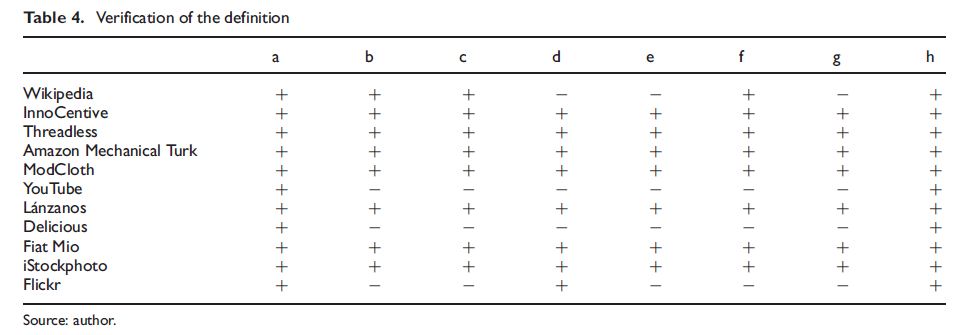
Since it looks like Crowdsourcing isn’t going anywhere, you may want to acquaint yourself with some of the finer details of what defines it. There are certain characteristics that define Crowdsourcing with corresponding examples of sites that meet some or all of the criteria:

a) There is a clearly defined crowd
b) There exists a task with a clear goal
c) The recompense received by the crowd is clear
d) The crowdsourcer is clearly identified
e) The compensation to be received by the crowdsourcer is clearly defined
f) It is an online assigned process of participative type
g) It uses an open call of variable extent
h) It uses the internet

In Conclusion: Not that this subject is anywhere near over, but this blog is. Crowdsourcing is here to stay and that doesn’t seem to be such a bad thing, especially when you consider that the concept has evolved into more benevolent channels. “Crowdfunding”, where people from all over the world donate sums from tiny to huge, can fund such endeavors as small businesses in the developing world (Kiva.org), equipment and supplies for cash-strapped public schools (Donorschoose.org) and creative projects (kickstarter.com).

Burstein, D.D. (2011). 5 lessons in participatory marketing from Doritos’ “Crash the Super Bowl” and CMO Ann Mukherjee. Fastcocreate.com

Estellés-Arolas, E and González-Ladrón-de-Guevara, F. (2012). Towards an integrated crowdsourcing definition. Journal of Information Science (38) 138. pp. 189-200.

Hongkiat.com Blog http://www.hongkiat.com/blog/what-is-crowdsourcing/

Inevitable? http://www.talentzoo.com/beyond-madison-ave/blog_news.php?articleID=13802

Recaptcha. http://www.readwriteweb.com/archives/recaptcha_stopping_spam.php


Posted in Uncategorized | Tagged , , , | 5 Comments

Don’t Hate, Collaborate – Random Collision Theory

It was last week when I walked into my director’s office and noticed something odd: The lady sitting at my director’s desk was not my director! In fact, it was someone from an entirely different department. I work in the public relations division at R&R Partners, Nevada’s largest advertising agency. We are an integrated agency offering our clients a variety of tools to help disseminate their message to key stakeholders, including media planning/buying, creative services, account management, digital strategies, public relations, government affairs, and interactive marketing.

So why was the director of our digital team sitting among the public relations practitioners? The answer lies in collaboration and integration – two words that work in tandem to help define one another. According to Kitchen and Burgmann (2010), integration with regard to marketing is “the attempt to present a consistent message across the available promotional mix elements…” (p. 1). For example, at R&R Partners our goal is to mesh marketing disciplines in our marketing toolbox to create an impactful campaign for our clients. Collaboration is how the individuals in the agency work together to get the job done in a consistent, seamless manner.

In order to foster an environment of collaboration at R&R Partners, the executives decided to move directors’ offices to other departments in an attempt to increase communication among disciplines. Directors from other departments randomly collided in order to get out of their marketing silos and interact with other disciplines. The theory stems from several challenges facing integration and collaboration at the agency level.

What’s the Problem?

Kitchen and Burgmann (2010) explain that collaboration begins with senior management. At the top, strategies are devised to maximize integrated marketing campaigns for clients. However, the idea of integrated marketing is relatively new. Formerly, agencies would specialize in one marketing discipline, such as media buying or creative services. In order to formulate a cohesive message, agencies began to integrate the disciplines to help their clients.

Of course, as new as this integration idea is, it created conflicts at the top. Kitchen and Burgmann (2010) explain that some of these issues stem from fear of change, turf battles (the need to protect one’s status, cross-functional training, the need for equal consideration across functional areas, etc.), lack of strategic vision, KPI difficulties, control issues and many more.

In essence, PR managers didn’t understand the creative process. Creatives didn’t understand how to buy and plan media. Web developers didn’t understand the flexibility of media flights. And so on.

This necessitated the need for a change to the integrated process. Collaboration became one of the biggest focuses internally at IMC agencies in order to better facilitate external clients.

Random Collision Theory

“The most valuable tribe is a tribe of unusual suspects who can challenge your world-view, expose you to new ideas, and teach you something new. A tribe of unusual suspects can change the world if it is connected in purposeful ways.” –Saul Kaplan, CNN Money

Just like the above quote states, collaboration is achieved when all parties involved are open to new ideas that cohesively drive an overall message or campaign. In a recent article by Saul Kaplan on CNN Money, the idea of “random collision” is introduced to represent how collaboration may be accomplished in an environment consisting of different personalities and expertise.

Random collision theory is the idea that marketers must think outside their own silos in order to truly present clients with opportunities that will set their products or services apart from competition. It is necessary to collide with unusual suspects in order to expand our minds and truly accomplish collaboration in an integrated environment.

The term “unusual suspects” is used to define comfort zones. Random collision occurs when one is open to step out of his/her comfort zone and mingle with unusual suspects. In order to foster collaboration, marketers need to be comfortable with interacting with others to learn new ideas and how those ideas may be used to develop new marketing tactics.

One of the most prevalent examples of random collision at work is via social media. Social media has allowed us to interact with unusual suspects and open our mind to new relationships and concepts. Kaplan (2012) explains, “We live and work in a networked world complete with mega bandwidth and social media platforms to help us collide with more unusual suspects if we just look up from our silos.” In order to achieve integration, marketers must collide with other disciplines. They must collaborate effectively and think in different silos.

At R&R Partners, random collision theory is not just an idea, but also a way of conducting business. It has changed the way we collaborate on a daily basis, making our integrated efforts more valuable to our clients. I now walk down the public relations aisle at work and talk to social media strategists and creatives on the way to my director’s new office in the media section. Government affairs associates are seen talking with digital production coordinators in the studio. Random collision has not only created an outlet for establishing new relationships at R&R, it has equipped us with the necessary tools for successful collaboration.

References:

Kaplan, S. (2012, May 9). The “random collision” theory of innovation. CNN Money online. Retrieved from: http://tech.fortune.cnn.com/2012/05/09/random-collision-innovation/

Kitchen, P. & Burgmann, I. (2010). Integrated marketing commuication. Wiley International Encyclopedia of Marketing. John Wiley & Sons Ltd.

Posted in Uncategorized | 1 Comment

The “Igniter”

Have you ever driven down Sunset Boulevard in Los Angeles? It’s an explosion of outdoor advertisements, all vying for our attention. I am big fan of outdoor; when properly executed, it’s a 24/7 avenue for invasive and creative communication. Colloquially, it’s art – amplified.

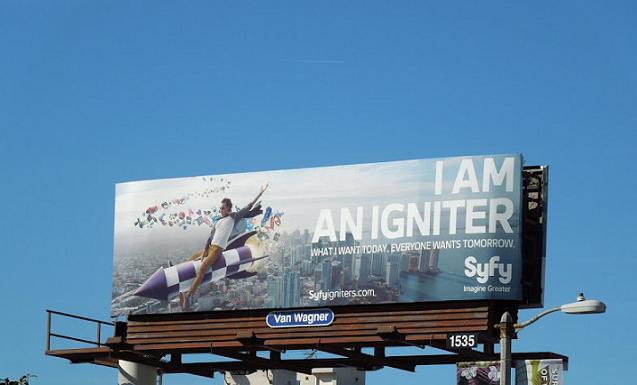
A few weeks ago I was driving on Sunset, and noticed two advertisements from Syfy, the science fiction and fantasy programming cable network. They immediately caught my attention. Here are the ads:


These advertisements intrigued me because they’re in the voice of the individual, not the brand. Whenever I see the word “I” in advertising, I’m drawn in. Someone is personally taking control of a message. To me, it is this ownership that can often times have more validity than a “buy me now message” from Budweiser or McDonald’s, for example.

The marketer in me (I studied marketing in undergrad, and currently work in marketing at Universal Pictures) is constantly analyzing marketing communications of brands. I do my own personal assessment of what I think is working, what’s not, and what are the up and coming messaging trends. Brands are successful at marketing when they create an ad (via any channel) and entice the consumer to find out more. If a consumer is willing to do more research, invest their own time and energy, it’s a win in regards to initial communication strategy. As Young (2010) states in this week’s readings, this is where awareness, involvement, and active consideration can occur.

But with so much noise in the media landscape, messaging all too often comes and goes without any impact on the consumer. The Syfy ads stuck a chord with me, however. I saw the ads and immediately asked myself “Igniter? How does this relate to Syfy? I need to find out what this is about.” And to the internet I went.

What is an Igniter?

In January 2012, Syfy and research firms PSFK and Simmons partnered together to research today’s consumer. Based on the results, Syfy believes that the consumer is “more powerful today than ever (“Syfy uncovers, 2012).” But there is a particular type of consumer that the network has deemed powerful – the Igniter. But what defines an Igniter? Below are characteristics that the cable network believes describes this powerful consumer.

  • Insatiable need to constantly be in-the-know about the latest and greatest everything.
  • Must-have mentality drives them to try, do and buy the next big things.
  • Vocal in telling everyone about their latest finds. Because they’re at the forefront, people listen to what they have to say.
  • Optimistic
  • Rethink Status Quo
  • Inventive
  • Risk Taker
  • Creative
  • Open-Minded

Take a look at the below video for a visual description of an Igniter.

Syfy Igniter – Video Ad

Here’s a cull of the narration from the above ad.

An audience that lives for the next big thing. Who’s the first to try it, the first to buy it, and most importantly, the first to tell everyone about it. They’re Igniters. What they buy today, everyone wants tomorrow. And where do you find this audience? Syfy.

I like what Syfy is doing with this creative. What do you think? Does it work? I believe the ad does an effective job at integrating marketing into everyday life, and depicts Syfy as the place where brand advocates are located. According to the network, its programming (and subsequently its viewers) is advantageous for advertisers.

Essentially, the video ad tells me that brands move around, they are no longer static. This concept is very much in the vein of Young’s (2010) “liquid media” theory. Consumers (Igniters) have the power to propel a brand (“seamlessly”) through numerous channels, and to numerous audiences.

Selling the Igniter to Advertisers

Syfy’s Igniter campaign is ultimately a sales pitch to advertisers to buy media on the network. To help its case, the network does have leverage with several statistics.

In an 18-49 index by cable network, Syfy claims to be the “best place to find Igniters,” with a leading index of 112 (“Cable upfront,” 2012). Last year was the most-watched year ever, with an average of 1.2 million viewers in prime time 2011 (“Cable guide,” 2012). Lastly, “Syfy posted double-digit gains for men, women and adults in the first quarter of 2012 compared with the first quarter of 2011 (“Cable guide,” 2012).”

An Extension of Re-branding

It’s interesting to note that this is not the first time Syfy has gone through a re-branding stage.

In 2009, the SciFi channel went through a re-branding phase, where the network was renamed Syfy, and a new logo was born (Karpel, 2012). This was executed by David Howe, President of Syfy, all in an effort to deviate from perceptions that sci-fi programming is only viewed by males, and as a way to give the channel a fresh look keen on innovation. Howe states that the intention was to create a brand that “was extendable into new platforms (Karpel, 2012).” As leverage, Syfy.com just had its best year ever, with 3.7 million unique views and 30 million page views. The network also has a Facebook and Twitter account.

I remember not being a fan of the new Syfy logo. At first. I thought it was very pedestrian and didn’t speak to the core viewers. But over time the logo grew on me, and I can actually appreciate its meaning. It broadens the capabilities of the network, as the previous logo was very focused and suffocating in terms of creative potential. The new logo is open and diverse. Much like its programming and much like its audience.


David Howe, Syfy president

No More Inside Walls

Author Chris Grams wrote a book in 2012 called The Ad-Free Brand. He discusses the rising power of the consumer, and the necessary actions of organizations to be accepting of this power.

The Syfy ads reminded me of Grams’ book because it embodies so many aspects of the author’s ideas. Here is a particularly important statement from Grams:

Brands are no longer built inside the walls of corporations, but instead they are built together by organizations and the communities of customers, contributors, partners, and detractors surrounding them (p.8).

The Igniter campaign creates a relationship between the network and the consumer. And the advertiser.

Cheers

Cheers to Syfy for being proactive in its communication with advertisers. The network is ultimately out to get business, just like any other organization. But this strategy is smart and definitely different than what I have seen from other networks. I would say Bravo is the only other network with comparable initiatives.

Syfy has taken what everyone “talks” about, and has put it in writing, into action.

Sources:

Cable guide 2012. (2012). Retrieved from http://brandedcontent.adage.com/cableguide2012/network.php?id=64

Grams, C. (2012). The ad-free brand. (p. 8). Indianapolis: Que.

Karpel, A. (2012). Syfy president dave howe on how to capture more diverse audiences. Retrieved from http://www.fastcocreate.com/1680084/syfy-president-dave-howe-on-how-to-capture-more-diverse-audiences

http://www.syfyigniters.com/

Syfy uncovers how highly imaginative people – igniters – move brands forward faster. (2012, January 18). Retrieved from http://www.thefutoncritic.com/news/2012/01/18/syfy-uncovers-how-highly-imaginative-people-igniters-move-brands-forward-faster-881203/20120118syfy01/

Young, A. (2010). Brand media strategy: Integrated communications planning in the digital era. New York: Palgrave Macmillan.

Posted in Uncategorized | Tagged , , , | 6 Comments

What’s in a 140 Characters?

Twitter has fundamentally changed the manner is which millions of people communicate.  Its impact on society has been profound.  If you are not engaged on Twitter, then you are missing out on this evolution and revolution in media communication.

So, What Exactly Is Twitter?

Twitter is a simple platform for electronic communication.  You are only permitted to type a maximum of 140 characters, yet able express whatever you like.  You have the ability to type in a status update on what you are doing at the moment, share an opinion, or a link to a blog or article that you like.  Incredibly, Twitter provides an outstanding platform to share breaking news updates concerning world events.  For example, twitter users were able to share Tsunami warnings in Japan by providing second by second updates that informed at-risk victims and aid workers, perhaps saving many lives.  But for many, Twitter, with its millions of users, provides the ideal platform to stay informed on major media events and trending topics.

What’s In A Hashtag?

The hashtag symbol, “#,” provides a great way to seek out information on an endless amount of topics.  By searching #eurocrisis, you can get information from twitter users on their thoughts about this current global event.  It provides a great way to see and read divergent views on matters.  Or, if you want to find people with similar interests, you can search #yoga and find people who share your passion for this exercise form.  The hashtag becomes your vessel to search out information to satisfy your curiosities and connect with those who share your interests.  Once you find people who share your interests or seem interesting, you then have the ability to follow them.

Why Do Twitter Users Want Followers Anyway?

Those new to Twitter may be confused by the concept of “followers.”  It is important to remember that followers are not the same as stalkers.  Followers are people that have searched profiles or tweets of people who they feel share common interests or think are interesting.  In other words, these people want to be your friend. But, don’t worry; you do not have to follow them back.  In the end, look at every new follower as someone you can potentially connect with.  Every time you receive a new follower, you should check out their profile and tweets to see if this is a person you would be interested in following.

Getting Started

Getting started on Twitter is free, easy, and takes only a few minutes.  You simply register your name, email address, create a password, and pick a twitter handle, or name.  You then fill out a profile, limited to 160 characters (which still confuses me as to why you get an extra 20 characters).  But, feel free to take advantage of the extra digital real estate.

Finally, you can then tweet your first message.  This is critical, because what you first tweet will determine whether anyone will ever follow you.  Okay, I am totally kidding, have fun with it and type whatever you like (well, maybe not?)

Twitter Can Censor What You Say?

Twitter is a great way to express your opinions on an endless array of subjects.  However, recently, Twitter has come under fire for its ability to “censor” tweets in certain countries.  According an article in USA Today titled “Twitter may censor tweets in individual counties,” Twitter has refined its technology to allow for the censorship of topics that local governments do not want its people to read.  It is no secret that countries like China, which currently blocks Twitter, and others around the world filter media sites.  Many groups are protesting this technology as they feel Twitter should protect First Amendment rights everywhere in the world.

However, while I am a champion of First Amendment rights, I see nothing wrong with Twitter filtering this content in other countries.  Twitter must follow the laws of other countries when doing business in those countries.  If countries like China want to filter content, then that is their right to do so!  We cannot impose American First Amendment rights on other countries and have our corporations break laws in these countries in the pursuit of freedom.  If the people in these countries want unfiltered content, then they need to take it up with their country leaders.

Reference

Scarff, Oli. (2012, January 27). Twitter may censor tweets in individual countries. USA Today Tech. Retrieved from http://www.usatoday.com/tech/news/story/2012-01-27/twitter-censor-tweets/52811702/1.

Article written by Joshua Sutterfield.  Known in the Twitter world as @SavvyJosh.

Posted in Uncategorized | Tagged , , , | 10 Comments

Is BuzzStream Buzz-Worthy?

I had never before heard of BuzzStream and since I spend a large majority of my time on the computer (and online) I would like to think that it is simply not that big of a name, yet, and not that I am out of touch with the up and up. In all honesty, either could be true. I actually came across this interesting marketing tool while chatting with Appency Press Owner, and friend of mine, Aaron Watkins. He claims to use it every day and loves it! I trust this guy, so I figured I’d sign up for the 14-day free trial and check it out for myself…

A Tool for Intergration

Kitchen and Burgmann (2010) have a clean and clear definition for the term “integration”. According to them, integration occurs when a consistent message is presented across all of the promotional elements a company uses. BuzzStream makes this easy to do from the PR perspective. This can be tricky because it’s not like a commercial or magazine add, where you create it and then have it sent out a thousand of times. PR is a lot more personal and requires that each individual contact feel like they are receiving your undivided attention. Of course this requires that more than one person be working on your contact list (which is, hopefully, filled with at least thousands of names). BuzzStream helps all staff members to maintain an integrated approach to PR by allowing you to…

  1. Create Templates for Promotional Emails. Each time you have a new message to send out you can create a template with the basic information and then personalize with your contacts’ information. This allows for mass emailing to run faster, but, hopefully, stay out of the SPAM filters AND give the impression that each email was personalized for the receiver.
  2. Assign Contact Tasks to Staff Members. BuzzStream allows you, the owner (or manager), to divide and concur. You can have a staff member be in charge of  specific relationships or a group of people that all, for instance, might be interested in your iPhone App (as opposed to your Kindle Book!).
  3. View Relationship Progress for all Contacts. Here is the key to the integration process. Instead of just trusting your employees, you can actually see all of the communications they are having with your contact list. Are they responding to potential clients’ tweets? Have they been exchanging emails? And are the emails being written via the proper templates and protocols?

Networking Through Stalking = BRILLIANT

Kitchen and Burgmann (2010) tell us that marketers should develop a well-established relationship between the company and the customer and what better way to do that then to do a little “background research” first! BuzzStream allows you, the company, to keep tabs on the most influential people in your field, collecting their various forms of contact information FOR YOU. So, when you are ready to take the plunge and offer them your product, you already know enough about them to be able to tell them exactly why they need this product (and maybe even do a little brown nosing)!

Also, BuzzStream lets YOU decide who is influential in your field. So as you cruise around the World Wide Web, reading blogs and articles (like all good PR boys and girls), you can “Buzzmark” the authors you think need to know about YOU (someday, not today, after you have stalked them sufficiently to be able to impress them!). The Buzzmarker is super easy to install and works exactly like a bookmark in the sense that when you find an article you like, all you have to do is click your buzzmarker (placed in your bookmarks bar) and you’ve created a whole new profile for that author!

Don’t worry BuzzStream won’t leave you on your own to find the golden influencers (although you can add your own contacts as you wish). No no, Buzzstream is going to help you find your “influencers!” Truthfully, this feature isn’t as well developed as it could be, but it does allow for you to create a search for various keywords that will be searched for across Twitter and most blogs.

Stalk N’ Tag

Where would we be today if we couldn’t TAG things? Lost. BuzzStream allows you to REALLY sort your contacts anyway you want by creating tags for everyone! You can categorize people based on anything you want, as well as attach any pertinent tweets or blogs they have written to their profile! This way you can truly personalize your PR strategy!

Some may call it research… some may call it stalking… I call it INTEGRATED PR!

Sources: Kitchen, P. & Burgmann, I. (2010). Integrated marketing communicationWiley International Encyclopedia of Marketing. John Wiley & Sons Ltd.

Posted in Uncategorized | 4 Comments

2011 SEO Trends & Questions

I came across the following post on a blog called ProvenSEO.com.  It brings up some interesting SEO trends taking place right now that include:

Social Media Optimization

SEO Trends for 2011Social media optimization is the new trend because of the growing popularity of social media sites. This is a very good opportunity for website promotion, increasing rankings with search engines and increasing traffic. This is also a great way to boost a website’s SEO prospects. This is why experts are now focusing on social media optimization and its different benefits to particular websites. Although this is still in its infancy stage, it has already been proven to have a considerable effect on SEO.

Mobile Internet

Smartphones, tablets and other devices are now one of the most popular means of connecting to the internet. This is because of the convenience of using these devices. Connecting to the internet is very easy and can be done almost anywhere. Therefore, the need for mobile SEO is now more essential than ever. This also brings a significant amount of change regarding SEO. Mobile websites require some minor changes regarding SEO like shorter keywords. Applications such as Mobile Search Services from Google and mobile keyword tools like AdWords are now available because of the popularity of mobile internet connection.

Importance of On-page SEO and Website Speed

Webmasters used to rely mostly on off-page optimization instead of on-page optimization. However, both are now almost equally important in order to have optimal results. The load time of a website is now also very important because the top search engines like Google are now penalizing sites that have a long load time. In addition, search engines are also giving low rankings to sites that use Meta tags improperly.

Personalize Searching

This is one of the most important trends in searching for 2011. Google, the largest search engine in the world have even made personalized search the default option. This means that users will only have personalized search features unless they specifically choose not to during a search. This means that popular sites which are frequently visited will have better search rankings for 2011. Hence, it is very important to build up a website’s branding and entice more visitors.

Some of these points listed in this article seem common sense, but they do raise some questions as well:

-How slow is too slow for a website?  How long will you wait for a page to load before you just close out and move on?

-Are you more likely to click on the paid ads or organic listings on Google?

-Have you personalized your search features on Google?  If so do you feel that their is significant value-added for others to do this?

Posted in Uncategorized | Comments Off on 2011 SEO Trends & Questions