Designing Children

Are Kids 6+ the Next Competition for App Designers and Marketers?

Tiny Tapps’ iPad App Signals an Ushering in of a Whole New Wave of Really Young App Developers and Graphic Artists


Move over Zuckerberg – you are gettin’ old school…fast.

Like with athletic phenoms, musical prodigies and other computer nerds the youth movement is moving quickly and aggressively into the tech side of applications and software.  Not the consumer demo side – the designer side. But we aren’t talking about teens anymore.  Tiny Tap is the latest of the apps to transform children into techtykes by helping them customize a game or playable book with their own photos, cam shots, music, narration and other techniques that can be shared.  What better way to learn how to tell a good story, and isn’t a good storyteller also a good marketer?

Out of 200,000 plus, iPad apps (Apple, 2012) TinyTap (http://techcrunch.com/2012/05/25/tinytap-app-lets-kids-create-customized-ipad-books-games/#comment-box) is one of handful that takes home schooling to a new level and may signal a trend in better assisting our young people with developing applicable skills in this sprawling technological landscape, through story telling, graphic design and programming.  This also puts those teachers turned software company advisors in a peculiar position –from front seat to back in favor of the actual users of the software (Donahoo, 2011).

Not to leave aspiring writers and artists out of the game, the Scribble Press application (http://itunes.apple.com/us/app/scribble-press/id487300076?mt=80) allows children to draw, color or write designs and messages utilizing a number of app features like markers and other tools.  Like TinyTap, Scribble has templates and examples that are offered in this free app to help children kick start the process.  Once the art is complete, the eBook can be published, printed and mailed (w/ a $9.99 purchase through the app) in soft or hardcover book.

As a marketer of “Big Kid” apps for iPhone and iPad (check out http://www.good-fish.com) and an amateur app developer (more Will Ferrell in The Other Guys than Zuckerberg), I understand the interesting characteristics of developing new ways for people to interact, using visuals and words to engage.  It’s only natural that as we acknowledge as we are teaching our children, they are listening and learning, and teaching us a thing or two as well.

I suppose easing kids into rather than PHP, Eclipse, Android SDK or other software/app language programming, these fledgling apps might provide them with the baby steps (couldn’t help this pun) before moving on toward bigger, more available projects.

But before we put this subject to bed, so to speak, the question has to be asked:  Do we really need that much more competition, especially from those young enough to be our kids?

As of this article’s publishing, the number of active iTunes App Store publishers in the U.S. is 162,296 (148 Apps, 2012).  [Sorry, no age statistics were available]  The numbers of children developers can only grow. Progress, right?

Apple.com (2012) App Store -Apple iPad. Home page.  Retrieved from http://www.apple.com/ipad/from-the-app-store/

148 Apps.Biz (2012). Number of Active iTunes App Store publishers in the U.S. (June) Retrieved from  http://148apps.biz/app-store-metrics/

Chen, Y. (2012). iPad App Lets Children Create & Publish Their Own Hard-Cover Books. (Jan. 11).  Retrieved from http://www.psfk.com/2012/01/publish-kids-books-ipad.html

Donahoo, D. (2011). Teachers: An Untapped App-Development Resource.  The Huffington Post. (August 29). Retrieved from http://www.huffingtonpost.com/daniel-donahoo/educational-apps_b_875736.html

Perez, S. (2012).  TinyTap App Lets Kids Create Customized iPad Books & Games.  Techcrunch.(May 25). Retrieved from http://techcrunch.com/2012/05/25/tinytap-app-lets-kids-create-customized-ipad-books-games/#comment-box

Posted in Uncategorized | Tagged , , , , , , , , , | 13 Comments

Taking Brand Messaging to a whole other world.

FaceBooks recent IPO debacle, in contrast to Google’s more stellar public release, does not diminish the company’s intrinsic value. Its true value stems from its biggest asset, its more than 800 million registered users worldwide. Essentially it has become the largest direct-mail listing service ever known and does not require the mailing of postcards to deliver a brand’s messaging. Yet, before there was FaceBook, there was another form on on-line social activity developing, the virtual world.

In June of 2003, Linden Labs created a virtual world called SecondLife. In this virtual reality world a person can become any character they can envision. It quickly became a destination spot for on-line gaming enthusiasts and where people gather, commerce follows. An economy quickly developed and even allowed some early merchants like  Ailin Graef to generate real world wealth through, of all things, selling real estate! As this world matured more and more real world companies ” Reebok, Nike, Amazon and American Apparel, migrated to it and set-up shop “in-world”. The benefit for advertisers here is that the brand experience can be made interactive, even if fictitious.

Fast forward now to 2012 and we find that people are more apt to consume virtual entertainment, news, sports and all levels of personal (and anonymous) communication on smaller mobile devices and go without an on-line avatar. With apps like Angry Birds generating millions of dollars in both direct sales and advertising revenues these little entertainment and productivity applications have become ubiquitous. Never mind the effect Twitter has had on word of mouth advertising previously found only on on-line product review sites.

All of the above social media technologies have served to fracture mass media’s hold on the consuming public. This creates the dilemma of stretching advertising dollars further than ever before. With fewer and fewer ad dollars being spent on traditional media like print, radio, and  television and the fact that consumers’ attention is getting harder to capture the job of marketing professionals is  moving beyond engaging message receivers and simply trying to locate where they now reside.

Ultimately, the purpose of marketing is to place the brand in the line of sight of those with an interest in the service or product. In order for marketing to accomplish the goals of emotionally connecting with consumers, eliciting a response, and causing a desired action it must now first locate its intended demographic in an entirely new world of media consumption and do so in fractions of a second. It seems that today the marketing professionals needs to be more “hunter” than salesman.

Resources:

Bianco, A., Lowry, T., Berner, R., Arndt, M., & Grover, R. (2004, July 12). The Vanishing Mass Market: New technology. Product proliferation. Fragmented media. Get ready: It’s a whole new world. Bloomberg Businessweek. Retrieved from http://www.businessweek.com/magazine/content/04_28/b3891001_mz001.htm

Edmoston, P. (2009). Google’s I.P.O., five years later. (Dealbook), New York Times.com, Retrieved from dealbook.nytimes.com/2009/08/19/googles-ipo-5-years-later/?pagemode=print

Hamburger, E. (2011, November 2). Angry Birds hit 500 million game downloads worldwide. Business Insider. Retrieved from http://www.businessinsider.com/angry-birds-sales-numbers-2011-11

Peterson, T. (2012, May 24). Facebook IPO word-of-mouth win for Twitter: Sentiment mostly positive for Zuck and company. (Technology), Adweek. Retrieved from http://www.adweek.com/news/technology/facebook-ipo-word-mouth-win-twitter-140759

Raice, S., Dezember, R., Bunge, J. (2012). Facebook’s IPO sputters: Underwriters Forced to Prop Up IPO of Social Network; Only a 23-Cent Rise. (Technology), Wall Street Journal. Retrieved from http://online.wsj.com/article/SB10001424052702303448404577411903118364314.html#printMode

Siklos, R. (2006, October 19). A virtual world but real money. (nytimes.com), The New York Times. Retrieved from http://www.nytimes.com/2006/10/19/technology/19virtual.html? _r=2&adxnnl=1&pagewanted=print&adxnnlx%E2%80%A6

Posted in Uncategorized | Tagged , , , , , , , | 4 Comments

The Power of Free

Did you say “free?” I’ll admit that I was slow and hesitant to dive into the world of online Continue reading

Posted in Uncategorized | 2 Comments

24/7 Connectivity: Is that a good thing or a bad thing?

Bling, bling. “What was THAT?” my mom said. It was a lazy afternoon, and we were watching three giraffes drinking water out of the watering hole about 100 feet in front of us. We were separated from them by the electrical fence that keeps elephants out at night, but it doesn’t do anything against the vervet monkeys that swoop in from the trees and steal the orange juice from the kitchen in the mornings. “I just got an email from Hans. It’s just work stuff,” said my dad.

My dad was working; that wasn’t a surprise. What was a surprise was that he was able to pick up a 3G connection about 30 miles outside of Dixie, South Africa. Dixie is about three hours by car from the nearest city. Dixie doesn’t have electricity. It doesn’t have running water, it doesn’t have a grocery store. It has a preschool, a storefront for passing tourists that’s open sometimes and a town elder. Goats roam the area, giant cooking pits are in front of every house, and floors are made of dirt. If you have windows on your house, you’re living big. And to get to the safari camp where we were, you have to go right through the heart of Dixie on the long, straight, dirt road, dodging cows and the occasional springbok along the way.

Staying connected is a wonderful thing. It enables you to keep up to date with news and Facebook from all corners of the earth, but it enables you to stay connected to work 24/7 also. A component of globalization means people need to stay connected and be available at all hours of the day and night to work. Another component is that employees need to be able to work flexible hours, which is part of what work-life balance tries to promote (The Economist, 2006). In fact, IBM reported that about 40 percent of its workforce works from home during flex hours (The Economist, 2006). This allows employees to complete personal obligations while also getting their work done. So in one sense, being able to stay connected from the most remote places on earth really is fantastic. But is it really necessary? When you take a holiday, shouldn’t you enjoy it, rather than worry about your email going off continually?

I think disconnecting is part of what makes holidays so relaxing. No work stress, no wondering if so-and-so got your email before you left and has responded, no fretting over emails that come across and feeling obligated to respond. Rather, your time away from work should be spent enjoying the company of who you’re with and experiencing something new. That’s why you take time off to begin with, right? To get away?

But it’s getting harder and harder to do that. I used to not mind my regular four-hour flights to our North American office in New Jersey because it meant I got to read my book, nap and enjoy the peace and quiet. Now with Wi-Fi on almost every American Airlines plane that flies to Newark, I spend those four hours typing away on my laptop and staying in touch. Lufthansa is about to make that an even bigger reality: the German airline has started offering Wi-Fi on trans-Atlantic flights (www.lufthansa.com). FlyNet, what Lufthansa is calling the service, is available on north Atlantic routes to start out but plans to have the service available south of the equator as well. This service is being very well received, and almost 20 percent of the airline’s long haul fleet is now equipped with the technology (www.lufthansa.com).

Despite my reluctance to stay plugged in all the time, I think it is the reality we have reached. The first ever phone call was made from Mt. Everest not too long ago, and Wi-Fi connectivity seems to be everywhere.

That afternoon in South Africa, my dad chose not to respond to his email; instead he enjoyed the giraffes and eventual wildebeest that came trudging through the field. But that doesn’t mean I didn’t find him catching up with the rest of the world after dinner that night. I guess when you’ve got to do work or be in touch with the rest of the world, being connected isn’t such a bad thing after all.

References:

Accessing the internet at cruising altitude. Retrieved June 2, 2012 from http://konzern.lufthansa.com/en/themen/net.html.

Anonymous (2006). Special report: life beyond pay – work/life balance: The Economist, 379 (8482) p. 84.

Posted in Uncategorized | 5 Comments

3 Reasons Why Your Brand Is Boring

Watch this video to truly understand how to not have a boring brand.


“The brand is not really controlled by marketing people, despite their huge budgets, their research programs and their panoply of branding, advertising and event managing…the brand is controlled by us—the consumers.”
Pete Barry
The Advertising Concept Book

Posted in Uncategorized | Tagged | 4 Comments

Driving Brand Awareness By Letting Others Do Your Talking

When I took my first job as a public relations account executive in an integrated marketing agency back in the late 90s, the vast majority of our technology clients spent a large percentage of their marketing budgets on the creation and placement of advertisements. The promotion of their products through the public relations discipline was an added luxury if there was some additional budget to spare. Then in the mid-2000s, print publications went digital and social media hit the mainstream – and how the roles have changed.

Today, all of the clients that retain my company’s public relations services primarily utilize public relations strategies and tactics, including social media marketing, to build brand awareness and drive the demand for their products and services. Very few of the clients devote budget towards advertising of any kind. What has changed the dynamics of marketing communications in the past decade to cause this shift in marketing strategy?

A study conducted by Nielsen in 2007 found that when deciding what products and services to purchase, consumers place the highest level of trust in the recommendations from other consumers (Nielsen, 2007). In fact, a report published by the Institute for Advanced Studies at Landcaster University reported that 95 percent of respondents do not trust advertising and only 8 percent trust what a company says about itself (Robles, 2010).

With such a high level of distrust in the messages conveyed through advertising, consumers have turned to trusted sources for information on products and services – their family and friends, or other unaffiliated individuals that have experience with these products and can provide an unbiased opinion of the product and brand. It is for this reason that public relations has become such an important component of the marketing communications strategy for many product companies. Through public relations tools, companies promote their products and services through articles and product reviews through the published work of unaffiliated individuals in the broadcast, print and online mediums. Social media allows product information and testimonials to be spread quickly among an individual’s close circle of family and friends providing valuable endorsements for companies and products that can quickly turn into sales.

Though the roles have switched and public relations has become the marketing communications tool of choice over advertising for many companies, there is still an important role that advertising fills. Advertising can be very effective in placing product and service information, including benefits and differentiators, in front of the eyes of their target audiences in a controlled manner. The visuals and messages conveyed through well-placed advertisements can open the eyes of a potential customer. With knowledge and interest in a particular product or service, the potential customer can then turn to the testimonial of a friend, family member or trusted journalist which can then open their wallet.

Nielsen (2007, October 3). Global Survey: Word-of-Mouth the Most Powerful Selling Tool. Retrieved from http://www.marketingcharts.com/television/global-survey-word-of-mouth-the-most-powerful-selling-tool-1884/

Robles, P. (2010, May 20). eConsultancy.com. Consumers don’t trust advertising, is social media part of the solution? Retrieved from http://econsultancy.com/us/blog/5927-consumers-don-t-trust-advertising-is-social-media-part-of-the-solution

Posted in Uncategorized | Tagged , , , , , , , | 3 Comments

Making Marketing Mobile

Another significant shift is beginning to occur in how consumers utilize the interactive space.  The growth of ownership and usage of mobile devices such as smartphones and tablets is beginning to affect user behavioral patterns and interactions with online content.  Pricing levels are making mobile devices more affordable to larger number of users.  More robust apps are being introduced and access speeds through mobile devices are increasing. These changes will result in motivating marketing executives to further evolve strategic and tactical marketing plans to be in position to effectively and efficiently engage consumers through these mobile platforms.

Mobile device ownership continues to show strong increases in all major demographic categories.  According to eMarketer, smartphones will be comprise just over half of total mobile devices in use by the end of 2013, and the area of strongest growth will be in adults who are 25 to 55 years old.  For the first time, smartphone sales outpaced traditional PC sales in 2011.  The iPhone from Apple and Google’s Android-based smartphones from other manufacturers dominate the smartphone market, with sales for both device types continuing to outpace year-over-year sales.  ComScore rankings show Android devices holding a slight edge over the iPhone in overall smartphone users, but iPhone user growth outpaced Android by two percentage points in the fourth quarter of 2011.

Rapid growth in the tablet market is predicted to continue in the near term as well.  Apple’s iPad sales have shown no sign of dropping off with strong unit and revenue growth continuing, assisted by the introduction of the new iPad device in early 2012.  Android-based tablet sales are also increasing, with several major manufacturers such as Samsung and Asus releasing much-improved devices with the most recent Android operating system in the spring and summer of this year.  Unit sales of all tablet platforms will hit close to 500 million by 2015 (Business Insider’s BI Intelligence).  As consumers begin to use tablets in ever-increasing numbers, PC sales are beginning to decline in response.  IDC, who provides research and market intelligence to the technology sector, says that tablet are, and will continue to have, an adverse effect on PC sales as the overall economy sputters and more advanced devices are introduced into the marketplace.

What does all of this mean to marketing professionals?  Mobile marketing becomes an even more significant touch point in overall marketing plans.  Another piece of the marketing puzzle for companies and brands will need to be explored, developed and implemented on a much greater level than is currently the case.  As consumers lean more heavily on mobile devices, the messaging and interactions will have to be delivered to where the people are. With mobile devices, your audience can be anywhere, at any time.  Consumer engagement can include activities including researching products for purchase, looking for deals or discounts on those products, even up to and including point-of-sale comparisons.  Instead of being tethered to a computer at home or the office, consumers will be able to access information in just about any place or setting.

There will be challenges in meeting the needs of clients, as well as working in the limited physical space that the smaller screens present.  The solutions to website, banner and search marketing have involved a great deal of “trial and error” over time, and in many ways, that continues to be the case.  There is not a one-size-fits-all approach that works across all segments of the marketplace.  Indeed, while some commonality exists in planning and implementation, the necessity for custom-tailored tactics remains. This is certainly the case with mobile marketing.

Developing parallel campaigns for Web and mobile can’t be ignored.  Any online presence will need to be built or optimized for mobile devices.  An example of an issue in marketing for mobile can be related to Facebook.  The social media giant has many opportunities and greater space for advertising and brand messages on the traditional Facebook website.  But Facebook has not had a great deal of success in providing similar experiences through the apps designed specifically for mobile.  This is most likely the result of the limited real estate mobile’s small screen provides.  As Facebook has recently become a publicly-traded company, many analysts and industry experts have stated the ability to market inside the Facebook mobile platforms will play a significant part in the company’s long-term success.

In implementing mobile marketing elements, companies have the opportunity to integrate current campaigns or create unique activities for mobile.  Regardless of the direction, some very basic requirements should be met. Messaging should be fine-tuned for the platform, allowing the delivery of information in a much more confined space.  Graphical and visual elements should be designed specifically for mobile environments that will have make impressions, but not consume large amounts of data bandwidth.  Forms for collecting consumer information should be designed to fit the device and environment.  Use of bar code scanning or QR codes might be suggested to take advantage of other functionality of the mobile device.  Sidewalk marketing tactics could be employed to deliver location-relevant information or specials inside a store.  In addition, location apps such as FourSquare could be used in conjunction with a unique offer available in-store only to entice a “check-in.”

These are just a few suggested tactics that could be used, but with the ability to “follow” a consumer wherever they are, there are many more creative ways that brands and companies can effectively use to make available content and information that will provide incentive and value to consumers, and highly successful engagement opportunities for marketers.

Posted in Uncategorized | Tagged , , , , , , , , , , , , , , , , , , , , , | 2 Comments

But how many marketing vehicles should I choose?

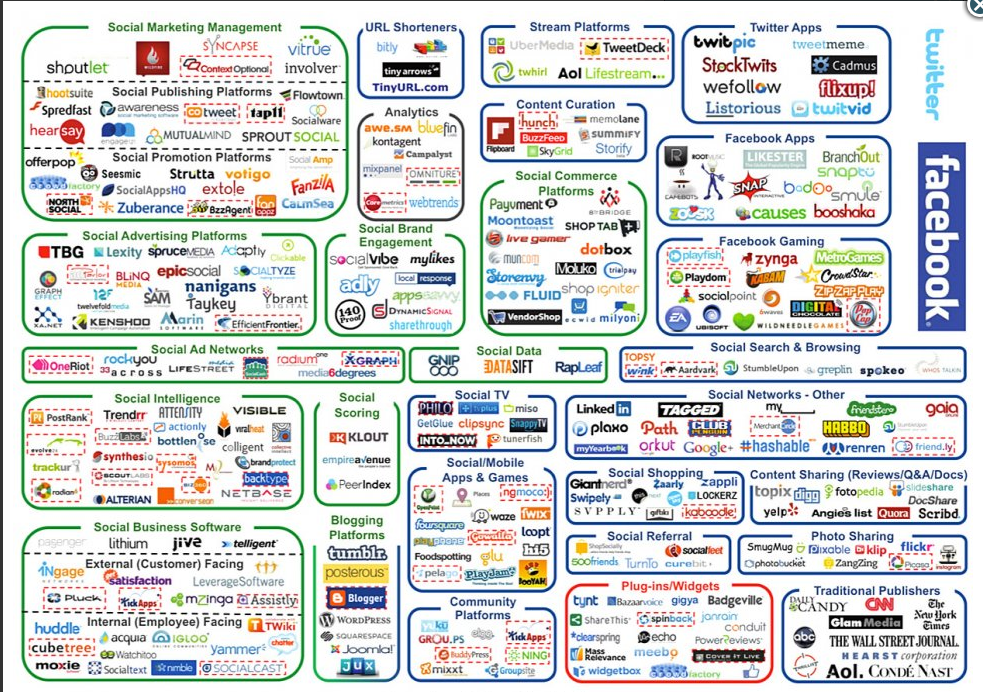
I certainly agree with Kitchen and Burgmann’s assertion that integrated marketing communication assists companies in coordinating consistent messages across various channels of communication (2010).  In addition, the authors write that the idea of integration is viewed by most marketing practitioners as “common sense.” (2010, p. 15).   However, I have found that the task of deciding exactly which elements to incorporate into the marketing mix can be overwhelming due to time and resource constraints.  For example, the relatively new category of social media provides a daunting landscape to pursue as illustrated in the diagram from Business Insider:

I set out to determine if there was statistical evidence as to the number of channels a tech marketer, like myself, should try to incorporate into an integrated marketing communications plan.  Fortunately, the analyst Daniel Klein of respected research firm, Forrester Research, wrote a blog that I found helpful and thought would be of interest to our class.

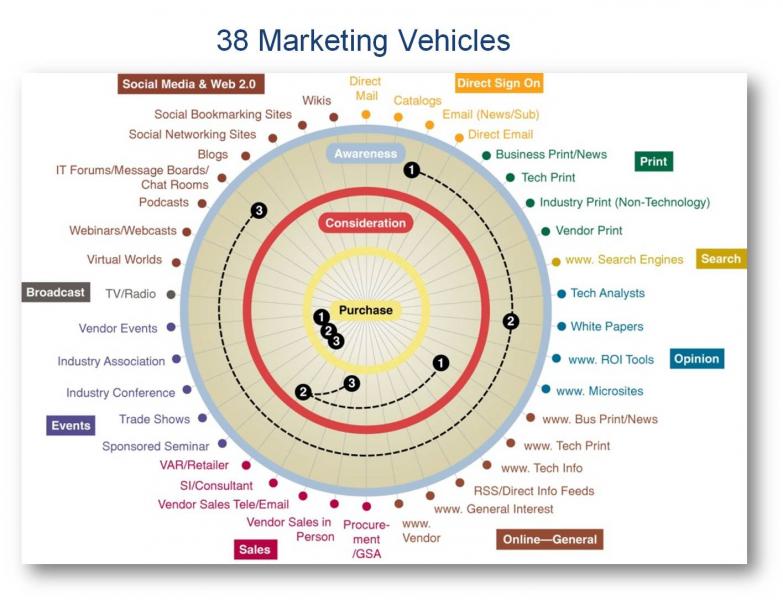
Klein’s research of over 100,000 tech marketers and clients uncovered “guiding principals” that led him to conclude that the average number of different sources of marketing vehicles used throughout the purchase funnel is 7.6 (2011). Forrester’s Wheel lists the variety of possible channels to consider:

Similar to the seven stages of consumer decision-making discussed in our video lecture from last week, Klein’s model contains three stages to summarize the buying process (awareness, consideration & purchase). Different vehicles should be used to move consumers from one stage to the next.  For example, potential buyers in the first phase, awareness, consume marketing from email, white papers and online forums.

Often I receive suggestions from fellow employees over the water cooler such as “we should advertise on bus stops” or “it would be great if we were featured in The Cheesecake Factory menus.”  Be they valid comments or not, most marketing budgets I have worked with in start-up ventures are extremely limited and require a very discerning selection from a variety of channels.  I hope that you find these charts and the 7.6 principal useful as well.

Kitchen, P. & Burgmann, I. (2010). Integrated marketing communication. Wiley International Encyclopedia of Marketing. John Wiley & Sons Ltd.
Klein, D. (May 23, 2011). How many marketing vehicles do you need? Guiding principle number two. Forrester Research. Retrieved May 31, 2012 from http://blogs.forrester.com/daniel_klein/11-05-23-how_many_marketing_vehicles_do_you_need_guiding_principle_number_two
Minato, C (May 17, 2012). This INSANE Graphic Shows How Ludicrously Complicated Social Media Marketing Is Now. Business Insider Advertising.  Retrieved June 1, 2012 from http://www.businessinsider.com/social-media-marketing-landscape-complicated-2012-5%29#
Posted in Uncategorized | Tagged , , | 4 Comments

Employees impact brand identity

When we think of branding, most of us probably associate the concept with the logo, colors, and impressions of our favorite companies. However, how many of us think of the impact of a brand on a company’s employees? Imagine the following scenario:

You are the U.S. CEO of a $12 billion professional membership firm in a meeting with a prospective client. The question of risk management compliance comes up so you quickly pull out a copy of a company approved Risk Angle article from the company Web site and hand it over. To your surprise, the prospective client also pulls out a similarly branded point-of-view document created by a local member firm that contradicts the recommendations of your article.

Situations like this emphasize the importance of brand and brand identity within an organization for all employees.

I recently had the opportunity to attend a brand workshop for a small company where the presenter shared a version of the above story. The purpose of the workshop was to review the company’s brand and visual identity system. The goal was to prevent a situation where the employees were independently creating marketing materials or content.

To demonstrate the importance of brand on an organization, the workshop presenter used Coca Cola as an example of good branding. According to Interbrand, a firm specializing in creating and managing brand value, Coke was the world’s most valuable brand in 2011, estimated at nearly $72 million. This designation didn’t happen overnight. It was a journey – from a carbonated drink to an experience shared worldwide.

a row of paint jars knocked overMoving to the internal organization, it too, followed a journey. Although the company is decades old, it took until 2003 to establish one ‘master’ brand. The organization now has a consistent vision, brand position, and brand personality. Now member organizations not only look the same but also act the same across geographies and services. And yet, challenges remain with regard to communicating brand the strategy. A quiz of attendees on the brand personality revealed no one in attendance knew the answer. The most popular option chosen was the organization’s 2015-strategy tag line. Others chose the company vision statement.

The brand personality opens the door to the visual identity. It defines all communications in a practical manner. When Coke’s brand is assessed at $72 million, it is due to the strategic use of their logo, colors, typeface, imagery, graphics and tone of voice. The participants in the workshop left with a better understanding of why brand is more than marketing’s job.

Posted in Uncategorized | 1 Comment

Blogging: easy money and glamour…or waste of time?

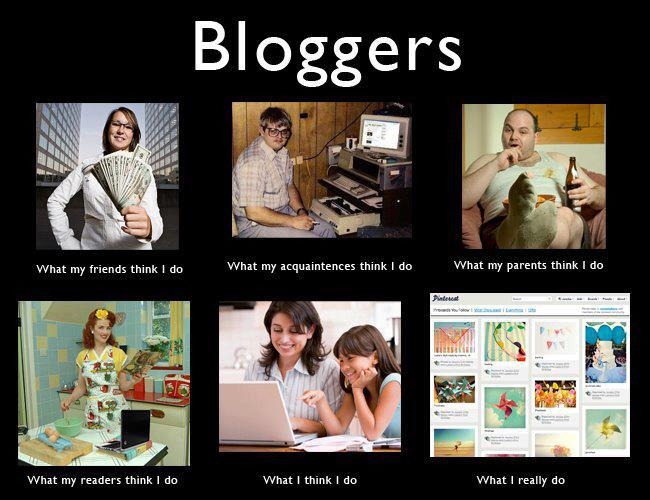
Blogging has undoubtedly taken off over the last few years. It seems like everyone is blogging these days: moms, teenagers, self-proclaimed chefs, fashion lovers and techies to name a few. Successful bloggers in the fashion industry are invited to exclusive fashion shows in Paris, have front row seats at New York Fashion Week and mingle with elite fashion designers and supermodels. Even 15-year old, Tavi Gevinson, who started blogging at age 11, has been able to make a name for herself in the industry and was recently sitting front row next to Vogue’s Editor-in-Chief, Anna Wintour in New York.

It seems pretty simple, right? Pick something you love to talk about, create a website and just talk about it. Wrong. According to Forbes, there are more than 20 million bloggers and only a mere 2% make a successful living. If there are so many bloggers out there and so few that can make a living doing it, is it worth the time and dedication needed to establish your blog and to gain the attention of advertisers? What makes some bloggers stand apart from all the others? Social Media Today credits SEO, keywords, buzz and  constant maintenance amongst other things to creating a successful blog. Although it seems simple for anyone to launch his or her own blog, the blogger needs to have basic marketing, especially online and Internet marketing, knowledge in order to compete in the cut throat blogger industry.

Social media outlets like Facebook, Twitter and Pinterest are jackpots for blogs. If a person reads a blog and shares the link with his or her friends or followers on a social media outlet, the blog is broadcast, for free, to that person’s network. An added bonus is that Millennials, 18-34 year olds and those who spend much of their time online, trust word of mouth over any other kind of advertising. In other words, they will be more likely to follow a blog if a friend or family member recommends it rather than if they discovered the blog through a paid advertisement.

To blog or not to blog? If you’re thinking of starting a blog, by all means, go for it! You’ll be sharing your thoughts, ideas and comments about something you enjoy talking about and you may even earn some money while doing it. But, before your blogging career truly takes off, don’t quit your day job. Blogging on the side is the perfect way to dabble in the field without fully jumping onboard not knowing where your career will end up.

http://www.forbes.com/2010/04/14/blogging-career-income-personal-finance-blog-income.html

http://www.thestylerookie.com/

http://socialmediatoday.com/index.php?q=zubinkutar/212318/what-makes-blog-successful

Posted in Uncategorized | Tagged , , , , , , , , , | 3 Comments