From drunken bros to refined gentlemen: the rebranding of Jagermeister

Let’s just start by saying that I am NOT a fan of Jagermeister.  And not because I dislike the strong, licorice taste of the alcohol…but because back in my early 20s– I had one to many “Jaeger bombs” with my friends, and it was enough to turn me off the drink forever.

Likely, many of you have similar stories, or “know someone” who can tell you tales of drunken Jagermeister nights.  But, the drink, known best for being served as an ice cold shot in college bars around the globe, has been experiencing a relatively large decline in sales in recent years.  The company points to a “huge number of new products, extremely aggressive pricing by competitors and changing consumer trends” as the culprits for the falling sales numbers (Bouckley, 2015).

Not willing to go down without a fight, Jaegermeister execs decided a risky rebranding strategy was in order. While not willing to alienate the college frat boys who still demand Jager as a staple in their drinking repertoire, the company knew they needed to be able to tell a different story of the drink in order to bring in a more sophisticated…and paying… crowd.  So they hired a “very serious” german mixologist and sent him into upscale bars in big cities, like New York, to convince the bar owners to see Jaegermeister as more than a “shot” consumed by barely legal adults (Garrison, 2016).

It’s a huge risk to tell two stories about the same product, at the same time.  But, the company feels its a risk worth taking.  And right now, it seems to be paying off, at least a little.  In one of the upscale bars, drinks are being made with jagermeister as a key flavor ingredient, if not the star of the show, and  that’s a start (Garrison, 2016).

The Jagermeister website is perhaps the best visual depiction of this strategy.  (See if here: http://www.jagermeister.com/en-int/drinks/)

The Jagermeister shot is branded as a “classic” on the page, but you can also find “your” drink. In fact, my self-imposed Jager ban might be over…I think I just could be ready for a Jagerita.


References:

Bouckley, B. (2015).  Jagermeister sales bomb: ‘Extremely aggressive’ US pricing hits herbal liquor.  Retrieved from: http://www.beveragedaily.com/Manufacturers/Jaegermeister-sales-bomb-Extremely-aggressive-US-pricing-hits-herbal-liqueur

Garrison, M. (2016).  Inside an infamous company’s risky marketing strategy.  Retrieved from:  http://www.marketplace.org/2016/01/26/world/inside-infamous-company-s-risky-marketing-strategy

Posted in Uncategorized | 2 Comments

Marketing to Mommies

I’ll start off by saying that this post is prompted by my personal experience. I’m currently 6 months pregnant, and, as a result, have had a whole slew of new advertisements, flyers, coupons, come my way. It’s almost unbelievable the amount competition for my dollar.

But perhaps you didn’t know that marketing to mommies is a big deal and a big business. The new parent dollar is a coveted one, and with good reason: research has shown the last months before a baby is born, brand loyalty is less, well, loyal. Parents may choose a different laundry detergent, toothpaste, dish soap, etc. to better meet the needs of their new lifestyle. This period of time, consumers are much more flexible about their spending than they are at any other point in time.

But even before the big announcement is made, many retailers already know when you or your loved one is expecting. A Forbes journalist famously reported a story about a man who, after his teenage daughter was inundated with marketing material from big box retailer Target, stormed into his local store and demanded that it stop. There was no way in the world his daughter, who was still in high school, was pregnant and furthermore, it was offensive that the company should be sending such material to a young woman.

It turned out that one of them was wrong, and it wasn’t Target.

But how did Target know that the girl was pregnant when her father didn’t even know?

The answer is data mining. Target (and undoubtedly countless other retailers) collect data on its shoppers. There are evidently algorithms that can predict pregnancy based on a shopper’s unique purchasing history — even if none of those products are specifically maternity or baby-related.

And if Target can get you during this brand loyalty vulnerable time, well, the benefits for them are two -fold. Target knows that if it can get you to make baby or maternity purchases while you’re pregnant or when you have a newborn, you’re more likely to buy other things there too out of the sake of convenience.

While dads are part of this equation too, moms are considered the more valuable prize. According to one study, the mother-figure in a household makes up to 85 percent of purchasing decisions for the family so marketers seek ways to speak directly to them.

According to information released by Instagram earlier this week, one out of every four women over the age of 18 on the social media platform is a mother. The company also found that half of all of the mothers who use Instagram follow businesses.

This data ought to give any marketing student pause.

That’s a free (or relatively inexpensive) way to talk directly to moms, who control the vast majority of spending in the household. So, if you lack the fancy statisticians and algorhythmic juju, but still want to talk to moms…Instagram is probably a good medium.

And if you’re wondering about our Target dad (now, presumably, a grandfather), he did apologize to the company.

Posted in Uncategorized | 4 Comments

CAN-SPAM… and no, I’m not talking about canned ‘meat’

CAN-SPAM is the U.S. federal regulation regarding the sending of commercial email and messages. Besides email, something else that’s covered under CAN-SPAM is SMS messaging.

To give a little background around CAN-SPAM…

What does ‘CAN-SPAM’ even mean? CAN-SPAM’s full name is Controlling the Assault of Non-Solicited Pornography And Marketing Act of 2003.

This law was enacted in 2003 by President George W. Bush and set the first standards for commercial email in the U.S. The ‘CAN’ in CAN-SPAM is a play on words and is suggesting that this law will help in “canning” spam.

Straight from the FTC themselves, here are the main requirements of CAN-SPAM:

  1. Don’t use false or misleading header information. Your “From,” “To,” “Reply-To,” and routing information – including the originating domain name and email address – must be accurate and identify the person or business who initiated the message.
  2. Don’t use deceptive subject lines. The subject line must accurately reflect the content of the message.
  3. Identify the message as an ad. The law gives you a lot of leeway in how to do this, but you must disclose clearly and conspicuously that your message is an advertisement.
  4. Tell recipients where you’re located. Your message must include your valid physical postal address. This can be your current street address, a post office box you’ve registered with the U.S. Postal Service, or a private mailbox you’ve registered with a commercial mail receiving agency established under Postal Service regulations.
  5. Tell recipients how to opt out of receiving future email from you. Your message must include a clear and conspicuous explanation of how the recipient can opt out of getting email from you in the future. Craft the notice in a way that’s easy for an ordinary person to recognize, read, and understand. Creative use of type size, color, and location can improve clarity. Give a return email address or another easy Internet-based way to allow people to communicate their choice to you. You may create a menu to allow a recipient to opt out of certain types of messages, but you must include the option to stop all commercial messages from you. Make sure your spam filter doesn’t block these opt-out requests.
  6. Honor opt-out requests promptly. Any opt-out mechanism you offer must be able to process opt-out requests for at least 30 days after you send your message. You must honor a recipient’s opt-out request within 10 business days. You can’t charge a fee, require the recipient to give you any personally identifying information beyond an email address, or make the recipient take any step other than sending a reply email or visiting a single page on an Internet website as a condition for honoring an opt-out request. Once people have told you they don’t want to receive more messages from you, you can’t sell or transfer their email addresses, even in the form of a mailing list. The only exception is that you may transfer the addresses to a company you’ve hired to help you comply with the CAN-SPAM Act.
  7. Monitor what others are doing on your behalf. The law makes clear that even if you hire another company to handle your email marketing, you can’t contract away your legal responsibility to comply with the law. Both the company whose product is promoted in the message and the company that actually sends the message may be held legally responsible.

Now that’s CAN-SPAM in a nutshell. Up in Canada, they also have similar regulations, but I have to say, they are a little more strict than we are in the U.S.

Canada’s ‘CAN-SPAM’ is called CASL (pronounced “castle”) which is an acronym for Canada’s Anti-Spam Legislation.

Starting July 2017, anyone sending commercial emails to anyone in Canada must receive ‘express consent’. In the U.S., we send emails based off of ‘implied’ consent, meaning, if someone hasn’t opted out yet, they probably want to receive email. But in Canada, this is not the case and senders of commercial email must have subscribers’ permission before sending any form of commercial email.

So, ladies and gents, you have a little over a year to be fully compliant! Right now at our company, we’re sifting through our database looking for the Canadian members to ensure we can prove they have given expressed consent. It’s a big undertaking, but it’s necessary. Commercial email senders must be able to prove in a court of law that their subscribers have given express consent. This evidence may be a form the subscriber filled out selecting to receive the emails. (A side note: the ‘check box’ must never be pre-checked under CASL.)

Other countries have their own set of regulations so whoever you’re sending to, you need to make sure you’re in compliance with their laws. Check this out if you want to see what other country’s laws entail. At my company, we send to subscribers in Mexico and Mexico doesn’t have regulation regarding commercial email, but all of our emails, no matter where we send are CASL/CAN-SPAM compliant.

If you’re a digital marketer, it’s important to know these laws and ensure to abide by them. These ‘rules’ not only have legal ramifications if they’re not followed, but they inherently provide better inbox placement and overall better reputation so your marketing long-term will be more successful.

https://www.fcc.gov/general/can-spam

https://www.ftc.gov/tips-advice/business-center/guidance/can-spam-act-compliance-guide-business

https://en.wikipedia.org/wiki/CAN-SPAM_Act_of_2003

http://blog.hubspot.com/marketing/what-is-can-spam-ht

http://fightspam.gc.ca/eic/site/030.nsf/eng/home

Posted in Uncategorized | 3 Comments

Let’s Talk About Generation Z

Other fellow marketers reading this may be familiar with an annual report released by Tubular Labs, a cross-platform analytics and insights company, that details upcoming trends and important considerations when marketing to specific demographics. We’ve all heard the M word — millennial, but I think Generation Z has gotten a bit lost in all that discussion. Who is Generation Z? Why, the next biggest thing! Generation Z consists of current consumers aged 7-17. These consumers have grown up in a completely digital world. While millennials were present for the slow transition over time to social media, the internet, and digital communication, Generation Z has been fully immersed in it from the time they were just toddlers, so it only makes sense to focus our thought process on how to reach this new group of consumers.

The report I’d like to share with everyone is called the Cassandra Report, and focuses on identifying larger macro trends that marketers and advertisers can use to reach Gen Z. Join me as we explore some of the more important of those trends and identify how they may be relevant to us as communication practitioners.

Z’s Are Grownups

And they like to be treated as such. No talking down to these folks — anything you can do to boost their confidence and raise them up are effective techniques. These folks have taken an exceptionally mature stance on life compared with other recent generations. Marketers must recognize that they are smart, intelligent people who are able to make their own decisions. By that same token, Gen Z’s are of the mindset that leisure time should be spent more effectively, in which they focus on personal achievements and goals even when they’re spending time relaxing. We’ve come to identify this phenomenon as “proplay” — in which recreational activities that were once done for fun are now skills-based learning opportunities.

89% of Zs spend part of their free time doing activities they consider productive and creative instead of just hanging out. – Cassandra Report, pg. 57

The Importance of Feedback

Giving and receiving feedback is very important to Gen Z-ers. Because these folks have grown up in a world where they can have anything delivered to them, anytime of the day (whether it be a pizza, or instant feedback in the form of likes and comments on social media), Gen Z-ers are highly open to feedback. They want to be a part of a “Feedback Loop,” in which they can attain a “real time understanding of what they’re doing right and how to be better.” This is actually something I have noticed in my own personal life as well, and it’s fascinating.

I really appreciate honest comments and feedback on social media because it can help you improve on your specialties, and that will always result in a better you. – Isaac, 16, CA

Thinking Mobile-First

Gen Z lives on their mobile devices 24 hours a day, 7 days a week. Forget about desktop computers — it’s all about iPhones and tablets! Most Z consumers consider their mobile devices an extension of themselves. All media is consumed on the platform, whether it be on social media or Netflix. Gen Z is fortunate enough to have the power of a home video camera and high-res digital camera in their back pocket at all times, which is also able to be harnessed to share their lives with the rest of the world. In order to continue being relevant, brands must recognize that mobile-first activity will only continue to increase and they must start optimizing all of their digital efforts for consumption on-the-go.

Consider offering content and games that young mobile mavens can access anywhere to enhance their lives, relieve them of boredom, and give them something to socialize around and share.

Certainly some very important and interesting insights above. Did anything surprise you? Why or why not?

As we continue to move forward in this constantly-changing world, it will always be important to understand who this next generation of consumers is and how they prefer to consume media. Remember: to be successful, we all must stay ahead of the curve!

Posted in Uncategorized | 7 Comments

April Fools!

I would bet that we each have a memorable April Fools prank that we can remember. Some of us might have fallen for a silly April Fools prank by a spouse or friend, and others victim to companies using social media channels to prank us all. Last year there were several companies that used media channels to create pranks on April 1. Honda announced the Honda HR-V SLFScreen Shot 2016-03-27 at 9.10.39 PM, the first car to install selfie cameras in the car taking photos that can
be uploaded to social media (CNBC, 2015). Amazon re-skinned their homepage circa 1999 and showed
products that could be used for a good prank (CNBC, 2015). Netflix, Samsung, Google, Groupon and Sony even got in on the fun and many consumers got a good la
ugh last year with these fun digital pranks (CNBC, 2015).

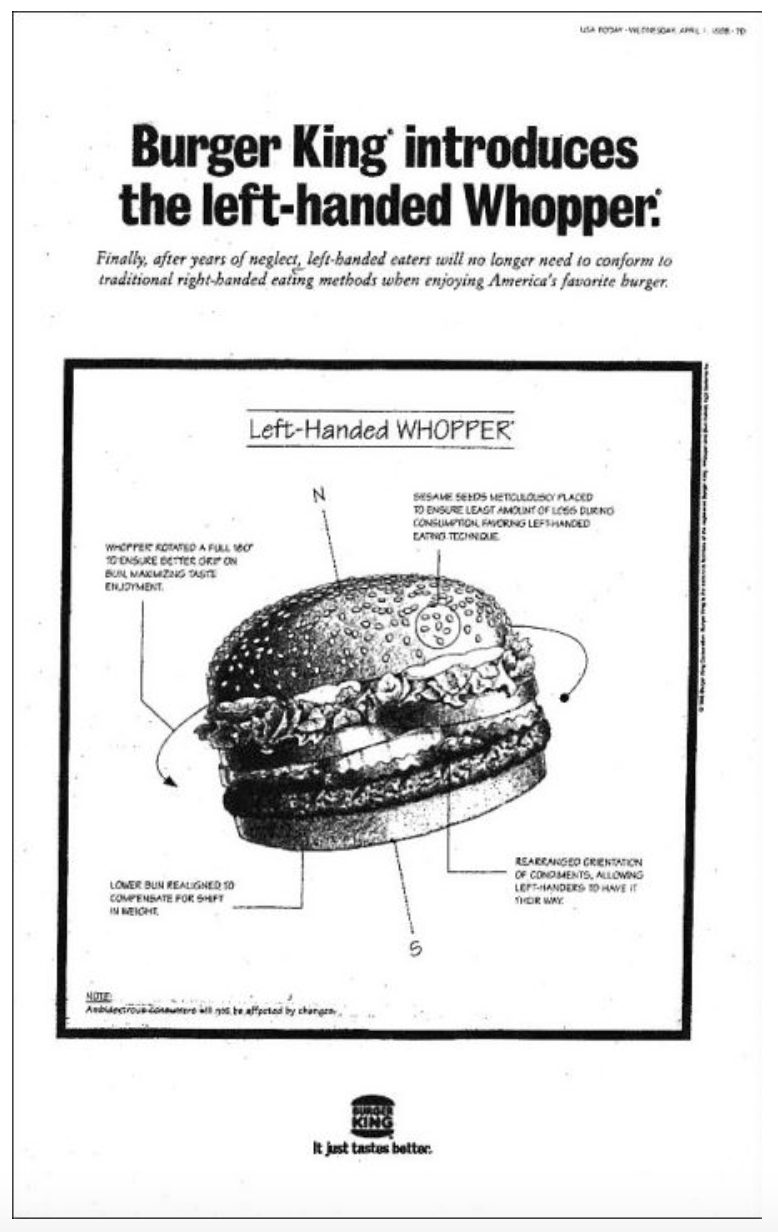
Back in 1998, Burger King introduced the left-handed Whopper for the 32 million left Screen Shot 2016-03-27 at 9.01.10 PMhanded customers in the US with a print advertisement (Yoon, 2016). The burger was exactly the same as the existing Whopper, but the “condiments were rotated to 180 degrees,” (Yoon, 2016, para. 16). Customers came in in droves to ask for the new burger and a lot of customers asked for the right-handed burger as well (Yoon, 2016). It’s actually funny to imagine how this went over with customers actually believing the Whopper could be right or left handed.

Let’s take a look back to how April 1st came to be April Fools day. April fools dates back to 1582 when Pope Gregory XIII decided that the calendar should be changed to the Gregorian calendar, moving New Years Day from March 31 to January 1 (Stack, 2014). The change in the calendar was widely publicized, but there were still people that did not get the message and they continued to celebrate on April 1 (Stack, 2014). Those folks were ridiculed and seen as foolish, called April Fools (Stack, 2014). And 434 years later, we still celebrate April Fools.

I’m one of those people that get’s a pit in my stomach as the day approaches. I know that I won’t get pranked by my family, but do tend to be gullible and always think ‘what if I do get pranked’ would I make a fool of myself? So, I ask all of you- do you have a good April Fools prank story? What companies do you think will be pulling pranks in marketing channels on Friday?

References:

CNBC, (2015). The best corporate April Fools’ Day pranks of 2015. CNBC. Retrieved from: http://www.cnbc.com/2015/04/01/rporate-april-fools-day-pranks-of-2015.html?slide=9

Stack, P.F. (2014). April Fool’s Day 2014: Religious Origins Of The World’s Silliest Holiday. Huffpost Religion. Retrieved from: http://www.huffingtonpost.com/2014/03/31/april-fools-day-2014_n_5045190.html

Yoon, F (2016). Top 10 April Fool’s Day pranks played by the media, The Star Online. Retrieved from: http://www.thestar.com.my/metro/focus/2016/03/26/top-10-april-fools-day-pranks-played-by-the-media-with-april-1-just-days-away-starmetro-takes-a-look/

Posted in Uncategorized | 4 Comments

Are you proud to be a Trojan?

With the word “pride” in this post, I am not specifically speaking of the LGBT pride movement, I am using the word in a more general sense.

We push out all sorts of emotional appeal in branding and advertising, from humor to sadness.  Those sort of emotions are easier to execute.  What is harder to do and what I believe USC and a lot of other universities has done an excellent job of in its integrated marketing communications plan is to instill the sense of pride.

But just think about it. What was the reason you chose to attend USC?  Besides it’s academic rankings, what was so special about the school that would make you pay such a high tuition and take out all those loans?  If you ask most people, it is the sense of the “Trojan Family” and the pride that comes along with being referred to as a Trojan.  So how does one bottle pride?

1/4 cup of the Trojan Marching Band

1/4 cup SC Football

1/4 cup Top Research University with Transformative Faculty

1/4 cup Stellar Students and Alumni!

Congratulations to those graduating this semester!  Fight on!

Posted in Uncategorized | Comments Off on Are you proud to be a Trojan?

Are you OK?

Facebook wants to know. This is the question the Facebook alert system asks you if you are marked via your locational status as someone within the geographic proximity of an attack, natural disaster or otherwise life-threatening situation (Toor, 2016). The site allows you to respond either via text message or online to let others know you are OK by marking you safe. Introduced in 2014, Safety Check gives your online “friends,” family and acquaintances peace of mind that you are accounted for and not missing, injured or worse (Baig, 2016).

While some have criticized Facebook for exploiting users by selling location and demographic data to marketers, it seems the company has found a way through Safety Check to utilize user specific data in a less controversial manner (Morran, 2014). The general premise of the Safety Check places Facebook in a “do good” role while acknowledging and encouraging safety and well being for its users.

However, while Safety Check has general good intentions behind it, some have found issue with the fact that the company has issued the alert system in response to some events and not others. Last year, the company came under fire for activating the checks in response to the November Paris terrorist attacks, but failed to issue the check after the bombings which took place in Beirut (Baig, 2016). This was seen as controversial as it made users feel as though Facebook was valuing the lives and well being of some of its worldwide (approximately 1.59 billion monthly) users over others (Smith, 2016). Mark Zuckerberg responded by summating that the company cares about all people equally and the intention was not to play favorites, but rather to alert people worldwide and look out for their safety (Rogers, 2016).

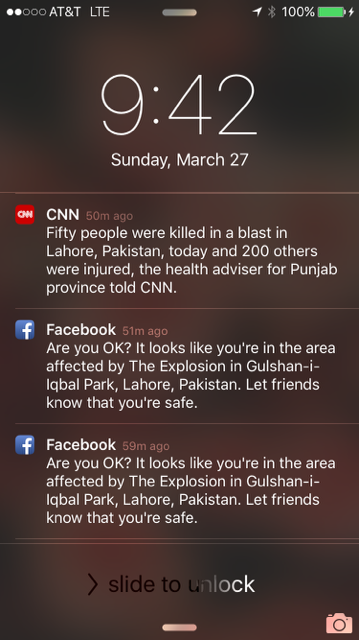
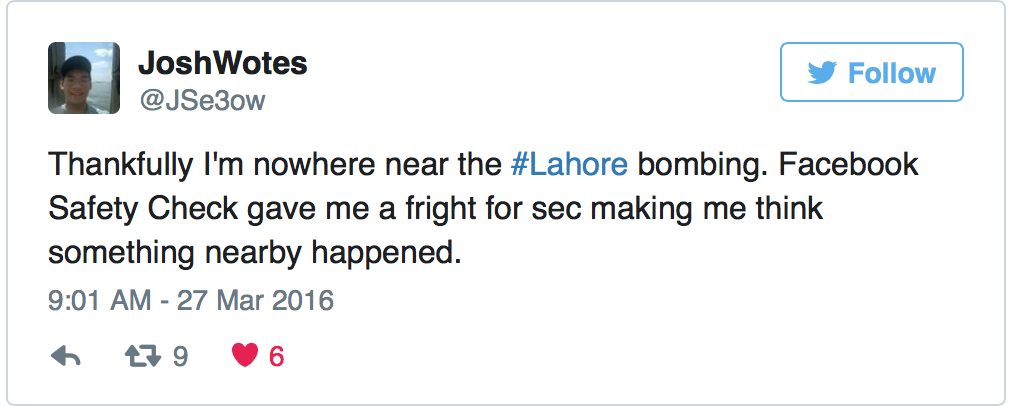
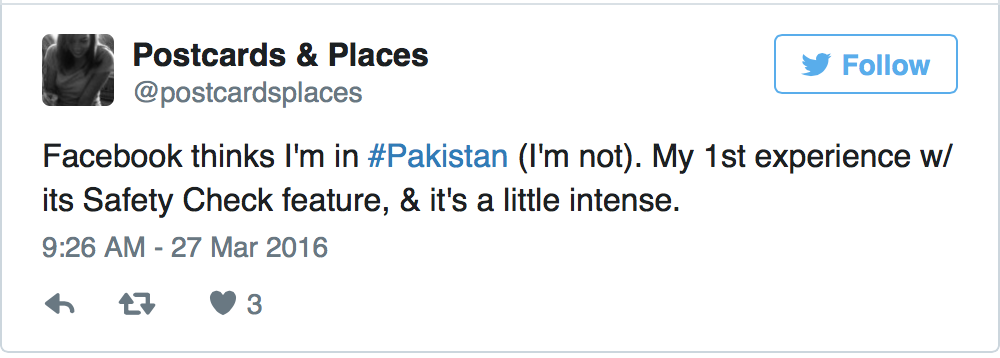
Then, a glitch in the alert system following the Lahore, Pakistan suicide bombing a few days ago on March 27, 2016 caused unintentional panic among users who received the alert by accident. I was one of these users. Here’s what I woke up to on the home screen of my iPhone:

Facebook post pic

iPhone screen

While I was saddened about the attacks and also thankful I was not nearby Lahore, I was somewhat concerned about my online affiliation with Pakistan, and quickly wondered how I had wound up on the alert list as someone located in this area. Did I somehow have online ties to Pakistan? How did location tracking data mark me in this region? What was Facebook doing with my personal data? The paranoia ensued. I was not alone in expressing this concern as many throughout Europe and even the United States reported that they had erroneously received the alert and were located no where near the bombing (Rogers, 2016).

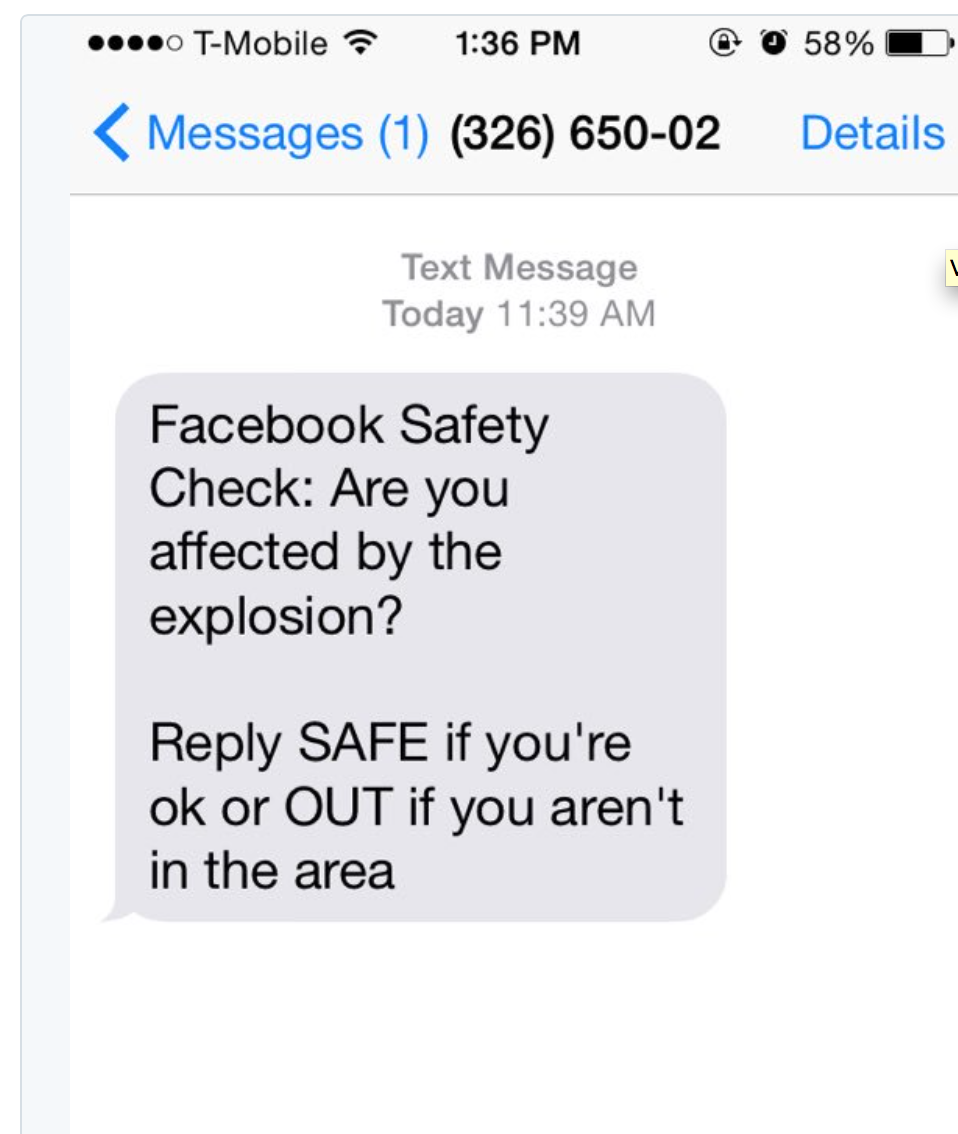
To make matters worse, some Facebook users received texts indicating that there had been an explosion, but no further information about where the explosion had occurred. This created even more anxiety as Facebook failed to provide accurate or complete information when executing the text alert portion of the Safety Check. Take a look:

Screen Shot 2016-03-29 at 4.02.24 PM

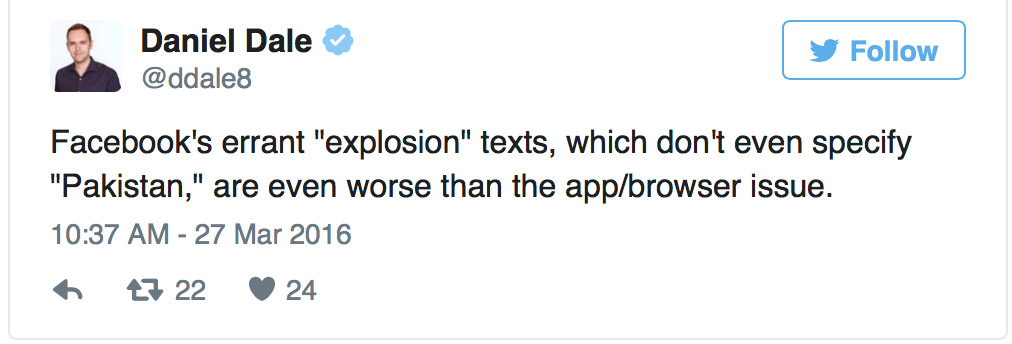
At the end of the day, most users were understanding and appreciative of Facebook’s gesture, responding with comments like, “I live in Ohio, but thanks for your concern anyway Facebook!” but others weren’t as pleased. Here’s what some had to say:

Screen Shot 2016-03-29 at 3.57.44 PMScreen Shot 2016-03-29 at 4.08.10 PMScreen Shot 2016-03-29 at 4.08.15 PMScreen Shot 2016-03-29 at 4.00.00 PM

What do you think about Facebook’s Safety Check alert system? Does it do more harm than good? Do you find it helpful? Are you OK with Facebook using location data to find you? Moving forward, especially with the recently issued travel alerts from the State Department in response to the instability in the Middle East, how do you think Facebook should utilize Safety Check for future events? Should it be used for every single event (large or small, natural disaster or not) in any area of the world? Let me know your thoughts!

References:

https://consumerist.com/2014/06/12/facebook-is-now-selling-your-web-browsing-data-to-advertisers/

http://www.usatoday.com/story/tech/2016/03/28/facebook-apologizes-safety-check-error-after-lahore-bombing/82338260/

http://www.foxnews.com/tech/2016/03/28/facebook-safety-check-glitch-sent-out-misdirected-notifications-following-pakistan-blast.html

http://expandedramblings.com/index.php/by-the-numbers-17-amazing-facebook-stats/

http://www.cbsnews.com/news/facebook-apologizes-for-safety-check-glitch-following-pakistan-bombing/

Posted in Uncategorized | 5 Comments

Marketing Communications Plan: Every Strategy is not for Every Brand

In the business world, leaders model their business plans after other successful competitors. For example: McDonald’s vs Burger King, Neiman Marcus vs Saks Fifth Avenue and Kmart vs Walmart. If a company appears to be the market leader in a particular category, then whatever strategy used to get them to the winning position, is now the road map to success aka “the business model”. Marketing executives from many companies spend a great deal of money on research. Executive management teams hire independent research firms to poll consumers on the likes or dislikes of various subjects and brands. For example when Democratic Presidential Candidate Nominee, Bernie Saunders announced his run for the oval on May 26, 2016, his inner circle planned on how to move forward with his campaign (Cillizza, 2016). Critics believe President Obama’s campaign did a great job targeting the American voters by communicating with on a grass root-social media level (Woodruff, 2012). Campaign leaders in Bernie’s camp feel this strategy could work for him as well. But can it?

download (1) images

In 2012, David Axelrod and David Ploufee, President Obama’s campaign manager and senior strategist created a new trend in the election process by marketing and promoting President Obama’s message of change via direct email marketing and social media (Rutledge, 2013). From the outside looking in, Obama’s campaign felt very organic and was a natural extension of Obama’s personality. Senator Bernie Sanders is running for the Democratic Presidential Nomination as we speak and his campaign managers are modeling his primary campaign strategy after President Obama’s. I have received many emails on Bernie’s behalf, but I never gave his organization my email address. How did they receive my information? Yes, I was on President Obama’s email list, but just because I voted for Democratic ticket in 2012 doesn’t automatically mean I will vote that way come November 2016. Bernie Sanders organization didn’t ask me if I wanted to have emails sent to my private email address. I am receiving at least 3-5 emails a day about him and his campaign and I am not happy about receiving these emails. His organization should have asked for my permission before accessing my account. I don’t mind seeing Bernie’s commercials on television and I don’t mind seeing him in the televised debates, however when it comes to my private email account, I have a problem a problem with receiving unsolicited mail. Senator Saunders campaign manager and strategist should have come up with a better marketing communication plan to help promote Bernie’s message to potential voters. I would have like to determine if I wanted to follow Bernie & contribute money to his campaign for President before I started receiving emails about sending donations. To this date I have not received one email or phone call from the Clinton, Trump, Cruz or Kasich organization and I am glad they are allowing me to choose which candidate I would like to support.

References:
Anderson, M. (2015). More Americans are using social media to connect with politicians. Retrieved from http://www.pewresearch.org/topics/campaign-outreach-and-strategy/

Cillizza, C. (2016). Bernie Sander’s presidential campaign announcement is sort of amazing to watch now. Retrieved from https://www.washingtonpost.com/news/the-fix/wp/2016/02/01/bernie-sanderss-presidential-campaign-announcement-is

Rutledge, P. (2013). How Obama Won the Social Media Battle in the 2012 Presidential Campaign. Retrieved from http://mprcenter.org/blog/2013/01/how-obama-won-the-social-media-battle-in-the-2012-presidential-campaign/

Woodruff, J. (2012). How They Did It: Political Tactics That Help President Obama Win A Second Term. Retrieved from http://www.pbs.org/newshour/bb/politics-july-dec12-tactics_11-07/

Posted in Uncategorized | 3 Comments

Give me that on-line religion!

As I am writing this post on Easter Sunday, I thought I’d take a peek at how religions relate to marketing and marketing efforts.

It has become a point of faith (forgive the pun) that integrated communications and social media are essential to marketing in the modern world. But does it make sense for selling that old-time religion?

Brandon Vogt thinks so (Schaffer, 2015). Vogt, who blogs at www.brandonvogt.com, uses his blog as a way to share his Catholicism in the online sphere. He noted in in an interview (Schaffer, 2015) that doing so allows him to reach a wide variety of people and start to engage them in discourse, whether they Catholics, Protestants or atheists.

“Look at any comment box and chances are you’ll see a panoply of characters: angry teenagers, joyous mothers, radical socialists, immature zealots, and more,” he said. “Blogging allows a probing skeptic who would never darken the doors of a church to stumble into a conversation with a priest.”

Josh Steimle (2015) noted in a Forbes article that the Church of Jesus Christ of Latter-Day Saints (commonly known as the Mormons or the LDS church), has worked hard to become a strong user of social media, search-engine optimization (SEO) and other strategies to spread the faith. The church leaders actively seek to use established best practices for SEO, noting that doing so makes it much easier to both serve the needs of people looking for information on the church and also to spread information to people who might be curious about the church. (Steimle, 2015).

As with so many other organizations, it’s a growing way to spread a message. The Pew Research Center (2014)  noted that 20 percent of U.S. adults had expressed their faith online – a number comparable to the number of those who watched religious programming on television (23 percent) or listened to religious programming on the radio. (20 percent). On the other hand, 40 percent of Americans shared their faith somehow in person.

But though, as Vogt noted (Schafer, 2015), the online environment can allow a skeptic to engage with believers in a less public environment; the Pew study showed that people who view religious material online and share their own faith online also tend to be the people for whom religion plays a strong role in their lives – Half of those who attend religious services weekly have viewed religious materials online and 31 percent have shared their own faith; on the other hand, 39 percent of those who say they seldom or never attend services said they have viewed religious content online, and only 8 percent have shared their own beliefs online.

Steimle (2015) suggested that one key element for religious organizations working in social media is to remember the social element. No matter how well the LDS church organizes its own online presence, he said, it gets the most engagement and the most response from people who find their way to the church via the sites and discussions of individual believers.

That is the key takeaway for me – it’s the discussion and the real human contact  — that seem to make the difference.

REFERENCES

Pew Research Center (2014, November 6). Religion and electronic media. Pew Research Center Religion and Public Life. Retrieved from: http://www.pewforum.org/2014/11/06/religion-and-electronic-media/

Schaffer, N. (2015, August 27). Ancient religions and new media: A match made in heaven. Maximize Social Business website. Retrieved from: http://maximizesocialbusiness.com/religion-and-social-media-5086/

Steimle, J. (2105, April 24). How Mormons use the Internet to spread the Good Word. Forbes Online. Retrieved from: http://www.forbes.com/sites/joshsteimle/2015/04/24/how-mormons-use-the-internet-to-spread-the-good-word/#1b3591a62866

Posted in Uncategorized | 5 Comments

The Museum of Feeling – Experimental Marketing of Fragrance

If you lived within 100 miles within the New York City and went on Instagram or Facebook frequently, you must have heard of the “Museum of Feeling” during the last quarter of 2015. A four-week pop-up near World Trade Center One in New York City, the Museum of Feelings was advertised as “the first museum that reacts to emotions.” Inside the free exhibit, there were modern art displays playing with the five senses:feel optimistic, feel joyful, feel invigorated, feel exhilarated and feel calm.

But as anyone who visited the exhibit soon found out, the MoF was not really a museum at all, but rather a brilliant example of experiential marketing that effectively harnessed the power of social media. The Museum of Feelings was a promotional stunt by Glade. The company was smart enough to know that a prominent, corporate-sponsored exhibit would fall under heavy scrutiny.

290511

So, how does a fragrance company have to do with feelings?

The whole concept of the MoF was to provide consumers with an experience that activated each of their senses, but focused on one in particular: smell. Each installation focused on generating a unique, positive emotion and pairing it with a scent, which the visitor only learned at the end was a Glade fragrance. From a “feel invigorated” zone to a “feel calm” area, the product became a large part of the consumer’s experience and helped guide them throughout the exhibit. Consumers were left feeling all the #positivevibes, but remained unaware of the brand behind them until the completion of their journey through the MoF.

This branding technique, referred to as experiential marketing, is nothing new, but has significantly increased in popularity over the past few years, with the Event Marketing Institute reporting that brands are estimated to have increased event and experiential budgets by more than 6% in 2015. So what made Glade’s effort stand out, and what marketing lessons can we take away from the Museum of Feelings?

3053990-inline-s-4-indulge-in-your-feels-at-the-museum-of-feelings

  1. Create FOMO. MoF take advantage of social media and people’s FOMO (Fear of Missing Out) mindset to create its popularity, prompted people to spend their Saturday and Sunday mornings waiting in a line to visit the museum. FOMO is one of the most important sentiments to understand when exploring the topic of experiential advertising, as it drives individuals to engage in order to avoid their perpetual fear of missing out. In the case of the MoF, whether you loved it or hated it, the reality is that you’re going to talk to your friends about how you stood in line for hours and what you stood in line for. Start building excitement for your effort before it launches, and let word of mouth take its natural course from there.
  2. Make your experience visually worthy. At the MoF, the visuals were so strong that consumers were excited about sharing their experience across Facebook, Twitter, Instagram and other channels.
  3. Enhance and Elevate With Social. Make sure to give your consumers a way to interact with your experience and brand on social, including creating a hashtag and check-in location so that they have a central hub in which to share their experiences. Social then provides something tangible for consumers to revisit after the experience is over.
  4. Set Time Constraints. Making your experience a limited-time only offer creates a sense of urgency for people to partake in it, and also helps create – you got it – that sense of FOMO we keep going back to.
  5. Evoke Positive Emotion. Appeal to consumer emotions and leave them feeling good about their experience. The MoF, for example, was able to blend a variety of marketing tools in a creative and engaging way that made consumers feel like they were part of a unique experience that they chose to take part in. All of the installations inside the museum were created to be reactive to human touch and presence, with the look of the museum changing inside and out depending on the “mood” of its visitors.

Nowadays, consumers don’t like to feel like they are being marketed to, the success of Glade and MoF leaves me with the following questions:

  1. Do you think experimental marketing is effective?
  2. Do you think the lessons learned from Glade can be applied to other brands
  3. What are the most important elements when you are planning an experimental marketing campaign to a brand?
Posted in Uncategorized | 4 Comments