#ShareACoke returns

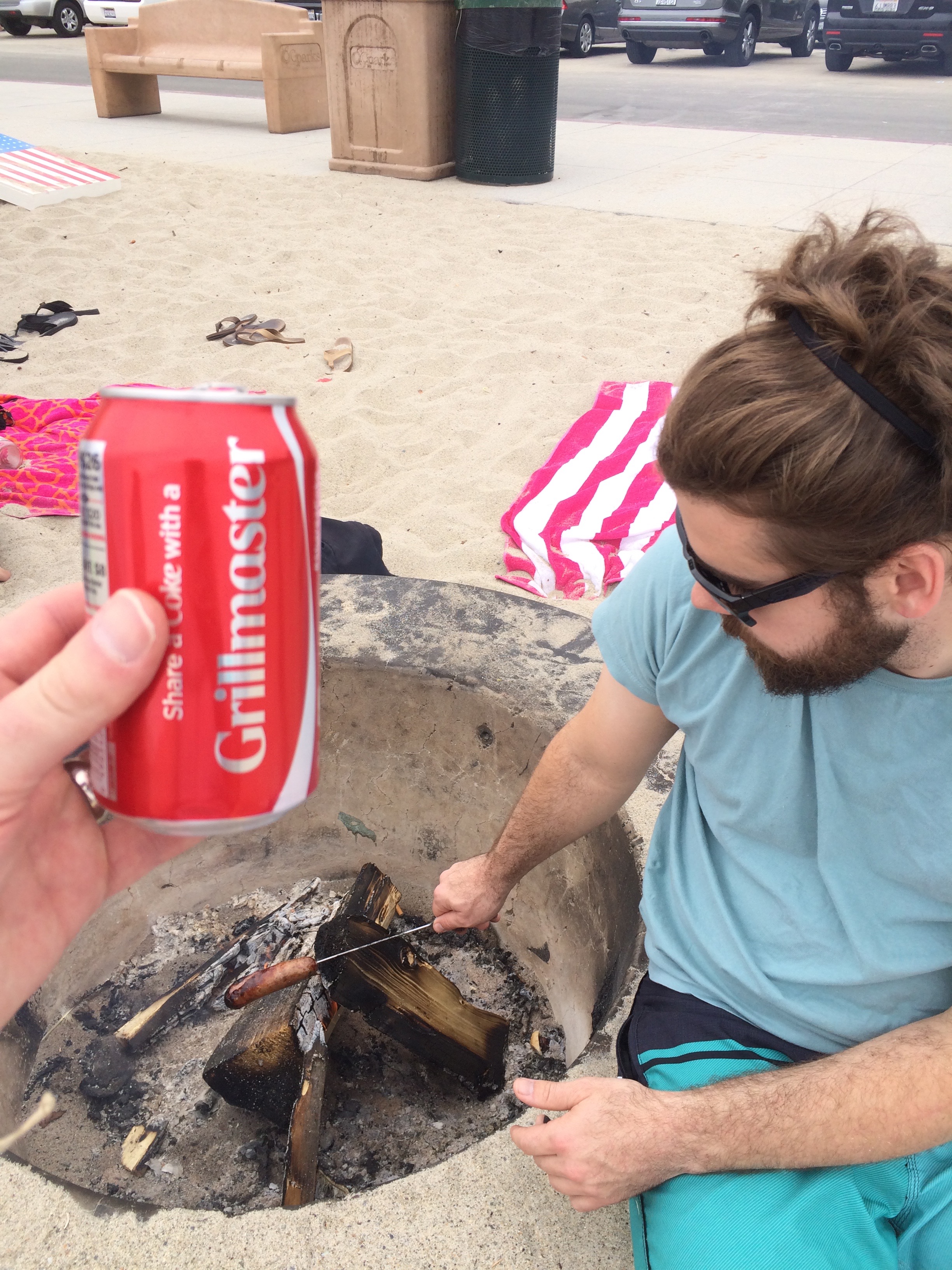
Coca Cola’s “Share a Coke” campaign last year – in which coke bottles and cans had the phrase “share a coke with” and a person’s name printed below it – was such a major success that Coke is running it again. This time, they have over 1,000 new names and nouns along with more options, including the ability to buy personalized bottles from their website according to a recent article on CNN Money. The brand is also running a more organized social media campaign around the “Share a Coke” effort, encouraging people to upload photos with the cans and share using #ShareACoke.

There’s no doubt that Coke has struck gold with this program. For the first time since 2000, the soda company saw sales volume grow as youths once again flocked to buy a bottle. Indeed, the entire marketing campaign was created in 2011 in order to reinvigorate Coca Cola’s younger drinkers, who were beginning to feel the brand was no longer speaking to their generation.

The campaign has been so penetrating and disruptive that it has actually drawn non-Coke drinkers to purchase the soda in order to take selfies with the labeled bottles and cans.

“I don’t drink it, never have,” Kelly DeWitt, 29, says. “But this one said ‘Share a Coke with a Bro,’ I had to buy it.”

IMG_3977


References

Schultz, E. J. (2015, April 10). ‘Share a coke’ to return, but bigger. Ade Age.

‘Share a coke’ is back with more of your names on bottles. (2015, April 14). CNN Money.

Posted in Uncategorized | 4 Comments

Celebrity + Popular Brand = Success?

Celebrities and popular brands go together like peanut butter and jelly.  Well, sort of.  How about this modified statement: celebrities and popular brands go together like peanut butter and jelly after the research showing why they should go together in the first place.  Apart from being long winded, that just about covers it.

Celebrities are everywhere.  Look at the latest television commercial, or the billboard on the highway, or any kind of social media feed.  And, of course, those magazines that are 80% print ads and 20% actual reading.  What do you see?  Who do you see?  And after viewing such ads and/or commercials, what compels you to buy the product?  Celebrities have been making appearances in ads for some years now, and the benefits of their partnership with brands is far-reaching.  For example, according to Nielsen, a global marketing research firm, Liam Neeson is currently one of the most influential celebrities in the branding world (Bauder, 2015).  This means that a Kitchen-Aid blender is more likely to be bought if Liam Neeson is shown using it.  Luckily, thanks to companies like Nielsen, celebrities aren’t using their ‘star power’ in vain.  It makes total sense — many people identify more with a product if they see something familiar about it; in this case, they see a familiar face associated with the product and they are more likely to support it (Daye, 2011).  Using a celebrity in an ad campaign should be a no brainer for companies, right?

As it turns out, not so much.  Every famous face does not instantly equal success, and in some cases, end up doing just as much to hurt the brand as it could to help it.  According to Daye (2011), celebrity ads featuring controversial celebrities did more to hurt the brand in question.  This means that the public either rejected the celebrity driven ad or weren’t influenced by the ad at all.  Society just doesn’t experience that wide and sparkly eyed “wow” like they used to.  Why is that?  Unlike the past, before the internet, before social media, now everyone knows everything.  Indiscretions are out in the open, and people can form an opinion on an issue before news networks broadcast it.  This means that not only can people disregard an ad featuring a particular celebrity, but if that celebrity is surrounded by controversy, they may focus on the celebrity’s wrongdoing instead of the product (Daye, 2011).

Rapper Rick Ross was briefly featured in an ad campaign for Reebok, an ad campaign that was pulled after some of his lyrics were criticized for promoting ‘date-rape’ (Sacks, 2013).  Although the lyrics have nothing to do with the shoe, Reebok found that many people were disturbed by the lack of concern displayed by Ross, even going so far as to starting a petition and protest the brand for including Ross in the campaign at all (Sacks, 2013).  It didn’t take long for Reebok to pull the ad to avoid further damage to the brand.

As marketing strategies continue to evolve, we see new and interesting trends develop.  Research shows more about consumer habits.  People are generally harder to impress, and celebrities don’t hold the power that they once did.  What does this mean for the world of marketing?  It’s just one more thing to account for.  In the race to find the perfect marketing strategy, ad agencies will need to stay on top of trends like these to stay relevant.

Samantha

References:

Sacks, E. (2013).  Rick Ross dumped by Reebok amid controversy over lyrics to song ‘U.O.E.N.O’ that seem to glorify date rape.  New York Daily News.  Retrieved from: http://www.nydailynews.com/entertainment/music-arts/rick-ross-dumped-reebok-date-rape-lyric-controversy-article-1.1314310

Daye, D. (2011). Celebrities In Advertising: A Marketing Mistake? Retrieved from: http://www.brandingstrategyinsider.com/2011/02/celebrities-in-advertising-a-marketing-mistake.html#.VWvzmKaSAmQ

Bauder, D. (2015). Nielsen Survey says Liam Neeson is a big ad man. Associated Press. Retrieved from: https://www.yahoo.com/tv/s/nielsen-survey-says-liam-neeson-big-ad-man-123903263.html

Posted in Uncategorized | 2 Comments

This means WAR! Mass Media vs. Social Media

SocialMedia_Data

Television, radio and print have been the voice of all communication for years, but has social media become the new outlet to obtain information? With approximately 83% of companies obtaining some force of a social media account, it is safe to say that social media is becoming the new dominant. As we all know, once something is posted to the Internet, it is NEVER deleted. With the functionalities of sharing (Facebook) and re-tweeting (Twitter) information, new stories have the power to go viral in a matter of minutes – if not seconds.

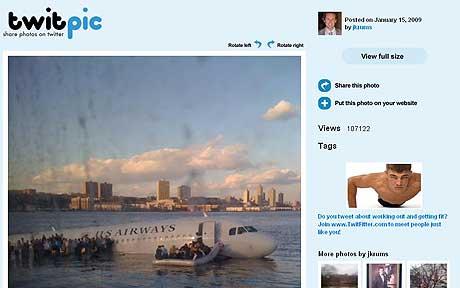
Several events have occurred worldwide that were initiated through a social media platform. In 2009, the power of social media through technology was introduced as a New York citizen,  Janis Krums, visually witnessed the crashing of United Airways Flight 1549 in the Hudson River by uploading pictures on via Twitpic – a third party photography application allowing users to posts pictures on Twitter. Twitter users documented the incident approximately 15 minutes before mass media nationally reported it.

twitpic_1240335c

Later that year, TMZ utilized this pedestal by informing the public via Twitter of the tragic death of Michael Jackson, also attaching a link to their website to elaborate on further details. Other events have emerged via social media before mass media, such as the death of the Osama Bin Laden and the engagement of Prince William and Kate Middleton.

Essentially, I believe mass media and social media works hand in hand. With social media being such a huge channel for the younger generations, this is bound to be a common practice of exposing news events. Social media also allows users to stay connected as they can exchange and research information via hashtags associated with current events to stay updated.

Through the incredible evolution of obtaining information faster, it is also important that we are inspecting the validity in the information received. For example, I view news stories on that appear on my Facebook feed quite often; however, I explore creditable newscast websites to ensure legitimacy. Although I am able to access Facebook and Twitter faster because I incorporate them in my daily schedule, I am still skeptical on certain material that I read. Once it is confirmed from mass media, then I consider it valuable.

References:

Beaumont, C. (2009, January 16). New York plane crash: Twitter breaks the news, again. The Telegraph. Retrieved from http://www.telegraph.co.uk/technology/twitter/4269765/New-York-plane-crash-Twitter-breaks-the-news-again.html

Macnamara, J. (2014). Which media set the news agenda: Mass media or/and social media?: Executuve Summary. Retrieved from Isentia: http://www.isentia.com/assets/blog/special/isentia_whitepaper_layout_international_d1.pdf

Osorio, B. R. (2015). Who’s winning in the mass media vs. social media war? [Blog]. Retrieved from http://www.philstar.com/business-life/2015/06/01/1460257/whos-winning-mass-media-vs.-social-media-war

Wood, M. (2013, April 19). Social media as breaking-news feed: Worse information, faster. CNET. Retrieved from http://www.cnet.com/news/social-media-as-breaking-news-feed-worse-information-faster/

Posted in Uncategorized | 1 Comment

Situational Analysis: Branding drones

While watching TV recently I was surprised to see that an Audi commercial (The drones. YouTube.) featured a driver using the car’s backup camera to escape from drones. I was surprised for two reasons. First, I am secretly scared of the idea of drones and picture Star Wars-like armies marching through the streets when I even hear the word and second, it seems that others are like me and that Audi thought they could somehow comfort potential drivers with the added safety feature of drone protection.

https://www.youtube.com/watch?v=vcV71liAMwc

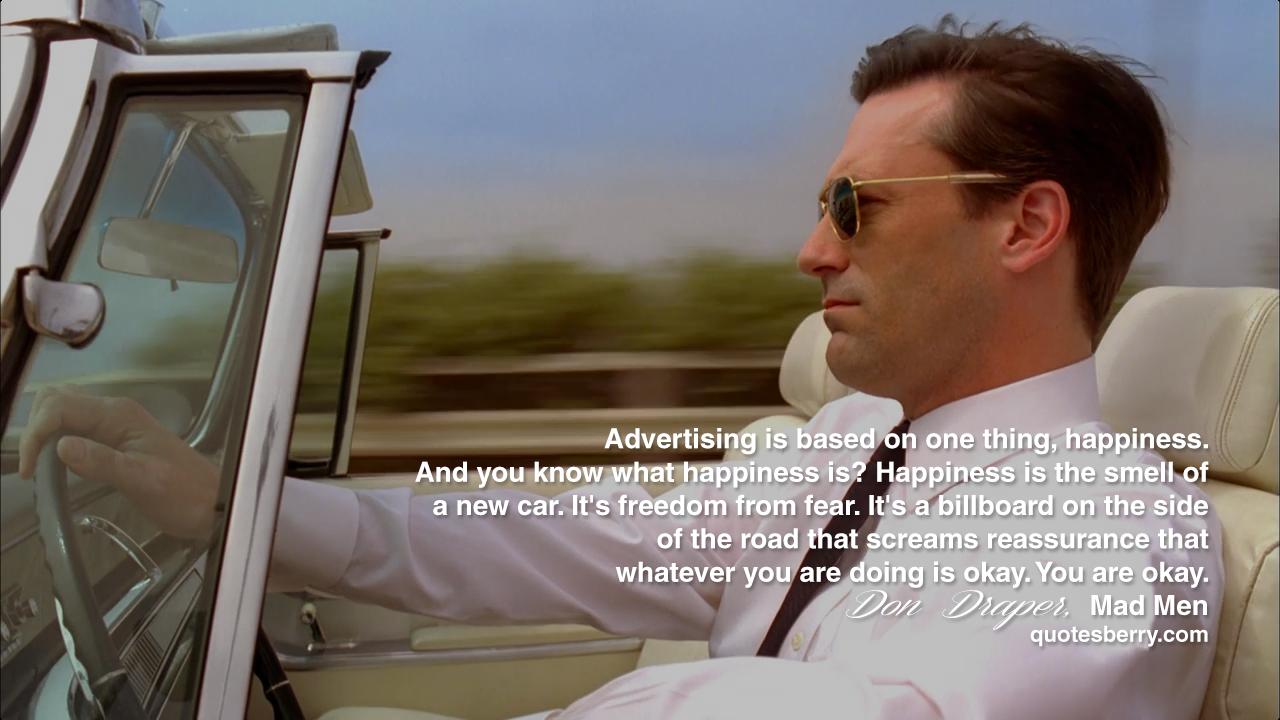
In the first episode of Mad Men (“Smoke Gets in your Eyes”), Don Draper tells us that happiness is freedom from fear. Harkening back to CMGT510, Dr. Cody taught us that fear can be an element of persuasion used in emotional appeals in advertising. Maybe Don attended Dr. Cody’s class?

Happiness is freedom from fear.

Happiness is freedom from fear.

According to Jennifer Hicks (2015), “drones have gone mainstream” and are no longer restricted to the military but are used in many industries for many purposes. Audi must have read her post. Let’s imagine the positioning for branding an imaginary drone that we will name Buzz (to reflect the droning sound of a friendly bee) produced by Acme Drones for delivering mail using the formulaic structure provided in this week’s instructional materials:

For [target market] [brand name] is the [product/service description] that [benefit] / [reason why].

For [mail delivery] [Acme Buzz] is the [drone] that is the [quietest model] so as to [maintain peace and not disturb a neighborhood].

Well, you can see how hard this might be to nail down the clear unique selling point of such a product. But whether it’s a not so terrorizing drone or another, more marketable product, it would still need situational analysis which starts with a branding audit. Reflecting upon the elements of our imaginary drone, we could envision the following:

  • Mission: To deliver mail in a timely, non-threatening way through any weather.
  • Vision: To increase the efficiency of mail delivery and reduce costs
  • Positioning: For [mail delivery] [Acme Buzz] is the [drone] that is the [quietest model] so as to [maintain peace and not disturb a neighborhood].
  • Brand Image: Quiet, efficient, hardworking (like our Bee association) Note: this is not what is portrayed in the Audi commercial and would need consumer research
  • Voice: Professional, soothing
  • Company Name: Acme (This would have made a great Wiley coyote cartoon – but maybe I am now showing my age)
  • Brand Architecture: Acme would have to determine if Buzz would use the umbrella Acme brand in promotion or stand on its own as only Buzz
  • Logo: Imagine the word Buzz with a bumble bee entwined
  • Visual Vocabulary: Like our bumble bee, yellow and black as colors and a simple font such as Gadugi
  • Messaging: Quiet, friendly delivery option at any time of the day or night
  • Tagline: Anywhere. Any time. Without a word.
  • Brand Experience: Safe, Undisturbed, Friendly

My takeaway is that every product – including drones – needs to go through this and it should help the marketing team crystallize the unique selling proposition.

SwotAnalysis

References:

Hicks, J. (2015, May 31). Innovative creative branding through drones. Forbes. Retrieved from http://www.forbes.com/sites/jenniferhicks/2015/05/31/innovative-creative-branding-through-drones/

“Smoke Gets in Your Eyes”. Mad Men. Lions Gate Entertainment. American Movie Channel. 19 July 2007. Television.

The drones. YouTube. Retrieved from https://www.youtube.com/watch?v=vcV71liAMwc


Posted in Uncategorized | Tagged , , | 2 Comments

Millennials: Redefining the Purchasing Habits of Parents

Source: http://thegbrief.com/articles/meet-today-s-millennial-mom-512

As if Millennials haven’t already kept marketers wheels spinning with their unique purchasing behavior and attitude, this youthful group is now reshaping the marketing strategies of a product category historically targeting past more traditional generations. Baby products. Millennials, defined as individuals born between 1980 and 2000, account for 29% of the American population. Recent research performed by Goldman Sachs shows that 90% of new mothers are Millennials, with an average age of 26 years old. The study also reveals that 43% of all children in the U.S. between the ages of 0-17 have a Millennial mother; this number is projected to increase over the next 10 years as those born in the 90s begin starting families. Although this cohort has had to overcome many obstacles resulting from an unfavorable economy, such as high unemployment and debilitating student loan debt, it has not deter this group from the pursuit of happiness, starting with building a family of their own.


What does this mean for marketers?

With over $200 billion in annual spending power, it is imperative that classic brands such as Huggies and Fisher Price reevaluate their marketing strategies in order to successfully capture the wallets of this consumer. As a Millennial that plans on starting a family in the near future, I strongly believe that my current values that play a role in my purchasing decisions will influence my household purchases in the future. Below are three key points that marketers must keep in mind in order for new and classic brands to be successful amongst in the evolving marketplace of Millennial parents.


  1. Be Social

As a tech-saavy cohort, Millennials frequently interact with friends, family along with strangers who share a common interest through social media. This cohort values brands that engage with them where they spend most of their time, which increases the likelihood of building brand loyalty.

Source: http://www.automotivedigitalmarketing.com/profiles/blogs/make-millennials-want-your-dealership-s-social-content

Source: http://www.automotivedigitalmarketing.com/profiles/blogs/make-millennials-want-your-dealership-s-social-content

  1. Be Authentic

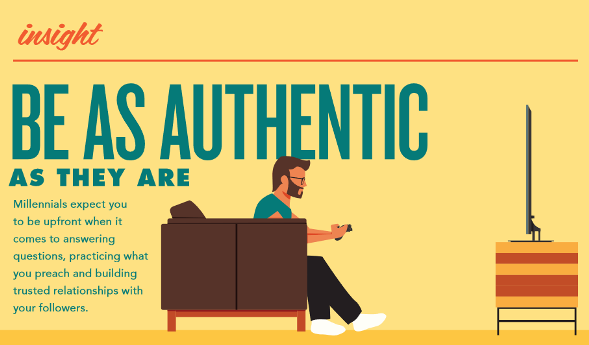
With an endless stream of information at their fingertips, Millennials easily navigate through this information, making sure to bypass gimmicky ad campaigns and the brands associated with them. Authenticity = Consumer Loyalty. In addition, Millennials find consumer reviews to be more influential in their purchasing decisions than advertisement.

Source: http://www.marketingpilgrim.com/2014/04/survey-says-millennials-are-not-a-one-night-stand-infographic.html

Source: http://www.marketingpilgrim.com/2014/04/survey-says-millennials-are-not-a-one-night-stand-infographic.html

  1. Be Socially Responsible

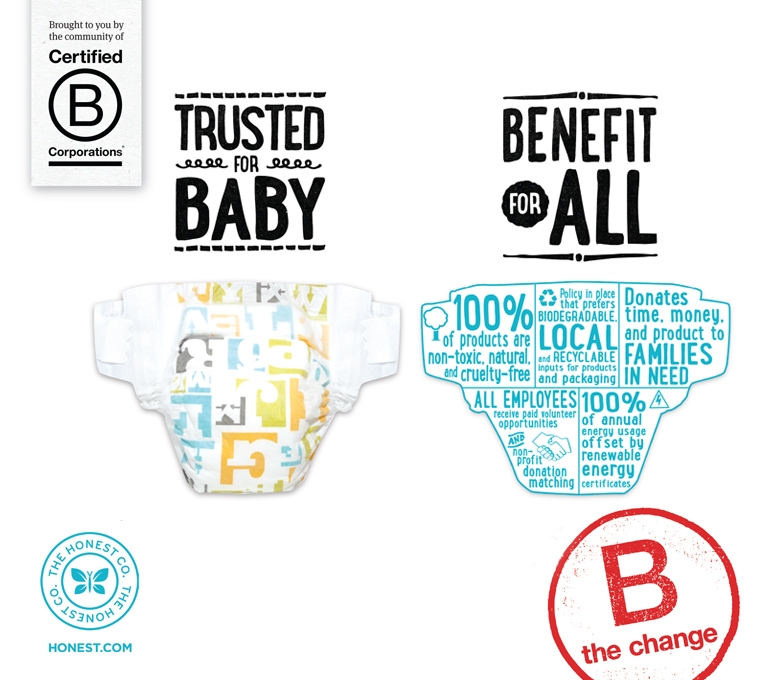
Arguably the most social and eco-conscious generation thus far, Millennials value a company’s commitment to giving back to society and they’ll pay the extra dollar to support companies who share this same value.

Source; http://bcorporation.eu/b-the-change/ads/the-honest-company

Source; http://bcorporation.eu/b-the-change/ads/the-honest-company

Sources:

http://mashable.com/2015/05/14/the-millenial-mom/

http://www.forbes.com/sites/danschawbel/2015/01/20/10-new-findings-about-the-millennial-consumer/

Posted in Uncategorized | 3 Comments

Persuasion in Advertising – 6 Ways to Hook Your Customer

When I was in undergrad at Purdue, my Com 318 Principles of Persuasion course went in depth with the numerous ways to persuade customers to buy your product in advertising. In the course we studied Robert B. Cialdini’s book Influence: The Psychology of Persuasion in which Cialdini lists 6 basic principles that influence people. These techniques have stuck with me ever since and I see examples of them being used all of the time. In advertising, it is important to understand how your audience is going to react to certain methods. The first key principle is:

1: Reciprocity

It is human nature to want to return a favor or compliment; it’s that feeling you get if someone gives you a birthday present, and you feel the need to get them something on their birthday. In marketing and communications, companies can use this in social media, by following or retweeting a person, they will be more likely to do the same. Advertisements with free samples are also utilizing reciprocity. It can also be used to maintain current customers through giving top sales teams trips of gifts. They will feel like they owe the company for these unexpected favors and in turn sell harder or remain loyal. In an About Money article by Lahle Wolf, she recommends being the first and last to “give” something. Have you ever experienced a store slipping in coupons in your bag as you are checking out? They are practicing reciprocity and expecting you to return to the store to use them.

Reciprocity

2: Commitment and Consistency

People like to remain consistent in their actions and are more likely to follow through with something if they commit orally or in writing. A personal example is back in undergrad, I was walking through a building on campus that tables set up for student organizations to promote their causes and whatnot. One group called me over and had a display about how using the word “retarded” in a derogatory way is extremely disrespectful and had a large poster they were getting people to sign and commit to never using the word in a derogatory way ever again. Using that word wasn’t a regular part of my vocabulary, but growing up in grade school where kids would use it a lot, I suppose it would slip out occasionally, so I signed the commitment. To this day, 6 years later, I remember that commitment and consciously make an effort to never use the word offensively. If I ever slip up, my mind goes straight to that commitment and I feel dissonance. Markers can use this to get people to commit, whether it be signing up for eblasts, social media, webinars or to be a brand ambassador.
Commitment

3: Social Proof 

People tend to follow the pack or the trends. We will gather other people’s opinions before we make a decision or fully commit. Think about it in terms of social media; are you more likely to follow someone with 50 followers or 50,000? Probably 50,000 because we are thinking, if so many people follow this person, they must have good tweets! Social proof is why companies want to have a good Yelp review or put testimonials and client’s logos on their websites.
taylor

4: Like-ability

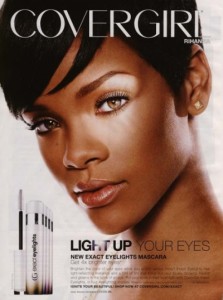
The title gives this one away, we are more likely to do business or buy product from someone we like. We see this in Presidential campaigns – we vote for the favorite candidate and even their looks can persuade us. Physical appearance has a lot to do with this category, not only with the spokesperson, but with the physical appearance if the website, social media site, or product.
Liking

5: Authority

The public is more likely to obey authority figures. Are you more likely to talk back to a police officer, your boss, a professor, or a random person? Most likely the random person who has no authority over you. We have an internal need to please people with authority and often look to those who are subject matter experts when making a purchase or large decision. Even presenting yourself as the expert can influence someone’s desire to do business with you. This can even be traced back to The Pitch, where coming across and knowledgeable and educated can win the business.

Authority

6: Scarcity

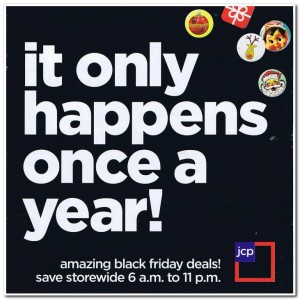
This tactic may be my favorite and I see it all the time – making a product sound scarce or like the opportunity is about to expire. If customers feel like something is scarce, it will generate a demand; they feel like the item is more desirable when it is limited. How many times a day do we hear “limited time offer”, “one day only”, or see that countdown on websites – “there are only 2 more left in stock!” Customers feel as if the item is all of a sudden difficult to find, so they have the urge to act quickly.
Scarcity

Now that you know and can recognize these 6 key principles of influence, I encourage you to practice them ethically. I’m not sharing these techniques for you to take advantage of people’s human nature, but to simply advertise your product in an effective and persuasive manner. What is the technique you feel gets used the most? Do you have any personal experiences with one of these principles or persuasion? Feel free to comment!


References:

Cialdini, R. B. (1993). Influence: The psychology of persuasion. New York: Morrow.

Lahle Wolf – About Money – The Principle of Reciprocity and How it Applies to Business

Jeff Sexton – The Social Media Examiner – 6 Powerful Social Media Persuasion Techniques

Manuel Jaeggi – Postcron – Use these 6 principles of the science of persuasion to get more customers before your competition does, or you might lose your business!

Megan Ritter – Demand Gen Report – The Art of Persuasion: 6 Effective Techniques for B2B Marketers

Posted in Uncategorized | 1 Comment

Creepy is memorable: How the new Hamburglar stole the Internet

hamburglar-600x450

McDonalds is in the midst of refreshing its brand after years of lagging sales and scrutiny over its nutrition and marketing practices to children. Just in time, the company has resurrected the once impish cartoon, the Hamburglar. Not only is McDonald’s notorious masked hamburger thief all grown up as an in-the-flesh marauder, he’s a husband, and a dad!

Some speculate the grown up Hamburglar is a response to McDonald’s history of using cartoon marketing to woo children. McDonald’s new Hamburglar may also be an attempt to court Millennials who have been turning away from fast food in favor of fresher and healthier alternatives. Bringing back a beloved mascot is certainly one way to connect with a younger (but not too young!) and hipper audience, and KFC appears to be doing it quite well with its pop-culturized version of Colonel Sanders.

McDonald’s has hit upon some unlikely social media gold with its awkward and some say downright creepy new Hamburglar. The Twitter universe lit up with hilarious commentary referring to the Hamburglar as a “hipster” and comparing him to the “Trivago Guy”. The Verge referred to the new character as “…a dad who picked the lamest costume at Party City.” The jokes and confusion over the new character even gave way to the hashtag #notmyhamburglar. Everyone, from the New York Times to Marketwatch to Mashable, to Huffington Post, is talking about the new Hamburglar.

McDonald’s social media strategy has centered around creating a “fun” image for the brand, and acknowledging the fact that the brand will always have its detractors as well as its advocates (Whiteside, 2013). As such, the company elected to unveil the new Hamburglar via a series of short “teaser” videos on Twitter. Unfortunately, the videos, featuring the Hamburglar in the stereotypical bumbling husband role have fallen flat with viewers.

McDonald’s is no stranger to the ups and downs of social media. In 2013, the company received unlikely social media attention when a video interview with Charles Ramsay went viral, following the horrific revelation and release of three Cleveland kidnapping victims. Ramsay was quoted as saying, “I was just eating my McDonald’s” when he heard the cries for help. McDonald’s was slow to respond after it was immediately thrust into social media conversation, but eventually ended up offering Ramsay free Big Macs for a year, and donated on his behalf to an organization for kidnap victims (Whiteside, 2013).

For better or worse, the new Hamburglar will most likely continue to be the butt of Internet jokes and will continue to generate E-wordof-mouth for the brand through sheer absurdity. It will be interesting to watch and see if McDonald’s attempts to join the fray and poke fun at itself a bit. Trivago, criticized for the sloppy appearance of its lackluster front man, held a public contest to give the guy a makeover, spinning an Internet joke into a marketing opportunity. Will McDonald’s intervene and admit that the new Hamburglar is just an out-of-touch suburban dad going through his first and most dramatic of many midlife crises? Or will he steal our hearts, along with our Big Macs?

References

Whiteside, S. (2013, June). Creating a more human brand image: McDonald’s social media strategy. WARC.

Posted in Uncategorized | 6 Comments

Knowledgeable consumers…what a concept!

Mad-Men-Quotes-1- (1)

Don’t laugh. I just started watching Mad Men this past week. Now that it’s over, I wanted to see what the fuss was about. I actually learned some things, namely that I really hope my grandfathers weren’t as misogynistic as all that, and that, if they were, that my grandmothers stood up for themselves a little better than some of the women in the show. But aside from the sociological lessons, the show is also a fantastic portrait of the ethical hinterland sometimes associated with the advertising and marketing industries.

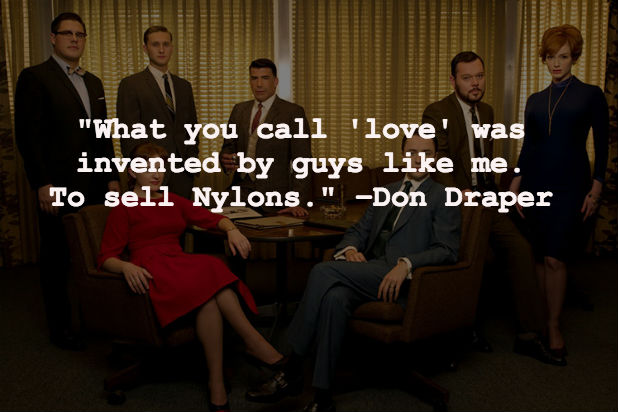
In the first episode, Don Draper, brilliant creative director for a large ad agency in Manhattan, is trying to come up with a new ad idea for a tobacco company client on the heels of an article in Reader’s Digest that is telling consumers that smoking might actually be bad for them. He finally sells the tobacco executives on this tag line: “The other tobacco leaves are filled with poisons and pesticides. Ours are toasted.” The suits love it, and Don’s career is saved. What’s more—the ad works. Sales go up. After all, what do consumers know, except what they are told by advertisers?

Of course, ads that are aren’t legally misleading can be very persuasive based not on fact, but on what marketers want consumers to believe. Think about it: the whole point of the advertising industry is to convince people to buy something they probably otherwise wouldn’t. Don Draper wasn’t actually telling a lie…was he?

But with the advent of the digital information age, this scurrying around the facts is becoming harder to do and less acceptable to consumers. If a company is not outright lying, and not necessarily misleading, are they really making anyone’s life better in any substantial way, as most ads claim, and if not, are they making it worse? Perhaps and perhaps not, but shouldn’t consumers know exactly what they’re getting?

Consumers are researching, fact-finding, googling, asking questions, and in general, demanding to know what they’re being sold. According to a recent Forbes blog on current marketing integration trends, written by marketing expert and Forbes contributor Avi Dan, transparency is becoming a trend in the marketing and advertising industry simply because consumers are demanding it, and consumers have an increasing amount of say in the marketplace. Dan thinks that most brands are still unwilling to engage in what he calls “radical transparency,” but that it will become increasingly necessary to success (and profit) to ensure that consumers trust them. And, like it or not, digital media and brands are more closely entwined than ever; people can see you (Young, 2014).

Digital and social media shine a light in dark corners where no light has ever been before. Consumers can no longer be reached just via their emotions. They want you to satisfy them cognitively first, and if you don’t, they’ll find the answer elsewhere. What’s a company to do? Make a product about which you don’t have to lie, give consumers the facts (knowledge), then engage their emotions (convince). It may really be as simple (and as ethical) as giving consumers credit for being the smart, engaged targets they are, and letting the facts speak for themselves.

References

Dan, A. (2015). 11 marketing trends to watch for in 2015. Forbes. Retrieved from http://www.forbes.com/sites/avidan/2014/11/09/11-marketing-trends-to-watch-for-in-2015/.

HBO. (2007). “Smoke gets in your eyes.” Mad Men, Episode 1. DVD.

Young, A. (2014). Brand Media Strategy: Integrated Communications Planning in the Digital Era. Palgrave McMillan.


Posted in Uncategorized | 2 Comments

Marketing Feminism

Fury Road 1

“Fury Road is sure to set the bar high for what can be done with a jolt of estrogen in the testosterone universe of blockbusters” (Howell, 2015)

Mad Max: Fury Road Movie Trailer: https://youtu.be/hEJnMQG9ev8

Last weekend I saw the movie Mad Max: Fury Road and I have to say that it was surprisingly entertaining and thought-provoking. However, not for the typical reasons of special effects, an intricate plot or memorable movie lines – although I was blown away by the movie as a whole.  I was stunned how the women in the film kicked some butt! I’m not sure how many fellow USC classmates have had the opportunity to go to the theater and see this movie yet, but I highly recommend it especially because of the incredible controversy erupting on social media and various news outlets right now on whether or not Mad Max: Fury Road is truly a feminist blockbuster.

Regardless of director George Miller’s approach and purpose behind the casting and development of Mad Max: Fury Road, the marketing strategy has been nothing short of brilliant. Charlize Theron shaves her head in this post-apocalyptic film, and dons a prosthetic arm, throughout her portrayal of Imperator Furiosa. The trailer for the film, print ads and billboards have all centered on the image of Theron as a desert warfighter. Even though the movie is entitled “Mad Max,” Max becomes more of a background character in this film, pushing the plot along, but contributing very little other than a few timely punches. Furiosa is the overall hero of the film, rescuing the enslaved wives of their colony, and bringing down the colony’s evil dictator. She’s not a “Wonder Woman,” but instead, Furiosa is someone more tangible that female audience members may actually be able to relate to on some level.

Personally, I believe that the success of this film is widely attributed to its release and marketing of feminism during such a critical time of military combat history. Women are preparing to go into more combat roles in the United States military, particularly the U.S. Marine Corps. Marine Corps females, in my opinion, should be motivated by a film like this because of the film’s willingness to show women fighting and dying alongside their male counterparts on the battlefield. Very rarely have I witnessed a woman brutally dying in a war scene, like I did in Mad Max: Fury Road. It demonstrated each woman’s passion and motivation for putting her own life on the line for a cause that she believed in.

The women portrayed in Mad Max: Fury Road broke away from the chains of patriarchal societies in order to ensure survival and independence.  Their willingness to fight and die proved to be nothing short of extraordinary, and should be a message for all women to stand up to their most intimidating and impossible life trials. Whether or not this film is a feminist revolution is still up for debate, but the discussion surrounding the topic is helping promote the movie in impressive ways throughout the globe.


References

Howell, P. (2015, May 8). Rise of the alpha female: Charlize Theron in Mad Max: Fury Road. The Star. Retrieved on May 30, 2015, from http://www.thestar.com/entertainment/2015/05/08/charlize-theron-in-mad-max-fury-road-embodies-the-new-alpha-female.html

King, T. (2015, May 20). No, Mad Max: Fury Road is not a feminist masterpiece (but that’s OK). NewStatesman. Retrieved May 30, 2015, from http://www.newstatesman.com/culture/2015/05/no-mad-max-fury-road-not-feminist-masterpiece-s-ok

Perry, H. (2015, May 13). ‘Mad Max: Fury Road’ Is the Feminist Action Flick You’ve Been Waiting For. Vice. Retrieved on May 30, 2015, from http://www.vice.com/read/the-new-mad-max-movie-is-both-badass-and-totally-feminist-944

Rosenberg, A. (2015, May 26). ‘Mad Max: Fury Road’ and the political limits of action movies. The Washington Post. Retrieved May 30, 2015, from http://www.washingtonpost.com/news/act-four/wp/2015/05/26/mad-max-fury-road-and-the-political-limits-of-action-movies/

Posted in Uncategorized | 1 Comment

Creating synchronized moments by Michelle Gipson

When R&B singer Jill Scott released her first album “Who is Jill Scott”, there was no advertising budget. Instead, marketers were employed to create what is loosely termed as “word of mouth” to contact key influencers throughout the market to answer the question “Who is Jill Scott.” This technique has worked not only worked in the music industry, it has worked for best selling books. For instance, the Harry Potter series and 50 Shades of Grey benefited from the work of “word of mouth.”

In a recent Annenberg class, I research Egypt and specifically the coup of 2012 that was not televised. Largely carried out by young adults through social media, the youth were able to unseat the ruling government, yet after the first few days of the revolution, the buzz died, the energy faded and power shifted. Similarly, this can happen with marketing campaigns that we might encounter in the workforce. To understand better why some campaigns, political or consumer, or more successful than others, I found information about “synchronized moments”.

Synchronized moments was studied by Dr. Zeynep Tufekci’s and presented in a Ted Talk and adapted for NPR’s Ted Talk Radio. Her research included the political unrest in Egypt and Turkey. Her research also compared those movements to the success of the Civil Rights Movement in Montgomery, Alabama that had no social media to use as a tool, yet its effects were longer lasting than most of the digitally inspired political protest.

Here are the key factors in sustainability:

Time – In order to think together collectively, digitally organized groups need time to commune with one another

Consensus – dialogue must be created to help groups with different agenda agree on how to proceed

Community – when community form past the immediacy of the situation, there is a long-term effect

Essentially, something that happens spontaneously must find organization in order to have longevity. The Civil Rights Movement was organized but it too was an organization that grew from differing factions and opinions. In today’s digital environment, participation happens quickly and grows to large scales. According to Tufekci, “good intentions are not enough.” As communicators, we should help organize these groups into communities to help the sustainability of any integrated marketing efforts we may have for our employers/clients.

Posted in Uncategorized | Tagged , , | 4 Comments