Which comes first? The product or the brand?

We live in a ready-made world. People are pressed for time and look to accomplish tasks without sacrificing too much of their day. Look around and you’ll see ready-made websites, templates for fliers or just about anything else you can imagine. How about a ready-made brand?

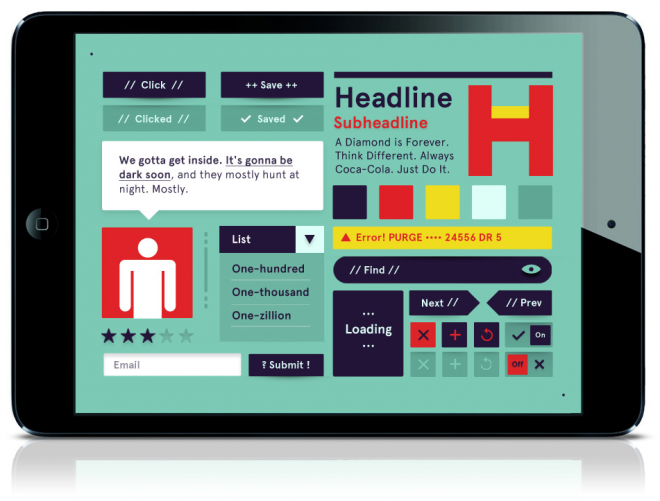
Ben Pieratt, a designer and co-founder of Svpply, is selling Hessian, a ready-made brand. Hessian is a complete, fully-integrated brand with no product attached to it. According to Tim Maly of Wired, the brand is selling for $18,000 and includes:hessian_s1_pt2_ui-660x501

–          Name

–          URL

–          Twitter and Tumblr accounts

–          20+ logo and other designs

–          10+ T-shirt designs

–          8 repeating patterns

–          1 website theme

–          1 app user interface theme

–          5 app icons

–          Brandbook with guiding principles

–          30 hours custom design time (for transitioning the brand to buyer’s needs)

To some, this may seem like a great deal. Yes, the footwork is done and everything one may need to introduce the Hessian brand to the world has been created. But is this an idea whose time has come or is this nothing more than an advertising gimmick?

According to Pieratt, his artistic passions drove him to create Hessian after being inspired by his son’s building blocks. He believes that the designers have creative concepts that they should get out, regardless of the lack of attachment to a brand. These designers, Pieratt believes, know how the concepts should be launched and marketed.

While designers do create the ideas that build a brand, the idea of a ready-made brand for a product seems a bit out of place. Brands are created to represent a company, product or service. The brand is meant to reflect the feel and essence of that which it represents. With a pre-developed brand, the product must live up to the brand. Sure, the buyers of the Hessian brand would save a bit of time creating a brand from scratch. But would their product or service be truly invested in the Hessian brand?

Oddly enough, Pieratt told Wired that the product-less brand has taken on a life of its own. Pieratt’s effort to sell the brand has brought increased attention and has essentially led Hessian to become a brand itself. Although he could use the money, Pieratt said he hopes the brand won’t be bought; he has bonded with his son thanks to his creative inspiration.

Posted in Uncategorized | 5 Comments

Pardon me, do you remember Grey Poupon?

When the curtain opened on the 85th Academy Awards, I had already begun drafting a blog post about a new marketing initiative by the Girl Scouts of USA, who this season introduced a “nutritional” cookie featuring NutriFusion vitamin spread. I was going to talk about the unique challenges — and rewards — of marketing a seasonal product and evaluate the organization’s attempt to connect with today’s health-conscious consumer.

But then two things happened. First, I searched the annals of Buy the Way and found that a former Annenberg student already wrote about the Girl Scouts. Her post offers a compelling analysis of the organization’s centennial rebranding effort, which you can read here. Second, I saw a commercial during the Oscars that captured my imagination and convinced me to change tack at the last turn. If you still want to read about the Girl Scouts’ new cookie, you can start here.


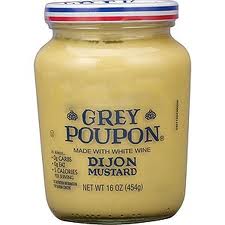
Jar of Grey Poupon Dijon mustard

If you were old enough to watch television in the 1980s, you knew (and probably loved) Grey Poupon’s “Pardon Me” ad campaign. Even if you came of age in the ’90s, you likely became familiar with the mustard maker’s famous TV spots through a long-lived series of parodies that kept cropping up in movies like Wayne’s World  and television shows like Married… with Children. 

1985 Grey Poupon Commercial

Married with Children Clip featuring Grey Poupon Parody

The campaign was a huge success, becoming a pop culture phenomenon and making a funny-sounding French brand into a household name. According to the Los Angeles Times (Hallock, 2013), Grey Poupon saw unprecedented sales growth in markets where the campaign aired, facilitating Dijon mustard’s transformation from an aspirational taste into an assimilated one (“Spreading,” 2010).

Although Grey Poupon is still one of the top-performing mustards in America (“Spreading,” 2010), this accolade has come to mean less and less as the condiment market has been flooded with specialty mustard products from competitors large and small. As the brand’s market share has shrunk, so have its sales (Choi, 2013). Grey Poupon may also have suffered from neglect as ” just one of many” Kraft brands. In fact, Kraft has not ordered a single commercial for the mustard since it acquired the brand through a merger with Nabisco in 2000 (Choi, 2013; Wahl, 2000).

That all changed tonight when a “throwback” commercial referencing the “Pardon Me” campaign of more than thirty years ago aired during the Academy Awards. The 30-second spot was billed as a “trailer” for a longer, two-minute version available online. If you didn’t see it, take a look:

Grey Poupon Throwback Commercial
https://www.youtube.com/watch?v=2Tj_eHWm6E0

Crispin Porter + Bogusky logo

Grey Poupon’s original “Pardon Me” campaign was created by agency Lowe Marschalk, which today operates under the name Lowe and Partners as a division of big-four agency Interbrand. But the last three decades have been volatile ones for the advertising industry, and Grey Poupon appears to have a new agency of record. Tonight’s commercial is the brainchild of Crispin Porter + Bogusky. While not among the “big four,” CP+B is a major player that recently garnered a lot of attention for its Super Bowl XLVII spots for JELL-O and Best Buy.

CP+B made a smart move by reintroducing Grey Poupon during the Academy Awards. The classy feel of Hollywood’s biggest night suits the brand that was once associated with the posh, Rolls Royce set.  And while Kraft only plans to air the commercial once (Choi, 2013) —  understandable, considering the tremendous price of Oscars advertising —  CP+B has created an integrated marketing campaign that may keep the buzz alive long enough to make Kraft’s investment worthwhile.

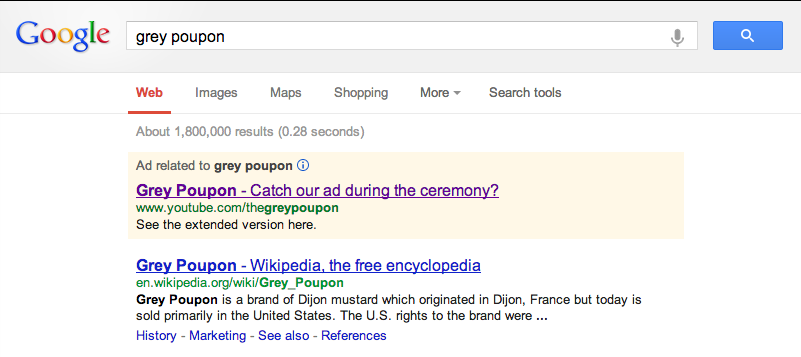
I saw a lot of Grey Poupon chatter on Twitter immediately following the commercial, and a Google search for “Grey Poupon” a few minutes later revealed that CP+B has taken advantage of paid advertising to steer traffic to the new campaign’s website, asking Googlers, “Catch our ad during the ceremony?”:

Screenshot of paid Google ad for Grey Poupon

Do you think CP+B’s approach will pay off? Has viral marketing created an environment where a single commercial spot is all it takes to kick off a brand rejuvenation? Let me know your thoughts.

References

Choi, Candace. (2013, February 19). Grey Poupon pins hope on ad during Oscars. USA Today. Retrieved from http://www.usatoday.com

Hallock, B. (2013, February 22). Oscars week: ‘Pardon me’ Grey Poupon ad brings back the ’80s. Los Angeles Times. Retrieved from http://www.latimes.com

Spreading the love. (2010, October 7). Bloomberg Businessweek. Retrieved from http://www.businessweek.com

Wahl, M. (2000, June 26). Philip Morris reaches deal for Nabisco. Chicago Tribune. Retrieved from http://www.chicagotribune.com

Posted in Uncategorized | Tagged , , , , , , , | 5 Comments

Coca-Cola’s Anti-Obesity Campaign

(*** Please note, I am posting this under Rachael Guia’s login because of problems with my own.***)

Coca-Cola recently launched a rather strategic anti-obesity marketing campaign under the guise of a PSA.  This campaign comes at the helm of much backlash against the soda and sugary beverage industry as the public is quickly becoming more aware of all of the health implications consuming such products has on the human body.  In response, Coca-Cola cleverly addresses the issue by explicitly avoiding the issue of the ingredients in its beverages (with the exception of Dasani water); and focuses instead on the more basic issue of caloric intake to obesity rates.

Coca-Cola takes the position that taking in a less daily caloric intake leads to lower incidences of obesity.  To help aid this, the campaign tells us that Coca-Cola has created new beverage sizes ranging from a can of Coke that has a mere 90 calories on upward so that every possible consumer type can have a product to choose from.  They also strategically mention that they are constantly looking into new and emerging zero-calorie sweeteners to add to their products to further reduce one’s daily caloric intake.   Their message is simple:  drinking their products will lead to weight loss by the sheer assumption that reducing calories in, takes weight off.  By carefully avoiding the controversial issue of the ingredients in their products and stressing their efforts in reducing obesity rates, they give off the perception that they care about everybody’s health and are doing everything in their power to further the cause.

Coca-Cola even takes the proactive stance of advocating an otherwise healthy lifestyle and pairing their reduced calorie drinks with exercise.  On the surface, their campaign appears to be an informative and caring message targeted to the general population.  To the average viewer, it may also seem as though Coca-Cola is acknowledging and taking responsibility for its less than healthy beverage offerings.  However, when you really stop and think about it, their message is quite deceptive to a less sophisticated audience.  The ingredients in sugary drinks and soda have been quite topical as of late, especially in light of the recent death of an otherwise healthy young 30-something year old female who died solely of the cause of drinking too much soda everyday.  Mayor Bloomberg’s ban on 16-ounce sugary beverages (other than beverages consisting largely of milk) has also brought national attention to his controversial law to fight obesity and improve health.  There are also the (also highly controversial) NYC Subway adds that show a rather graphical depiction of what happens inside your body as you drink soda and other sugary drinks.  And let’s not forget the findings about what goes into Diet soda and its health effects (and apparent findings that consuming Diet soda actually leads to weight Gain and not loss…).  None of this is mentioned in the campaign, of course.

See the commercial here:

Coca-Cola Anti-Obesity


Tori Bass

CMGT541, Spring 2013, Section B


Posted in Uncategorized | 2 Comments

Wanted: IMC Metrics to Measure Results

Recently, I was in a meeting where we were evaluating the results from our 2012 marketing communications efforts.  Based on our metrics, we met our overall objectives, generating positive results from our media, advertising, external web and other initiatives.  It was all good.

But we are now in 2013 and as we all know, today’s already complex communications environment continues to change at a rapid pace. Moreover, executives today not only depend on marketing communications to improve brand image and protect reputations, they also expect to see qualitative and quantitative evidence of how marketing communications is helping to achieve strategic objectives and contribute to the bottom line (Bradley, 2011).  As a result, the need to ensure we have the right measurement and evaluation tools in place for tracking and reporting our performance is more important than ever.

A key question in the process is how to engage ever-expanding social media platforms such as blogs, Twitter, Facebook and others. This short video clip featuring Jon Iwata, Senior Vice President of Marketing and Communications at IBM and chairman of the Arthur W. Page Society sums it up nicely: https://www.youtube.com/watch?v=Xtgyx9jXlSI

Indeed, engaging social media can be a bit daunting, especially for organizations that are accustomed to controlling all aspects of their communications (Hamilton, 2006, p. 14).  It also creates the need to establish the appropriate set of metrics to assess and report results.

Social media and metrics to measure results is certainly a hot topic these days.  Fortunately, the news is good.  According to Young (2010), “the accessibility of data, and the speed at which it is available, has made it easier for marketers to evaluate and optimize campaigns with higher precision.  Marketers have been able to adjust a campaign as it evolves, fine-tuning efficiency and response.  New media-measurement techniques have allowed marketers to test and improve each campaign over time, changing creative, media placement, position and timing” (Young, 2010, p.23).

Because of the need for effective tools for measuring and reporting results of marketing communications, advice abounds in literature, reports and blogs by various experts in the community.  One example is a report by the Altimeter Group entitled, “The Social Media ROI Cookbook:  Six Ingredients Top Bands Use to Measure the Revenue Impact of Social Media.”  It includes rich data and expert advice on qualitative and quantitative approaches to measuring the impact of social media on the bottom line.

Although there is clearly no “one size fits all” to addressing the challenge of measuring marketing communications, this report and others like it provide useful tips and techniques that are worth consideration.  But, like our rapidly changing environment, I’m sure this is a process that will continue to evolve.

References

Bradley, B. (2011). Five metrics and an ‘MBA’ to help measure the effectiveness of media coverage. PR News, 67(26), n/a.

Hamilton, N. (2006, Sep 04). Today’s media relations rules. PRweek, 9, 14-15.

Patterson, L. (2007). Taking on the metrics challenge. Journal of Targeting, Measurement and Analysis for Marketing, 15(4), 270-276.

Young, A. (2010). Brand media strategy: Integrated communications  planning in the digital era. New York: Palgrave Macmillan.


Posted in Uncategorized | 1 Comment

When the idea overshadows the product

Hannah Martine’s post “Bourbon blunders: Maker’s Mark’s big branding mistake” got me thinking about other brands that have had advertising “blunders,” and caused a backlash that had to be remedied by the manufacturer. And the first one to come to mind, although it happened between 2010 and 2012, was the fake band from the Freecreditreport.com commercials.

Freecreditreport.com (www.freecreditreport.com) launched a campaign of commercials that aired on television and were available online (featuring a fake band playing fake songs in 2007 (www.free-credit-report-band.com, 2013) that lasted through 2010. In 2010 amidst lawsuits and the idea of having a band tour and play the commercial songs, Freecreditreport.com replaced the band with “a real band” (www.free-credit-report-band.com, 2013). It wasn’t long though, before there was a backlash by consumers demanding that the old band return, which they did in June of 2012 (www.free-credit-report-band.com, 2013). What seems even more bizarre about this is that the original band’s three members are all professional musicians, too (www.free-credit-report-band.com, 2013).

However, consumers creating a backlash that a company fixes isn’t what I find interesting, as we saw in Martine’s post about Maker’s Mark, as well as countless mistakes that have been made throughout the years (New Coke anyone?). What I find interesting is that the Martin Agency of Richmond, VA., (Huffingtonpost.com, 2012) created a campaign to which consumers felt an emotional connection to that overshadowed the product. There were no complaints or backlash regarding Freecreditreport.com only being a free trial, not technically tree (Huffingtonpost.com, 2012), or that the product was faulty.

The Martin Agency may have created a campaign that may have benefited the musicians in the commercials more that Freecreditreport.com as each of the musicians in the commercial have their own bands (www.free-credit-report-band.com, 2013). I’ve been trying to think of another time this has happened, where an advertisement or the message in it became bigger than the product advertised. And at the end of the day, was this really a blunder because now people know the Freecreditreport.com band and as a result the site.

The original band


The replacements

http://www.youtube.com/watch?v=LPDdxwiRIl4

References

Dicker, R. (2012). Original band returns in ads for FreeCreditScore.com. The Huffington Post. Retrieved from http://www.huffingtonpost.com/2012/06/06/experians-freecreditscore-band_n_1574319.html.

Freecreditreport.com. (2013). Retrieved from http://www.free-credit-report-band.com.

Free-credit-report-band.com. (2013). Retrieved from http://www.free-credit-report-band.com.

Posted in Uncategorized | Comments Off on When the idea overshadows the product

Decision 2013: Cheesy Garlic Bread, Chicken & Waffles or Sriracha

Lays_

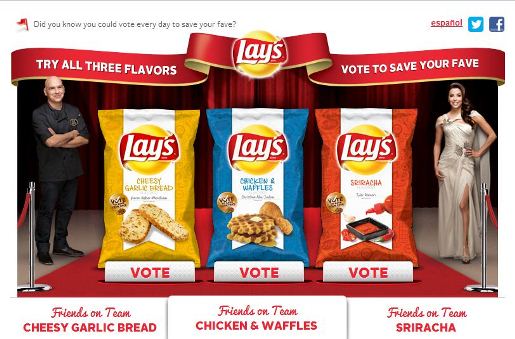
In front of me are three open bags of Lay’s potato chips. I have a very important decision ahead of me: which of these three flavors, Cheesy Garlic Bread, Chicken & Waffles or Sriracha, should I vote to be the next new flavor of Lay’s potato chips? Lay’s “Do Us a Flavor” marketing campaign is asking consumers to vote for their favorite flavor chip.

Celebrity chef Michael Symon and actress Eva Longoria appeared for the “Do Us a Flavor” campaign that launched this past summer.

Lay’s announced a contest seeking ideas for its next potato chip flavor and a $1 million dollar prize for the winning idea. Between July 20 and October 6, 2012, close to 3.8 million potato chip fans submitted their ideas through Lay’s Facebook page or by texting the word FLAVOR. (Lay’s 2013)

Last week, the three flavor finalists were announced through Lay’s commercials, its website and Facebook and Twitter pages.

The chips are available at grocery and convenience stores. Voting is open until May 13 through Lay’s Facebook page, on Twitter using the hashtag #SaveChickenWaffles, #SaveGarlicBread or #SaveSriracha or by texting “Vote” to a special number. The winning flavor will be announced after voting ends and will become the newest Lay’s addition. (Lays, 2013)

To be honest, I didn’t pay much attention to this contest until last week when I started to see lots of activity on Facebook, Twitter and Instagram. Lay’s campaign definitely created social media buzz in my world. Family and friends were weighing in on what flavor they voted for and I kept seeing photos of these chips on my social media news feeds. So, of course I felt compelled to join in on the fun.

Kudos to Lay’s for conducting a compelling and engaging marketing campaign. I went to two grocery stores before finding the three bags of chips at 7-11. I don’t recall ever doing this just for potato chips. This campaign drove me on a mission to find these chips and then vote for my favorite flavor. I think this was a clever way for Lay’s to use social media to promote a new product. And, if you’re wondering, I voted for: Chicken & Waffles.

References

Frito-Lay. (2012, July 20). Lay’s Potato Chips Teams Up With Eva Longoria And Iron Chef Michael Symon To Invite Consumers To Create The Next Great Potato Chip Flavor [Press release]. Retrieved from http://www.fritolay.com/about-us/press-release-20120720.html

Frito-Lay (Producer). (2012, July 23). Lay’s – Do us a flavor [YouTube video]. Available from http://www.youtube.com/watch?v=FU668JU9nn8&list=PL077C641046DFBF56

Frito-Lay. (2013, February 12). Lay’s potato chips, Eva Longoria and Chef Michael Symon to introduce three finalists vying for $1 million or more in grand prize winnings in the Lay’s “Do Us A Flavor” contest [Press release]. Retrieved from http://www.fritolay.com/about-us/press-release-20130212.html

Frito-Lay (Producer). (2013, February 14). Lay’s – Do us a flavor™ on the red carpet [YouTube video]. Available from http://www.youtube.com/watch?v=3Hg_Ex1tp_g&list=PL077C641046DFBF56&index=1

Sheila de Vera – CMGT 541 – B

Posted in Uncategorized | 20 Comments

Rebrand “marketing”?

Last summer, Harvard Business Review (HBR) declared that marketing is dead (Lee, 2012, para. 1). In the fall, Adobe (2012) commissioned a study that concluded digital marketing is failing consumers (para. 1). IBM (2013), however, sets the record straight: marketing is undergoing a “massive transformation”(YouTube). Deepak Advani, VP, Business Analytics at IBM, quite simply points out that going forward, marketing must focus on what happens with the customer after the purchase equally or more so than how the customer is approached prior to purchase (IBM, 2013, YouTube).

The Transformation of Marketing (IBM, 2013)

Does there need to be a new term for the word marketing, a word that reflects this reality? Perhaps, but that would be costly and inefficient. After all, how many MBA programs, associations, or industry publications (to name a few) would buy into the idea of scrapping the word marketing?

However, Advani’s advice is at the heart of relevance and engagement. Managing the experiences that consumers have with the brand after purchase makes the difference between a brand loyalist who is passionate and vocal and one who is not.  As students in the USC MCM degree program, we are, in a sense, being charged with carrying this notion into the marketing and communications departments in which we work – a challenge that takes on special meaning when the department is housed in an established institution or company rather than a cutting-edge visionary outfit.

One approach to this reality might just be to rebrand the word marketing. What if “marketing” was conceived as meaning quality, two-way conversation between a brand and its customers? Maybe then surveys and studies would no longer declare the death of marketing; consumers wouldn’t resist being “marketed to”; and traditional companies would understand why their marketing departments are clamoring for the resources to create these types of brand experiences.

After making such dire pronouncements, Lee (2012) and Adobe (2012) then discuss marketing in very similar terms to what Advani is calling for; so in a sense, the rebranding effort may already be underway. Perhaps marketing doesn’t fail consumers…the marketers do.

References

Adobe. (2012, October 24). U.S. study reveals online marketing is failing with consumers (press release). Retrieved from http://www.adobe.com/aboutadobe/pressroom/pressreleases/201210/102412AdobeAdvertisingResearch.html

IBM (Producer). (2013, February 1). The transformation of marketing [YouTube video]. Available from http://www.youtube.com/watch?v=BwZOAfa0FKc

Lee, B. (2012, August 9). Marketing is dead. Harvard Business Review. Retrieved from http://blogs.hbr.org/cs/2012/08/marketing_is_dead.html

Cathy Williams

CMGT 541

Fall 2012 cohort


Posted in Uncategorized | Tagged , , | 8 Comments

Bourbon blunders: Maker’s Mark’s big branding mistake

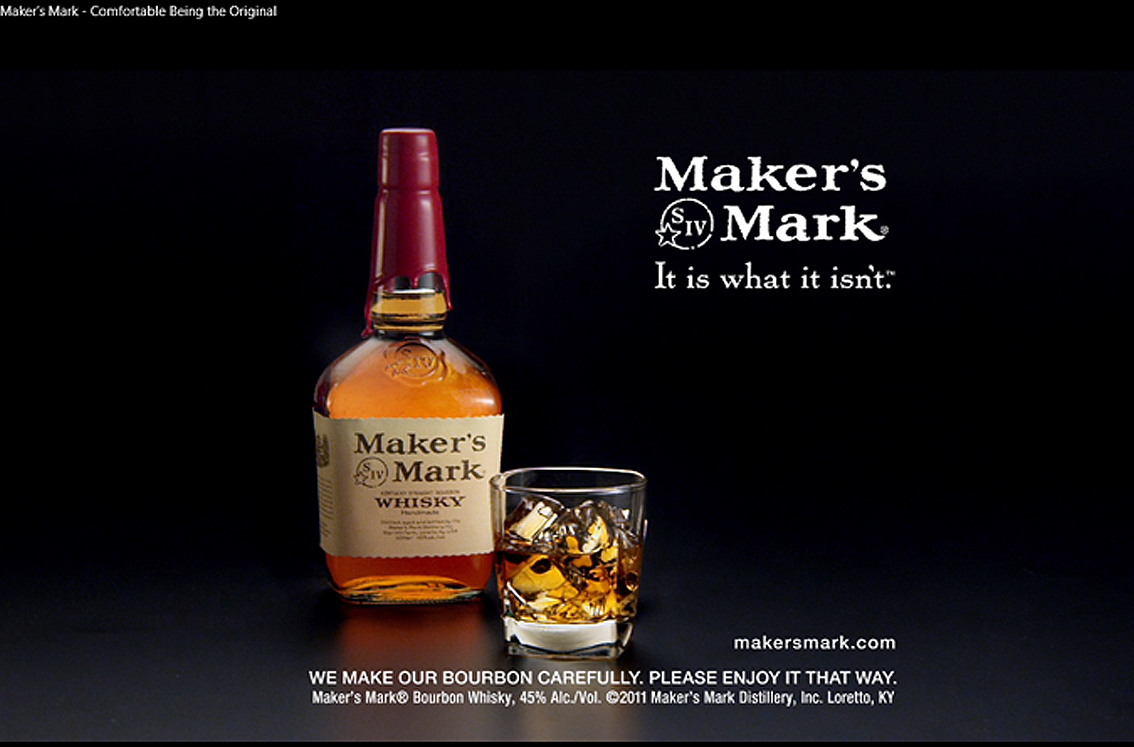
Makers Mark

It doesn’t get much more American than bourbon, and with a return to Americana palpable in pop culture, bourbon and American whiskey sales are up – as are production problems and marketing issues.

Interest in American whiskey has risen in pop culture through books like “Last Call: The Rise and Fall of Prohibition,” by Daniel Okrent, as well as in the documentary film “Prohibition,” by Ken Burns and Lynn Novick, and the HBO series “Boardwalk Empire” (Meece, 2011). Additionally, AMC’s hit show Mad Men has certainly played a part in re-branding your grandfather’s drink.

In the United States, “Most of the growth comes from an increase in flavored whiskeys in the past five years, which mirrors the increase in flavored vodka in prior years,” according to an interview with John Kristin “Kris” Sirchio, the Chief Marketing Officer of Brown-Forman, the parent company of Jack Daniel’s in Forbes. “The growth is also being fueled by small craft innovation” (Dan, 2012).

However, not only in U.S. markets, but internationally bourbon is seeing rising numbers; United States spirits exports grew 16.5% in 2011, reaching a record $1.34 billion, which beat out wine’s $1.14 billion and beer’s $334 million, according to data from the Distilled Spirits Council of the United States, a liquor trade group. Whiskey, including bourbon, accounts for 69% of spirits exports (Schultz, 2012). While the top export is Jack Daniels, which jumped to No. 19 on the Millionaires list from No. 21 last year, three other U.S. brands – Jim Beam, Maker’s Mark, and Wild Turkey – were among the fastest-growing whiskies in the world (Schultz, 2012).

In the midst of this bourbon boom, some distilleries are having trouble keeping up with market demands (Merwin, 2013). Recently, Maker’s Mark learned an interesting lesson in market research and backlash due to its shortage of product nationwide. In an effort to stretch its limited supply, Maker’s Mark announced in February it would reduce the alcohol by volume by 3% in an effort (Maker’s Mark, 2013). Backlash ensued on Facebook and other social media sites, as well as blogs, op-eds, and more. One week after its announcement, Maker’s Mark recanted in a statement on its website, stating, “effective immediately, we are reversing our decision to lower the ABV of Maker’s Mark, and resuming production at 45% alcohol by volume (90 proof). Just like we’ve made it since the very beginning” (Maker’s Mark, 2013). The tone of the release was personal and sincere. It began with “You spoke. We listened. Dear Friends, Since we announced our decision last week to reduce the alcohol content (ABV) of Maker’s Mark in response to supply constraints, we have heard many concerns and questions from our ambassadors and brand fans. We’re humbled by your overwhelming response and passion for Maker’s Mark. While we thought we were doing what’s right, this is your brand – and you told us in large numbers to change our decision. You spoke. We listened. And we’re sincerely sorry we let you down” (Maker’s Mark).

Maker’s Mark learned an important lesson in marketing this month. The company failed to conduct proper research and consider all stakeholders, and loyal fans of the product mostly felt cheated by the decision to “water down” (Merwin, 2013) the bourbon in an effort to stretch the limited supply. But, what could have easily been a brand disaster for the distillery turned into an interesting study in listening to customers and reversing a corporate decision, ultimately creating a week of media buzz for the bourbon brand.

By Hannah Martine

References:
Dan, Avi. (2012, July 5). When it comes to whiskey, America knows Jack. Forbes.
Retrieved from http://www.forbes.com/

Maker’s Mark (2013). You spoke. We listened [Press release]. Retrieved from
http://www.makersmark.com/#!/live-feed/news/34-you-spoke-we-listened

Meece, Mickey. (2011, December 24). Bourbon’s all-American uproar. The New York
Times. Retrieved from http://www.nytimes.com/

Merwin, Hugh. 2013, February 11). Maker’s Mark is watering down its bourbon. New
York Magazine. Retrieved from http://newyork.grubstreet.com/

Schultz, E.J. (2013, February 17). Maker’s reverses decision to lower alcohol content,
makes amends. Advertising Age. Retrieved from http://adage.com/

Schultz, E.J. (2013, February 6). Bourbon boom overseas fuels record spirits sales.
Advertising Age. Retrieved from http://adage.com/

Schultz, E.J. (2012, June 8). Global booze trends: winners, losers and how elections
spurred rum brand in Philippines. Advertising Age. Retrieved from http://adage.com/

Posted in Uncategorized | 14 Comments

billboard1TV commercials, digital billboards, static billboards, radio advertisements, print ads.  Every day we are bombarded with advertisements trying to get us to buy it, try it, get it, or use it.  Whatever it is!  The first advertisement was most likely a cave drawing done with stick figures attempting to get a prehistoric man either to try fire or to buy a wheel.  So, what is next in the world of advertising?  That would be SoLoMo. 

What is SoLoMo?  You may ask.  The term SoLoMo is the blending of three words social, local and mobile.  SoLoMo is a term that advertisers and marketers use to describe the pulling of an advertising message to a user on a mobile device.

A computer program extrapolating information from a mobile device accomplishes the act of pulling the advertisement.  This information includes information such as the user’s location and activity on Facebook, Twitter, and/or Foursquare.  Historically, advertisers pushed advertisements on the consumers.  We were force fed commercials.  The commercials the advertisers wanted us to see.  Thanks to the advent of SoLoMo now when you see a Starbucks advertisement on your IPad you know, it is because, this morning, you checked in to Starbucks on Facebook.

–          Vicki Young   CMGT 541-B

Posted on by schmulev | 8 Comments

Making a Difference: One Petition at a Time

TigerTechnology continues to change the way we communicate with others. The Internet enables users to reach beyond individual communities and connect with people around the world. With the development of social media websites, connecting to others on a global level has never been easier than it is at this moment. Most of us know Facebook’s history and that it was created as a way for college students to connect to one another. That Facebook is very different from what it is used for today. College students still use Facebook, but many are turning to “cooler” forms of social media to connect with their friends. So, who is using it?changeorg_logo_LRG_new

Many organizations have implemented social media marketing strategies. Why? That’s simple; Facebook, Twitter, Pinterest, and LinkedIn are easy tools used to reach people who want to share, connect, sell, influence, ask for support, and promote one’s cause. It was on Facebook when I first became familiar with Change.org. A family member asked me to sign a petition for a cause she felt very strongly about. My first reaction was thinking she was yet another activist in the making. After trying to ignore the first few petition requests posted on my Facebook page, I decided to see what this organization was about.

According to their website (2013), Change.org was founded in 2007 and has followers in 196 countries around the world. So, they reach all corners of our world with a presence in every country. That is impressive. Furthermore, Change states that in 2010 they had 1 million followers, in 2011  6 million, and in 2012 they reached 25 million (Change.org, 2013). According to New York Times journalist Nicholas Kristoff, Change.org is growing by more than one million members a month (2012). Additionally, Kristoff reports that Change founder Ben Rattray states that 10,000 petitions are started each month on the website (2012). Not for sale

Change.org is a platform for people to voice their opinions and ask for support for issues they deem are unjust. No issue is too big or too small. Change.org gives anyone with computer access a voice if they want one. People have gone up against large organizations, local government, Hollywood studios (Kristof, 2012), and social issues affecting human rights in countries like Nigeria and Ecuador (Change.org, 2013). What’s more, issues involving victims of abuse can be given a voice on this website even though they did not have one on this planet. These victims include our four-legged friends and beautiful mammals that roam our earth and live in our ocean waters. the-japanese-whaling-ship-niss

It is easy to start a petition and ask followers to support a cause. There are three simple questions that Change.org requires to begin the process; 1. Who do you want to petition?, 2. What do you want them to do?, 3. Why is this important? It is as simple as filling in the blanks to move from a position of lacking power to one that demands change. Standing up and speaking out has never been easier. There are few language barriers and no geographic boundaries. Petitions gain support locally or around the world. If you doubt that change really happens from these petitions, go the their website and read about the victories that have come to fruition from this process.polar-bear-main2

The next time your receive a Facebook post with a Change.org petition take a closer look, and if you agree with the petition, take a few moments to sign and share the petition. Better yet, why not partner with Change.org and social media websites like Facebook or Twitter, and demand change for a cause or an organization that stirs the passion within your heart. You may just get the change you are looking for! ~ Jacqueline Cavalier Nelson

Change Twitter Logo


References:

Change.org: The world’s petition platform. . (2013). Retrieved from https://www.change.org/start-a-petition

Kristof, N. (2012, February 04). The New York Times: After recess-change the world. Retrieved from http://www.nytimes.com/2012/02/05/opinion/sunday/kristof-after-recess-change-the-world.html?_r=0

Posted in Uncategorized | 7 Comments