Stay if you dare: how booking.com make the most of Halloween?

Everyone loves Halloween.

pumpkin-resized-600.jpgKids knock on neighbor’s doors and expect the candies. Teenagers hang out with a group of friends in the horror night at Universal Studio. Adults put on their costumes and indulge themselves in the Halloween parade after a long day’s hard work.

Holiday is not only the time for celebration, but also the perfect time to engage with the valued customers. According to Experian Marketing Services, a global information services company, 49 percentages of the marketers claimed to launch holiday marketing campaign before Halloween.

Here is the question: How do our beloved brands promote themselves during the fourth most popular holiday in the U.S.?

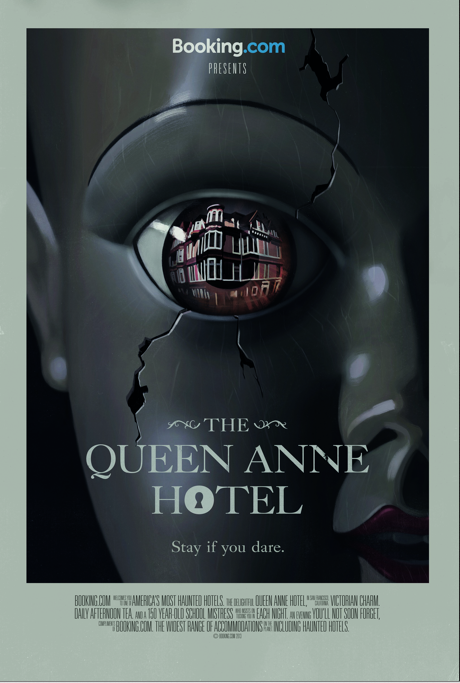
The brilliant Haunted Hotels Campaign, launched by one of the biggest online travel firm Booking.com, really stood out in this year’s Halloween creative idea. First, Let’s take a journey into the horror TV commercial focusing on the room 410 inside the haunted Queen Anne Hotel.

The big creative idea of the campaign is promoting staying in a room in one of American’s famous haunted hotels as an unconventional way to celebrate Halloween. This “Stay if you dare” challenge is a provocative hook that captured both the attention and curiosity of the young generation. The tagline is “with 350,000 accommodations including haunted hotels”. In this regard, the intention of the campaign is not to increase the haunted hotel sales, but to position Booking.com as a comprehensive and superior online accommodation provider.

Besides the movie-style TV commercial, the Haunted Hotels advertising campaign also design an online website featuring the seven haunted hotels(http://www.booking.com/haunted/) and  tailor-made posters displayed in movie theaters across the U.S.
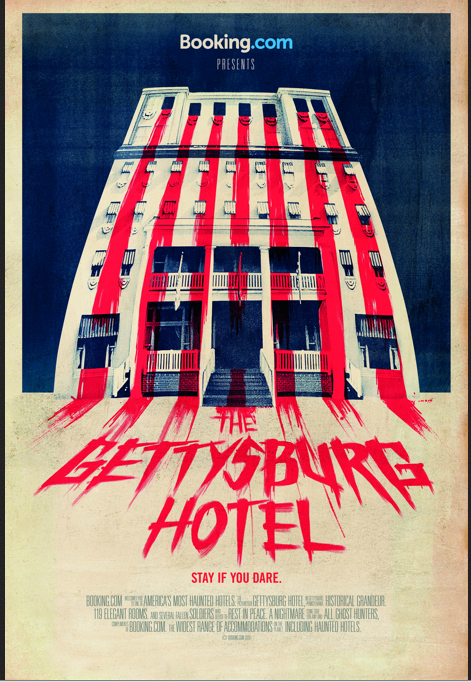
               屏幕快照 2013-11-04 下午7.46.25

In my point of view, I consider it is a successful creative holiday marketing campaign. The first reason is that they capture the right emotion at the right time, which has not yet to be exploited by other travel companies. In contrast to traditional holiday marketing campaign capitalizing on happiness, Haunted Hotels campaign was trying to tap into the fear and curiosity among their target group. Unlike usual flat claims of online booking companies, Booking.com has focused on a niche and present it in an unexpected and intriguing way.

The second advantage is the wise use of storytelling technique. The campaign showcased the frightening stories of seven haunted hotels in a concrete and vivid way. Each story reveals the mysterious stories of how these locations came to be so ‘haunted’, guiding the visitor into a special travelling experience. The incorporation of horror stories will grab audiences’ attention at the first sight and also associate the brand with uniqueness and adventure. On the campaign website, travelers can easily book their next ghostly getaway and also share the scary stories with their friends on Facebook, Twitter, Google+ and Pinterest.

How do you feel about this campaign?

Will the “scared to death” technique really work on the branding for Booking.com during the Halloween?

More importantly, as both Christmas and Thanksgiving are around the corner, we have welcomed the arrival of the biggest holiday season in the year.What is your own holiday shopping experience? Share some constructive insights about how to make your holiday marketing campaign stand out.

Sources:

1.49 percent of marketers  launch a holiday campaign before Halloween

2. Booking.com’s journey into fear this Halloween


Posted in Uncategorized | Tagged , , , , | 6 Comments

It’s Call of Duty time.

This is it. Counting down in three days, it’s the time of the year when millions of gamers all have been expected. “It’s Call of Duty time.”

Call of Duty: Ghosts (via geek.com)

Activision’s latest Call of duty franchise Ghosts will be released on November 5, 2013. To start off  their brand new campaign for the latest game, Activision collaborated with their long-time partner 72andSunny and created a series of trailers depicting the hard-core call of duty fans. From making fun of the colleague at work, taking night shift, having dinner in a fancy restaurant, to a doctor’s appointment, a dentist’s treatment, Call of Duty gamers in the new commercial “Faboom” show their enthusiasm and sometime bizarre behaviors because they are so into the game.

This is not the first time 72andSunny took charge of the commercial of  Call of Duty. In the past, 72andSunny had created stellar work for Activision, including trailers featuring celebrities like Kobe Bryant, Jimmy Kimmel, Jonah Hill, Same Worthington and Robert Downey Jr., and also creative campaign such as “The Replacer” in which Peter Stormare playing in his tough guy persona replace the crazy gamers as a good husband, a great employee and a nice grandson while they are busy at the duty. 72andSunny had scored awards from Effie and Adweek.

http://www.youtube.com/watch?v=OZwdpXgPbKc

The new commercial “Faboom“, however, generated two opposite opinions. Some think it is a nice reminder of how it is to play Call of Duty, which is known for its high-quality graphic design and sometimes it just makes you feel like you are actually in the game. Some gamers, however, feel this ad is not really their cup of tea, because for them, it’s all about the game itself. An ad without showing its actual game play does not really spoke to them. Moreover, it just reminds people how coo-coo the gamers are, because they can not tell the difference between virtual and real world. Also, if it’s for the non-gamers, it cannot really attract them to play the game because who wants to be the crazy guy that mumbling about the game in a fancy restaurant?

http://www.youtube.com/watch?v=MNxh7umVOZ0

Besides “Faboom”, 72andSunny, again, made a live-action trailer for Call of Duty: Ghosts. For the first time only, they picked a female celebrity featuring in this trailer. The actress is none other than Megan Fox – the former Transformers girl. Do you think this trailer performs much better than the “Faboom” trailer?

Posted in Uncategorized | 2 Comments

India’s Tanishq Ad: A Rare Jewel

TV_highquality

Image via wikimedia

Sometimes advertising seems pointless, doesn’t it?

There are plenty of mediocre, unmemorable advertisements out there (‘non-sticky’, if you will).  There are some advertisements that arguably do more harm than good. But then sometimes, there are advertisements that break through the static and make a daring statement.

images-1

Image via flickr

Tanishq jewelry in India did just that.

The jewelry company recently released an advertisement that has generated a lot of discussion and praise on social media. The advertisement features a beautiful bride getting ready on her wedding day. She plays and giggles with a little girl, who we later discover is her daughter. As the advertisement unfolds, the viewer realizes that this is the second marriage for this bride– a largely taboo topic in Indian society. In addition to showing an otherwise fairly invisible scene in Indian media, the advertisement features a relatively “dusky” actress by Bollywood standards.

Screen Shot 2013-11-02 at 9.59.24 AM

Screenshot via YouTube


But despite these ‘undesirable’ qualities, here she is: happy and loved.

Screen Shot 2013-11-02 at 10.01.28 AM

Screenshot via YouTube


The advertisement has been met with a lot of positive response, including filmmakers, designers, and members of India’s parliament. However, some criticized the jewelry company for having double standards (they also recently released an app that details ‘patriarchal’ rituals and practices for traditional marriages) or for trying to be a societal “moral compass.”

The advertisement creative director, however, claims that they didn’t want to come across too strong and “didn’t want to make it look like we were trying to make a point.” It appears a point has been made, however. And the people (mostly) like it.

What do you think of this ad? Can you think of any recent advertisements in the US or other countries that have made daring statements on society? Do you think it’s out of place for advertisers to do so?

Personally, I find the ad beautiful and artfully done. I hope to see more advertisements like this one in the future.

Posted in Uncategorized | Tagged , , , | 5 Comments

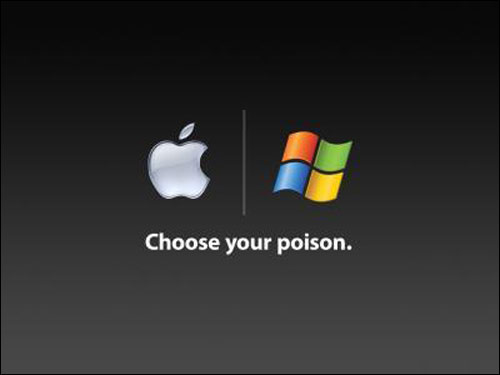
Apple vs Microsoft: a new battle begins – a pricing battle.

There has been a long lasting war in the post world war II era, between two tech giants, that is Microsoft and Apple. They have been fighting with each other since the advent of personal computer. Last week, we went through some of the “Mac vs PC”campaigns from both side of the companies, and I believe that everybody in class enjoyed what they have been doing to each other.

1272879890y7Ivuth8


So yes, they are still fighting in 2013. However, this year, Apple adds a new weapon. As we all know, every year, there is always some news coming from Apple, either from the WWDC (Worldwide Developer Conference ), or from its new product release event. As the world most valuable company, Apple acts as an industry leader, riding on the technology innovation trend and gradually eating the market share from other companies. Last week, it released the latest operation system for Mac products, which is the OS X Mavericks, and the latest version of iWork and iLife. Along with the software updates, Apple also announced its latest products, the new iPad Air and iPad Mini 2, and new Macbook Pro and Mac Pro. Besides the higher resolution, bigger screen, lighter weight and other “foreseeable” updates, the most significant change for us as consumers would be the price. When Microsoft makes its PC software suits from $139 to $399, Apple announced them free. As Tim Cook, the CEO of Apple teased about Microsoft in his keynote presentation, yes, it is quite amazing that not only the operation system, but also the iWork and iLife are free now. Compared to the price of Microsoft Windows 8 and the Microsoft Office, Apple now plays a new card that it has never used before to the market, that is the free card.

This move is very unordinary. After years of battle between the two, the pricing has been steady for a long time for both Microsoft and Apple until Tim Cook said the word “Free”.  This makes me wonder, are those two “tired” of doing sophisticated marketing strategies? Is Apple switching to a new pricing strategy?

The reasons behind this, from a personal point of view, may lie in several perspectives. First of all, as Apple is growing and reaching to a wider range of consumers than it used to be before 2007, there is still a part of its target consumers who are blocked away from Apple products by the higher price compared to other PCs. By lowing the price of its softwares, Apple may be able to reach to those people by cheaper softwares instead of hardwares. This can also be seen from the fact that the softwares are free along with any purchase of Apple products. Notably, Apple used to believe that great hardwares are their biggest selling point. But now, they are focusing on the power of softwares, which is, or used to be, Microsoft’s key strength. As the CEO said in the keynote presentation, he wants to make sure that “our customers have access to our greatest and latest new features”. Second,there has been a lot of intellectual property protection issues for Apple’s software in some countries, especially those developing markets in Asia. This move will directly challenge the illegal use of Apple Apps.


However, the real impact of giving away free softwares is no clear enough. On one hand, the market analysts predict that this move will push the use of Apple App Store and hardware. On the other hand, this is also causing tension for other software and app designers. Should they follow this path? If yes, then what about their costs? And most importantly, as Apple is stepping into Microsoft’s comfort zone, what are they going to react?

So, welcome to a new battle. Actually, the fights between two companies is a good thing in the market. Ultimately, it is the consumers who benefits the most from it, with more choices and better prices. Let us wait and see.


Sources:

Apple, Microsoft And Free Software

http://www.usatoday.com/story/tech/2013/10/22/apple-mavericks-free/3151093/

http://www.businessweek.com/articles/2013-10-22/why-apple-wants-its-software-to-be-free

Posted in Uncategorized | 5 Comments

Google’s race for relevance: How does it affect content marketers?

google_hummingbird-580x334

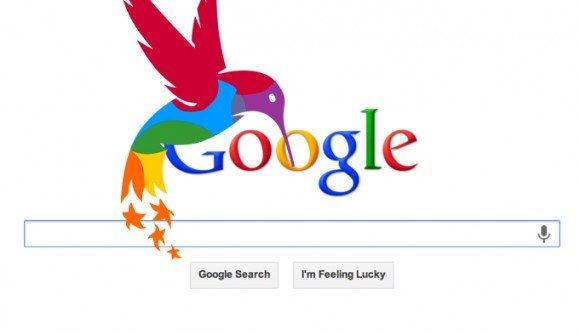
It has become a natural routine for people to google on questions and information. Just by typing a few words, Google could deliver search results by matching webpages that have keywords similar to what I typed. However, we still have to go through the search results to find the most relevant information. Lately, Google has updated its search algorithm again. The new Hummingbird algorithm was launched in late September and it provides search results that relates to the contextual meaning of the typed words and phrases. Originally, people would see googling as a question and answer sort of search but this update has made the search more human sensitive and more similar to a conversation.

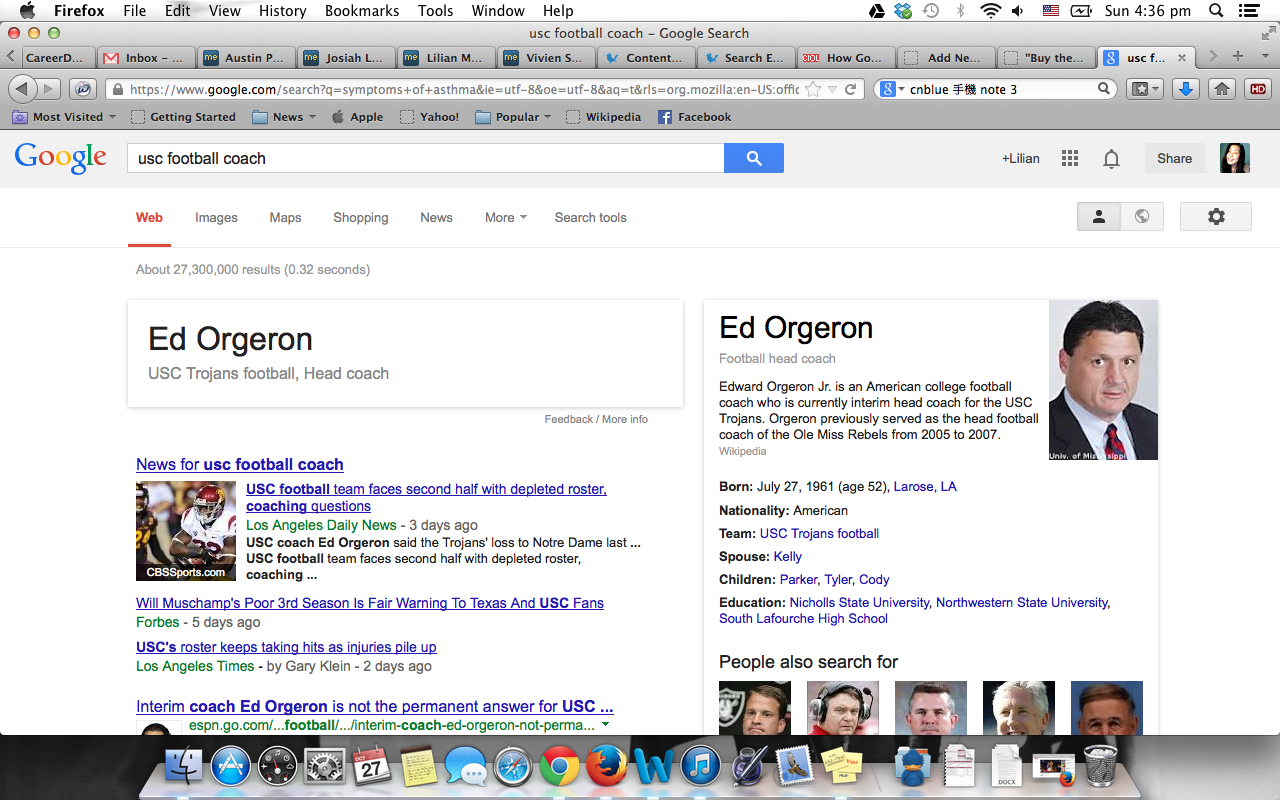
Screen Shot 2013-10-27 at 4.36.23 pm

What this means is that if I search for “USC football coach”, it would pop up a full complete profile of the current USC Football team coach, Ed Orgeron. Originally, the old search might only link you to USC football related webpages with the search words but now the semantic search will give you a overall profile of the person and may even list contacts or Linkedin pages of the relevant person.

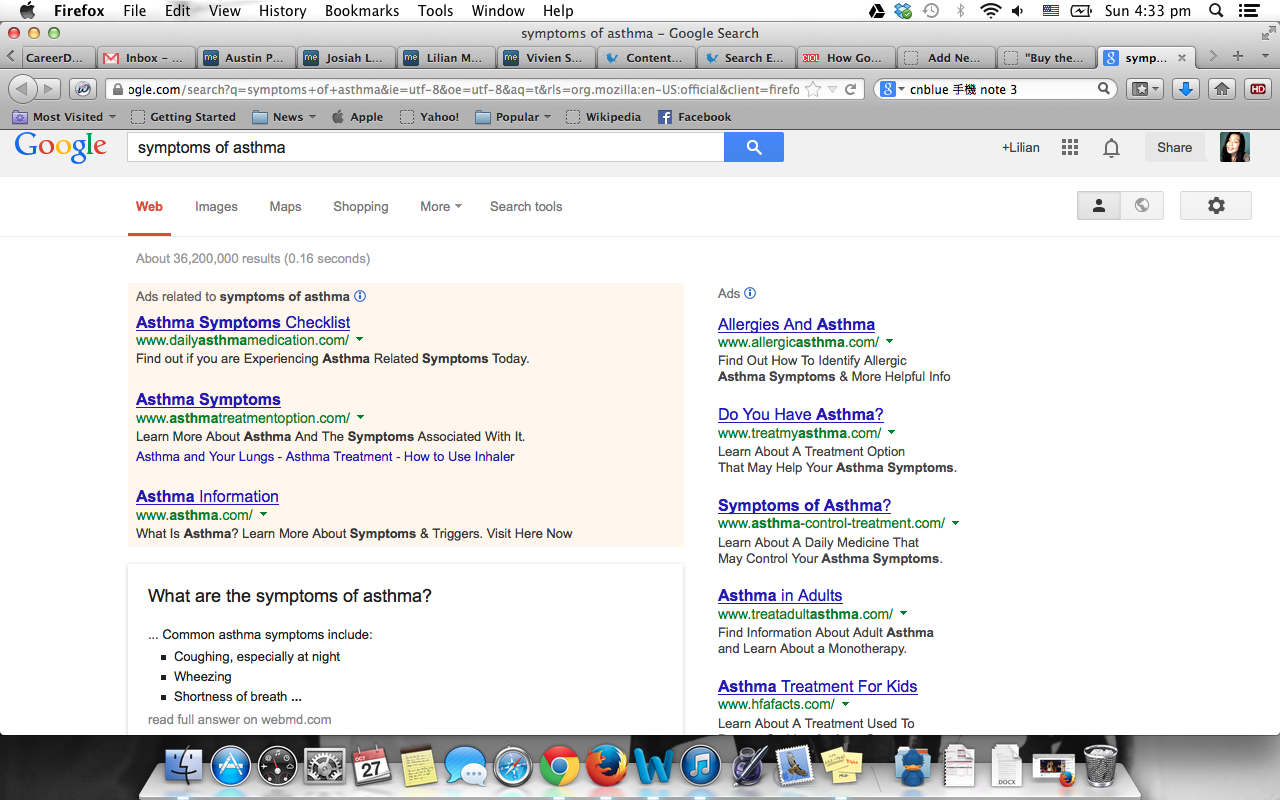
Screen Shot 2013-10-27 at 4.33.36 pm

Another example is that if I type “the symptoms of asthma,” Google would have indexed an answer from nih.gov and displayed the answer directly in the search results.

Obviously, this is a great improvement but how will it affect content marketers?

Our content might be filtered out easily. First, there are author rankings, if you have no reputation online, you’re simply a nobody or anonymous online, your content will not appear on the top results. Other than that, if your content has not been optimized properly with meta tags, Google will also filter out your results. Even if you have completed meta tags and descriptions, if you use the same topics for all your contents, it will be defined as less influential and eventually filtered out in the Google search too.

Thus, in order to successfully market your content, if is important to first publish on sites with reputation and authority as well as to have proper and distinctive meta tags and topics.

Sources:

http://www.marketingprofs.com/articles/2013/11833/should-you-be-worried-about-googles-hummingbird-update
http://www.marketingprofs.com/articles/2013/11834/what-google-hummingbird-means-for-content-marketing

Posted in Uncategorized | 2 Comments

Auto-Complete?

Great advertisements not only exist in the private sector. Creativity can also be found in advocacy campaigns of NGOs and international organizations. This is the ad that strikes me most recently.

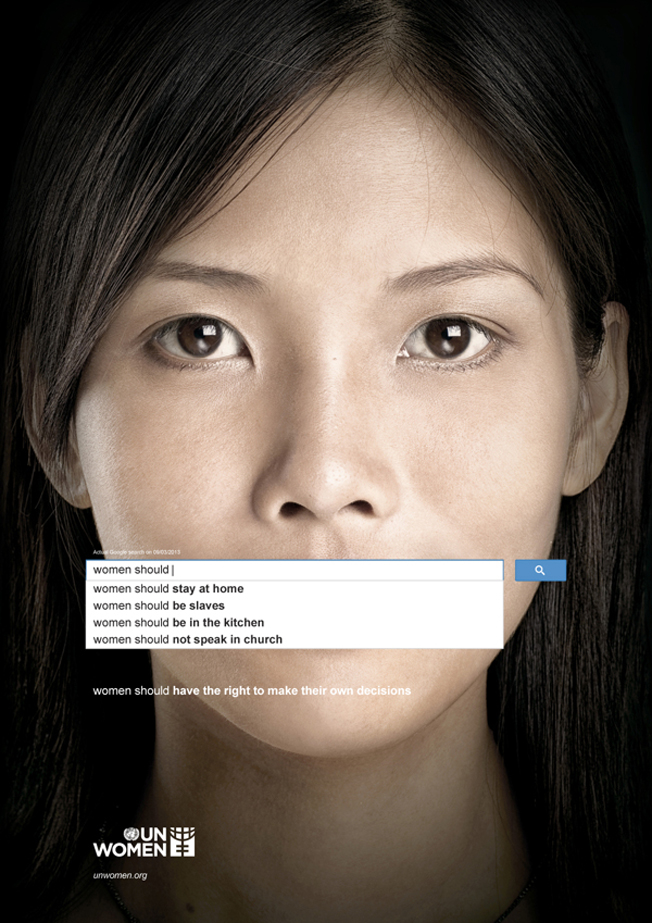
autocomplete-truth2


Here’s a simple and powerful campaign idea from UN Women using real suggested search terms from Google’s autocomplete feature. The “Auto-Complete Truth” campaign exploded across social media and generated worldwide discussion, aka gone viral. “This campaign uses the world’s most popular search engine (Google) to show how gender inequality is a worldwide problem. The adverts show the results of genuine searches, highlighting popular opinions across the Internet.” said by the creator, Christopher Hunt from Ogilvy & Mather Dubai.


This campaign, however, also raised concerns and debates. Some people thought that the creators edit the results of the Google searches you did for this campaign. In a follow up interview by Adweek, a question was raised about whether they have taken out some irrelevant suggestions or even edited the results to focus on the most egregious examples of sexism. According to Memac Ogilvy & Mather Dubai, none of the searches were engineered to produce the results. In order to raise awareness of the inequality women face, they did choose to highlight the most compelling answers, to deliver the most impact, however the search results from Google autocorrect were not falsified in any way.


I think the reasons for the success for the UN Women campaign are truth and simplicity. With eye-catching images (carefully included different demographics) and autocomplete results, the ads caught people’s attention and encouraged them to search it on Google. When they realized that what the ads were telling was true, they were then educated and might start concerning this issue.

autocomplete-sexism3

So tell me, my dear readers, do you think the creator had edited the results of the autocomplete?

Posted in Uncategorized | 2 Comments

Do fake reviews even work?

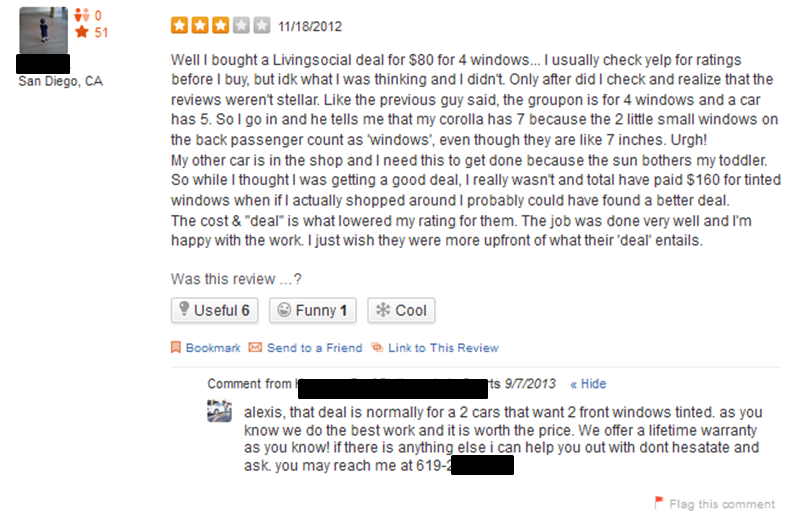
When I turned 16, my parents and I headed to a local car dealership for my first car. Because we were purchasing it new, I was able to pick out the color I wanted. I thought black cars looked chic, so I was set on a black car. My parents tried to convince me to go with a lighter color because it shows less dirt, scratches, and dings and the inside stays cooler, but being a typical 16 year old girl, I would not listen. Several years passed without regretting the black color choice, until I moved to Tucson, Arizona to attend college at the University of Arizona. Well for anyone who has 1) ever been in Arizona during the summer and 2) has a dark colored car, probably knows where this is headed. For those of you who do not know, let me break it down for you: black cars + over 110 degree weather = VERY scorching hot seats and steering wheel. By this point, I was convinced I needed my windows tinted to help with the heat.

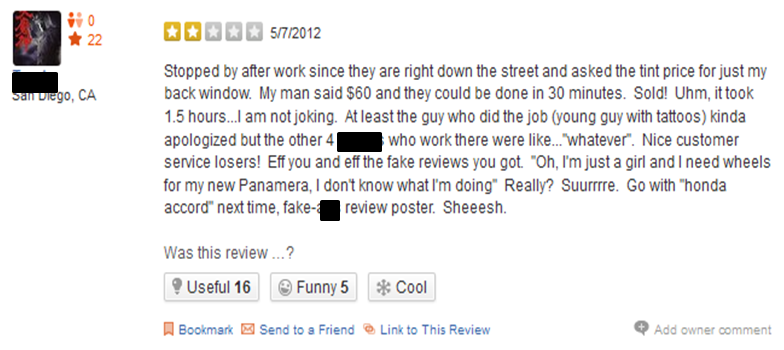
A negative review points out a fake post. Source: Yelp

A negative review points out a fake post. Source: Yelp

Flash forward to a few weeks ago, my dad forwarded an email to me from Amazon Local. Since I was curious, I decided to look through and see the local deals they were offering. As I was scrolling through the email, one particular deal caught my eye: window tinting. I copied the company name, pasted into Google, and pulled up their Yelp page. I was surprised to see that all of the positive comments looked bogus and all the negative comments looked like real customers. I was immediately turned off and decided to forgo purchasing the window tinting deal. Even with the “positive” reviews, I was a little suspicious because the company did not come across as trustworthy.

When I mentioned this to my dad, he sent me a text message with a link to an USA Today article. This article was titled “Undercover crackdown on phony online reviews”. To summarize, this article told a story in which potential customers, who owned a yogurt shop in Brooklyn, reached out to Internet search engine optimization companies to counteract negative online reviews posted by customers. Some of the companies willingly agreed to write fake, yet positive, reviews; however, little to the their surprise, the owners of the yogurt shop turned out to be New York State Attorney General’s office investigators who were working to crackdown on bogus online reviews. In the end, 19 companies agreed to pay fines for violating state laws against false advertising.

As marketers, we understand the importance of ethics. We also know there are state and federal laws which prohibit us from doing certain things that come across as unfair to consumers, and yet, we still hear the horror stories of companies taking the plunge and getting in trouble. According to research from Businessweek, 70% of individuals consult reviews and ratings before making a purchase. This means customers visit websites such as Yelp, Google Local, and Citysearch in order to make a purchasing decision. With over half of all individuals consulting popular review websites, it is perfectly logical that companies would want glowing reviews written about them. It may seem as if posting these fake reviews will help to attract more customers, but how will it affect brand image when customers, such as me, are able to read between the lines and determine a fake post versus a real post?

An owner replying to a negative comment. Source: Yelp

An owner replying to a negative comment. Source: Yelp

After reading the window tinting company’s online reviews, I saw them as an irresponsible and untrustworthy company because they took the easy way out. Reviews not only benefit potential customers by aiding with their purchasing decisions, but they also benefit the companies. Reviews are an honest reflection from customers, and thus, companies can use this information for improvement. Instead of focusing time on counteracting negative reviews, companies should reply back. By doing so, this shows the customers that the company actually cares. I believe it is so much easier to counteract negative reviews by posting fake and positive reviews, but why would I want to support a company that would do so? If there are willing to take the easy way out with their online reviews, does that mean they would be willing do the same with the window tinting job on my car?

I honestly think companies do not understand the overall harmful effects that fake reviews can cause. Humans are not stupid; they can, and will, connect the dots themselves. We know it is much worse for consumers to connect the dots themselves since they have the tendency to be more negative. Instead, companies should be transparent and have open communication in order to stop customers from connecting the dots. Sure, a company might have negative online reviews, so let me ask this. What looks worse: A company with negative online reviews along with positive reviews that are clearly fake or a company with negative online reviews and the owners comment back in a sincere way? Personally, I believe the latter looks much more professional and respectable. This leads me to believe fake reviews do not work because there are many other things companies can do to overcome the fake reviews in a more successful and sincere way.

Source: http://socialmediatoday.com/sector45/1433331/why-online-reviews-matter

Posted in Uncategorized | 1 Comment

Facebook Ad Effectiveness Rises: Convenience vs. Privacy

post 1

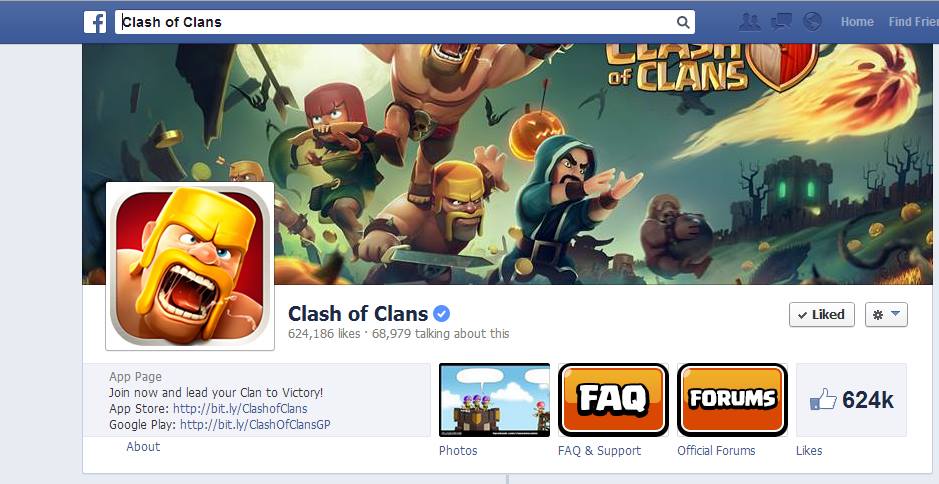
Clash of Clans Facebook Page (Source: Facebook)

Several days ago, I got on Facebook and browsed my fiends’ timelines and their updates. A suggested post from a game provider surprised me. Its post said, “Are you getting tired of Clash of Clans? Try our brand new combat strategy game today for free”, with very appealing visual graphics. I had been playing Clash of Clans for a while, and felt a little boring by playing it. At that moment when I saw that ad, I felt that was the voice of my heart, “Yes, I would like to try the new game.” I also noticed that I began to receive different suggested posts on different games since I started to play Clash of Clans on Facebook.

1

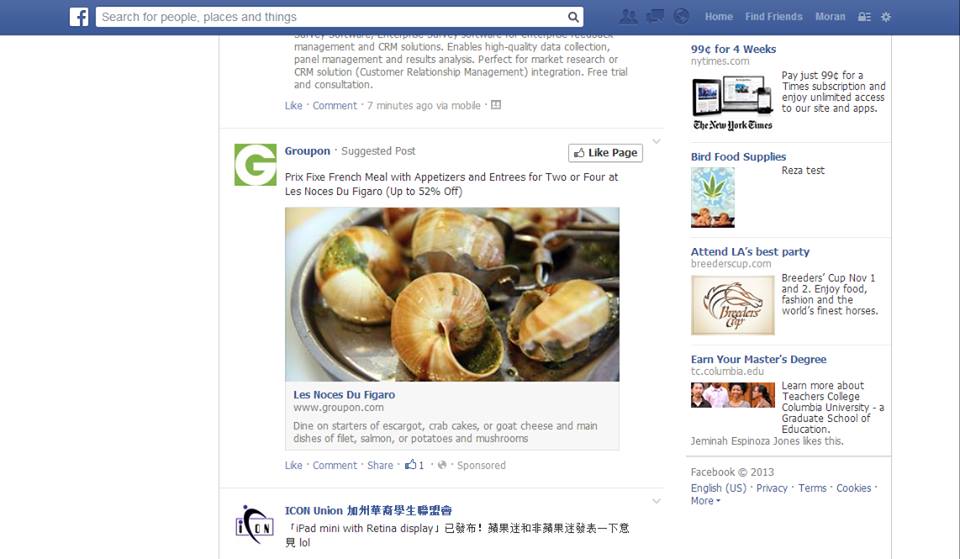
Groupon Suggested Post (Source: Facebook)

3

Groupon Page (Source: Groupon)

Then, today, I looked at my Facebook news feed and was actually shocked by one of the suggested posts. It was from Groupon. The post wrote “Prix Fixe French Meal with Appetizers and Entrees for Two or Four at Lex Noces Du Pigaro”. This was exactly what I looked at on Groupon the day before yesterday, the same restaurant with the same picture. What shocked me was that neither did I have a Groupon account, nor did I link Groupon with my Facebook account, how could Facebook know that I looked at this particular restaurant online.

The ads on Facebook are getting more relevant. And they are getting more effective. Kenshoo Social, the marketing technology platform, found out that conversion rates for ads on Facebook were 2.36 times higher in the third quarter of 2013 and revenues up 2.16 times, conversion volumes up 2.85 times, and recorded a tripling of return-on-investment. Its research covered 85 billion ad impressions across a representative sample of major brands, discovering that ad impressions rose 13%, click volumes increased 14.4% and cost-per-click reduced 9% over the quarter.

Nanigans, the predictive lifetime value company offering Software-as-a-Service for social and mobile performance marketing at scale, released a benchmark report for retailers advertising on Facebook on October 16, 2013. The report result suggested that Facebook was found to have delivered an average 152% return-on-investment over the past year while click-through rates rose 3.75 times.

下载

Facebook Logo (Source: Facebook)

I think there are three main reasons for Facebook’s improved ad performance. First, brands have made effort to improve its advertising products to make them more engaging and delivering enhanced audience targeting capabilities. Second, brands have become better at promoting their most relevant products, improving their ad customization capabilities. Third, Facebook users have become more tolerant toward ads on Facebook. I remember that when Facebook Beacon was first launched in 2007 with 44 partner websites, it caused considerable controversy due to privacy concerns. Two years later, it was shut down in 2009. Beacon was a part of Facebook’s advertisement system that sent data from external websites to Facebook. Certain activities on partner sites were published to a user’s News Feed. Facebook users now are becoming more engaged with brands after viewing more relevant ads.

As the ads are becoming more relevant, convenient and effective, I wonder if one day the brands have the capability to anticipate what the customers what and have customized ads base on anticipation. And I still have some privacy concerns towards Facebook ads. To me, it is kind of like trade privacy for convenience.


Sources:

http://kenshoosocial.com/blog/quarterly-facebook-advertising-performance-q3-vs-q2-2013/

http://www.nanigans.com/2013/10/16/benchmark-report-retailers-facebook-advertising-roi-holiday-shopping/

Posted in Uncategorized | 2 Comments

Today’s Apple — A Fusion of Fashion, Luxury and Technology

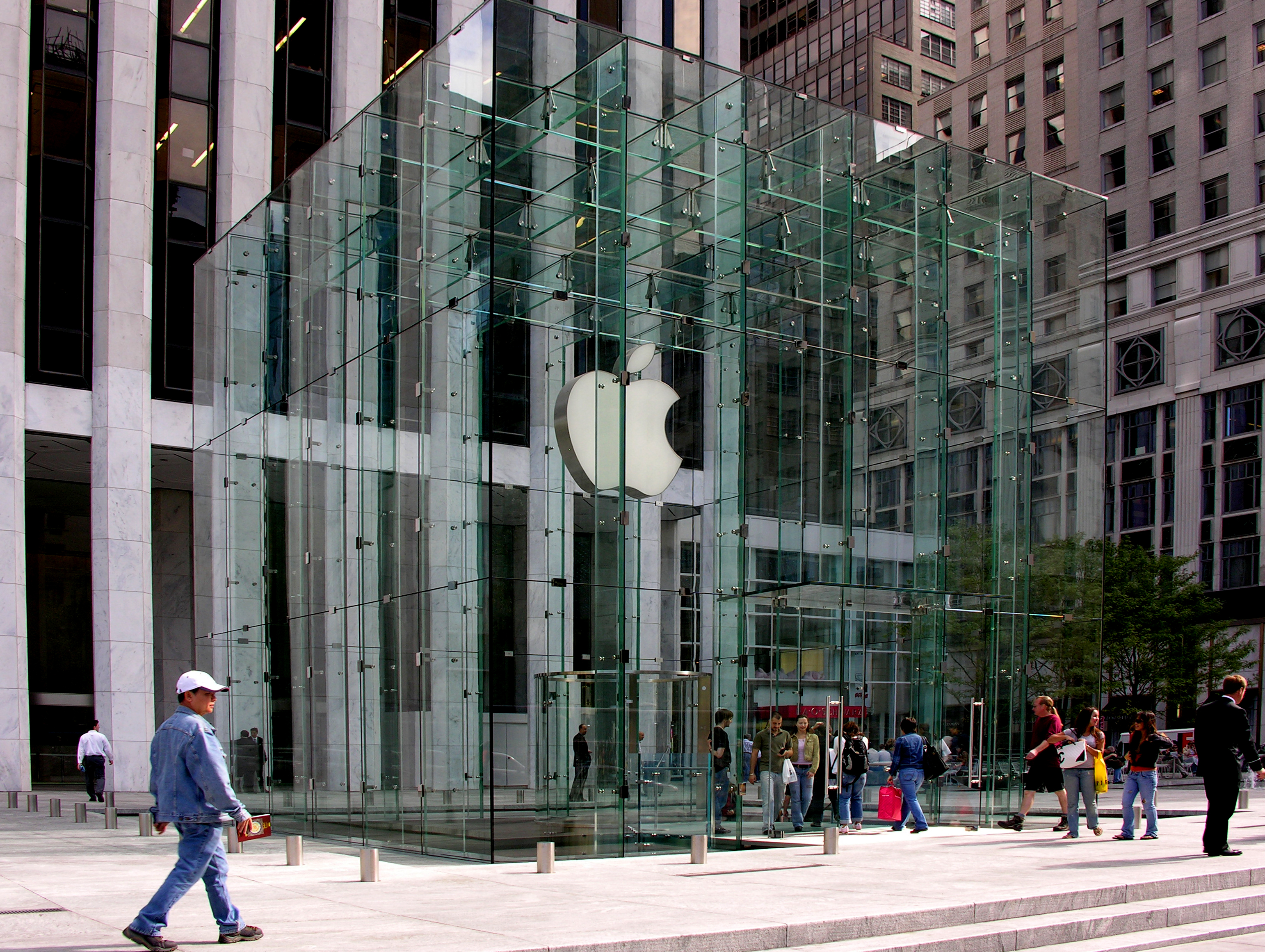
Just a couple days ago, tech giant Apple announced its new hire — Angela Ahrendts, the former CEO of British high-fashion brand Burberry. As she takes over the important, but long vacant role of Apple’s new retail chief next year, she will become the only female among the 10 people executive team.


Angela Ahrendts is highly praised for having transformed Burberry into a globally admired symbol of fashion and luxury while maintaining its heritage. During her 7-year tenure, Burberry positioned technology as one of the top priorities of its brand strategy. Burberry has not only established a strong presence on social media platforms such as Facebook, but also built a unified experience for its online and physical stores. That being said, bringing in her experience and knowledge of retailing, Ahrendts’ new job at Apple is to revamp both Apple’s physical and online retail efforts so that online shopping and in store experiences can be seamless. 

Interesting enough, in the summer, prior to Angela Ahrendts, Apple also hired Paul Deneve, the former chief executive of Yves Saint Laurent–the French fashion house, to work on special projects. Many started to wonder what is Apple up to? What is going to happen in its next big event? A runway show? Although the marriage of fashion and technology seems quite confusing to general consumers, it is nonetheless a smart step that Apple has taken. In fact, according to a survey participated by 27 experts and 2000 consumers in UK, Apple was ranked as the No.1 luxury brand, followed by Aston Martin and Rolex.

Isn’t it interesting that a computer and smartphone maker is perceived as the most luxurious? It’s probably because the definition of luxury has completely changed over time. Now, people care much more about performance and design than logos and history. Greg Furman, founder and chairman of Luxury Marketing Council commented that Apple is just like the best luxe brands out there– it has “impeccable products, service and merchandising,” and its marketing is “image driven and highly creative.”

In my opinion, as a brand that is always pursuing a little edge, embracing a new territory and hiring someone like Angela Ahrendts may be the perfect way for Apple to market itself as edgy and unique. What do you think?


-Andrea

Posted in Uncategorized | 2 Comments

Arcade Fire: Yet another casualty of faulty guerrilla marketing

Ah, the elusive success of the guerrilla marketing campaign… That tricky little green fairy chased by nouveau-marketing firms and cutting edge ad agencies. As Jay Conrad Levison, coiner of the actual phrase defines it, the art of “achieving conventional goals, such as profits and joy, with unconventional methods, such as investing energy instead of money.” If you are successful, your brand has likely achieved the ultimate grand-prize. Coolness. If you fail, well, you and yours are likely to go down in (very stylish) flames.

The reason it is so difficult to pull of a successful stealth campaign, perhaps, is because the modern roots of guerrilla marketing (not the original concept, but the contemporary re-envisioning of its design and feel) don’t come from the corporate world. They come from art.

Take, for example, one of the earliest guerrilla marketing campaigns of my recollection—Obey. Shepard Fairey, the artist who later went on to design and distribute Obama’s iconic, campaign winning Hope portrait, peppered the streets and subways of New York with a highly stylized, mysterious image of Andre the Giant. The images, which generally took one of two forms (see below), followed to daredevil placement tactics of renowned street artists Banksy and Invader. These artists stage a type of visual urban invasion, placing stickers, murals and posters in highly visible, hard to reach, and absolutely illegal places.

obey_wallpaper_02-349933491

obama-hope-poster-Tuff-City-Supply

The purpose of the Obey campaign, however, was not simply that of an act of art. Fairey intended the Obey images to call attention to the ethically fuzzy practice of guerrilla marketing and stealth ambient advertisements. Along the way, Obey’s rebellious social parody, became a phenomenon in and of itself. By the early 1990s, tens of thousands of Obey images were plastered around urban centers around the globe. Fairey’s unruly anti-advertising stunt became synonymous with a cool, damn-the-man subculture.

And then of course, irony of ironies, Obey went on to become an enormously lucrative line of clothing and merchandise. How convenient that the branding and advertising had already been so well established.

Fairey’s work inadvertently set the standard in guerrilla marketing, to be used to sell real flesh and blood products, but riding on the winds of what at least appears to be a grassroots, community supported, self-propelling fan art. Unfortunately, this is extremely difficult for a brand to pull off, both ethically and aesthetically. Sony famously blew it with their infamous 2005 PlayStation Portable graffiti campaign, their faux street art, visually unclaimed by the brand itself, was physically and emotionally rejected from the very community they were trying to reach. The hazy lines of brand authenticity and consumer trust were breached, and Sony suffered.

Sony's doomed PSP ad

Sony’s doomed PSP ad

The most recent victim of guerrilla marketing backlash was none other than the much loved indie-gone-mainstream band Arcade Fire. For their new album “Reflektor,” which is, incidentally very good, the band’s leader embarked on a self-declared “weird art project” to promote their 9/9/13 release. The “art” in question came in many forms, banners, posters, and most controversially, spray painted stencils. Though the band eventually claimed responsibility for the mysterious symbols popping up in urban spaces, they were originally quite cryptic and, in essence, vandalism.

Arcade Fire's "Reflektor" graffiti in Austin, TX

Arcade Fire’s “Reflektor” graffiti in Austin, TX

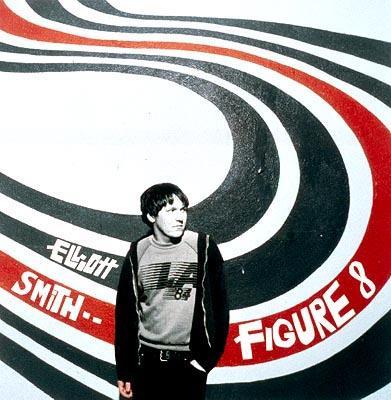
Graffiti and indie music have a long, trusted relationship. Within certain bounds, it’s cherished and celebrated amongst fans—Daniel Johnston’s “Hi. How are you?” frog (Austin, TX) and Elliot Smith’s Figure 8 mural (Silver Lake, CA) have even gone as far as becoming shrines to their late or struggling artists.

Daniel Johnston's iconic mural in Austin, TX

Daniel Johnston’s iconic mural in Austin, TX


Elliott Smith's beloved Figure 8 mural in Silver Lake, CA

Elliott Smith’s beloved Figure 8 mural in Silver Lake, CA

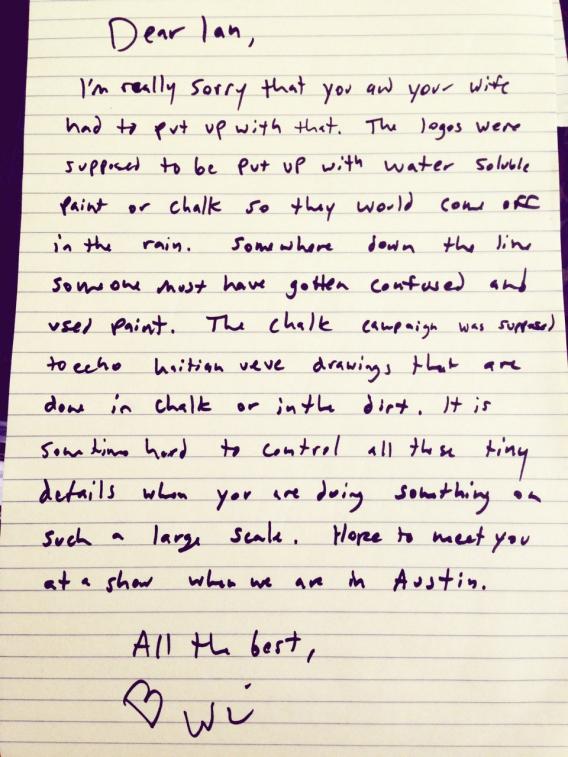
And though many thought the “Reflektor” campaign was ingenious, one particular man and his wife, whose small business was victim of the band’s “arty” vandalism felt otherwise. Used, and betrayed, in fact. And they would consider themselves fans of Arcade Fire. Ian Dille sums up the nuanced distinction quite nicely:

“If you’re a talented young artist who considers the urban environment your canvas, by all means, spray-paint a building. If you’ve got a radical social agenda and you think spray-painting property is the best way to convey your message? Go ahead. If you’re a gangbanger and you want to mark your territory, I can learn to live with that.

But if you’re an internationally renowned band that’s defacing public and private property for promotional purposes, maybe go back to the drawing board, and think some more about how you want to let people know about your music.”

It is worth noting that the band’s front man, Win Butler, publically and personally apologized, explaining that the paint in use was intended to be water soluble, the damage had already been done. Literally and figuratively.

arcadefire_apology.jpg.CROP.article568-large

Resources:

Banksy. (Director). Guetta, Thierry. (Producer). (2010). Exit through the gift shop [Motion picture]. United States: A Banksy Film.

CBC News. (2009). When ad campaigns go bad. CBC News. Retrieved from http://www.cbc.ca/news/when-ad-campaigns-go-bad-1.826689

Coulehan, Erin. (2013). Arcade Fire’s Win Butler sheds light on ‘Reflektor.’ Rollingstone Magazine. Retrieved from http://www.rollingstone.com/music/news/arcade-fires-win-butler-sheds-light-on-reflektor-20130911

Dille, Ian. (2013). My wife was vandalized by Arcade Fire. Slate. Retrieved from http://www.slate.com/blogs/browbeat/2013/09/12/arcade_fire_graffiti_marketing_vandalism_or_both_relektor_ads_are_a_nuisance.html

Musgrove, Mike. (2005). What looks like graffiti could really be an ad. The Washington Post. Retrieved from http://www.washingtonpost.com/wp-dyn/content/article/2005/12/25/AR2005122500589_pf.html

Pelly, Jenn. (2013). Arcade Fire confirms Reflektor campaign is theirs. Pitchfork Music. Retrieved from http://pitchfork.com/news/52041-arcade-fire-finally-confirm-reflektor/

Singel, Ryan. (2005). Sony draws ire with PSP graffiti. Wired. Retrieved from http://www.wired.com/culture/lifestyle/news/2005/12/69741

Posted in Uncategorized | Tagged , , , , , , | Comments Off on Arcade Fire: Yet another casualty of faulty guerrilla marketing