Back in January we reported on Groupon’s group buying system (read our original post). Now, the coupon giant is looking to expand even more. The company is set to launch its new service, Groupon Now, in less than a month. The service is accessible via a smartphone application that monitors your location and the day of time. Based on this information, Groupon Now delivers time-sensitive deals at a number of local venues including eateries and mom and pop shops.
The traditional Groupon “deal-of-the-day” has been extremely successful. Not only has it spawned a number of knock offs, but it has also given Groupon the title of the fastest growing company ever. In 2009 the company had 120 employees and offered deals in 30 cities. Today, the company has to 5,900 employees and offers more than 900 deals in 550 markets.
Despite Groupon’s success, the “deal-of-the-day” is a one-time “have coupon will use” model. The new Groupon Now taps into the enormous and fluid market of consumer foot traffic. The Group Now app will work by providing consumers two options—either “I’m hungry” or “I’m bored.” Clicking either button will reveal time and location-specific deals.
The new model allows restaurants to offer deals during specific days and hours that are generally slow, attracting businesses that saw little advantage to the traditional Groupon coupon system. The main benefit for businesses is greater efficiency and cost savings. Groupon Now allows merchants to cut down on perishable waste—like food ingredients, labor hours and anything else that has to be disposed of if not used immediately. Groupon Now seeks to eliminate 10 percent of parishability for small businesses, which could equate to huge savings.
Some small business owners, however, are worried about the value of their product dropping due to Groupon Now deals. While these coupons will certainly get customers in the door, they may discourage customers from ever wanting to pay full price. For these businesses the one-time coupon model is more appropriate. One restaurant owner in Raleigh, N.C. said “There’s no reason for customers to come in all the time if they can always get a discount. That’s the reason we like Groupon; it’s only a one-time deal.”
So, while Groupon Now offers new capabilities for consumers and an innovative marketing approach for merchants, its benefit for small businesses is arguably questionable. Will the new service boost the awareness and efficiency of small businesses or will it devalue their products?
Facebook Join American idol to Build the Brand through Viral Video Sharing.
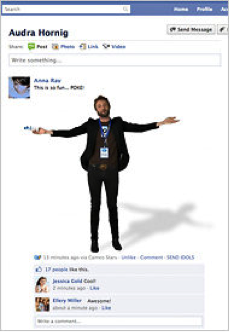
Having a large number of Facebook followers certainly demonstrates the popularity of “ American Idol”, but that is not where the story ends. Beginning Friday, Facebook encourage users to send each other video messages such as birthday greetings or a poke recorded by the 10 finalists on “ American Idol”. The videos are supported by an application called Cameo Stars and will charge $ 1 to the users.
The aim of the project is to increase the equity of “ American Idol” brand, and build up the brand; meanwhile, to develop compelling products that they can sell continuously. According to the co-producer of American Idol, the video is customized to the users, as the celebrity is walking toward them and talking toward the camera, and it is being delivered to the users on their own page.
The application Cameo Stars was designed to target the cultural obsession with celebrities and the exploding market for virtual goods. The company previously pay commission to celebrities, and now they begin a partnership approach.
The ideal development for the partnership would be the involvement with a third party advertiser to finance the videos, so Facebook users can send them at no cost — a brand-funded model. For advertisers, Cameo Stars position content from brands by using a soft advertising strategy, which also promote viral marketing. This is especially strategic as a lot of Facebook users are becoming immune to what is in the right margin and are mentally blocking out ads.
Would Facebook users be interested in sending out celebrity greetings by paying $1? Would companies advertise on these types of videos, given that fact that it is not a mainstream consumer Facebook app? I would love to hear your opinions.
Reference:
Newman, A. (2011) “Birthday Greetings From an ‘Idol’ Contestant to Build the Brand”, the New York Times, [Accessed on 03/23/2011] http://www.nytimes.com/2011/03/24/business/media/24adco.html?ref=technology
Remember the days when we used to visit bookstores, and spent hours browsing its shelves? Some of our pastimes included sitting on a couch while absorbed in our favorite reads.
Now imagine getting cozied up with a hard and angular eBook.
Some of the most innovative marketing products today revolve around technology, and eBooks and eReaders are far from an exception. EBooks have shown great performance while paperbacks and hardcovers fluctuated and decreased in sales. Sales for eBooks in 2010 have been reported to reach as high as 164%, inspiring physical bookstores (large chains and local independent bookstores) to adapt to the eReader generation in order to lure consumers to their products. Publishing companies are also struggling to balance the digital side of their business – which amount to huge expenses – while print sales still make up 90% of revenues.
But will the popularity of eBooks last forever, or is it just another trend at its peak? One thing is for sure, physical bookstores should think before they rush to ditch efforts at selling print. The eBook may become obsolete just as fast as it arrived. As Christopher Mims said in Technology Review, “Ebooks are nothing like music or even movies and television…books have a kind of usability that, for most people, isn’t about to be trumped by bourgeois concerns about portability”. While some books may be appealing on a digital format, certain genres – cookbooks, textbooks, among many others – are much better off on print.
Furthermore, this tug-of-war in the book industry is one of many examples that surround and highlight a bigger issue; is the domineering hand of technology taking over? Will we always welcome a ‘technological makeover’? And how stable will these products ultimately be?
You can never be too secure in today’s competitive marketplace, where products are constantly being reinterpreted and updated as the ‘new and better’ version or model. Before you know it, the next hottest item will be ready to steal the spotlight away from you.
In conversations about marketing strategies using online media, the words “go viral” often come up. For me, they bring to mind campaigns that are memorable and fun to share because of humor or shock value. For example, most people are familiar with the Old Spice campaign advertisements that have accrued an enormous fan base around the world. The link above is a special report from www.AdAge.com that gives readers 10 concrete and thoughtful tips about effective viral digital advertising:
1. Start with a goal for your brand
2. Pick a creative concept that’s going to grab attention
3. Encouragement encouragement
4. Go easy on the branding
5. If you use heavy branding, use it wisely
6. The more the merrier
7. Celebrities don’t guarantee views
8. Network, network, network
9. Use paid media strategically
10. Dont underestimate Facebook
I have picked out a few that name some very important ideas that indicate the directions in which advertising seems to be moving.
3. Encourage engagement: Many campaigns in the recent years have focused on rallying audience participation through contests, crowd-sourcing, social media interactions etc. Recognizing that consumers become more invested and loyal to a product or brand when they feel that their voices are heard is key component of promoting viral media, since the consumers are the primary source of promotion.
6. The more the merrier: While many consumers get easily overwhelmed by the number of options presented to them in the store, the threat of saturation does not apply in the media. The author recommends creating alternative viral video clips, using web series ad opposed to just one video, and dispersing the videos through a variety of media, so that consumers are not only familiar with the brand from mere exposure, but stimulated by the variety and energy.
7. Celebrities don’t guarantee interviews: Too many companies have signed celebrity endorsers to boost sales, and some of the campaigns seem to ride entirely on the brand equity the celebrity brings. Perhaps consumers are wizening up and recognizing that they too often, such tactics merely have famous people being paid too much money to hold a bottle and smile, and would rather see advertisements that have more a more genial tone of voice that engages them in a more personal manner (see point #3).
10. Don’t underestimate Facebook: Facebook and other social networking tools are becoming powerhouses of information, networking and influence. The flexibility and mobility such platforms they provide viral campaigns cannot be underestimated by any means.
Have you watched Google’s Super Bowl Ad? If you missed it out like I did, here is the actual ad on Youtube Google Parisian Love. Basically, this ad tells a story of a Parisian romance happened with the help from a series of Google searches. A young man found his love for life during a study abroad program in Paris. In the entire commercial, there was nothing related to football, no hot girls with gigantic breasts walking around and there were no talking animals. However, such simplicity turned out to be one of my favorites. It reminded me how Google impacts my life on daily bases. As we learnt from Bros. Health (2001), this emotion-based advertising managed to tell the audience a story that can make them smile.
Such an unexpected self-promoting commercial by Google–the search giant/advertising company might seem unnecessary. Google has already reaped billions from online ads with a search market share over 70 percent. In addition, Google the name itself is almost a verb when it comes to search. Especially when this ad had been on YouTube for over three months before it has finally being shared by a wider audience. So why does Google bother?
Google chose to air this ad on the Super Bowl, in my opinion, with a motive of reminding the public about the brand in a positive light. It has not been a good couple of years for Google besides the growing trend financially. With the lawsuit Google was in for offering millions of books free online; the silent game Google chose to play after added feature called “AdSense” advertising criticized by mass as the privacy invasion; not to mention its high-profile threat to stop censoring search results in China. Maybe it is time for Google to have some positive buzz. This TV commercial with no narration received certainly did not disappoint anyone. With largely positive feedback/twits, word of mouth marketing expert David Binkowski twitted that @Google ad was very good. Value proposition was dead on and they told their story extremely well.”
I would like to hear your opinion on this. Do you think it is unnecessary for Google to spend money on the Super Bowl since it has majority market share in search engine? Or do you think Google is making a right move at the right time?
In an age of information overload and overexposure, advertisers are constantly trying to find ways to connect and reach out to its target consumers. The accessibility and volume of information available to the general public allow advertisers to flood consumers with advertisements at any given time and place. In additional to advertisements in traditional media like television and print, advertisers have gravitated towards advertising in other mediums.
In 2008, the highly anticipated video game Grand Theft Auto IV grabbed the world’s attention when it broke the record for the most successful entertainment release in history. Within 24 hours, Grand Theft Auto IV grossed $310 million dollars worldwide. In comparison, the most successful book release, Harry Potter & The Deathly Hallows, grossed $220 million and the most successful film, Spider-Man 3, grossed $117 million within the same time. In fact, the video game industry has been growing at an alarming rate in the past few years. In the past five years, the video game industry has been growing 28% annually, while the movie and music industry lags behind with 1.8% and -10.0% growth rates respectfully. As of 2009, the video game industry is estimated to be worth $10.5 billion dollars in revenue. The video game industry was an untapped goldmine, and was simply too large and profitable for advertisers to ignore.
Advertisers now have developed several ways to communicate their marketing messages in video games. Product placement is a widespread method advertisers often use to advertise their products. For example, Metal Gear Solid 4 features various Apple products such as laptops and desktop computers, as well as an in-game iPod. In addition, all the cars in the video game Tom Clancy’s Rainbow Six: Vegas 2 are manufactured by Dodge. Another way for advertisers to subtly insert advertisements into video games is virtual billboards. In the video game Second Life, the billboards in the virtual city includes virtual billboards for Sony BMG. In fact, prior to the presidential election in 2008, the Barack Obama campaign paid for in-game virtual billboards in another video game Burnout Paradise. In-game sponsorships are extremely popular in sports games. Emulating sponsorships in real sports, advertisers often use brands to sponsor certain events in video games, like the “Sprite Slam Cam” in NBA 2K11.
Advertisers are constantly trying to explore options to find out how to embed their messages in video games without letting the consumers realize that they are being sold to. In traditional advertising mediums like television, the consumers are comfortable with and accept commercials as a part of the viewing experience. However, it’s different for video games. Console games usually cost around 45 dollars, and gamers may not feel comfortable for having obvious commercials in their purchased products. The exception may be games like sport games, in which the sponsorships in-game emulate that of real life presentation on television and on street. Although the video game industry is large and growing, advertisers have to be careful about how they advertise their products and brands.
We’ve all seen the power of social media. Facebook can get you jobs or lose you opportunities. Blogs can make you famous or infamous. And with knowledge comes power. Used in the correct way, the Internet becomes your adoring public, praising your work and allowing you to explode onto the pop culture scene; used in the wrong way, you can become a disgrace. And now, another opportunity has come to showcase the good and the bad.
YouTube, a Google owned website, is famous for its user generated content. If you haven’t seen the “Grape Stomping Video” or “Charlie Bit Me,” it seems like you’ve been living under a rock. In the past few days, the video hosting site has seen a lot of traffic.
We start with the good. As we end our week, we all breathe a sigh of relief for it’s finally Friday. And, as we’ve now seen and heard, we are not the only ones. Rebecca Black, a 13-year-old girl, has burst onto the scenes with her hit single “Friday.” Now, I can’t boast that I listen to the most sophisticated music but I can say with confidence that this song is terrible. The lyrics are awful, her voice is painfully nasal and the video looks like a teen movie gone horribly wrong. So what’s the good news? For one, if you didn’t know the days of the week, she can teach you! Also, her viral music video has been seen over 14,300,000 times. And, as I reiterate again, it’s terrible. Using the power of the Internet, this untalented little girl has been able to get a following, whether or not it’s full of people who love her or hate her is a different story. But, her goal has been reached. Right now, millions of people are listening to her single, including my roommate as I type, which is offered of iTunes, making her name in music huge. If you care to subject yourself to this current monstrosity, the link is: http://www.youtube.com/watch?v=CD2LRROpph0.
Now we explore the devastating effects the Internet and YouTube can bring. As you’ve all probably seen, a student at UCLA recently posted a rant pertaining to her thoughts of the Asian culture on Campus. Not only did her broad remarks show ignorance to the community, but the video got especially juicy when she “spoke” in an Asian language. Since the posting of the video went viral, life for Ms. Wallace has been hard. Rumors of her expulsion from school have circulated, as radio shows, large newspapers and news programming have all covered the story as people slam her for her racist comments. It’s been noted that this very well could damage her professional career forever as no company is going to want to associate with her. While she has offered a public statement of apology, the future of Ms. Wallace is still to be seen, and all because she decided to post her rant on the Internet. To watch her rant, please visit http://www.youtube.com/watch?v=u7XAJo3rQn8.
So my discussion prompt on the matter ties in ideas of ownership of the Web as well as ownership of personal content. While Net Neutrality is a hot topic now, we must also understand that as soon as content goes out onto the Web, we lose control of it. Your pictures on Facebook, even if untagged, are always on there; you can’t control who sees them or who can save them and take them as their own. We must be very cautious when approaching what content we put out there. That being said, we must also need to learn how to manipulate the technology, using it for our own gain. Like any type of media before it, there is power within content and within people who subject themselves to it. So do we make a “contract” with the Internet as soon as we begin to use it and can we blame anyone but ourselves for the consequences?
Although we are still in the spring break, I think people have idea what is happening in the world. The biggest thing that every country pays attention to is the earth quake, tsunami, and the most dangerous nuclear plant jeopardy happened in Japan.
I have been watching CNN for more than three days. The radiation in Japan is “extremely high”, and it may come to California recently. Fortunately, the radiation will not be dangerous for California residents, it is very small. However, the residents here is began to scare buying the “iodine” related thing.
On Mar 13, I searched on Amazon, the Kelp tablet (180 tablets) is $8.57 included shipping, and the iodine table (14 tablets) is around $ 8. However, when I checked Amazon on Mar 15, the kelp went up to more than $10, and the iodine table is soaring to $500!!!! I cannot believe my eyes. (I checked just now, it went back to $39, still higher than usuall).
This situation is also happening in my home country China. Many cities now is almost sold out of salt!!!!! I do not know who said that sea salt is good for prevet radiation, but just people are waiting a extremly long line to buy them!!!
citizen in Beijing waiting in a long line to buy salt!!
This is one of the most popular business areas in Beijing, I cannot believe that so many people waiting to buy salt! It looks like salt can do everything. Actually, there is no authority said anything about salt will do benefit for the radiation. Rumors were made and people came out on the street.
salt was sold out
This is a grocery in a southern city of China, there is a big sign said “Salt was sold out here, Thanks”.
no more salt
Consumers were shocked that the shelf of salt was totally empty!!
This situation never happened before, even at the SARS period. However, some of friends they really need to buy salt for cooking, they cannot find at that moment. They need to go out to eat. Fortunately, Chinese government said the price will not go up, and ask people to be rational on scare buying.
The situation now is still not clear, we just pray for Japan and hope Japanese can make it, hope the radiation could be controled, and will not influence other regions. In addtion, wherever we live, let’s be rational on buying things, idine or salt or other products. We need to listen to the update news and I think even the radiation come to LA, the government will tell us the right things to do.
The other night when I was lounging around, dog sitting alone at my parent’s house, I started to rummage through the kitchen to figure out what I was going to do for dinner. The pantry had spices, cooking liquids and Nutrisystem meals that my mom had long given up on; the refrigerator only had condiments and beverages; the freezer only had ice cream and frozen packages (my parents clearly are not health nuts). Having not been in the mood to make a ketchup/milk/Nutrisystem concoction, I opted to try out the frozen mashed potatoes. Although not your typical dinner entrée, I found cooking it to be the perfect activity because it was both simple yet personal. The reason for this is because I only had to steam the bag of chopped potatoes in the microwave, mash them up and the directions left the rest up to me. So, instead of following a strict recipe or use a pre-made package of seasonings (like with Nutrisystem…), I could make use of the garlic, butter, Parmesan, pepper and salt that my parents already had. While not a wildly exciting meal, I enjoyed it because the product allowed me to add my own personal touch. Like my mashed potatoes, numerous other popular goods are jumping on the bandwagon and allowing for consumer personalization.
This ability to take a product and make it your own is by no means a new concept. Many are familiar with “the Ikea effect,” which is the buyers’ opportunity to assemble furniture on their own. By giving audiences both the necessary tools and the freedom to do what they want with them, buyers are given the chance to feel a sense of accomplishment and make the product somewhat personal. This in turn creates additional value to every product.
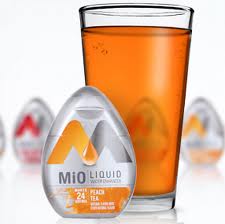
The latest brand to introduce this buyer customization,is Kraft, which will soon release MiO, a squeeze bottle of flavoring and a dropper to alter the taste of water to each and everyone’s personal desire (sounds a lot like G2 or Chrystal Light, I know). This new product, like many before it (Nike, Apple, Harley-Davidson, etc.) is really catering to the millennial generations, which have taken on the mantra: “It’s not only ‘the customer is always right’ but ‘I’m always right.’” Customization and personalization are key in pleasing buyers today and this trend is really starting to gain momentum as preferences become more and more fragmented. Much like crowdsourcing, idea-generators and preference-makers are being outsourced to the masses in a bottom-up like manner.
Soon we will be able to reflect our individual personalities in many of the goods we buy, but do you think this is possible across all products?
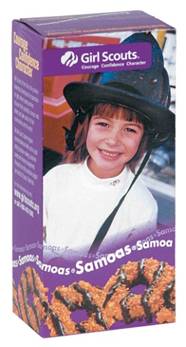
It’s that time of year again – piles of brightly colored boxes are beginning to appear stacked high on tables outside storefronts all over the world. This is not a special holiday or shoe sale, but the annual Girl Scouts’ cookie sale, a rite of passage into spring for almost 100 years and a $700 million business led by girls who now are selling upwards of 400 boxes of cookies an hour!
Before you read any further, set aside your stale childhood juice box impression of the Girl Scouts associated with camping and crafts you may have been familiar with growing up, whether you were a Girl Scout or not. Founded in 1912, the Girl Scouts now have 3.3 million girl and adult members in 90 countries worldwide with 1 in every 10 girls participating. But, today’s Girl Scouts is not your grandmother’s, your mother’s, or even your older sister’s variation of Scouting. With 2012 marking the centennial celebration of the Girl Scouts of the USA, leaders have looked for ways to freshen up the Girl Scouts’ brand to make it as hip as ever and in tune with the Justin Bieber crowd and beyond.
The solution? A makeover, the first of its kind in 30 years!
According to a July 7, 2010 press release, which made the effort public, Chief Marketing Officer, Laurel Ritchie, told ABC news, “We heard our logo looked a little, tired, weathered, worn and discolored, like it had been out on a picnic table all winter”. Additionally, she said the goal is to reposition the Girl Scouts so that it is relevant to girls since research revealed awareness of the Girl Scout brand but not a full understanding of its direct benefits. Ritchie’s statement supports the re-branding vision of Kathy Cloniger, CEO of Girl Scouts of the USA, to “revitalize and energize”.
The January 19, 2010 video clip, “What Can a Cookie Do” uploaded by GirlScout Videos laid the message of the power of an individual girl through the use of a cookie as a mechanism for personal growth and change. Whether intended or not, the overall feel including font, colors, movement, and themes directly mirror in a splendid application “The Girl Effect” (May 2008) video clip, sponsored by Nike.
“The Girl Effect” movement is too powerful not to be mentioned here but any further detail would require a separate entry to do it justice. Simply put, if you empower a girl with basic skills applied to cookie sales or cow farming she could become successful and in turn influence her direct community and later change the world. So, the heart of the Girl Scouts’ re-branding message is effectively placing additional emphasis on and playing off the new brand of the modern girl being independent and powerful by herself alone.
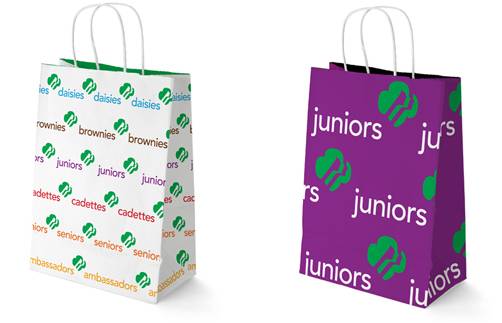
In a truly integrated fashion, the Girl Scouts’ have managed to combine online, traditional media, and place based marketing in a multichannel strategy. Most of which has been carefully planned and executed but some of which has been much like a game of hide-and-seek with new initiatives popping up around the map. Overarching the entire campaign at its foundation is the revised color palette and trefoil logo created by Original Champion of Design, which moves toward a more vibrant green and away from its old logo, originally designed by Saul Bass in the 1970s. These decisions to change were drawn from focus group sessions that revealed modern hairstyles, longer/thinner necks, and lowercase letters would all make the Girl Scouts more approachable and casual to the target audience of young and teenage girls.
The traditional outlets such as news ads highlight themes of girls participating in sports, featuring Serena Williams, career ambitions with females in space, and community involvement. This general campaign hopes for $30 million in pro-bono placements for traditional broadcast and print journalism to airports and online messaging.
Online, the Girl Scouts have it covered. With a stand-alone website, YouTube Channel, Flickr Group, Facebook page, and Twitter account its daily reach grows exponentially through the application of technology making Girl Scouts social media gurus. The “Cookie Club”, a password protected website, enables Girl Scouts to even send e-cards with a link to an order form online asking for pledges.
Jud Hoffman, the Global Policy Manager at Facebook, told coworkers one day his daughter was selling Girl Scouts cookies and he had created a Facebook event for people to purchase. Many responded with dismay as they typically only had credit cards and could not make a purchase with cash. He quickly huddled with James McKelvey and Jack Dorsey, cofounders of Square, a dynamic duo of a downloadable app and 2.5cm dongle that scans credit cards, and implemented this technology to assist his daughter in selling 400 boxes of cookies in an hour! It probably helped that Facebook’s Randi Zuckerberg tweeted simultaneously, “Some very smart, enterprising Girl Scouts are at Facebook HQ w/boxes of cookies & @square devices. Making SERIOUS bank.”
This is of course a story of extremes but there are many examples of e-payment options being used. E-payment options are a trend and are increasingly popular on mobile technology. Girl Scouts in northeastern Ohio were selected to use the GoPayment app and credit card reader by Intuit, a small business processing payment company, who is also offering use of these free and reduced costs services to Girl Scouts nation-wide in the U.S.
One of the best uses of technology so far, unbiased of course, is the “Cookie Locator” App which can be downloaded to the iPhone, itouch, and iPad. Chicago’s southside West Chesterfield Girl Scouts troop were the first to implement. This handy app enables cookie-craved consumers to find a cookie booth location between February 18 and March 13.
So, with this year’s re-branding effort of the Girl Scouts it is quite likely that you’ll receive emails, tweets, and reminders via a Facebook friend, in case, heaven forbid you’ve somehow missed the cookie sale in person and need to be reminded. It’s also a matter of convenience too-for those who only carry plastic. Never fear, chances are you’ll be able to pay after you find a cookie sales booth using your handy mobile phone app and then swipe with Square or another form of GoPayment. Girl Scouts are evolving to be not only business savvy but technologically as well. Wouldn’t your Grandmother be happy you’ve successfully brought forth an age old tradition of cookie sales into the convergence of technology?

 Back in January we reported on Groupon’s group buying system (read our original post). Now, the coupon giant is looking to expand even more. The company is set to launch its new service, Groupon Now, in less than a month. The service is accessible via a smartphone application that monitors your location and the day of time. Based on this information, Groupon Now delivers time-sensitive deals at a number of local venues including eateries and mom and pop shops.
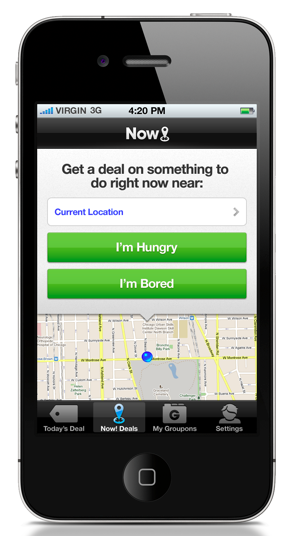 Despite Groupon’s success, the “deal-of-the-day” is a one-time “have coupon will use” model. The new Groupon Now taps into the enormous and fluid market of consumer foot traffic. The Group Now app will work by providing consumers two options—either “I’m hungry” or “I’m bored.” Clicking either button will reveal time and location-specific deals.